Developmental Editing • Structure Before Polish

Developmental Editing Service for Stronger Manuscript Structure and Flow

Higher-level editorial guidance before detailed language polishing

For manuscripts whose ideas are valuable but whose organisation, sequencing, emphasis, or section purpose still needs work. Our developmental editors review the manuscript as a whole and give practical guidance to strengthen how the argument develops without taking ownership of the author's research or intended meaning.

  • Organisation and section sequencing reviewed at manuscript level
  • Idea progression, emphasis, gaps, repetition, and transitions evaluated
  • Detailed developmental comments guide your next author revision
  • Standard turnaround: 5 days • Plan price: ₹10,000/-
Developmental editing service for manuscript structure, sequencing, idea development, and editorial guidance

Developmental Editors

Matched for higher-level manuscript review

Confidential Handling

Your manuscript stays private

Whole-Manuscript Judgment

Structure, purpose, progression, and emphasis

5-Day Standard Turnaround

A defined review window for developmental work

Actionable Author Guidance

Comments explain what to revise and why

1

Developmental Editing Plan

A single, clearly scoped service for manuscripts that need structural and conceptual guidance before sentence-level polishing. The emphasis is on how the manuscript works as a whole.

Developmental Editing

For documents that need higher-level editorial guidance before detailed language polishing, especially where organisation, development of ideas, sequencing, or overall manuscript effectiveness needs improvement.

Turnaround: 5 days
Plan price
₹10,000/-
Higher-level organisation, content development, and manuscript-flow review

What this plan includes

  • Overall manuscript organisation and section sequencing review
  • Evaluation of idea development, progression, and emphasis
  • Identification of content gaps, repetition, weak transitions, and structural imbalance
  • Recommendations for improving section purpose and overall narrative flow
  • Detailed developmental comments for author revision
  • Editorial guidance that preserves the author's research, argument, and intended meaning
Important: Developmental editing focuses on manuscript architecture and content effectiveness. Detailed copyediting, proofreading, or final language polishing is best carried out after the author has considered and implemented the developmental recommendations.

The 5-day turnaround is the standard timeline for this plan. Very long, technically complex, or heavily reorganised manuscripts may require a confirmed schedule after document review.

2

When Developmental Editing Is the Right Next Step

Developmental editing is most useful when the manuscript's core material exists, but the reader experience is weakened by how that material is organised, developed, weighted, or connected.

01

The Pieces Are There, but the Structure Is Not

Sections contain useful material, yet their order or internal purpose makes the manuscript feel fragmented, repetitive, or difficult to navigate.

02

Ideas Need Stronger Development

Important claims appear too early, key reasoning is underdeveloped, or supporting material is not introduced at the point where readers need it.

03

Progression and Emphasis Feel Uneven

Some sections receive too much space while more important points are rushed, creating imbalance in the manuscript's argument or narrative.

04

You Need Direction Before Language Polishing

You want an editorial map for revision before investing time in sentence-level editing that could be undone by later restructuring.

Developmental editing is not ghostwriting. The editor diagnoses structural and content-level issues, explains why they matter, and recommends revision options. The author's research, argument, evidence, and final editorial decisions remain with the author.
3

How We Read a Manuscript Developmentally

Rather than starting with commas and sentence polish, the review moves from manuscript purpose to structure, progression, reader continuity, and finally an actionable revision path.

Stage 01

Purpose & Reader

Clarify what the manuscript is trying to accomplish, who it is for, and what the reader should understand at each major stage.

Stage 02

Architecture

Review overall organisation, section order, information hierarchy, and whether each section performs a clear function.

Stage 03

Idea Development

Trace how claims, concepts, evidence, and explanations are introduced, expanded, connected, and prioritised.

Stage 04

Continuity & Balance

Identify gaps, repetition, abrupt transitions, misplaced material, and sections that are disproportionately brief or extensive.

Stage 05

Revision Guidance

Provide developmental comments and practical recommendations so the author can revise structure and content with clear priorities.

3

What Helps Us Review Your Manuscript in Context

developmental editing works best when the editor has enough context to distinguish intentional academic choices from language or presentation problems. Share the latest manuscript, deadline, academic level, citation style, target guidelines, and any areas you want the editor to prioritise.

Your Paper

Send the latest editable version whenever possible so the editor works from the manuscript you actually intend to submit.

Deadline & Time Zone

Provide the exact date, time, and time zone so the developmental editing schedule can be aligned with your submission window.

Academic Level

State the study or publication level because expectations for tone, terminology, and intervention depth differ across contexts.

Citation Style

Identify the required citation system so obvious in-text and reference-presentation inconsistencies can be checked in context.

University Guidelines

Attach relevant university, department, publisher, or journal instructions that affect headings, formatting, references, tables, or figures.

Editor Instructions

Tell us where the manuscript feels weakest—for example paragraph flow, repeated wording, academic tone, dense sentences, or organisation.

4

Documents That Benefit from Developmental Editing

developmental editing can be applied to developed academic and professional documents that need deeper clarity, paragraph-flow, tone, organisation, terminology, and presentation improvement while preserving the author’s original contribution.

Developmental editing can support many document types, but suitability depends on the manuscript condition rather than the label alone. The strongest fit is a manuscript with substantial content already written but with unresolved questions about organisation, development, sequencing, emphasis, or overall effectiveness.

Citation & Formatting Support

We check in-text citations, reference lists, ordering, punctuation, capitalization, and document formatting against the style you provide.

APA
MLA
Harvard
Chicago
IEEE
Vancouver
University Specific

Developmental Editing Experience Across Diverse Journals, Universities and Societies

Supporting authors, researchers, students, and institutions preparing academic work for leading publishers, journals, universities, and scholarly communities worldwide.

Academic publisher logos including Emerald Publishing, Elsevier, Springer, Wiley, SAGE, Oxford University Press, Taylor & Francis, PLOS, IEEE, Frontiers, Wolters Kluwer and Cambridge University Press

Have a question about whether developmental editing fits your manuscript?

Share your document details, deadline, academic level, and editing requirements using the enquiry form. We’ll review your needs and help you identify the appropriate next step.

Send Your Enquiry
5

Why Authors Use Developmental Editing Before Polishing

Developmental editing looks above the sentence level. The goal is to help the author see where the manuscript is working, where its structure or idea development weakens the reader experience, and what revisions can make the whole document more coherent and effective.

Contentxprtz 10 Years of Trust

Clear Communication

Scope, priorities, deadlines, and manuscript-specific instructions are captured before editing so the depth of intervention is clear.

Academic-Quality Editing

Editors refine wording, sentences, and paragraph flow with attention to academic context rather than applying mechanical corrections alone.

Transparent Scope

developmental editing has a defined purpose: deeper language and presentation improvement without taking over authorship or changing the research contribution.

Reliable Delivery

Delivery planning considers document length, complexity, and requested checks so the confirmed schedule is realistic and usable.

Your Ideas Stay Yours

Edits are made to improve expression and readability while retaining the author’s argument, evidence, interpretation, and intended meaning.

Academic Integrity

The service supports author-created work by improving existing text; it is not a substitute for conducting research or completing assessed work.

6

How the Developmental Editing Service Works

A structured workflow captures your manuscript purpose and context first, then evaluates architecture, section purpose, idea progression, continuity, and balance before returning detailed developmental guidance for author revision.

1

Upload Your Paper or Email Us

2

Share Your Requirements

3

Choose Your Deadline

4

Receive Your Edited Document

7

What You Receive from a Developmental Review

The review is delivered in a revision-friendly format so you can see where structural issues occur, understand the editor’s reasoning, and decide how to implement recommendations while retaining control of the manuscript.

1

Annotated Manuscript

2

Developmental Overview

3

Detailed Developmental Comments

4

Revision Priorities

Deliverables may vary depending on the editing plan and any additional service selected.

8

Our Developmental Review Quality Process

The manuscript is reviewed first for high-level architecture and content development, then for continuity and balance. Developmental comments are checked for clarity, actionability, and consistency before the files are prepared for delivery.

1

Edit

The editor works through the manuscript for grammar, sentence construction, academic expression, paragraph flow, repetition, consistency, and presentation issues within the Editing scope.

2

Review

The edited text is reviewed in context to check that changes remain coherent across paragraphs and do not unintentionally alter the author’s meaning.

3

Quality Check

A final pass checks language consistency, formatting presentation, terminology, obvious citation issues, tracked changes, and requested manuscript-specific requirements.

4

Final Delivery

The tracked version, clean copy, and included comments or additional deliverables are prepared for the author’s final review.

Not sure whether developmental editing is the right depth?

Share your document type, approximate word count, academic level, deadline, and the support you need. We’ll help you identify a suitable editing scope before you submit.

Request a Developmental Review
9

Support After the Developmental Review

Add selected support only when it helps your submission workflow, such as journal formatting, word-count reduction, editor Q&A, manuscript review, cover-letter assistance, or additional editorial review.

Expert Q&A

Free

Use the post-edit support period to ask why a passage was changed, clarify an editor query, or discuss a reasonable revision to wording within the confirmed Editing scope.

Certificate of Editing

Free

Request a formal editing certificate when a journal, university, supervisor, or other recipient asks for evidence that the manuscript received professional language editing.

Journal Formatting

Free*

Have the final manuscript presentation aligned to supplied journal instructions, including relevant headings, references, tables, figures, margins, and other specified elements.

Word Count Reduction

Free*

Tighten repetitive or unnecessarily expanded wording to help meet a target length while retaining the manuscript’s core argument, evidence, qualifications, and academic meaning.

Manuscript Review Card

Free*

Receive a concise editorial overview of recurring language, flow, consistency, or presentation issues that deserve the author’s attention after the detailed edit.

Cover Letter Support

Prepare or refine the language and presentation of a journal cover letter so the submission is introduced clearly and professionally without overstating the manuscript’s contribution.

Two-Editor Review

Add a second editorial pass where an additional reviewer checks the edited manuscript for unresolved language problems, internal consistency, and final presentation.

Subject-Area Editor Matching

Where possible, match the manuscript with an editor familiar with the relevant academic field so terminology, disciplinary conventions, and context can be handled more appropriately.

Support Through Submission

Use the available support window for reasonable questions about delivered edits, journal-facing presentation, and author revisions connected to the completed developmental editing service.

ContentXprtz money back guarantee

Money Back Guarantee

Our service guarantee applies to language-quality issues that are clearly within the confirmed Editing scope. If a journal or reviewer identifies a qualifying language problem after delivery, share the relevant feedback so the issue can be reviewed against the agreed work. Editorial quality cannot guarantee acceptance, because academic decisions also depend on research quality, originality, methodology, journal fit, reviewer judgment, and institutional requirements.

10

What We Check

developmental editing covers more than correctness. We review how sentences and paragraphs work together, whether academic expression is precise, and whether style, terminology, formatting, and citations are presented consistently.

Grammar & Syntax

Sentence Structure & Clarity

Academic Expression

Terminology & Style Consistency

Paragraph Flow & Coherence

Presentation & Formatting

Citation Presentation

Manuscript-Specific Priorities

11

See the Difference Professional Editing Can Make

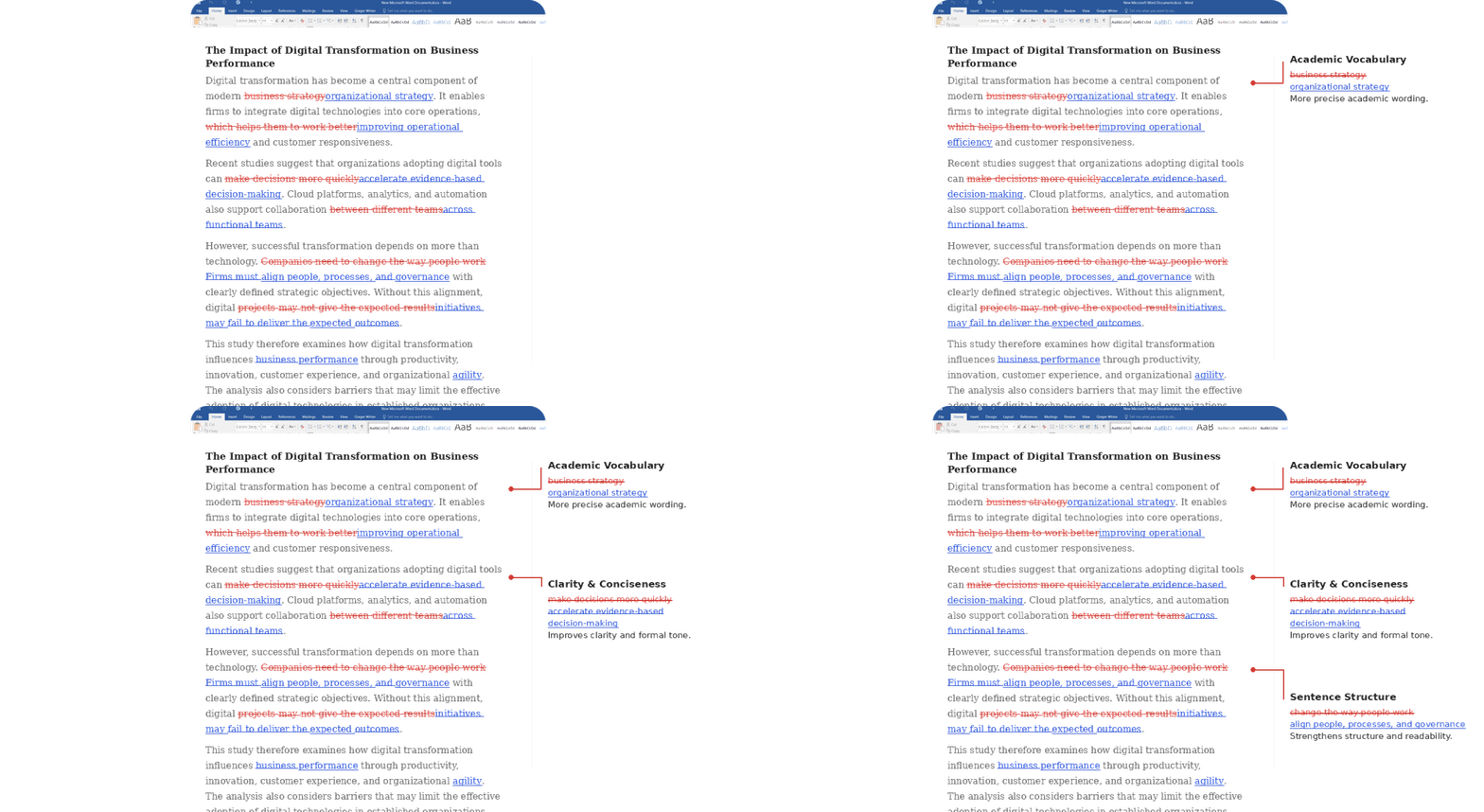
The example below illustrates the type of intervention developmental editing may apply: clearer sentence construction, more precise academic wording, improved relationship between claims and evidence, smoother flow, and comments where the author should confirm meaning.

Removed Added / revised Editor note
BEFORE: AUTHOR DRAFT Chapter 5 · Discussion

The survey results clearly prove that mentoring always improves doctoral productivityindicate a positive association between perceived mentoring quality and self-reported doctoral productivity in this sample. The relationship remained statistically significant after adjustment for year of study and discipline.

This means universities should increase mentoring because it will make every researcher more productive.These findings suggest that mentoring quality may be a relevant factor when institutions design researcher-support initiatives; however, the observational design does not establish a causal effect.

AFTER: EDITED VERSION Ready for author review

The survey results indicate a positive association between perceived mentoring quality and self-reported doctoral productivity in this sample. The relationship remained statistically significant after adjustment for year of study and discipline.

These findings suggest that mentoring quality may be a relevant factor when institutions design researcher-support initiatives; however, the observational design does not establish a causal effect.

Clearer academic expression Stronger sentence logic Improved paragraph flow More precise claims Meaning preserved
12

Editing Across Academic Disciplines

Review subject-area samples to see how editorial decisions differ across disciplines. developmental editing adapts language and presentation to the manuscript context rather than applying one generic writing style to every field.

Medical/Clinical Sciences — developmental editing

190+
Subject Areas
17000+
Medicine related journals
20.7
Avg. years of editor experience

Life Sciences — developmental editing

250+
Subject Areas
8000+
Life science related journals
14
Avg. years of editor experience

Physical Sciences and Engineering — developmental editing

350+
Subject Areas
13000+
Physical Science & Engineering related journals
14
Avg. years of editor experience

Economics and Business — developmental editing

75+
Subject Areas
2500+
Business related journals
20
Avg. years of editor experience

Ready for deeper language, flow, and presentation editing?

Tell us what you are submitting, when it is due, and the areas you want reviewed. We can help you choose the right editing level and confirm the scope before work begins.

Get Your Editing Quote
13

What Clients Value in Deeper Developmental Editing

My research paper was complete, but several paragraphs felt repetitive and difficult to follow. The developmental editing pass tightened the wording, improved transitions, and left the argument intact.

Student profile photo★★★★★

The editor did more than correct grammar. Dense sentences were reorganised, terminology became more consistent, and the comments helped me identify places where my intended meaning was not obvious.

Aarav MehtaMaster’s Student, India
Student profile photo★★★★★

I used developmental editing before journal submission because the discussion section felt uneven. The revisions made the relationship between results and interpretation much clearer without changing my conclusions.

Emily CarterCollege Applicant, United States
Student profile photo★★★★★

The tracked changes were especially useful. I could see where wording had been shortened, where transitions were improved, and where the editor had queried an ambiguous statement instead of guessing.

Nisha RaoScholarship Applicant, India
Student profile photo★★★★★

My dissertation chapter needed a deeper language edit after supervisor feedback. The service improved paragraph flow and academic tone while keeping my citations, examples, and core analysis in place.

James WalkerUndergraduate Student, United Kingdom
Student profile photo★★★★★

The clean copy was noticeably easier to read, but it still sounded like my work. The strongest improvements were in sentence logic, repeated phrasing, and transitions between ideas.

Fatima KhanGraduate Student, UAE
Student profile photo★★★★★

The team helped polish my argumentative essay. They caught repeated errors, improved transitions, and made the essay sound more academic.

Liam NguyenUniversity Student, Australia

Is the Manuscript Ready for Developmental Editing?

Developmental editing works best when the manuscript already has substantive author-created content but still needs higher-level decisions about structure, order, emphasis, development, and reader flow before final language polishing.

Developed Content

Your research, evidence, and main argument are already present; the editorial need is clarity and presentation rather than content creation.

Uneven Section Flow

Individual sections may contain useful material, but transitions, sequencing, or emphasis make the manuscript harder to follow than it should be.

Ideas Need More Development

Important ideas, explanations, or links between claims need fuller development before sentence-level polishing will be worthwhile.

Author Meaning Must Be Preserved

You want higher-level editorial guidance while keeping control of your claims, interpretation, evidence, research contribution, and final manuscript decisions.

12

Developmental Editing Service FAQs

Common questions about scope, suitability, author control, structural comments, turnaround, price, and what should happen before or after a developmental review.

What is developmental editing?

Developmental editing is a higher-level review of how a manuscript is organised and how effectively its ideas develop. It focuses on structure, sequencing, emphasis, section purpose, gaps, repetition, transitions, and overall flow rather than concentrating primarily on grammar or final sentence polish.

When should I choose developmental editing instead of copy editing?

Choose developmental editing when significant structural or content-level decisions are still unresolved. Copy editing is better after the manuscript structure is stable and the main need is sentence-level correctness, consistency, style, and presentation.

What is included in the ₹10,000 plan?

The plan includes overall organisation and section-sequencing review, evaluation of idea development and emphasis, identification of gaps and repetition, recommendations for stronger section purpose and narrative flow, detailed developmental comments, and guidance designed to preserve the author's research and intended meaning.

What is the standard turnaround?

The stated standard turnaround is 5 days. A confirmed delivery schedule may depend on manuscript length, complexity, and the extent of developmental review required.

Will the editor rewrite my argument or research?

No. The service is designed to diagnose issues and recommend ways to improve the manuscript while preserving the author's research, argument, evidence, and intended meaning. Final content decisions remain with the author.

Does developmental editing include detailed grammar correction?

Detailed language polishing is not the main purpose of this plan. Because structural revision can lead to substantial rewriting by the author, final copy editing or proofreading is generally most efficient after the developmental recommendations have been considered and implemented.

Can you review only selected chapters or sections?

Yes, provided the selected material can be assessed meaningfully in context. For chapter-level or section-level work, share enough surrounding information for the editor to understand the document's purpose, sequence, and relationship between sections.

What should I send with my manuscript?

Send the latest editable manuscript, your deadline, document purpose, target reader or publication context, any relevant guidelines, and notes about sections you believe are weak or difficult to organise.

What kinds of problems can developmental comments identify?

Comments may flag unclear section purpose, weak progression, missing explanation, duplicated material, abrupt transitions, misplaced content, uneven emphasis, structural imbalance, or points where the reader is likely to lose the argument.

What should I do after receiving the developmental review?

Work through the recommendations in priority order, revise the manuscript as the author, and resolve major structural or content changes first. Once the structure is stable, consider copy editing or proofreading for final language and presentation polish.

15

Request a Developmental Editing Assessment

Tell us about your manuscript, word count, deadline, intended reader or publication context, and the sections that feel structurally weak. We will review whether the document is a good fit for developmental editing and confirm the scope.

Document & deadline

Share the document type, approximate word count, exact deadline, and time zone.

Developmental scope

Describe the higher-level concerns you want reviewed, such as section order, idea progression, repetition, missing connections, weak transitions, or uneven emphasis.

Purpose & reader

Tell us whether the manuscript is for a journal, thesis, dissertation, book, report, proposal, or another audience so the editor can assess structure in context.

§
Current manuscript stage

Explain whether this is an early complete draft, revised draft, supervisor-reviewed version, or a manuscript being reorganised after feedback.

Guidelines & supporting files

Provide university, journal, supervisor, or submission instructions that the editor should follow.

Priority concerns

Highlight the chapters or sections where purpose, sequencing, development, transitions, balance, or overall reader flow feels weakest.

Helpful to include: document type, approximate word count, deadline, intended reader, current manuscript stage, relevant guidelines, and the structural or developmental concerns you want the editor to prioritise.
Developmental Editing Enquiry

Request a Developmental Review

Share your contact details and manuscript context so we can review developmental scope, confirm whether the manuscript is ready for higher-level editorial guidance, and assess the 5-day delivery window.

Security check * Loading question…

Include enough detail for us to judge editorial depth. Journal, university, supervisor, or formatting instructions can be provided with the manuscript when the request moves forward.

International Organization for Standardization (ISO) Certifications

Our editing operations reference recognised information-security, quality-management, and translation-service standards as part of the wider controls used to handle client documents and service delivery.

ISO/IEC 27001:2022

Information Security
Management System

ISO 9001:2015

Quality Management
System

ISO 17100:2015

Translation service
requirements

Assured Security and Availability

Data Security

Manuscripts and related client information are handled through controlled processes intended to protect confidential academic and unpublished material throughout the editing workflow.

We prioritize data confidentiality with robust policies, procedures, and infrastructure to secure your valuable information.

24-Hour Availability

Email support is available around the clock for service questions, document-submission issues, deadline information, and follow-up connected to your editing request.

We offer 24-hour email support to provide you with accurate information and to swiftly address & resolve all your queries.

Secured Payment

Payment options include major cards, PayPal, and bank transfer, with available pay-now or pay-later arrangements shown during the service process.

We accept payments via Paypal and all major debit/credit cards & bank transfers. Use our flexible Pay now or Pay later options.