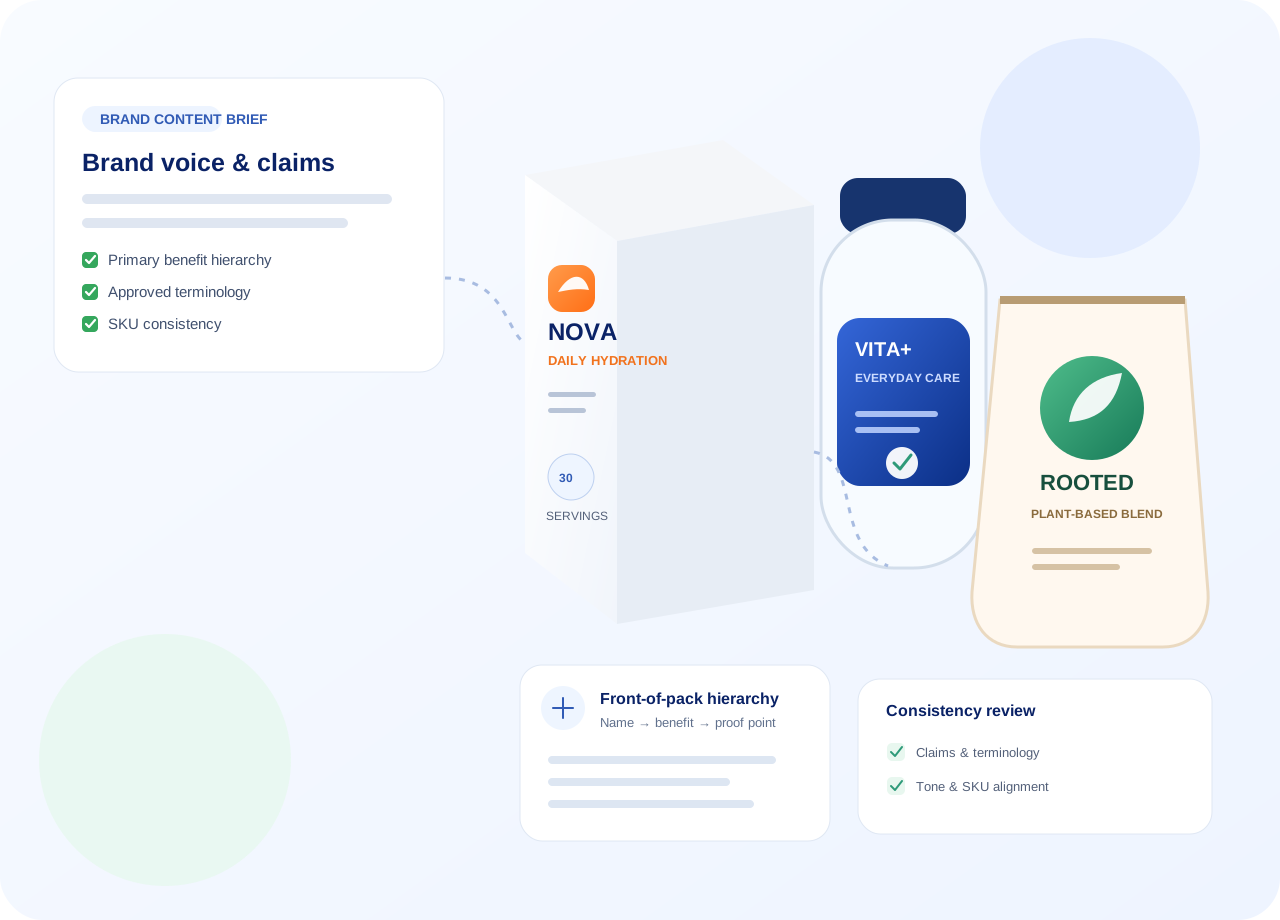
Packaging & Brand Content Service for Clarity, Trust & Sales
★★★★★4.8 rating from Researchers, Authors, Students, and Scholars
Create packaging copy and brand messaging that help customers understand the product quickly, recognise its value, and experience a consistent brand across cartons, labels, pouches, bottles, inserts, retail listings, and product variants.
Organize packaging copy so product identity, value, benefits and required information are easy to scan.
Keep brand voice and approved terminology consistent across labels, cartons, pouches and inserts.
Build reusable messaging structures that can scale across related SKUs and brand touchpoints.
Apply human editorial QA for clarity, consistency and review-ready packaging content.
Brand ConsistencyOne voice across pack and product touchpoints
Clear HierarchyContent organised for quick scanning
Claims DisciplineApproved wording kept visible and consistent
SKU AlignmentStructured master copy for variants
Quality ReviewEditorial QA before final handoff
Packaging Content Investment
Packaging & Brand Content Project Pricing
Packaging work is shaped by SKU count, pack format, approved product facts and the number of brand touchpoints that must stay consistent. A project minimum allows the scope to be defined without hiding the commercial starting point.
Projects from
₹10,000project minimum
Suitable for: For a focused packaging-content assignment that combines more than a single isolated line of copy.
Regulated categories, multi-SKU ranges, multilingual packs, substantial naming work, print-layout iteration and wider brand messaging systems may require a custom scope.
1
Complete Packaging & Brand Content Solutions
Build a coherent messaging system from the first glance at the pack to the supporting product story. Deliverables can be scoped individually or combined around a product launch, packaging refresh, or multi-SKU rollout.
Packaging Copy
Front, side, and back-panel copy structured for clarity, hierarchy, and brand fit.
Product Naming & Taglines
Names, descriptors, straplines, and short positioning lines that support recognition.
Label & Carton Content
Organised label language for bottles, boxes, jars, pouches, sleeves, and cartons.
Brand Voice & Messaging
Messaging pillars, tone cues, product language, and reusable brand expressions.
Benefit & Claims Copy
Benefit-led wording built around facts, approved claims, and supplied proof points.
Adapt core packaging messages into channel-ready bullets, descriptions, and snippets.
Variant & SKU Copy
Consistent master-copy systems with controlled differences across flavours, sizes, and variants.
Brand Story Content
Concise origin, purpose, product-story, and brand-belief content for packaging and inserts.
Packaging Microcopy
Short instructions, prompts, icons text, warnings context, usage cues, and utility copy.
2
Our Packaging Content Creation Process
A practical workflow connects the brand brief, product facts, packaging hierarchy, writing, review, and handoff so the final copy is easier for brand, design, ecommerce, and approval teams to use.
01
Discovery
Review product facts, audience, category context, and launch goals.
02
Brand Mapping
Align voice, terminology, positioning, approved claims, and naming rules.
03
Hierarchy
Map front-of-pack, support copy, proof points, and panel priorities.
04
Writing
Develop persuasive, concise copy that fits the brand and content space.
05
Consistency QA
Check claims, terminology, tone, repetition, naming, and SKU alignment.
06
Handoff
Deliver clearly labelled copy blocks for design and implementation teams.
07
Review & Refine
Apply consolidated feedback while protecting consistency across the set.
Ready to Start Your Service?Use the defined scope to move directly from review to checkout.
A Packaging Content Framework Built for Decision-Making
Good packaging has very little time and space to communicate. The content should lead with what matters, support the claim with the right proof, and stay consistent wherever the product appears.
Packaging Content Framework
Product name and descriptor clarity
Primary benefit and supporting proof
Brand voice and terminology alignment
Panel-by-panel content hierarchy
Variant and SKU consistency
Approved claims and mandatory-copy mapping
Retail and ecommerce message continuity
Messaging That Converts Attention into Understanding
NOTICE
UNDERSTAND
BELIEVE
CHOOSE
REMEMBER
Customer-centred benefit language
Clear hierarchy instead of copy overload
Specific, credible proof points
Quality Assurance
Grammar, spelling, and style check
Claims and supplied-facts consistency
SKU, variant, naming, and terminology check
Brand voice and tone review
Handoff-readiness check for design teams
QACONTENT REVIEWED
Turn the Brief Into a Finished DeliverablePlace your order when the scope and delivery expectations match your requirement.
Packaging Content for Products, Categories & Growth Teams
The same content framework can be adapted to different categories and business models while keeping the product facts, audience, packaging format, and brand voice at the centre of the brief.
Industries We Support
Beauty & Personal Care
Food & Beverage
Health & Wellness
Electronics & Accessories
Home & Lifestyle
Fashion & Accessories
Baby, Kids & Family
Pet & Animal Care
Typical Packaging Content Stack
Product name & descriptor
Primary benefit
Proof points
Brand story
Usage & utility copy
Channel adaptations
Bar lengths illustrate messaging hierarchy only; they are not usage or performance statistics.
Choose a working model that fits a single packaging refresh, a product launch, a high-volume SKU programme, or ongoing brand-content support. Final scope, pricing, and delivery timing are confirmed after the brief is reviewed.
Engagement Models
Project BasedDefined scope for a launch or refresh
RetainerOngoing brand and packaging support
Pay As You GoFlexible bursts for changing needs
Monthly PackagesPlanned recurring content output
Collaboration & Delivery Formats
Editable copy document
Copy matrix / spreadsheet
Panel-by-panel handoff
Annotated review notes
SKU content matrix
Consolidated final copy
Example Content Calendar
Phase
Content Focus
Primary Goal
01
Brand & product brief
Alignment
02
Master packaging hierarchy
Clarity
03
Core pack copy
Communication
04
SKU / variant adaptations
Consistency
05
Retail / ecommerce adaptations
Channel fit
06
QA & consolidated handoff
Readiness
Ready to Place Your Order?Continue securely to checkout and begin the service with the agreed deliverables.
Use these answers to understand typical scope, inputs, review boundaries, and collaboration for packaging and brand content projects.
What is included in a Packaging & Brand Content Service?+
The service can cover packaging copy, front-of-pack messaging, back-panel copy, product descriptors, benefit hierarchy, taglines, label microcopy, inserts, brand-story content, variant or SKU copy, retail adaptations, and supporting message architecture. The exact scope should be confirmed for each project.
Can you work from an existing brand guideline?+
Yes. Existing brand voice, terminology, messaging pillars, style rules, approved claims, naming conventions, and visual hierarchy notes can be used as the working reference for the copy.
Can you create content for multiple SKUs or product variants?+
Yes. A structured master-copy approach can be used to keep recurring language consistent while clearly differentiating flavour, size, formulation, pack format, audience, or other variant-specific information.
Do you write both front-of-pack and back-of-pack content?+
Yes. The content can be organised for different packaging zones, including product name, short benefit statement, supporting proof points, usage or product information, brand story, microcopy, and other approved content fields.
Can you help improve packaging content that already exists?+
Yes. Existing packaging copy can be reviewed for clarity, hierarchy, repetition, tone, benefit communication, terminology, consistency, and fit with the supplied brand direction.
Do you verify legal or regulatory compliance?+
The service can organise supplied claims, mandatory wording, disclaimers, and approved terminology into clear packaging content, but it does not replace legal, regulatory, scientific, or market-specific compliance review. Final approval should remain with the appropriate qualified reviewer.
Can you adapt one packaging message for ecommerce and retail listings?+
Yes. Core approved messaging can be adapted into channel-appropriate product descriptions, marketplace bullets, retail snippets, launch content, or supporting product-page copy while keeping the positioning consistent.
What do you need before starting?+
A useful brief includes the product or SKU list, target audience, brand guidelines, product facts, approved claims, mandatory statements, current packaging copy if any, competitor or category context, target markets, pack dimensions or copy limits, and the desired delivery format.
Can you work with packaging designers or agencies?+
Yes. Copy can be structured to support handoff to design teams, agencies, packaging studios, or internal brand teams, including clearly labelled copy blocks and hierarchy notes.
How are revisions handled?+
Revisions should be based on the confirmed scope and consolidated feedback. A clear feedback round helps preserve consistency across claims, tone, terminology, and multiple packaging panels or SKUs.
How is pricing calculated?+
Pricing depends on the number of products or SKUs, copy volume, research and message-development depth, number of packaging panels or content types, required adaptations, review complexity, and revision scope. A quote can be provided after the brief is reviewed.
How long will the project take?+
Delivery timing depends on the number of SKUs, content complexity, completeness of the source material, approval dependencies, and required review depth. Share your target launch or artwork deadline so a realistic schedule can be discussed.
Ready to Strengthen Your Packaging & Brand Content?
Share the product, target market, packaging format, SKU count, brand direction, approved claims, and launch timing. We can review the brief and help shape a practical content scope.
✓Packaging-specific copy scope
✓Flexible multi-SKU support
✓Human-written content
✓Structured editorial QA
Packaging & Brand Content Enquiry
Discuss Your Requirement
Provide enough detail for us to understand your packaging content needs, product range, and target delivery window.
Brand-led contentPackaging-ready structureHuman editorial reviewClear handoff for teams