Source-Aware Development
Claims and context are shaped around available evidence.

Turn expertise, research, interviews, internal knowledge, and emerging points of view into credible thought leadership that is structured for the audience, grounded in supportable evidence, and written in a recognisable executive or expert voice.
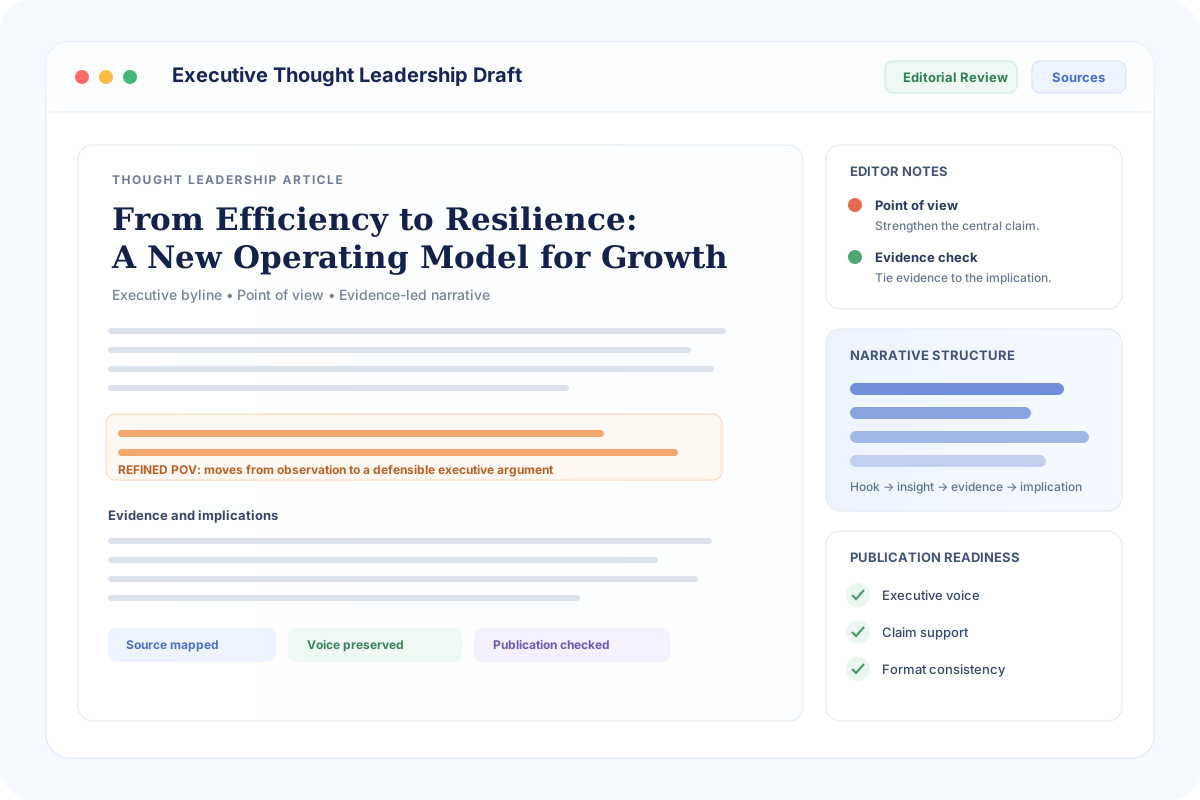
Claims and context are shaped around available evidence.
The author perspective remains central to the final narrative.
Unpublished ideas and internal materials stay project-focused.
Important changes and open questions are made visible.
Thought leadership is strongest when expertise is transformed into a distinctive, supportable argument—not simply expanded into more content.
This illustrative excerpt shows the editorial depth: the work is not limited to grammar. It clarifies the claim, links evidence to implication, and strengthens the author’s point of view.
Many organisations have improved operational efficiency through automation, but efficiency alone is no longer a sufficient operating objective when supply, talent, technology, and customer conditions shift quickly.
The stronger leadership question is not simply where to automate. It is which capabilities must become more adaptive without sacrificing control. That distinction changes how leaders evaluate process design, data access, decision rights, and investment priorities.
Evidence about cycle time, exceptions, service recovery, or decision latency becomes more useful when it is connected to a strategic implication. The role of thought leadership is to make that implication explicit and defensible.
A thought leadership draft should become more authoritative and easier to follow without losing the expertise, intended meaning, or author identity behind it.
Companies are using more automation. This creates efficiency, but it can also create new risks. Leaders should think about resilience and make sure their operating models can respond to change.
Automation changes the economics of efficiency, but it also increases the cost of brittle decision systems. The leadership opportunity is to redesign the operating model so that faster execution is paired with faster sensing, clearer decision rights, and disciplined exception handling.
Automation changes the economics of efficiency, but it can also expose the cost of brittle decision systems. A resilient operating model therefore pairs faster execution with faster sensing, explicit decision rights, and disciplined exception handling.
The distinction is editorial depth and purpose. Thought leadership should express a credible perspective that the intended author can stand behind.
| Aspect | General Content Writing | Thought Leadership Service |
|---|---|---|
| Primary goal | Explain a topic clearly. | Develop and communicate a distinctive, supportable point of view. |
| Starting material | Brief, keywords, or topic. | Expertise, interviews, internal material, research, notes, drafts, and strategic context. |
| Argument depth | Often informational or descriptive. | Thesis, tension, evidence, implications, limitations, and audience relevance. |
| Author voice | Can use a broad brand tone. | Preserves the intended executive or expert perspective and language. |
| Evidence handling | May include supporting sources. | Plans how evidence supports, qualifies, contextualises, or tests important claims. |
| Editorial review | Clarity, grammar, structure, and style. | Also reviews positioning, argument coherence, claim strength, source relationship, and publication fit. |
| Outcome | Useful content on a subject. | A publication-ready expression of expertise with a clear reason for the audience to pay attention. |
The exact deliverable is defined by the brief, but the service can support a range of executive, research-led, and expert communication formats.
The workflow can be scaled to the project, while preserving a clear sequence from author intent to final publication-ready content.
Deliverables are matched to the agreed scope. A typical project may include working, clean, and editorial-support files rather than a single opaque final document.
Thought leadership development is adaptable to expert-led topics. The subject matter and source material determine the research, terminology, and editorial approach required.
Thought leadership projects may contain unpublished strategy, internal research, executive views, or pre-publication material. The workflow is designed around controlled handling and clear project access.
Provide only the materials needed for the agreed work. Sensitive information should be identified in the brief so it can be treated appropriately during editorial development and review.
Thought Leadership Service pricing and turnaround are quoted after scope review.
Balanced planning for projects with normal review, research, and stakeholder coordination requirements.
Earlier scheduling can be discussed where project scope, materials, and editorial capacity allow.
For time-sensitive requirements, feasibility is assessed against research depth, format, review needs, and final deadline.
The quote is shaped by the actual work required rather than by a generic package label.
Use the service when the expertise already matters but the message needs stronger positioning, evidence, structure, voice, or publication readiness.
Turn strategic observations and operating experience into a clear, authored point of view.
Develop bylined articles, executive commentary, or opinion-led narratives around business priorities.
Translate specialist knowledge into accessible, credible content for wider professional audiences.
Convert studies, internal findings, or evidence packs into insight-led external narratives.
Shape firm expertise into point-of-view papers, reports, white papers, or executive articles.
Support executive visibility with a repeatable editorial process that preserves author voice.
Answers focus on scope, author voice, research, deliverables, revision handling, publication fit, confidentiality, pricing, and scheduling.
The service can include point-of-view development, research and source planning, interview or source-material synthesis, narrative structure, drafting, editorial refinement, evidence checks, citation or source presentation where appropriate, and publication-format preparation according to the agreed scope.
It is designed for executives, founders, subject-matter experts, researchers, professional teams and organisations that want to communicate a clear, differentiated and supportable point of view to a defined audience.
Yes. The service can begin from interview transcripts, notes, presentations, source packs, an existing outline, a rough draft or a combination of materials, depending on the agreed project scope.
Voice preservation is treated as a core editorial requirement. Drafting and revision are guided by the intended author perspective, terminology, level of formality and audience rather than replacing the author with a generic brand voice.
Research support can be included when it forms part of the agreed scope. Sources are used to strengthen, contextualise or test claims rather than to manufacture unsupported authority.
Suitable formats can include executive articles, bylined commentary, op-eds, point-of-view papers, white papers, research-led reports, executive briefs, keynote or speaking narratives, and professional social thought leadership content.
Revision handling is defined with the project scope. Editorial changes are kept transparent, and important questions about meaning, evidence, positioning or author intent are surfaced for review instead of being guessed.
Yes, when publication guidance or audience requirements are supplied. Structure, length, tone, framing and supporting elements can be aligned to those requirements without making publication or acceptance guarantees.
No. The service focuses on the quality, clarity, evidence, positioning and readiness of the content. Publication decisions, distribution, media placement and audience performance are controlled by external platforms, publications or campaign conditions.
Confidential source materials, drafts and internal information are treated as project materials and handled through the same controlled, private workflow used for client content. Only information needed for the agreed work should be supplied.
Pricing and scheduling are quoted after scope review because requirements can vary by format, research depth, source-material volume, interview involvement, technical complexity, review needs and deadline.
Provide the intended format, audience, objective, existing materials, subject area, research or interview needs, approximate length if known, publication or brand guidance, review stakeholders and required deadline.
The value is not a claim about guaranteed reach or publication. It is a clearer process for turning expertise into content that can withstand editorial and audience scrutiny.
Share the intended author, audience, format, topic, available materials, research needs, and deadline. The brief can then be reviewed for editorial depth, evidence requirements, scheduling feasibility, and quote preparation.
Provide enough context for a meaningful scope review. Fixed price and turnaround are not assumed before the brief is assessed.
Bring your expertise, notes, research, interviews, or existing draft. Contentxprtz can help shape the point of view, evidence, narrative, voice, and editorial readiness around the brief you actually need.