Research Proposal
Refine scope, research questions, objectives, and chapter direction.
From idea to final submission, our Thesis Service helps you organise research inputs, develop a coherent chapter structure, strengthen academic presentation, respond to feedback, and prepare a clean final manuscript—while you stay in control of your research, interpretation, and academic decisions.
Build the manuscript in connected stages so research decisions, chapter development, review, and final preparation remain visible rather than becoming one large end-stage rewrite.
Refine scope, research questions, objectives, and chapter direction.
Organise sources, synthesise themes, and build the research context.
Present methods, sampling, variables, procedures, and ethical considerations.
Structure results, tables, figures, and analysis narratives around the research questions.
Develop each chapter with clear argument flow, evidence, and academic tone.
Map feedback, strengthen clarity, and document author decisions.
Finalise formatting, references, tables, figures, and submission checks.
A thesis can require very different kinds of support at different stages. The service is scoped around the work your project genuinely needs rather than treating every thesis as the same task.
Clarify scope, research questions, objectives, and feasibility.
Source organisation, synthesis, research-gap framing, and evidence mapping.
Present methods, sampling, measures, procedures, and ethical considerations.
Structure quantitative or qualitative outputs into a readable results narrative.
Strengthen section development, academic flow, argument, and chapter coherence.
Respond to supervisor comments, author feedback, and revision priorities.
Apply supplied guidelines, check references, figures, tables, and presentation.
The working process makes the transformation visible: raw or fragmented material is organised into a reviewable draft, refined through comments and evidence checks, and prepared for final submission.
Previous literature has shown that transportation policies and urban mobility systems influence access, behaviour, and sustainability outcomes.
Choose the level of intervention based on what your manuscript needs. Collaborative development is deeper than editing; editing is deeper than final-stage proofreading.
| Aspect | Collaborative Development | Editing / Language Enhancement | Proofreading / Final Polish |
|---|---|---|---|
| Scope | Structure, argument, research flow, chapter development, and evidence organisation. | Improve clarity, flow, coherence, language, and presentation of an existing draft. | Grammar, spelling, punctuation, formatting, and final consistency checks. |
| Best For | Building chapters, developing ideas, strengthening methodology or analysis presentation. | Refining an existing draft, improving explanations, logic, and readability. | Final checks before submission when the content and structure are already complete. |
| Includes | Outline, drafting support, revision loops, feedback integration, and chapter-level development. | Rewriting within the author's existing content, stronger transitions, terminology, and consistency. | Language checks, style consistency, reference presentation, and formatting corrections. |
| Your Role | Active collaboration, research decisions, evidence ownership, approvals, and feedback. | Review and approve revisions; provide clarification where meaning is uncertain. | Final review and confirmation of author details, references, and submission requirements. |
| Outcome | A developed, well-structured working manuscript shaped through transparent collaboration. | A clearer, more coherent, more readable version of your existing draft. | A polished final document ready for author submission review. |
Academic-integrity requirements vary by institution and programme. You remain responsible for following your university's rules on permitted assistance, authorship, disclosure, citation, ethics, and final submission.
The service starts from the materials you already have and turns them into an organised, reviewable workflow rather than separating writing from the underlying evidence.
Structure your material into a clear research framework.
Connect the evidence to the research questions and chapter purpose.
Build chapters with stronger logic, evidence, and academic flow.
Incorporate feedback and strengthen clarity, argument, and presentation.
Each stage has a clear input, output, and review point so you know what is happening, what you need to provide, and what will be delivered next.
Share your topic, material, current stage, guidelines, and requirements.
Output: Project briefClarify challenges, depth of support, priorities, milestones, and deliverables.
Output: Scope planMatch the project to suitable subject and research-method support.
Output: Expert assignedBuild a chapter sequence and practical work plan around the supplied material.
Output: Chapter planDevelop agreed sections with source-aware academic writing and visible comments.
Output: Draft chaptersReview feedback, author decisions, supervisor comments, and required changes.
Output: Revised draftsPrepare the clean manuscript, supporting notes, and agreed submission materials.
Output: Final packageA milestone model makes larger thesis projects easier to review and redirect before too much work is built on an unresolved issue.
Kick-off, briefing, and plan approval.
Literature scan and chapter outline.
Draft agreed chapters or sections.
Quality check and evidence review.
Author review and consolidated comments.
Feedback incorporated by agreement.
Address external or academic feedback.
Final polish and consistency check.
Completeness, files, and final review.
Deliverables are tailored to the agreed scope, but the working model keeps revisions, feedback, references, figures, and final manuscript preparation visible and reviewable.
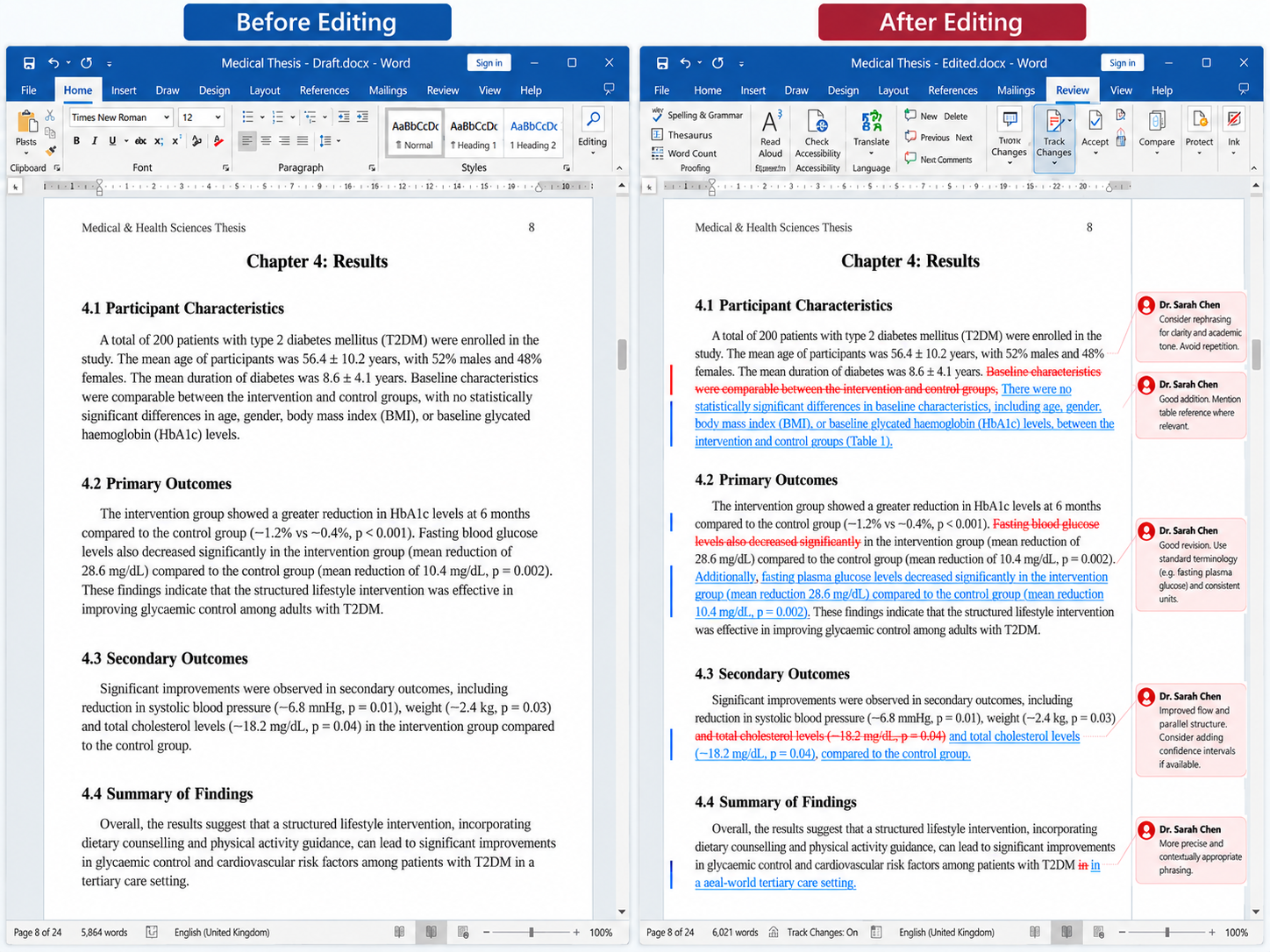
Tracked changes and comments where useful.
A clean version reflecting approved revisions.
A clear record of major changes and actions.
Normalised reference and citation presentation where scoped.
Style, layout, headings, figures, and guideline checks.
Reviewed figure, table, caption, and cross-reference presentation.
A structured response to supervisor or reviewer comments when requested.
Thesis projects vary too widely for one fixed package. Scope is based on your discipline, project stage, document length, research complexity, required support, and submission needs.
We provide a project-specific quote after reviewing the materials and scope. No unsupported fixed price or turnaround is assumed.
Quality checks are built into the workflow so structure, evidence, academic presentation, references, feedback, and final-delivery requirements can be reviewed at the right stage.
Review your topic, material, research stage, guidelines, and requirements.
Create a clear outline, chapter plan, and research-evidence map.
Develop content from supplied research and keep revisions visible.
Review citations, references, terminology, figures, tables, and formatting where scoped.
Check quality, consistency, completeness, and agreed academic requirements.
Package the agreed manuscript and supporting deliverables for author review.
A collaborative model is useful when the project needs more than a final edit: structure, research synthesis, chapter planning, feedback integration, and a clear route to submission.
Because Thesis Service is custom-scoped, the timeline is agreed only after the project materials and deadline are reviewed.
Visualise work across agreed milestones, with enough space for review and feedback cycles.
Where feasible, prioritise selected chapters or urgent revisions against a defined submission need.
Deliver chapters or milestone outputs progressively so review can happen before the next stage.
Turnaround depends on project length, complexity, current draft stage, research readiness, requested depth of support, review cycles, and the submission date.
We plan milestones together so the quality of the work is not separated from the time available.
These answers explain how Thesis Service is scoped, how collaboration works, and what you should prepare before requesting a quote.
Share your topic, research question, existing notes or drafts, relevant data or analysis, university or department guidelines, formatting requirements, and any supervisor feedback already received. The more context you provide, the more precisely the support can be scoped.
Yes. Support can be scoped to a particular chapter or stage, such as the literature review, methodology, results, discussion, conclusion, revision, or final submission preparation.
Working drafts can use tracked changes, clear comments, chapter-level notes, and review checkpoints so you can see what changed, understand why it changed, and approve or revise the direction.
Yes, when the relevant university, department, supervisor, citation, or formatting guidelines are supplied. Requirements are reviewed at the start and can be checked again during final preparation.
Revision needs are agreed as part of the project scope. For milestone-based projects, feedback can be incorporated at agreed review points before the next stage is developed.
Projects can be considered across medicine and health sciences, engineering and technology, computer science and IT, business and management, social sciences, humanities and literature, environmental sciences, and interdisciplinary research. Methodology support is matched to the material supplied and the project scope.
Project files are treated as confidential service materials. Only information needed for the agreed work should be shared, and sensitive research or participant information should be handled in line with your institution, ethics approval, and data-governance requirements.
No. Your research question, evidence, data, findings, interpretation, and academic responsibility remain yours. Support focuses on organisation, clarity, synthesis, presentation, and revision based on the material and direction you provide.
Yes. Supervisor comments can be mapped to chapters or action points, incorporated into the next working draft where appropriate, and tracked so you can see how each item has been addressed.
Yes. Early-stage support can begin with research notes, outlines, partial drafts, literature material, or chapter fragments. The first step is to organise what exists, identify gaps, and agree a practical chapter plan.
Thesis projects are quoted individually because scope varies by word count or length, research complexity, current stage, depth of support, data-analysis requirements, formatting needs, review cycles, and deadline. A quote is provided after the project brief is reviewed.
Turnaround is planned after reviewing the scope, current draft stage, length, research complexity, requested support, feedback cycles, and submission date. Delivery can then be structured around agreed milestones rather than an unsupported fixed timeline.
The process is designed around transparent collaboration, traceable revisions, source-aware writing, and preservation of your research ownership. You remain responsible for complying with your institution’s rules on authorship, permitted assistance, disclosure, citations, ethics, and submission.
Start with your current materials. We will review the project stage, scope, deadline, and support required before confirming a custom plan.
Provide enough information for us to understand what you already have and where you need support. A custom quote is based on the actual project rather than a generic package.
Share your details below. You can provide sensitive project files later through an agreed secure process if required.
Good synthesis. Add the most recent contrasting study.