Question Bank Development
Structured banks of assessment items organised around your topics, outcomes, competencies, audience level, and preferred item mix.
- Item IDs and metadata
- Topic and outcome mapping
- Difficulty labels when defined in the brief

Develop structured assessment content that reflects your learning goals, competency framework, audience level, and scoring approach—from question banks and scenario-based items to rubrics, answer keys, rationales, and review-ready assessment packs.
Coverage, formats and outcomes can be defined before item development.
Build mixed assessment sets rather than relying on one item type.
Include keys, rationales, rubrics or model responses where required.
Organise content for internal review, revision and downstream use.
Assessment projects vary by item type, scoring depth, subject expertise, and bank size, so a project minimum gives useful guidance without forcing unlike assessment needs into artificial packages.
Suitable for: Institutions, EdTech teams, training providers, and course teams that need a scoped assessment deliverable rather than isolated ad-hoc questions.
Question-bank volume, specialist domains, scenario depth, rubric complexity, custom metadata, multi-stage SME review, and platform-specific delivery can materially change the final quotation.
Assessment content can be developed as a complete assessment pack or as focused support for a specific stage such as item writing, rubric creation, outcome mapping, or content review.
Structured banks of assessment items organised around your topics, outcomes, competencies, audience level, and preferred item mix.
Multiple-choice and other objective-response content designed around a clear stem, defensible answer logic, and purposeful alternatives.
Short-answer, essay, analytical, and explanation-based prompts for assessing reasoning, understanding, and written application.
Context-rich tasks that ask learners or candidates to interpret information, make decisions, solve problems, or apply rules.
Scoring support that makes expected performance clearer for reviewers, instructors, assessors, and content teams.
Review existing content for clarity, ambiguity, duplication, answer logic, coverage, alignment, and consistency with the agreed blueprint.
A clear workflow keeps the content tied to the assessment purpose instead of treating question writing as an isolated task.
Define audience, goals, subject scope, outcomes, source material, item formats, volume, scoring needs, and delivery requirements.
Organise coverage, item distribution, learning outcomes or competencies, difficulty expectations, and assessment structure.
Create questions, scenarios, options, answer keys, rationales, rubrics, model responses, and supporting metadata as scoped.
Check wording, ambiguity, duplication, alignment, scoring logic, coverage, consistency, and presentation against the brief.
Prepare the approved assessment content in the agreed document, spreadsheet, template, or structured handoff format.
Choose one format or combine several formats to match the skills, knowledge, and behaviours your assessment needs to evaluate.
Stems, options, keys and rationales for objective scoring.
True/false, matching, selection, ordering and similar formats.
Focused prompts with expected-response or marking guidance.
Analytical prompts supported by criteria or model-answer guidance.
Context-based tasks for application, judgement and decision-making.
Task prompts, observation criteria, rubrics and evidence requirements.
Assessment content can be scoped around your subject matter and delivery context. The examples below show common areas where structured assessment content may be useful.
Domain coverage should be confirmed in the project brief along with source material and reviewer requirements.
A structured workflow is designed to make the assessment easier to review, manage, and use.
Assessment content can support organisations that need structured questions, scoring guidance, or review-ready evaluation materials.
The final deliverable depends on your brief. A structured assessment pack can combine questions with the metadata and scoring information your team needs to review and use them.
Select the components that belong in your project rather than forcing every deliverable into every assessment.
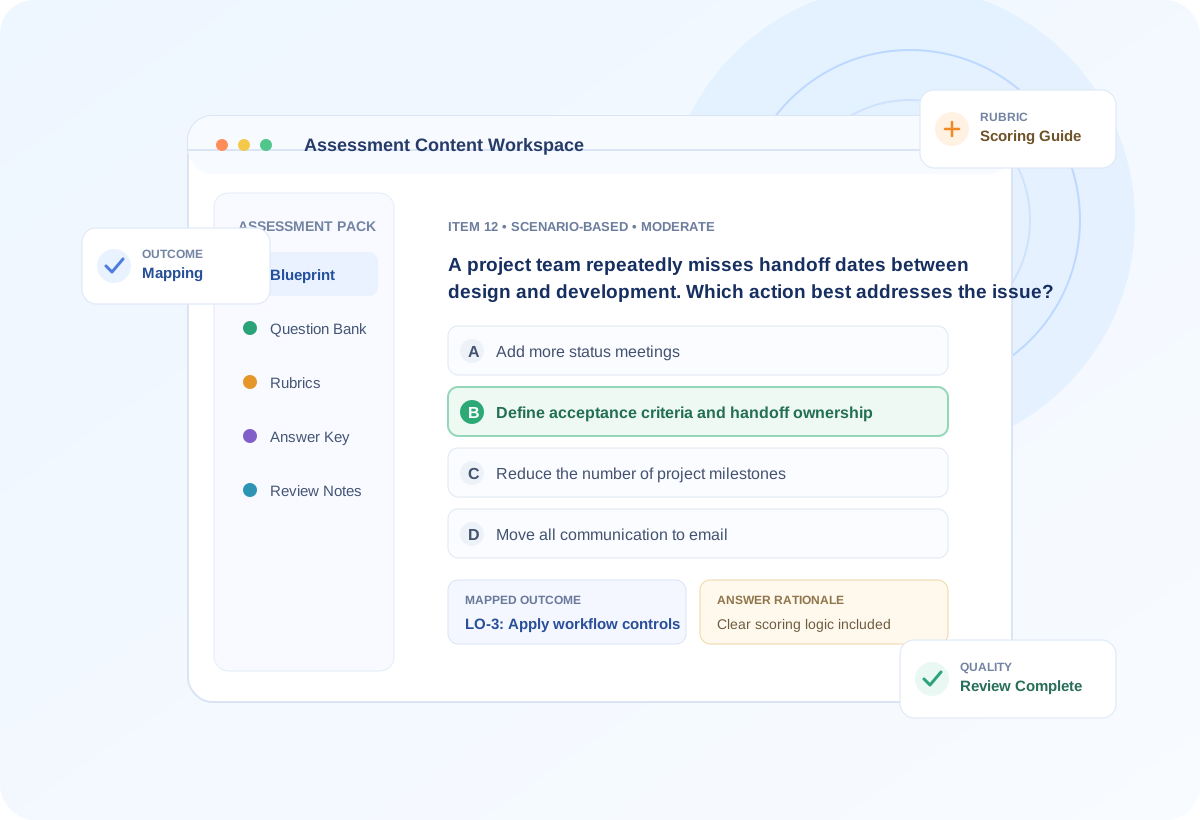
Illustrative content below shows the type of structure a review-ready item can use.
A project team repeatedly misses handoff dates between design and development. Which action best addresses the underlying workflow issue?
Different review roles can be applied to the project depending on subject complexity, assessment purpose, volume, and quality requirements.
Connect purpose, outcomes, coverage and assessment structure.
Work from approved source material, references and domain context.
Develop items, scenarios, prompts, options and supporting content.
Prepare keys, rationales, rubrics, criteria or model responses.
Review clarity, ambiguity, consistency, alignment and presentation.
Check the final content against the agreed blueprint and delivery brief.
This section sets out the practical quality principles the Assessment Content Service is designed around.
Items are written against an assessment purpose, outcome, competency, or blueprint requirement.
Questions are reviewed to reduce avoidable ambiguity, confusing instructions, and inconsistent phrasing.
Answer keys, rationales, model responses, and rubrics can be reviewed with the items they support.
Content can be organised with IDs, metadata, mapping and fields that support later review and maintenance.
Scope, duplication, consistency, alignment, answer logic and presentation can be checked before delivery.
Choose a model that matches the stage of your assessment project and the type of development or review support you need.
Create a defined assessment pack, exam, quiz set, or question bank against an agreed brief.
Discuss projectPlan recurring batches of assessment items for courses, programs, products, or content pipelines.
Discuss workflowAdd new items to an existing bank while following supplied templates, taxonomies, and metadata fields.
Expand your bankReview existing content for structure, clarity, alignment, scoring logic, coverage, and quality-control needs.
Request a reviewShare the audience, subject scope, learning outcomes or competency framework, item formats, approximate volume, scoring requirements, source material, and delivery needs so the project can be scoped around the assessment you actually need.
Answers to practical questions about assessment formats, blueprints, outcome mapping, rubrics, review, deliverables, and project scoping.
An Assessment Content Service develops and reviews the content used to evaluate knowledge, understanding, application, and performance. Depending on the brief, this can include assessment blueprints, question banks, objective items, constructed-response questions, case or scenario tasks, rubrics, answer keys, rationales, and outcome mapping.
The service can cover multiple-choice questions, true-or-false and other objective items, short-answer questions, essays, case studies, scenario-based tasks, practical prompts, quizzes, tests, and mixed-format assessment packs.
Yes. When learning outcomes, competencies, syllabus objectives, or a framework are supplied, items can be mapped to the relevant targets so coverage is easier to review and manage.
Yes. The scope can include answer keys, model responses, scoring rubrics, marking guidance, and answer rationales when those deliverables are part of the brief.
The workflow begins with a blueprint that defines topics, outcomes, item formats, weighting, intended difficulty, and coverage. Content is then reviewed against that blueprint before final delivery.
Yes. Existing items can be reviewed for clarity, ambiguity, duplication, answer-key consistency, outcome alignment, coverage, difficulty signals, distractor quality, and formatting consistency according to the agreed scope.
A useful brief normally includes the target audience or learner level, subject or topic scope, learning outcomes or competencies, preferred item formats, approximate question volume, difficulty expectations, scoring approach, reference materials, style requirements, and any delivery deadline.
Yes. If you provide a template, sample item, style guide, LMS format, spreadsheet structure, or naming convention, the content can be prepared to follow those requirements where practical.
Yes. Scenario and case-based items can be developed when the assessment needs learners or candidates to interpret information, apply rules, make decisions, or demonstrate judgement rather than only recall facts.
Yes. Delivery can be structured in editable document or spreadsheet formats appropriate to the project brief, with fields such as item ID, question, options, correct answer, rationale, difficulty, topic, outcome mapping, and reviewer notes where required.
Quality review can include scope and blueprint checks, language and ambiguity review, answer-key and rubric consistency, duplicate-item review, coverage checks, formatting consistency, and a final delivery check against the agreed brief.
Share enough detail to identify the assessment purpose, content scope, expected item formats, scoring needs, source material, review requirements, and deadline constraints.
Tell us who the assessment is for and what knowledge, skills, competencies, or outcomes it needs to evaluate.
Share the approximate number of items and whether you need MCQs, short answer, essays, cases, scenarios, practical tasks, or a mix.
Specify whether the project needs answer keys, rationales, rubrics, model responses, marking guides, or performance criteria.
Include the syllabus, learning outcomes, competency framework, policy, training material, textbook, reference documents, or approved content sources.
Provide the required date, time zone, document or spreadsheet template, LMS fields, and any review or revision milestones.
Use the form below to share the project scope so the assessment requirements can be reviewed clearly.