Unclear Report Story
Sections exist, but the report does not clearly connect strategy, performance, challenges and outlook.

Turn source material, approved data and stakeholder inputs into a coherent annual report narrative with stronger structure, consistent messaging, design-ready copy and an organised review process.
A complete annual report combines multiple specialist workstreams, so a credible project minimum is clearer than pretending a full report can be bought at the price of one editing or design task.
Suitable for: Organisations that need coordinated annual-report support across narrative, editorial review, data presentation, and report preparation rather than one isolated task.
Listed-company disclosures, large page counts, extensive writing from raw inputs, bespoke design, BRSR/ESG work, photography, interactive versions, or multiple languages are quoted as larger engagements.
Annual reports become difficult to complete when messages, data, owners and review cycles are not aligned. These are common content-development problems the service is designed to help organise.
Sections exist, but the report does not clearly connect strategy, performance, challenges and outlook.
KPIs and charts appear without enough context, explanation or linkage to the surrounding business story.
Multiple section owners use different tones, terminology and levels of detail, making the report feel fragmented.
Terms, metric names, table labels, dates or cross-references do not remain consistent from one section to another.
Unclear approvers and fragmented feedback create rework close to the intended publication or design deadline.
Copy reaches layout without a clear hierarchy, callout guidance, caption text, table notes or controlled final wording.
The exact engagement is tailored to your brief. A full annual-report project can move from source review and report architecture through section development, consistency checks and final delivery.
Audience, purpose, scope and report goals.
Prior report, data packs, notes and approved inputs.
Section order, hierarchy and narrative path.
Chair, CEO or leadership copy from supplied points.
Profile, purpose, priorities and operating context.
Explain outcomes using approved source material.
Structure commentary around supplied figures.
Organise sourced governance and risk content.
Align narrative, metric names and source notes.
Present workforce and culture material consistently.
Clarify labels, notes, callouts and explanatory copy.
Improve consistency across related sections.
Clarity, tone, flow, grammar and consistency pass.
Consolidate approved feedback and version changes.
Clean structured copy for publication or design.
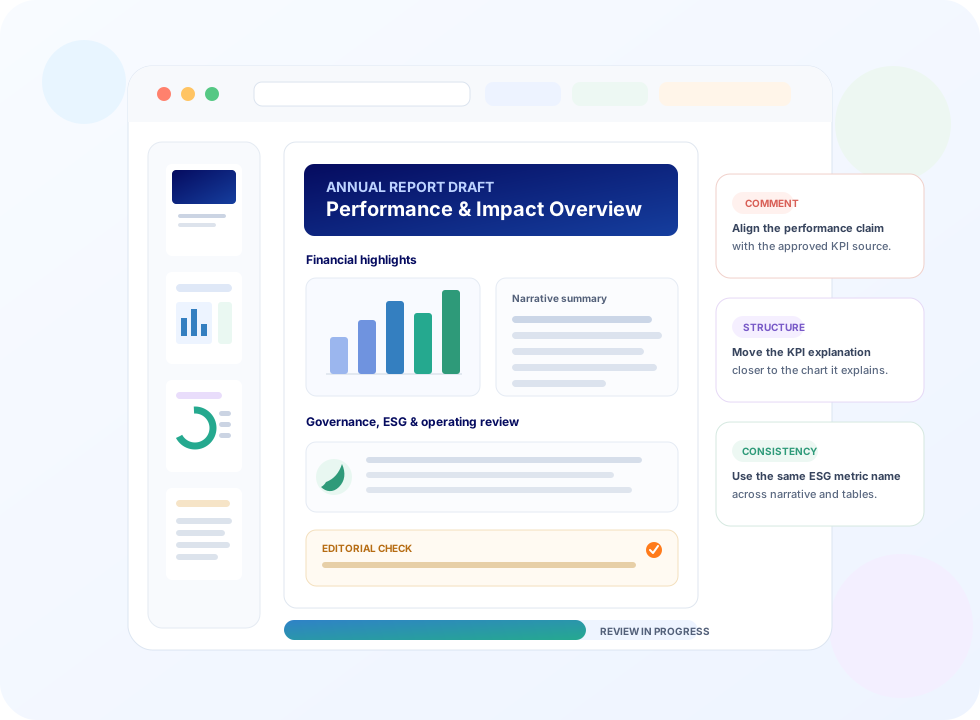
A representative example shows how a loosely assembled annual-report passage can become a clearer, source-led section with stronger hierarchy, traceable review comments and design-ready wording.
“This year was strong and we did many things across the business. Results improved in several areas and we continued our sustainability work. The charts show what happened.”
Performance overview. Organise the section around the approved priority areas, then place each verified KPI explanation beside the relevant table or chart.
The revised section presents performance in a defined sequence, links the narrative to the approved KPIs, explains the purpose of the accompanying chart, and keeps sustainability terminology consistent across the report.
A full Annual Report Service focuses on the report as a complete communication product—its architecture, narrative, data context, cross-section consistency and controlled handoff—not only sentence correction.
| Support Dimension | Proofreading / Formatting Review | Language Editing | Full Annual Report Service |
|---|---|---|---|
| Report framing & scope development | ✕ | ✕ | ✓ |
| Section architecture & information hierarchy | ✕ | Limited | ✓ |
| Leadership and strategic narrative development | ✕ | Limited | ✓ |
| KPI, chart and table narrative alignment | ✕ | Limited | ✓ |
| Governance / ESG section structuring | ✕ | Limited | ✓ |
| Cross-section terminology consistency | Basic | ✓ | ✓ |
| Grammar, clarity and editorial polish | ✓ | ✓ | ✓ |
| Design-ready hierarchy, callouts and captions | Basic | Limited | ✓ |
| Stakeholder revision consolidation | ✕ | Limited | ✓ |
| End-to-end annual report content development | ✕ | ✕ | ✓ |
The approach can be adapted to different reporting contexts when the relevant source material, audience, required disclosures and approval responsibilities are clearly defined.
Strategy, operating review, financial highlights, governance, people, risk and stakeholder narrative.
A joined-up narrative connecting strategy, performance, resources, governance and longer-term value creation.
Source-led environmental, social, governance and impact narrative with consistent metric naming and context.
Annual performance, programmes, outcomes, governance and stakeholder reporting for institutions and organisations.
Mission, programmes, impact, governance, funding context and outcome narratives based on supplied evidence.
Performance-focused narrative, priorities, material developments and approved financial or operational highlights.
Member, programme, governance, funding and year-in-review content organised for a defined stakeholder audience.
Annual activity, milestone, outcome and learning narratives for programmes with defined source evidence and owners.
A controlled workflow helps keep source material, section ownership, narrative development and stakeholder review connected from the first brief to final handoff.
Share source files, prior report, target deadline and expected output.
Confirm sections, owners, writing depth, review cycles and dependencies.
Build a coherent report structure and section hierarchy.
Draft or refine approved content around the agreed narrative.
Check that wording, tables, captions and supplied metrics align.
Review tone, terminology, flow, headings and cross-references.
Apply consolidated approved feedback with version discipline.
Prepare clean structured copy for publication or design handoff.
The strongest annual-report workflow starts with controlled source material and clear owners. Deliverables are then shaped around the scope confirmed for your project.
A multi-stage editorial review is designed to make the report coherent, consistent and ready for the client’s factual, legal, financial and governance approvals.
Check section sequence, hierarchy, duplication and narrative flow.
Improve readability, concision, tone and sentence-level clarity.
Flag wording that needs confirmation against approved material.
Review terminology, KPI names, headings, captions and references.
Check hierarchy, tables, callouts, labels and design-handoff cues.
Complete an editorial final pass before client approval and release.
Annual reports combine several types of organisation information. The content approach should keep those areas consistent while treating non-public drafts and supplied source material carefully.
Non-public drafts, source files and organisation information should be handled as confidential service material through the designated workflow. Share only material you are authorised to provide, identify restricted sections or handling requirements early, and keep final factual approval with the appropriate organisation owners.
The published starting price above covers the defined entry scope for Annual Report. Larger, deeper, or faster-turnaround requirements are quoted after the actual materials and deliverables are reviewed. Scope and schedule should be confirmed after the actual report requirements are reviewed.
Choose the delivery priority that best matches your reporting calendar. Availability is confirmed only after the report and review process are assessed.
A quote can be prepared after reviewing the level of development and the condition of the source material.
Use these answers to understand typical scope, source-material expectations, review responsibilities, pricing logic and the boundaries of an annual-report writing and editorial engagement.
The service can be scoped around annual-report planning, section architecture, narrative development, leadership messages, performance commentary, governance and ESG content, financial-highlight narrative, tables and captions, cross-section consistency, editing, and design-ready copy. The exact scope is confirmed against the material you provide.
Yes. A project can begin from a mix of approved source material such as prior reports, leadership notes, presentations, spreadsheets, policy or governance material, and draft sections. The clearer the source ownership and approval status, the easier it is to build a controlled annual-report narrative.
Yes. If the report is substantially drafted, the scope can focus on structure, flow, clarity, tone, repetition, section consistency, headings, tables, captions, cross-references, and final editorial preparation rather than full content development.
No. This is a writing, structuring, editing, and report-development service. Financial figures, legal disclosures, regulated statements, assurance conclusions, and formally approved metrics remain the responsibility of the client and its authorised finance, legal, governance, or assurance teams.
They can be developed or refined from approved talking points, source material, and the organisation’s preferred tone. Final factual accuracy, attribution, positioning, and executive approval remain with the organisation.
These sections can be structured and edited when you provide the relevant approved source material, terminology, metrics, frameworks, and disclosure requirements. The service does not create or validate regulated disclosures without source support.
Yes, the content can be organised so tables and charts are clearly introduced, labelled, captioned, and explained in the surrounding narrative. Source numbers and the underlying calculations should be supplied and approved by the client.
Yes. The content can be delivered with a clear hierarchy, section order, headings, callouts, table notes, caption text, and other editorial cues so it is easier to hand over for layout. Any separate graphic-design or production scope should be confirmed in the quotation.
Review rounds and stakeholder checkpoints should be agreed as part of the project scope. Consolidated feedback, clear approvers, and version control help avoid conflicting edits and keep the report aligned to the approved narrative.
The published starting price above covers the defined entry scope for Annual Report. Larger, deeper, or faster-turnaround requirements are quoted after the actual materials and deliverables are reviewed. A custom quote can be based on factors such as report length, number of sections, condition of source material, amount of writing versus editing, table or chart complexity, review cycles, formatting needs, and deadline.
For the published starting scope, typical delivery is 2–4 weeks for a focused report. The delivery plan should be confirmed after the report length, source-material readiness, stakeholder review process, complexity, and required output are assessed.
Useful starting material includes the reporting brief, previous annual report, approved corporate or brand guidance, leadership notes, section owners, source documents, performance data, financial highlights, governance or ESG material, required disclosures, preferred structure, and target deadline.
Non-public drafts, source files, and organisation information should be treated as confidential service material through the designated submission and delivery workflow. Only provide materials you are authorised to share, and identify any special handling requirements at the start of the project.
Yes. Share your brand voice guidance, prior-year report, terminology preferences, naming conventions, and any board-, investor-, regulator-, or stakeholder-facing requirements that should control the writing and editing approach.
Tell us what stage your annual report is at, which sections need support, what source material is available, who will review the draft, and when the final content is required.
Share report type, approximate length, required sections and intended audience.
Explain whether you have prior reports, approved data, draft sections, leadership notes and disclosure material.
State whether you need full drafting, partial section development, deep editing or final refinement.
Identify key approvers, expected revision rounds and the target content or design-handoff date.
Share your contact details and annual-report requirements so the project scope, quote and delivery plan can be assessed.
Share your reporting brief and source-material status so the right writing, editing and review scope can be defined.