Course Architecture
Curriculum mapping, module sequence, lesson hierarchy, and learning-objective alignment.

Turn subject knowledge, source material, or an existing curriculum into clear, learner-focused course content. Content can be structured around modules, lessons, activities, assessments, e-learning screens, and supporting materials according to the project brief.
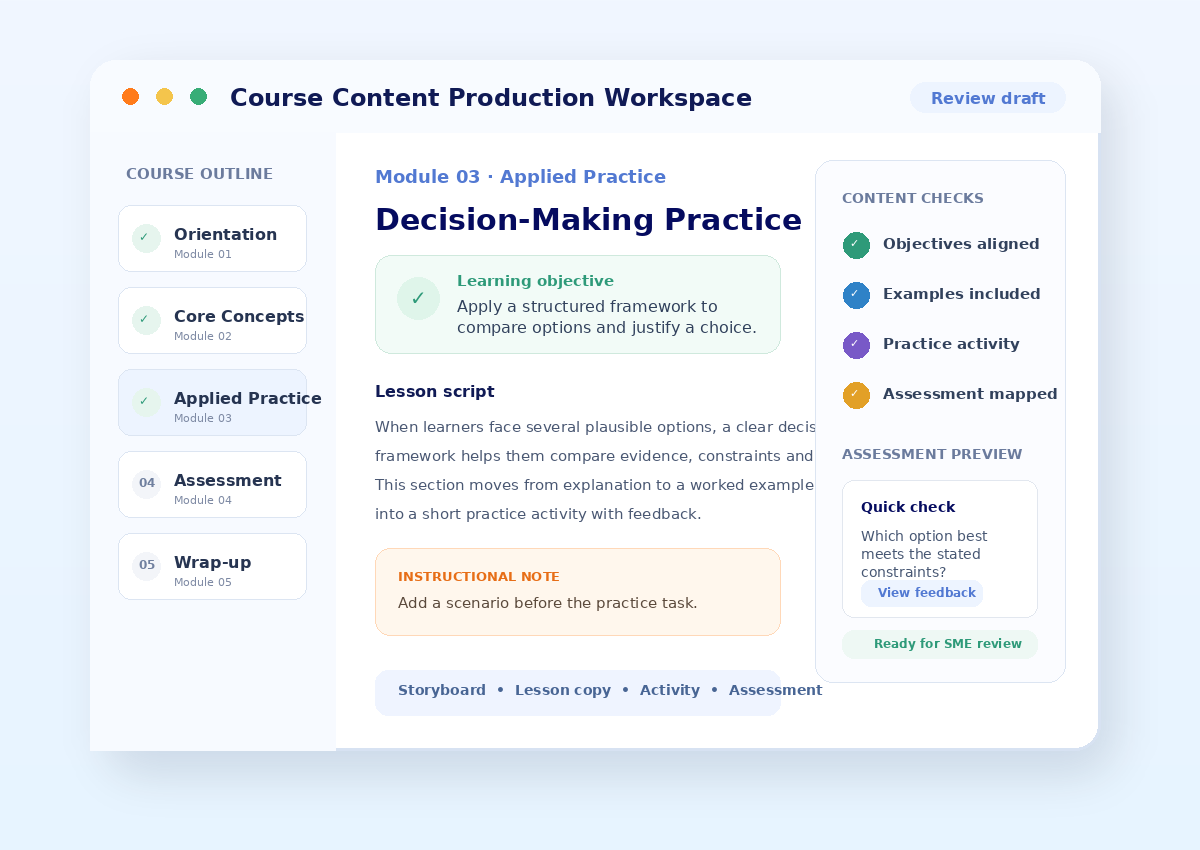
Course-content work can begin with a single module and expand into architecture, lesson writing, assessments, storyboards, and learner resources. Pricing therefore starts with a defined workstream rather than a generic package.
Suitable for: Course creators, institutions, EdTech teams, and L&D groups that need a structured module, refresh, or content-production starting point.
Multi-module programs, extensive subject research, high-interactivity storyboards, multimedia production, LMS authoring, and specialist review increase the project scope and are quoted separately.
Build the content components your learning program needs. The exact combination is defined by the audience, source material, delivery format, and agreed project scope.
Curriculum mapping, module sequence, lesson hierarchy, and learning-objective alignment.
Explanations, examples, worked scenarios, transitions, summaries, and learner-facing lesson copy.
Practice tasks, reflection prompts, exercises, scenarios, and application-focused learning activities.
Knowledge checks, question sets, answer keys, rationales, and feedback text where included in scope.
Screen-by-screen content, narration or on-screen copy, interactions, developer notes, and checks.
Learner handouts, facilitator notes, workbooks, reference material, and supporting course documentation.
A staged workflow keeps the learning purpose, content structure, subject input, and review process visible from the start.
Clarify learner profile, goals, source material, delivery format, constraints, and expected content components.
Create the course architecture, module flow, lesson sequence, learning objectives, and content map.
Draft lesson content, examples, activities, assessments, scripts, storyboards, or supporting materials.
Collect consolidated stakeholder or subject-matter feedback and refine the content against the agreed brief.
Prepare the approved content package in the agreed editable or handoff format for the next production stage.
Good course content is more than a collection of facts. It needs a purposeful sequence, clear explanations, opportunities to apply knowledge, and a review path that keeps subject accuracy and learner usability connected.
Each section should have a clear role in the learning journey.
Drafts are easy to review for terminology, examples, and subject accuracy.
Modules and lessons follow a repeatable information hierarchy.
Feedback can be tracked against the agreed content plan and review stage.
The same subject matter may need a different content treatment depending on how learners will access, practice, and apply it.
Session structure, facilitator prompts, learner activities, and supporting presentation copy.
Step-by-step lessons with explanations, checks, examples, and independent practice.
Connected content for live instruction, independent study, and follow-up practice.
Short-form scripts, lesson chunks, screen copy, recap content, and knowledge checks.
Compact content structures designed for concise screens and focused learning moments.
Facilitated learning flows with exercises, case activities, worksheets, and takeaways.
Course content can be scoped across academic, technical, business, and professional learning topics when suitable source material and subject inputs are available.
The content structure is designed around what learners should understand, practice, or demonstrate—not around page count alone.
From objective to activity to assessment.
The structure can connect what learners need to know with what they need to do and how understanding is checked.
The workflow can be adapted to organizations that need structured learning materials for academic, professional, internal, or digital learning programs.
A strong content brief helps separate subject accuracy, instructional structure, format requirements, and stakeholder review so each can be checked deliberately.
A project may begin with a topic outline and source documents. The first deliverable can be a content map showing the module sequence, learning objectives, lesson purpose, and planned activities. Once that structure is approved, lesson copy and assessment content can be developed against the same map.
This is an example of how a staged content workflow can reduce late structural changes. The actual process should be matched to the project scope.
Instead of relying on invented profiles or unsupported credentials, this section shows the types of expertise a course content workflow may require.
Shapes learning objectives, module sequence, lesson purpose, and the overall content architecture.
Provides or reviews domain knowledge, terminology, examples, and technical context.
Develops explanations, examples, scripts, learner instructions, summaries, and supporting copy.
Creates knowledge checks, scenarios, practice tasks, answer keys, and feedback where required.
Checks consistency, clarity, objective alignment, content flow, and handoff completeness.
Coordinates consolidated reviewer feedback, version control, and final content decisions.
Review points can be built around the project so structural decisions are resolved before the full content package is finalized.
Module sequence, objectives, lesson purpose, and planned content components.
Tone, level, depth, examples, activity style, and lesson pattern before scale-up.
Full module or course draft with consolidated comments from designated reviewers.
Practice tasks, questions, rationales, and feedback reviewed against learning goals.
Approved content organized in the agreed editable, storyboard, guide, or handoff format.
Questions to help scope the right content workflow, inputs, learning format, and review process.
A course content project can include course architecture, learning objectives, module and lesson content, examples, activities, assessments, e-learning storyboards, and learner or facilitator materials. The exact scope depends on the brief and intended learning format.
Yes. Existing syllabi, curriculum maps, outlines, source materials, and subject-matter notes can be used as the starting point for structuring and developing course content.
A project can begin with a course idea, audience description, learning goals, and source material. The first stage is then to define the content architecture, module sequence, and required deliverables before drafting begins.
E-learning storyboard development can be included where the project requires screen-by-screen content, narration or on-screen copy, interactions, knowledge checks, and developer notes.
Assessment content can be included when it is part of the agreed scope. This may involve knowledge checks, quizzes, scenario questions, practice tasks, answer keys, and feedback text aligned with the learning objectives.
Yes. The content structure can be adapted to internal training, onboarding, professional development, process training, compliance learning, product education, and other workplace learning contexts when the necessary source material is supplied.
Yes. A review workflow can be structured around subject-matter expert feedback so technical accuracy, terminology, examples, and context can be checked while the learning content remains clear and usable.
Where included in scope, core source content can be reorganized for formats such as instructor-led sessions, self-paced lessons, blended learning, video scripts, microlearning, workshops, or learner guides.
Useful inputs include the learner profile, course goals, syllabus or topic list, source material, preferred tone, delivery format, assessment expectations, branding or style guidance, and any review requirements.
The page uses a review-led workflow: outline or sample content can be checked first, followed by draft review and consolidated feedback. The exact revision arrangement should be confirmed as part of the project scope.
Pricing and turnaround are confirmed after scope and deadline review. Project scope, content volume, complexity, formats, and review requirements need to be understood before commercial details are confirmed.
Use the enquiry form below and share the course topic, learner audience, expected deliverables, source material, and target date. The request can then be reviewed against the required scope.
Choose a scope that matches the size and maturity of your learning initiative. Fixed pricing and turnaround are intentionally not shown because scope-dependent details are confirmed after review for this service.
For one course requiring architecture, lesson development, activities, assessments, or supporting materials.
Discuss scopeFor selected modules or lessons that need to fit an existing curriculum, template, or learning platform.
Discuss modulesFor a connected group of courses or learning paths that need a consistent structure and content pattern.
Discuss programFor teams that already have material but need help with architecture, review, gaps, or format adaptation.
Discuss requirementShare the course topic, learner audience, source material, delivery format, and the content components you need. The request can then be scoped without inventing a fixed package, price, or turnaround.
Provide enough detail for the scope to be reviewed against your learning objective and required deliverables.