
Academic & Professional Legal Research

Legal Research Service for Stronger Authorities, Clearer Analysis & Defensible Arguments

4.8/5 · Trusted by 1,250+ researchers, scholars and academic teams

Build a research-ready foundation around a defined legal question with structured support for case law, statutes, regulations, secondary authorities, source trails, counter-authorities, and clear legal issue synthesis.

  • Research questions organised by issue, jurisdiction, source type, and required depth
  • Primary and secondary authorities separated so the source hierarchy stays clear
  • Supporting and contrary authorities captured with context rather than isolated quotations
  • Research findings delivered with a usable citation and source trail
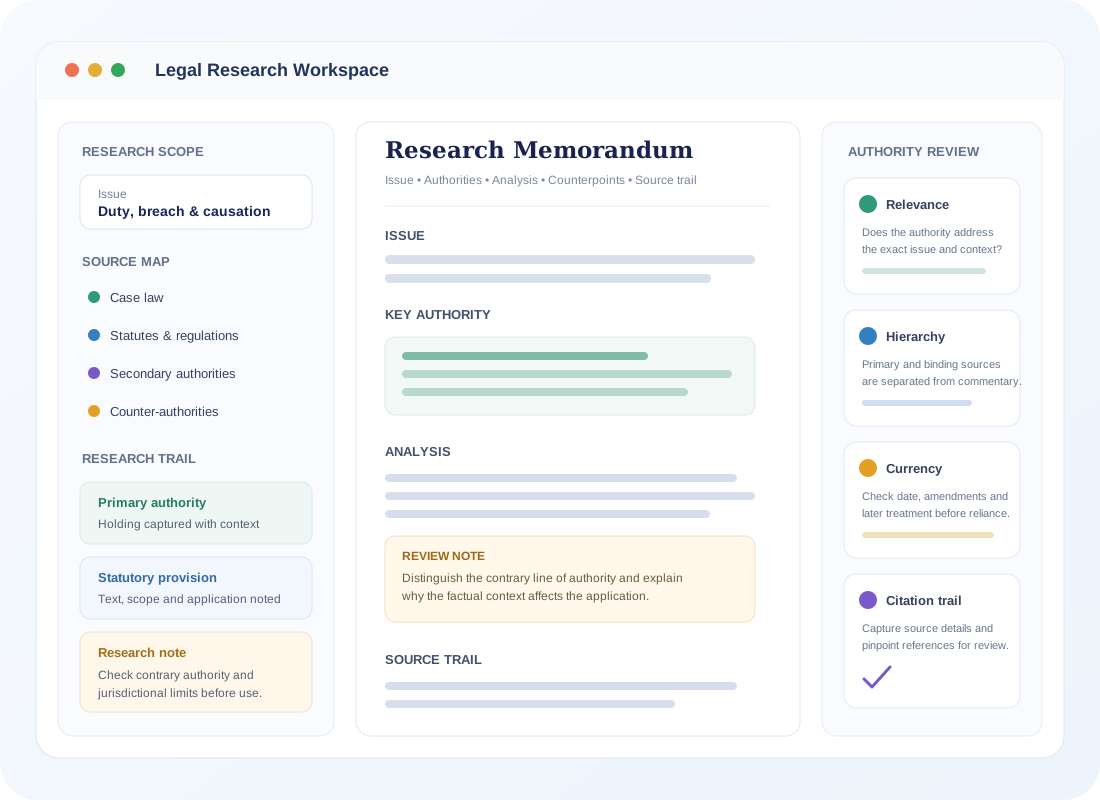
Legal research workspace showing case law, statutory sources, authority review notes and a structured research memorandum
Focused Research QuestionsIssue-led scope before searching
Authority HierarchyPrimary and secondary sources separated
Jurisdiction-Aware ResearchSources kept within legal context
Citation & Source TrailFindings remain reviewable
1

Common Legal Research Challenges We Help Address

Legal research becomes difficult when the question, authority hierarchy, jurisdiction, source currency, or citation trail is unclear. The research method should expose those gaps instead of hiding them.

Unclear Legal Issue

The research question is too broad or mixes multiple issues.

Weak Authority Hierarchy

Commentary is used without distinguishing stronger primary authority.

Outdated or Superseded Sources

Authority is cited without attention to later treatment or change.

Inconsistent Citations

Source details and pinpoint references are incomplete or uneven.

Research issue: Whether a duty arises in the defined factual context and how later authority affects the test. The initial search identifies potentially relevant primary authorities, but relevance depends on jurisdiction, procedural posture, and the precise legal issue. Statutory text and later amendments must be read in context. The analysis should also test contrary authority and limiting decisions before a proposition is used. A complete research trail records source details, the holding or rule, its application, and any caution needed for reliance.
Jurisdiction Mismatch

Authorities are relevant in topic but not controlling or comparable in context.

Insufficient Evidence of Proposition

A conclusion is stronger than the authority actually supports.

Missing Counter-Authorities

Research captures supporting cases but not contrary lines or exceptions.

Weak Source Readiness

Research notes cannot be traced quickly back to the source and pinpoint.

Issue & LimitationsAuthority & StructureSource & EvidenceCitation & Presentation
2

What This Legal Research Service Covers

The scope can be shaped around one focused issue or a broader research project. Each workstream should serve the defined question rather than simply collect more sources.

Research Question Refinement

Clarify issues, sub-issues, assumptions, jurisdiction and research boundaries.

Case Law Research

Find potentially relevant judicial authorities and organise them by proposition and context.

Statutes & Regulations

Map statutory and regulatory provisions relevant to the defined legal question.

Secondary Source Research

Use commentary and academic literature to frame doctrine, debates and research pathways.

Authority Review

Check relevance, hierarchy, dates, treatment, limits and jurisdictional fit before use.

Citation & Source Trail

Capture enough source information for later checking, citation and reviewer follow-up.

Legal Issue Synthesis

Bring authorities together into rules, distinctions, counterpoints and unresolved questions.

Research Memo / Findings

Present the research in a structured output that can support drafting or academic analysis.

3

Research Support and Authority Review Work Together

Discovery and review solve different problems. Research support develops the source base; authority review tests whether the source base is usable, balanced and clearly connected to the question.

Research Support
Issue & Search StrategyBreak the question into searchable legal issues and source categories.
Primary Authority DiscoveryIdentify relevant case law, statutes, regulations and official materials.
Secondary ResearchUse commentary and literature to understand doctrine, terminology and competing views.
Research NotesRecord propositions, factual context, quotations, pinpoints and source details.
SynthesisOrganise authorities into a clear research narrative rather than a source dump.
VS
Authority Review
Relevance & Hierarchy CheckAssess whether the source actually supports the proposition and what weight it carries.
Jurisdiction & Context CheckKeep authorities within their proper court, jurisdiction, procedural and factual context.
Counter-Authority ReviewSurface contrary authorities, exceptions, distinctions and unresolved tension.
Citation Trail CheckConfirm the notes preserve enough source detail for review and accurate citation.
Research ReadinessCheck that conclusions are qualified to the evidence and usable for the intended purpose.
4

The Legal Research Journey We Support

A strong legal research trail moves from a precise question to a structured, reviewable output. Each step narrows uncertainty and improves the link between authority and conclusion.

1

Research Question

Define issue, purpose and assumptions.

2

Jurisdiction & Scope

Set courts, sources, dates and limits.

3

Source Strategy

Plan search concepts and source order.

4

Authority Research

Collect relevant primary and secondary sources.

5

Synthesis

Organise rules, tests, facts and application.

6

Counter-Authority

Test contrary cases, exceptions and limits.

7

Citation Trail

Capture source details and pinpoints.

8

Research-Ready Output

Deliver structured findings for review or drafting.

5

How a Legal Research Review Can Look in Practice

The objective is not to make notes longer. It is to make the authority trail clearer, the limitations visible, and the research output easier to review and use responsibly.

1  Initial Research Note

Issue stated too broadly

The court will likely apply the general rule because several decisions support the proposition. The authorities are consistent and therefore the position is settled.
  • No jurisdictional limit stated
  • No hierarchy between sources
  • No contrary authority identified
  • Source trail is incomplete
2  Researcher / Reviewer Notes

Authority and context added

The initial line of authority supports the general proposition, but its application depends on the defined jurisdiction, procedural posture, and the facts triggering the test.
Authority: separate binding primary sources from persuasive commentary.
Counterpoint: identify decisions that narrow, distinguish, or reject the proposition.
Source trail: retain citation details and pinpoint references for each proposition.
3  Research-Ready Version

Qualified conclusion with source trail

The research now states the governing issue narrowly, distinguishes authority by weight and jurisdiction, explains relevant limitations, and records contrary material before presenting a qualified research conclusion.
  • Issue and jurisdiction aligned
  • Primary authority distinguished
  • Counter-authority considered
  • Pinpoints and source notes captured
  • Conclusion qualified to the evidence
6

Our Legal Research Engagement Workflow

The workflow starts with the question and ends with a reviewable research trail. Scope, source types and output format are agreed around the actual research need.

7

Legal Subjects & Research Types We Can Scope

The exact scope should always be tied to a defined question and jurisdiction. The categories below show common legal research contexts rather than a claim of universal coverage.

Constitutional & Public Law

Corporate & Commercial Law

Contract & Obligations

Employment & Labour Law

Intellectual Property

Technology, Privacy & Data

International & Comparative Law

Interdisciplinary & Socio-Legal Research

8

Our Legal Research Quality & Review Methodology

Quality review focuses on traceability: what question was researched, what sources were relied on, how the authority was characterised, what limitations exist, and whether a reviewer can follow the trail back to the source.

1  Research StructureIssue tree
Jurisdiction & scope
Source strategy
Assumptions & exclusions
2  Authority QualityRelevance
Hierarchy
Primary vs secondary
Context & applicability
3  Citation & Source CheckSource details
Pinpoint references
Quoted material
Link / citation consistency
4  Counter-Authority ReviewContrary cases
Exceptions & limits
Jurisdictional differences
Unresolved gaps
5  Final VerificationQuestion-to-answer consistency
Qualified conclusions
Research trail completeness
Presentation readiness
Research-Ready
Legal Research Pack
9

Your Research. Your Sources. Clear Research Boundaries.

Legal research can involve confidential facts, unpublished work and high-stakes source interpretation. The workflow should preserve source integrity and make the limits of the service visible.

Confidential Handling

Share only the materials needed for the research scope and avoid unnecessary sensitive information.

Limited Research Access

Use access and workflow controls appropriate to the files and sources involved in the assignment.

Source Integrity

Keep the distinction between quoted authority, paraphrased analysis and researcher synthesis clear.

Respect for IP

Use sources for research and citation without presenting third-party text as original work.

Clear Service Boundaries

Research support informs analysis but does not replace legal advice, representation or professional judgment.

10

Engagement Scope & Project Scheduling

Research engagements vary by question, jurisdiction, source depth, output format and review requirements. These factors should define the scope before the work is scheduled.

Scope Depends On

Research QuestionsNumber, complexity and whether sub-issues must be separated.
JurisdictionsSingle-jurisdiction, comparative or multi-jurisdiction research.
Source DepthCase law, statutes, regulations, guidance and secondary literature.
Date Cut-OffHistorical period, update window or authority-currentness requirement.
Output FormatResearch notes, authority table, memo, update or structured findings.
Review DepthSource discovery only or deeper authority, counterpoint and citation review.

Project Scheduling Considerations

Scope-First Planning

Scheduling starts after the question, jurisdiction, source depth and output are clear enough to estimate the work.

Deadline-Sensitive Review

Share the exact deadline and time zone so feasibility can be considered against the defined scope.

Milestone-Based Research

For broader projects, issues or source categories can be organised into reviewable research stages.

Scheduling is affected by research depth, number of questions, jurisdictions, availability and complexity of sources, output format, and the level of authority checking requested.

Ready to Strengthen Your Legal Research Before Submission or Review?

Build a clearer authority trail, surface limitations and counter-authorities, and turn scattered sources into a structured research output that is easier to review.