✦
Professional Medical & Scientific Manuscript Support
Medical Manuscript Service for Clearer, Journal-Ready Research Communication
★★★★★4.8 rating from Researchers, Authors, Students, and Scholars
Prepare your clinical, biomedical, public-health, or healthcare manuscript with structured editorial support for scientific language, section flow, terminology, references, figures, tables, journal instructions, and revision readiness—while keeping your study data, conclusions, and authorship under your control.
Scientific and medical terminology consistency across the manuscript
Clearer abstract, methods, results, discussion, and conclusion presentation
Reference, figure, table, caption, abbreviation, and cross-reference checks
Journal-guideline alignment when author instructions are supplied
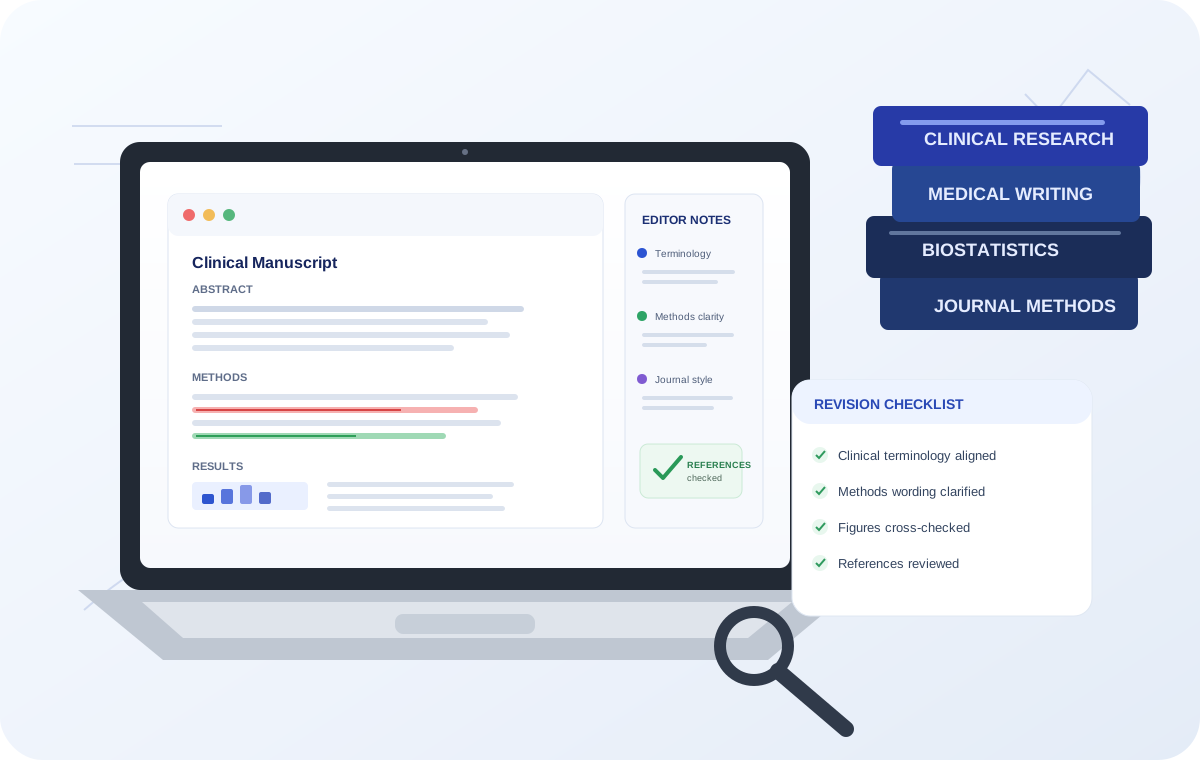
Service visual: an author-created medical manuscript undergoing editorial review for scientific presentation, terminology, references, and journal readiness.
Medical Manuscript Costs
Medical Manuscript Service Pricing Paths
Medical manuscripts can need very different levels of intervention. These prices separate final proofreading, deeper editing, publication support, and full writing so authors can choose without paying for unnecessary scope.
Proofreading
Final-stage correction for an already developed manuscript.
From ₹5,000up to 3,000 words
Delivery2 business days
OutputTracked + clean copy
Grammar and typo correction
Terminology and abbreviation consistency
Basic reference/caption presentation checks
Final language-quality pass
Higher word-count proofreading plans are available up to 18,000 words.
Final quotation: Depends on word count, manuscript maturity, specialty, figures/tables, references, target-journal requirements, and deadline.
Medical Manuscript Focus
Clinical and health-science presentation needs
Scientific Consistency
Terminology, units, symbols and abbreviations
Review-Friendly Files
Clear revisions and editor queries where agreed
Author-Controlled Science
Your data, interpretation and final decisions remain yours
Journal Guideline Support
Author instructions reviewed when supplied
1
Professional Medical Manuscript Support Built Around Your Study
A medical manuscript is more than polished prose. Its scientific language, section logic, terminology, evidence presentation, figures, tables, references, and journal-specific requirements need to work together without changing what the research actually says.
What This Service Does
The Medical Manuscript Service supports authors who already have research content, study materials, or a manuscript draft and need help presenting that work more clearly and consistently for academic or journal readers.
Editorial work can address language, scientific phrasing, section transitions, reporting consistency, terminology, abbreviations, references, tables, figures, captions, cross-references, and alignment with supplied journal instructions.
The service is designed to strengthen communication and presentation. It does not create patient data, alter study results, replace scientific judgment, or take ownership of the author's research contribution.
2
Who This Medical Manuscript Service Is For
The service is most useful when the underlying research already exists and the main need is clearer, more consistent, journal-aware manuscript presentation.
Postgraduate & Doctoral Researchers
Preparing health-science research for academic or journal submission.
Clinical Researchers
Presenting study design, methods, findings, tables, figures, and clinical terminology.
Biomedical Authors
Working with technical terminology, experimental reporting, units, symbols, and references.
Public-Health Researchers
Preparing epidemiology, population-health, health-policy, and programme-evaluation manuscripts.
Journal Authors
Preparing a new submission or revising a manuscript after editorial or reviewer feedback.
Healthcare Research Teams
Coordinating multi-author manuscripts that need consistent language, terminology, and presentation.
3
Are You Facing These Medical Manuscript Challenges?
Common manuscript problems often sit at the boundary between scientific content and presentation. Editorial support should make that boundary clearer, not blur it.
Dense Scientific Language
Correct science that still reads awkwardly, repetitively, or ambiguously.
Weak Section Flow
Abstract, methods, results, and discussion do not connect as clearly as they should.
Terminology Inconsistency
Abbreviations, units, symbols, drug or procedure terms vary across sections.
Reference & Citation Issues
In-text citations and reference-list presentation are inconsistent or hard to audit.
Figure & Table Mismatch
Captions, numbering, units, abbreviations, or textual cross-references do not align.
Journal Instruction Gaps
The manuscript needs closer alignment with supplied author or publisher requirements.
4
What’s Included in Our Medical Manuscript Service
The exact scope is confirmed after review, but a medical manuscript project can be structured around the following editorial workstreams when they are relevant to your document.
Scientific Language Refinement
Improve clarity, grammar, syntax, phrasing, concision, and discipline-appropriate academic tone without changing scientific meaning.
Section & Narrative Flow
Strengthen connections between title, abstract, introduction, methods, results, discussion, conclusion, and supporting sections.
Medical Terminology Consistency
Review terminology, abbreviations, units, symbols, capitalization, and notation for internal consistency.
References & Citation Presentation
Check citation and reference presentation against the supplied style or journal instructions and flag inconsistencies needing author review.
Figures, Tables & Captions
Review numbering, captions, abbreviations, units, cross-references, and presentation consistency across visual elements.
Journal Guideline Alignment
Review supplied author instructions for section order, headings, references, tables, figures, and manuscript presentation requirements.
Abstract & Conclusion Refinement
Improve precision, readability, and alignment between the manuscript’s stated purpose, reported findings, and concluding language.
Reviewer-Revision Support
Help organise language and presentation revisions around editor or reviewer comments while leaving scientific response decisions to the authors.
Consistency Review
Check recurring terms, headings, section labels, acronyms, numerals, capitalization, and related presentation choices throughout the manuscript.
Final Author-Review Readiness
Return the manuscript in a form that makes it easier for the authors to review changes, resolve queries, and prepare the next submission step.
Ready to move forward?Start the service with the scope and delivery option that fits your document.
From Difficult Draft to Clearer Medical Manuscript
The service sits between your research and your next submission step: authors provide the scientific content, the editorial workflow improves how that content is communicated, and the authors retain control of every scientific decision.
Before
Your manuscript may contain
Dense or uneven scientific phrasing
Inconsistent medical terminology or abbreviations
Weak transitions between manuscript sections
Reference, figure, table, or caption inconsistencies
Journal-format details that are easy to miss
→
Our Service
Editorial support at each relevant layer
Language and scientific-expression review
Section-flow and internal-consistency checks
Terminology, units, symbols, and abbreviation review
References, figures, tables, captions, and cross-references
Journal-instruction alignment when guidelines are supplied
→
After
A clearer manuscript for author review
More consistent scientific language and terminology
Stronger readability across core sections
Cleaner reference and visual-element presentation
Documented queries where author clarification is needed
Better prepared for the next journal or revision step
6
How Our Medical Manuscript Process Works
A structured workflow starts with the manuscript and submission context, then moves through editorial review, author-visible revisions, quality checks, and final delivery.
01
Submit Manuscript
Share the latest editable manuscript and relevant supporting files.
02
Confirm Requirements
Tell us the target journal, concerns, instructions, and desired editorial scope.
03
Scope the Work
The manuscript is reviewed so pricing, delivery timing, and work depth can be confirmed.
04
Editorial Review
Language, consistency, structure, references, visuals, and supplied guidelines are reviewed as agreed.
05
Quality Review
Revisions, queries, consistency points, and agreed presentation checks are reviewed before delivery.
06
Final Delivery
Receive the agreed files for author review, query resolution, and next-step preparation.
Want expert support on the next step?Choose the service now and continue with a clear, defined workflow.
Deliverables are matched to the confirmed scope. The examples below show the types of review-friendly outputs that can be included when relevant to the project.
Edited Manuscript
A manuscript file containing the agreed editorial revisions.
Clean Reading Copy
A clean version can be provided where it forms part of the agreed workflow.
Figure & Table Notes
Comments on captions, numbering, units, abbreviations, and cross-references where reviewed.
Reference & Style Checks
Presentation notes tied to the citation style or journal instructions you supplied.
Editor Queries & Notes
Questions or action points where wording, evidence, or context requires author clarification.
8
Medical Manuscript Final Scope & Delivery Factors
This service does not use an unrelated catalogue price or fixed delivery claim. Your quote and delivery schedule are confirmed after the manuscript, word count, document condition, journal requirements, supporting files, and requested scope have been reviewed.
Scope-Based Service
Medical Manuscript Assessment
Share the manuscript and submission context so the editorial depth can be matched to the actual condition of the document.
PricingConfirmed after manuscript and scope review
TurnaroundConfirmed with the project scope
Best forMedical, clinical, biomedical, public-health, and healthcare manuscripts
FormatEditable manuscript plus supporting files and instructions where relevant
Word count and the number of sections, tables, figures, appendices, and references affect the review effort.
Editorial Depth
Language refinement, deeper structural support, reference checks, and journal-format work require different levels of intervention.
Scientific Complexity
Technical terminology, specialised notation, complex tables, and dense methods or results sections can expand the review scope.
Journal Requirements
Detailed author instructions, formatting rules, reference styles, and revision requests can add specific checks to the project.
Supporting Materials
Reviewer comments, supplementary files, figures, tables, reporting checklists, or response documents may require coordinated review.
Delivery Need
Your required submission date is considered during scoping so the confirmed delivery plan reflects the actual work requested.
9
Why Choose Us for Medical Manuscript Support?
The service is structured to improve research communication without crossing the boundary into inventing results, replacing authorship, or changing scientific conclusions.
Medical Context Awareness
Editorial attention to scientific and health-research presentation.
Structured Editorial Review
Language, flow, consistency, references, visuals and instructions reviewed systematically.
Clear Scope
Work is defined around the manuscript condition and the support you actually request.
Author Control
Your study data, interpretation, claims and final submission decisions remain yours.
Journal-Aware Review
Supplied author instructions can be incorporated into the editorial checklist.
Transparent Queries
Unclear scientific statements are flagged for author input rather than guessed.
Review-Friendly Delivery
Outputs are organised to support author review and the next manuscript step.
Ready to get this document professionally supported?Use the same secure service checkout shown in Pricing & Delivery.
Quality control is most useful when it checks both the changes themselves and the consistency of the manuscript as a whole.
1
Editorial Review
2
Consistency Check
3
Reference & Visual Review
4
Revision Verification
5
Client-Ready Delivery
11
Specialist Roles in a Medical Manuscript Workflow
Rather than presenting invented staff profiles or unsupported credentials, the workflow below shows the types of editorial responsibilities that may be assigned within a medical manuscript project.
Medical Manuscript Editor
Language, scientific expression & manuscript flow
Focuses on clarity, readability, terminology, section transitions, academic tone, and the internal consistency of the author-created manuscript.
Reviews reference presentation and supplied journal requirements and flags inconsistencies that need correction or author confirmation.
Quality & Consistency Reviewer
Cross-document verification before delivery
Checks recurring terminology, abbreviations, cross-references, figure and table presentation, and the consistency of agreed editorial changes.
12
Medical Manuscript Support Across Health-Science Areas
Projects may come from different health-science contexts. The editorial scope is defined by the actual manuscript, terminology, submission requirements, and support requested.
Clinical Medicine
Cardiovascular Research
Neuroscience
Biomedical Science
Pharmacology
Epidemiology
Public Health
Nursing & Allied Health
Health Data & Outcomes
13
Professional Medical Manuscript Support vs. Doing Everything In-House
The value of editorial support is not that authors stop making scientific decisions. It is that they can separate scientific ownership from the detailed work of making the manuscript clearer, more consistent, and easier to review.
Common In-House Challenges
When research teams edit under deadline pressure, presentation problems can remain even when the science itself is sound.
Authors are too close to the text to notice unclear transitions or repeated terminology
Multi-author sections may use inconsistent abbreviations, wording, or formatting
Reference, figure, table, and caption checks compete with scientific priorities
Journal instructions can be detailed and easy to apply inconsistently
Reviewer revisions may need both scientific decisions and careful language implementation
Professional Service Benefits
A separate editorial pass can concentrate on manuscript communication while authors retain control of the science.
Focused language and scientific-expression refinement
Consistent terminology, abbreviations, units, and manuscript presentation
Structured checks across sections, references, figures, tables, and captions
Journal instructions incorporated into the review when supplied
Queries surface ambiguous points for author decision instead of guessing
14
What a Stronger Medical Manuscript Should Help You Achieve
These are editorial goals—not acceptance guarantees or outcome statistics. The purpose is to make the manuscript clearer and more internally consistent for the authors and intended readers.
Clearer Scientific Communication
Readers can follow the manuscript’s purpose, methods, findings, and interpretation more easily.
Better Terminology Consistency
Medical terms, abbreviations, units, symbols, and related language are used more consistently.
More Coherent Presentation
Sections, references, figures, tables, captions, and cross-references work together more cleanly.
Stronger Author Review Readiness
Authors receive a clearer document and a more organised set of revisions or queries to assess before submission.
Ready to start your project?Buy the service now and move directly to the next step.
Ready to Prepare Your Medical Manuscript for the Next Submission Step?
Send the latest manuscript, target-journal details, supporting files, and your priority concerns. We’ll review the scope before confirming price and delivery timing.
Answers to common questions about scope, suitable manuscript types, journal instructions, scientific meaning, terminology, references, figures, reviewer revisions, files, pricing, delivery, and authorship boundaries.
What is a Medical Manuscript Service?+
It is editorial support for author-created medical and health-science manuscripts. The service can improve scientific language, clarity, organisation, terminology consistency, references, figures, tables, journal alignment, and revision readiness while preserving the author's research and intended meaning.
Which medical manuscript types can be reviewed?+
The service is designed for common medical and health-science manuscript formats such as original research articles, clinical studies, systematic or narrative reviews, case reports, short communications, public-health papers, and related journal submissions, subject to the scope confirmed for the project.
Can you work with a target journal's author guidelines?+
Yes. When you provide the relevant journal or publisher instructions, the manuscript can be checked against the supplied requirements for items such as section order, headings, references, tables, figures, and presentation.
Does the service change my results or research conclusions?+
No. Editorial work is intended to improve presentation and clarity, not to fabricate, replace, or alter the author's study data, results, interpretation, or research contribution. Queries are used when an issue cannot be resolved safely without author input.
Can medical terminology and abbreviations be checked for consistency?+
Yes. Terminology, abbreviations, units, symbols, capitalization, and related scientific presentation can be reviewed for consistency within the manuscript and against instructions you provide.
Are references and citations included?+
Citation and reference presentation can be checked for consistency and alignment with the supplied style or journal instructions. The exact depth of bibliographic verification should be confirmed as part of the project scope.
Can figures, tables, captions, and cross-references be reviewed?+
Yes. Figure and table titles, captions, numbering, textual cross-references, units, abbreviations, and presentation consistency can be reviewed when those elements are included in the submitted files.
Do you support manuscripts that have received reviewer comments?+
The service can support language and presentation revisions after peer review and can help organise changes around reviewer comments. Scientific decisions and the substance of the author response remain with the authors.
What files should I submit?+
Send the latest editable manuscript, the target journal instructions if available, figures and tables where relevant, your reference style, any reviewer or editor comments, and a clear note describing the areas you want prioritised.
How are pricing and turnaround determined?+
Pricing and delivery timing are confirmed after the manuscript and requested scope are reviewed. A starting price is shown in the Pricing & Delivery section above. The final quotation and delivery commitment are confirmed after the actual scope, files, requirements, and deadline are reviewed.
Will I be able to see the editorial changes?+
Where the agreed workflow uses tracked editing, revisions can be returned in a review-friendly file together with editor comments or queries where clarification is needed.
Is the service a substitute for authorship or medical research?+
No. The service supports author-created research and manuscript preparation. It does not conduct the study, create patient data, make clinical decisions, or replace the authors' responsibility for the scientific content and final submission.
16
Request a Medical Manuscript Assessment
Share enough information for the manuscript condition and requested work to be reviewed. Pricing and delivery timing can then be confirmed for the actual scope rather than copied from an unrelated service plan.
Manuscript & word count
Send the latest editable file and approximate word count, including major supplementary content where relevant.
Target journal or publisher
Include the journal name and author instructions if you want the manuscript reviewed against them.
Required submission date
Provide the exact deadline and time zone so delivery feasibility can be assessed during scoping.
Priority concerns
Highlight language, flow, terminology, references, figures, tables, journal formatting, reviewer revisions, or other areas needing attention.
Supporting files
Attach or mention figures, tables, reviewer comments, reporting checklists, reference requirements, or supplementary material relevant to the requested work.
Useful context: manuscript type, medical or health-science area, word count, target journal, submission date, reference style, current revision stage, and the specific problems you want the editorial review to address.
Medical Manuscript Enquiry
Send Your Manuscript Requirements
Your message should describe the manuscript and scope clearly enough for an initial assessment.