Unclear Report Flow
Sections do not connect logically or the reader cannot see how the research question, method, results, and conclusion relate.
Strengthen the structure, clarity, technical consistency, and presentation of a scientific report while keeping your research, data, interpretation, and authorship under your control.
Scientific reports can be technically sound yet difficult to follow when structure, evidence presentation, terminology, or formatting is inconsistent.
Sections do not connect logically or the reader cannot see how the research question, method, results, and conclusion relate.
Scientific terminology, units, symbols, abbreviations, or discipline-specific phrasing are inconsistent or difficult to read.
Tables and figures are present but the text does not clearly guide the reader through the most relevant observations.
In-text citations, references, numbering, or cross-references are presented inconsistently within the report.
Procedures, variables, conditions, and measurements are difficult to scan because information is not organised clearly.
Headings, captions, labels, tables, figures, and document presentation do not follow a consistent hierarchy or supplied template.
Scope is adapted to the report you provide. The emphasis is on clearer scientific communication and presentation, not on creating unsupported research content.
Review section order, headings, subheadings, paragraph purpose, and the progression from research objective to conclusion.
Refine grammar, syntax, concision, scientific phrasing, transitions, and readability while preserving intended meaning.
Improve clarity of procedures, variables, conditions, units, definitions, and methodological sequencing based on supplied content.
Strengthen how observations are introduced, compared, and connected to tables and figures without changing the underlying data.
Improve the separation of observation, interpretation, limitations, implications, and conclusion where the author’s analysis is supplied.
Check presentation consistency, ordering, obvious mismatches, and cross-references within the agreed scope.
Review labels, terminology, captions, numbering, callouts, units, and consistency between visuals and report text.
Check recurring terminology, abbreviations, capitalization, section references, headings, and presentation before handoff.

Useful when you have research content, notes, data, or a developed draft that needs clearer scientific presentation.
Laboratory reports, project reports, thesis-related report sections, and research summaries.
Internal or external scientific reports that need consistent methods, results, visuals, and technical terminology.
Multi-author drafts requiring consistent terminology, section flow, formatting, and presentation.
Research reports, progress reports, technical summaries, and documents prepared for institutional review.
Evidence-based reports that combine technical explanation, data presentation, figures, and recommendations.
Reports that must follow supplied university, laboratory, publisher, funder, or organisational formatting instructions.
A Scientific Report Service should improve precision and readability without overstating what the evidence shows.
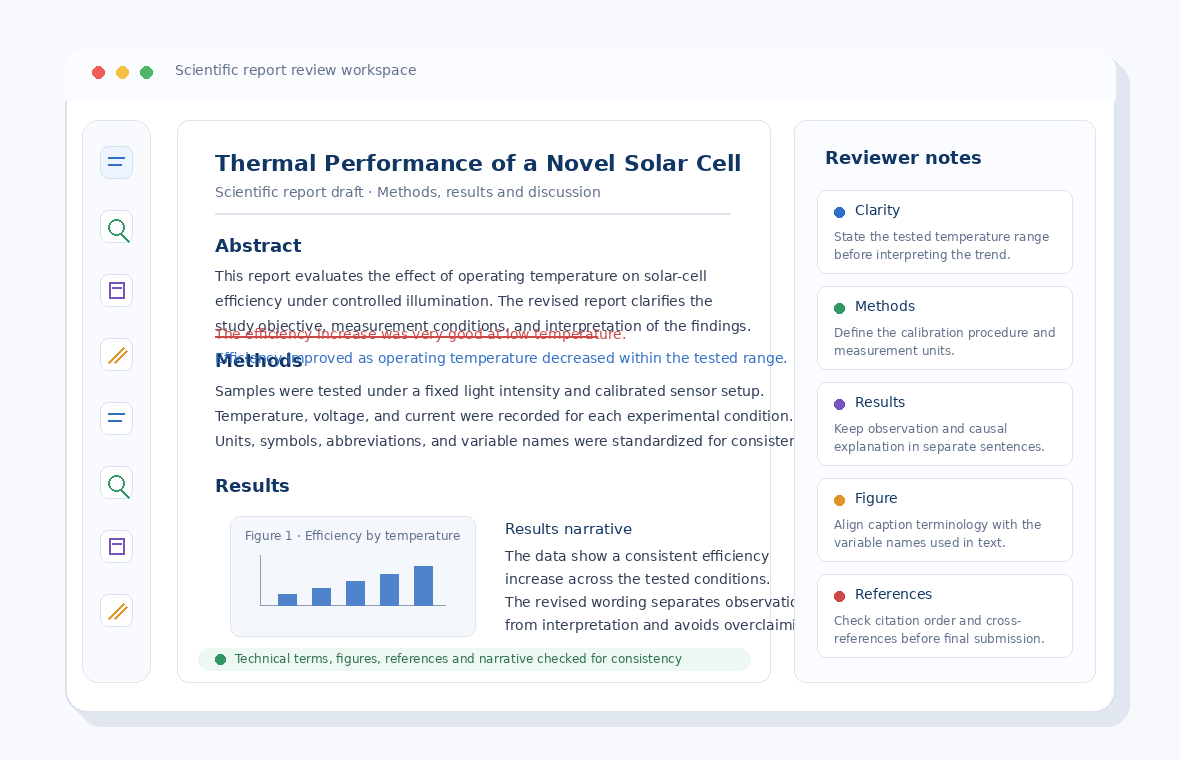
“The efficiency increased a lot when the temperature was reduced, which proves that lower temperature makes the device work better in all situations.”
“Within the tested range, efficiency increased as operating temperature decreased. The result describes the observed experimental trend; broader causal claims require evidence beyond these conditions.”
A practical review flow from scope assessment to a report you can evaluate and finalise.
Provide the draft, requirements, approximate length, deadline, and any applicable template or style guide.
The report is reviewed for required depth, technical presentation needs, formatting, and deadline feasibility.
Structure, wording, terminology, data narrative, visuals, references, and consistency are addressed within scope.
Key revisions, recurring terms, cross-references, formatting, and unresolved author queries receive a final review.
Receive the agreed report versions and comments so you can review changes and complete author decisions.
Deliverables are designed to make revision review clear and to separate editorial improvements from decisions that require author input.
A version showing editorial changes so you can see how language, flow, and presentation were improved.
A clean version for reading after revisions have been reviewed and author decisions have been resolved.
Comments for unclear scientific meaning, missing context, inconsistent terminology, or issues that should not be guessed.
Presentation updates for supplied headings, tables, figures, captions, references, and template requirements within scope.
Checks connecting figure/table terminology, labels, units, numbering, captions, and textual callouts.
A final review of recurring language and presentation details across the report.
The service can be scoped around the scientific content you provide and the reporting format you need to follow.
The value is not a promised score or acceptance outcome; it is a clearer, more consistent report that remains accountable to the author and the evidence.
Review focuses on technical language, report sections, evidence presentation, and scientific conventions.
Editorial changes support communication while research claims and author decisions remain yours.
Unclear scientific meaning is flagged for author input instead of being silently invented.
Tables, figures, captions, units, and textual references can be reviewed together for consistency.
Supplied university, laboratory, client, journal, or organisational instructions can guide presentation checks.
Visible changes, clean copy, and editor queries help you evaluate what changed before finalising the report.
Practical answers about scope, research integrity, deliverables, pricing, timing, and report requirements.
It is structured support for presenting scientific work as a clear, coherent report. The service focuses on organisation, scientific narrative, terminology, tables and figures, citations, formatting, and readability while keeping the research content and conclusions under the author’s control.
The page is designed for research reports, laboratory reports, technical reports, project reports, experimental summaries, methods-and-results documents, and other science-focused reports where the underlying research content is supplied by the author.
Yes. The service can help improve section purpose, sequencing, transitions, and the relationship between methods, results, interpretation, and conclusions without inventing experiments, data, or findings.
No. The service should improve presentation and communication of supplied research, not fabricate data, replace the author’s analysis, or alter findings without a clear author-led basis.
We can review presentation consistency, labels, units, terminology, captions, callouts, numbering, and cross-references when the relevant figures, tables, and source information are supplied.
Yes. The review can focus on consistent scientific terminology, abbreviations, symbols, units, and notation across the report, with comments where author clarification is needed.
Citation and reference presentation can be reviewed for consistency and obvious mismatches within the agreed scope. Source verification and the accuracy of the underlying references remain the author’s responsibility.
Yes, when you provide the applicable template or instructions. The report can be aligned to supplied requirements for headings, section order, formatting, tables, figures, citations, and presentation.
Depending on the agreed scope, you can receive a revised report with visible changes, a clean version for review, and editor comments or queries where scientific meaning, evidence, or presentation requires author input.
This page does not publish a fixed price for Scientific Report Service. Share the document, approximate length, required scope, formatting needs, and deadline so an appropriate quote can be prepared.
A delivery date is confirmed after the report length, complexity, requested checks, and deadline have been reviewed. No fixed turnaround is stated on this page.
The enquiry and delivery workflow is presented as a confidential document-handling process. Avoid including sensitive material in an enquiry message unless it is necessary for scope review and you are comfortable sharing it through the selected submission channel.
Share the report type, approximate length, required review depth, formatting instructions, and deadline. The request can then be assessed for scope, quote, and delivery feasibility.