Unclear or Narrow Problem Statement
The core issue or context is not well defined, or the scope is too broad to study.

Turn your research idea, notes, or existing draft into a clear, logically structured proposal that addresses the problem, literature gap, objectives, methodology, feasibility, ethics, formatting, and submission requirements relevant to your programme or funding brief.
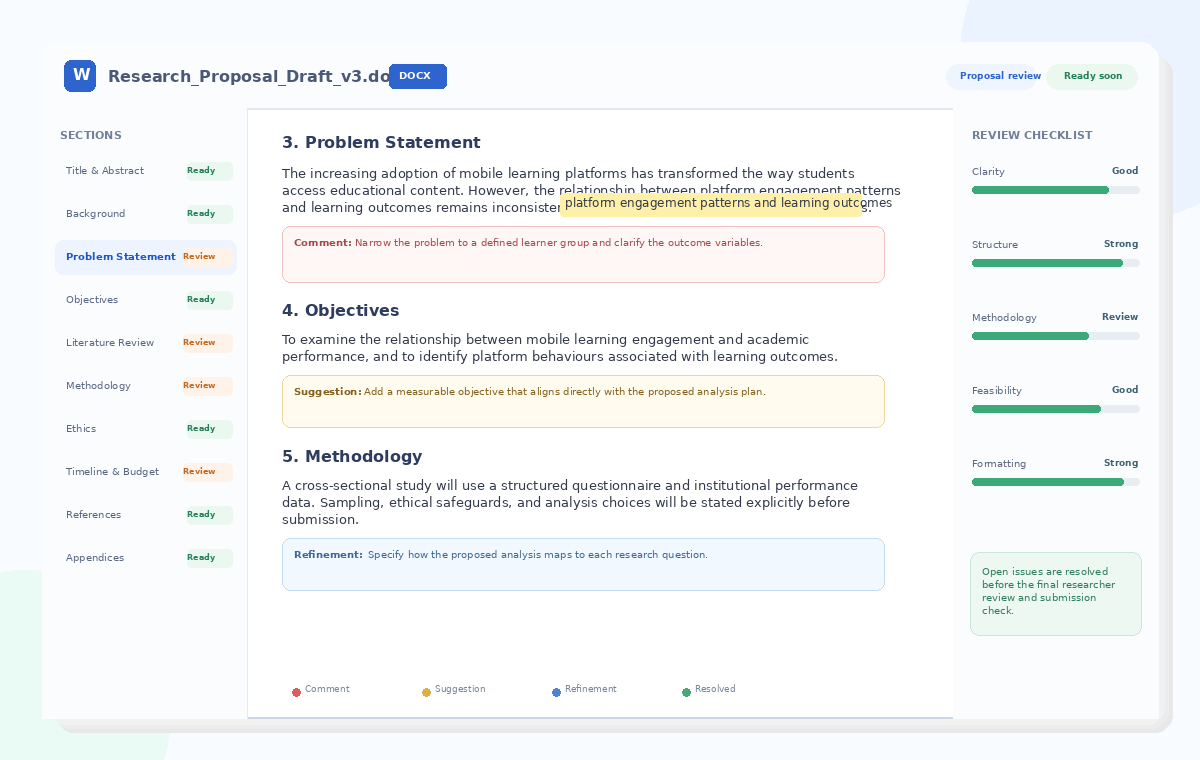
Research Proposal Service is priced from ₹5,000 for one defined proposal-review module. The entry engagement covers proposal-stage and guideline review together with problem, gap and methodology support; work beyond that defined scope is assessed separately.
The starting price covers a defined entry scope. Larger or multi-stage requirements involving research problem, gap, objectives, methodology, feasibility and institutional or funder requirements are quoted after the materials and deadline are reviewed. A shorter deadline for Research Proposal Service can be assessed after the working files and requested scope are reviewed; accelerated delivery is confirmed only when feasible for that assignment.
Common issues we identify during initial review.
The core issue or context is not well defined, or the scope is too broad to study.
Existing studies are not critically mapped, so the unresolved gap is unclear.
Objectives are not specific, measurable, or aligned with the stated problem.
The proposed design does not logically address the objectives or suit the context.
Ethical risks, permissions, access, or practical constraints are not adequately addressed.
Milestones, resources, or costs are not sufficiently justified for the planned study.
Support is scoped to your actual requirements and the format supplied by your university, funder, supervisor, or committee.
A representative example showing how proposal-level development goes beyond surface language correction.
“I want to study how social media affects students. Many students use social media every day and it takes their time. It also affects their studies and sleep. I will do a survey and ask some questions. Then I will see the results and give suggestions.”
This study aims to investigate the impact of social media usage patterns on academic performance and sleep quality among undergraduate students.
A structured questionnaire will be administered to a sample of 300 students across three universities.
Data will be analysed using multiple regression to examine relationships.
This study investigates the relationship between social media usage patterns, academic performance, and sleep quality among undergraduate students in urban universities.
A stratified random sample of 300 students will complete a validated questionnaire. Multiple regression analysis will be used to examine the relationships between variables.
The broader the proposal challenge, the more important it is to evaluate logic, alignment, methodology, feasibility, and reviewer-facing completeness—not only language.
| Support Dimension | Proposal Formatting Review Structure & presentation check | Language Editing Grammar & style improvement | Full Research Proposal Support End-to-end academic development |
|---|---|---|---|
| Idea framing & scope development | × | × | ✓ |
| Research questions & objectives | × | × | ✓ |
| Literature mapping & gap identification | × | × | ✓ |
| Methodology design & alignment | × | × | ✓ |
| Ethics, feasibility, timeline & budget coherence | × | × | ✓ |
| Logical flow & section integration | ✓ | × | ✓ |
| Academic tone & clarity | ✓ | ✓ | ✓ |
| Formatting & referencing | ✓ | ✓ | ✓ |
| Submission-readiness checklist | × | × | ✓ |
| Reviewer-focused refinements | × | × | ✓ |
| Best for | Checking format & structure | Language polish | Complete proposal development support |
Each format is shaped around its own review criteria, section requirements, evidence needs, and decision audience.
Doctoral research framing, contribution, methodology, feasibility, and milestone planning.
Focused postgraduate proposals with clear questions, methods, and achievable scope.
Structured proposal support before dissertation or thesis research begins.
Research-focused narratives that connect need, objectives, methods, outputs, and resources.
Clear methods, participant handling, risk, consent, and data-management presentation.
Research plans shaped for competitive academic or funding applications.
Course, capstone, departmental, or institutional project proposal development.
Concise research concept documents for early review, discussion, or approval.
The workflow moves from your research brief to a structured, reviewed, and clearly documented proposal package.
Share your topic, requirements, existing notes, draft, and supporting guidelines.
We assess the proposal stage, objectives, required sections, and support needed.
The work is aligned with an appropriate academic or subject-area specialist.
A logical section framework is created around the required proposal format.
Content is clarified, expanded, aligned, and refined collaboratively.
Methods, objectives, feasibility, ethics, and section relationships are checked.
Citations, references, headings, style, and document consistency are reviewed.
You receive the agreed files, review notes, and a clean version for your own final review.
The aim is consistency across research logic, language, methods, formatting, and final document presentation.
Check logical flow, section purpose, and alignment.
Improve clarity, concision, and readable academic expression.
Ensure scholarly language supports the intended meaning.
Verify that methods, sampling, ethics, and analysis align.
Check citations, style, numbering, and document consistency.
Review agreed scope, file accuracy, and submission-readiness presentation.
Final turnaround depends on word count, complexity, current draft stage, and confirmed scope. No fixed delivery time is claimed until review.
Support can include idea framing, proposal structure, background and rationale, problem statement, literature mapping, research gap, objectives and questions, methodology presentation, sampling and data collection, analysis planning, ethics and feasibility, timeline, budget or resources where required, expected outcomes, references, appendices, formatting, and review notes. The exact scope is confirmed from your brief and institutional or funder requirements.
Proofreading focuses mainly on final language correctness, while language editing improves grammar, clarity, and style. Research Proposal Service can work at a broader level: scope, proposal logic, research questions, literature-to-gap connection, methodology alignment, feasibility, section integration, and submission-readiness presentation, in addition to language refinement where agreed.
Yes, where methodology support is part of the agreed scope. The review can assess whether the proposed design, sampling, data collection, variables, and analysis plan are clearly explained and aligned with the research questions. Final methodological choices remain the researcher’s responsibility and should follow supervisor, institutional, ethical, and disciplinary requirements.
Common working files include DOCX and PDF, along with institutional guidelines, reference files, spreadsheets, questionnaires, or supporting notes where relevant. Deliverables can include a tracked-changes DOCX, a clean DOCX, review notes, a structure or flow map, methodology observations, formatting/reference checks, and a submission-readiness checklist when included in the agreed scope.
Revision support can be included when it relates to the agreed proposal scope and reviewer or supervisor feedback. The number and depth of revision rounds should be confirmed in the quotation so the deliverables and deadline are clear before work begins.
Turnaround depends on proposal length, current draft stage, methodological complexity, guideline requirements, references, appendices, and the deadline. Standard, priority, and express handling may be considered after the materials are reviewed. A specific delivery time is confirmed only after scope assessment.
These answers clarify what the service can support and what remains under the researcher’s academic responsibility.
Support can include idea framing, proposal structure, background and rationale, problem statement, literature mapping, research gap, objectives and questions, methodology presentation, sampling and data collection, analysis planning, ethics and feasibility, timeline, budget or resources where required, expected outcomes, references, appendices, formatting, and review notes. The exact scope is confirmed from your brief and institutional or funder requirements.
Proofreading focuses mainly on final language correctness, while language editing improves grammar, clarity, and style. Research Proposal Service can work at a broader level: scope, proposal logic, research questions, literature-to-gap connection, methodology alignment, feasibility, section integration, and submission-readiness presentation, in addition to language refinement where agreed.
Yes, where methodology support is part of the agreed scope. The review can assess whether the proposed design, sampling, data collection, variables, and analysis plan are clearly explained and aligned with the research questions. Final methodological choices remain the researcher’s responsibility and should follow supervisor, institutional, ethical, and disciplinary requirements.
Common working files include DOCX and PDF, along with institutional guidelines, reference files, spreadsheets, questionnaires, or supporting notes where relevant. Deliverables can include a tracked-changes DOCX, a clean DOCX, review notes, a structure or flow map, methodology observations, formatting/reference checks, and a submission-readiness checklist when included in the agreed scope.
Revision support can be included when it relates to the agreed proposal scope and reviewer or supervisor feedback. The number and depth of revision rounds should be confirmed in the quotation so the deliverables and deadline are clear before work begins.
Turnaround depends on proposal length, current draft stage, methodological complexity, guideline requirements, references, appendices, and the deadline. Standard, priority, and express handling may be considered after the materials are reviewed. A specific delivery time is confirmed only after scope assessment.
The service is designed around confidential handling of unpublished research materials. Access should be limited to the assigned team, and sensitive research information should not be shared with unrelated third parties. If you require an NDA or specific data-handling arrangement, mention it before sending sensitive files.
Yes. You can start with a topic, concept note, outline, supervisor comments, partial draft, literature notes, or an existing proposal. The amount of support required will depend on how much is already developed and which sections still need framing, evidence, or methodological clarification.
Yes. Share the current template, word limits, section headings, evaluation criteria, formatting instructions, citation style, and any supervisor or reviewer comments. Those materials should control the proposal structure where they conflict with a generic format.
No. Approval, funding, ethics clearance, and academic acceptance depend on the quality and feasibility of the research, institutional criteria, competition, reviewer judgment, and the researcher’s own decisions. The service focuses on clearer, more coherent, and better-presented proposal development rather than guaranteed outcomes.
Research Proposal Service starts from ₹5,000 for one defined proposal-review module. Larger quotes reflect total word or page count, support depth, draft condition, methodology complexity, formatting and reference requirements, appendices or tables, and the requested deadline.
Send the research topic and tentative title, institutional or funder guidelines, proposal purpose and target committee, current draft or notes, methodology expectations, deadline and milestone dates, citation style, formatting requirements, and any supervisor or reviewer feedback.
Tell us what you are preparing, what stage the proposal has reached, which guidelines apply, and when you need the work. The enquiry is used to assess scope, feasibility, delivery priority, and the most appropriate support.
Provide enough detail for the team to judge the academic scope and respond with a tailored quotation.