Unclear Information Architecture
Users cannot find the right task, concept, or reference because content is organised around internal teams rather than user needs.

Turn complex product knowledge, engineering inputs, process details, and fragmented source material into documentation that helps readers find answers, complete tasks, understand systems, and review technical content with less ambiguity.
End-to-end technical documentation needs a project minimum because discovery, structure, writing, review, and output preparation all consume effort beyond raw word count.
Suitable for: Best for teams that need a small but coherent set of user, product, process, or technical documentation prepared for handoff.
for a focused documentation set of up to 8 topics or pages built from reasonably complete product inputs
Technical Documentation Service starts at ₹18,000 for a focused documentation set of up to 8 topics or pages built from reasonably complete product inputs.
Buy Service NowLarger documentation libraries, complex developer content, source discovery, extensive visual production, repository publishing, or multiple output systems require a broader project quote.
Documentation problems often begin before the writing stage. The biggest gaps are usually connected to structure, ownership, audience, source quality, and review discipline.
Users cannot find the right task, concept, or reference because content is organised around internal teams rather than user needs.
Critical setup steps, edge cases, and process decisions remain in chats, tickets, meetings, or individual memory instead of maintainable documentation.
A document can be technically correct but still fail when it assumes the wrong background knowledge, permissions, tools, or starting point.
Comments arrive without clear ownership, open questions are not tracked, and the final document can contain unresolved assumptions.
Release changes, terminology updates, and process revisions can make documentation inconsistent when ownership and update points are not defined.
The service can span the full documentation path from discovery and source review through information architecture, drafting, technical review, quality checking, and final handoff.
Goals, source material, audience
Users, roles, prerequisites
Notes, tickets, drafts, specs
Hierarchy, navigation, page plan
Task-led, concise, structured copy
Steps, code, tables, callouts
Diagrams and annotated visuals
Questions, assumptions, validation
Consistency, usability, references
Clean files and agreed support items
A useful documentation project does more than correct sentences. It turns fragmented knowledge into a clear task path, identifies what must be verified, and produces a clean final document once technical questions are resolved.
Notes, tickets, SME messages, and old pages may contain the right facts but lack a reliable sequence, audience context, prerequisites, or ownership.
Use token endpoint. If expired maybe refresh. Need v2.
Header auth required. Ask platform team about retry.
The draft establishes the user task, adds prerequisite context, separates procedure from concept, and flags details that need technical validation.
Prerequisite: Create a client credential before requesting a token.
Step 1: Send a POST request to the authentication endpoint.
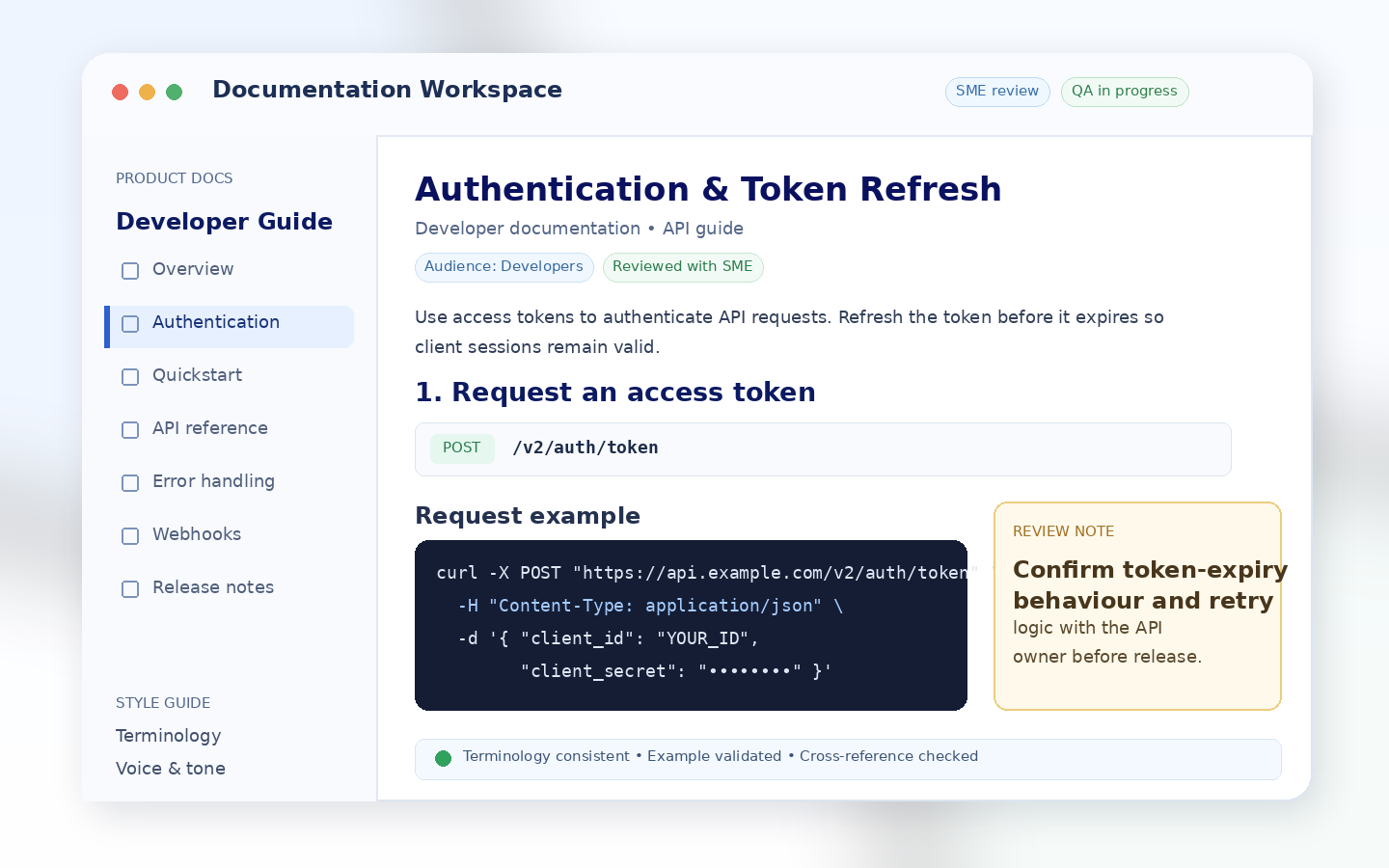
After technical validation, the final page presents the confirmed task flow, examples, expected behaviour, and cross-references without unresolved author notes.
Before you begin: Create the required client credential.
1. Request an access token.
2. Add the token to the Authorization header.
Next: See Error handling for expired or invalid tokens.
Choose the level of intervention based on the real problem. If the source is already complete, a light language pass may be enough. If the structure, audience path, technical gaps, or documentation architecture need work, a fuller technical documentation service is more appropriate.
| Service Level | Basic Copyediting | Technical Documentation Service | Documentation Program Support |
|---|---|---|---|
| Primary focus | Grammar, wording, readability, surface consistency | Structure, audience, task flow, technical clarity, review, maintainability | Broader documentation system, standards, governance, recurring content operations |
| Source-material assessment | Limited | Yes | Yes |
| Information architecture | Usually not included | Included when needed | Can extend across a documentation set |
| Technical questions / assumptions | Light flagging | Explicitly surfaced for SME validation | Tracked across recurring documentation work |
| Examples, procedures, diagrams | Existing content only | Can be developed when in scope and supported by source material | Can be standardised across document families |
| Best for | Technically complete documents needing final language polish | New or existing docs needing stronger structure, clarity, validation, and user focus | Teams building or maintaining a larger documentation practice |
The right format depends on the reader and the job they need to complete. A project may involve one documentation type or a connected set of pages.
Endpoints, authentication, SDK guidance, code examples, error handling, integration notes.
Getting started, feature workflows, task instructions, configuration, troubleshooting.
Repeatable procedures, roles, inputs, decision points, controls, handoffs, exceptions.
Components, dependencies, interfaces, data flows, operational context, design decisions.
Searchable articles, FAQs, troubleshooting paths, support-ready explanations.
Release notes, migration guidance, change impacts, deprecations, update instructions.
Prerequisites, setup steps, environment configuration, validation, rollback guidance.
Onboarding guides, role playbooks, operating instructions, internal reference material.
The workflow keeps source collection, information design, drafting, technical review, and quality checking visible so unresolved technical points are not disguised as finished content.
Share the existing material, product context, intended audience, and desired output.
Clarify document types, depth, dependencies, open questions, and review expectations.
Define who will use the documentation, what they are trying to accomplish, and what they already know.
Create a page hierarchy and content sequence that supports finding, learning, and doing.
Write or reorganise content with clear headings, procedures, concepts, warnings, and references.
Integrate code, commands, tables, examples, or process details when they are in scope and verifiable.
Surface assumptions and technical questions so the right owner can validate accuracy.
Check consistency, terminology, navigation cues, task completion, links, and repeated elements.
Provide the agreed final files and supporting handoff items in the confirmed format.
Deliverables are confirmed during scoping. The items below show the typical building blocks of a technical documentation handoff, not a fixed package applied to every project.
The agreed technical document set, organised for the intended audience and use case.
Editable source material where the chosen delivery format supports an editable handoff.
Open questions, assumptions, validation points, or author/SME actions identified during the project.
Page hierarchy or documentation architecture when information design is part of the scope.
Agreed terminology, naming, style, or repeated conventions where these are useful for future consistency.
Diagrams, examples, tables, screenshots, or callouts included only when they are part of the confirmed project.
Quality review goes beyond grammar. The final documentation should be technically reviewable, internally consistent, navigable, usable for the intended task, and complete against the agreed project scope.
Questions and assumptions are made visible for owner validation.
Terminology, headings, labels, references, and repeated patterns are checked across the document set.
Task order, prerequisites, navigation cues, and reader context are reviewed from the target-user perspective.
The agreed deliverables are checked for completeness, clean presentation, and handoff readiness.
Final files and agreed supporting materials are prepared for your documentation workflow.
Technical documentation can sit across software, engineering, infrastructure, data, operations, and internal enablement. The project is scoped around the source material and review access available for the specific subject area.
Developer guides, integration instructions, API references, SDK and platform content.
Configuration, operations, architecture, runbooks, migration and environment guidance.
System behaviour, procedures, technical specifications, installation and maintenance guidance.
Data processes, model or pipeline operations, interfaces, governance and technical usage guidance.
SOPs, controls, handoffs, role guidance, workflow and exception documentation.
Onboarding, support knowledge, training material, playbooks and internal reference content.
Technical documentation may involve unreleased product information, credentials, architecture details, internal procedures, or customer-facing content. State your handling requirements before sharing sensitive material.
Identify any restricted material, NDA need, access limitations, or approved collaboration method during scoping.
Where possible, provide example values or redacted credentials instead of production secrets.
Sensitive architecture or product behaviour should be confirmed by the appropriate owner rather than inferred.
The desired file format and handoff method should be agreed before final delivery.
Turnaround is confirmed after scope and deadline review. A realistic timeline depends on how much source material exists, the technical complexity, the number of documents, review access, and the level of writing or restructuring required.
Document volume, technical depth, diagrams, examples, and platform requirements all influence delivery planning.
Technical questions need the right owner. Review delays can affect the final documentation timeline even when the writing stage is complete.
Confirm how many review stages are needed and who approves technical accuracy, product wording, and final delivery.
The service is designed around the documentation problem itself: turning technical source material into structured, reviewable, user-focused content without hiding gaps that still require expert validation.
Documentation is organised around the reader, task, prerequisite, and decision—not merely around the source material.
Questions, assumptions, and unresolved technical points can be surfaced clearly instead of being hidden inside polished prose.
Clear hierarchy, reusable patterns, terminology, and page roles make future updates easier to plan.
Code, commands, screenshots, diagrams, and tables are used where they help a reader complete a task or understand a system.
The final check looks beyond grammar to consistency, usability, navigation, terminology, and delivery completeness.
Deliverables are planned around the format and documentation workflow confirmed during scoping.
Common questions about scope, source material, technical review, formats, timing, pricing, confidentiality, and deliverables.
The scope can include planning, information architecture, drafting, restructuring, examples, diagrams, terminology control, review notes, and final handoff. The exact mix is confirmed after the source material, audience, document type, and review process are understood.
Yes. A documentation project can begin from mixed source material such as outlines, engineering notes, product briefs, process documents, screenshots, issue tickets, meeting notes, or existing drafts. During scoping, the available sources are reviewed and missing inputs are identified.
API and developer documentation can be scoped when you can provide the relevant technical source material, expected audience, endpoint or SDK information, examples, and access to appropriate subject-matter review.
Yes. Existing documentation can be reviewed for structure, clarity, consistency, task flow, terminology, duplication, missing context, and maintainability. The recommended depth depends on how complete and technically current the material already is.
Share the format you need—for example an editable document, Markdown, HTML, a knowledge-base export, or another documentation workflow. Format compatibility and handoff requirements are confirmed during project scoping.
They can be included when they are part of the agreed scope and the underlying technical information is available. Visuals and examples should support the user task rather than decorate the page.
Technical documentation works best with defined SME checkpoints. Drafts can flag assumptions, unresolved questions, and verification points so the appropriate product, engineering, operations, or domain owner can confirm technical details before final handoff.
Yes. Provide the relevant style guide, terminology list, template, naming conventions, and sample pages. These inputs can be used to align structure, tone, labels, formatting, and repeated terms.
Turnaround is confirmed after scope and deadline review. A project timeline is confirmed after scoping.
Technical Documentation Service starts at ₹18,000 for a focused documentation set of up to 8 topics or pages built from reasonably complete product inputs. Larger documentation libraries, complex developer content, source discovery, extensive visual production, repository publishing, or multiple output systems require a broader project quote.
Describe any confidentiality, access-control, or NDA requirement before sharing sensitive material so the handling expectations can be confirmed as part of the project setup.
Typical handoff items can include the agreed final documentation, editable source files where applicable, a clean version, review or issue notes, terminology or style guidance, and any agreed diagrams or examples. The exact deliverables are confirmed before work starts.
Tell us what you need documented, who will use it, what source material already exists, and how the final content needs to fit your workflow. The project can then be scoped around the real documentation problem.
API docs, product guide, SOP, knowledge base, process documentation, architecture material, or another technical format.
Existing drafts, notes, tickets, product specifications, screenshots, process maps, or other source inputs.
Identify the SME, product owner, engineering reviewer, or process owner who can validate technical details.
Share the target delivery format, any style guide, important milestone, and confidentiality requirement.
Share enough detail to assess scope, technical complexity, required inputs, and the most appropriate documentation approach.