
Academic Book Development & Editorial Readiness

Academic Book Service for Clearer, Cohesive, Publication-Ready Scholarly Books

Editorial support for author-developed academic books, monographs, edited volumes, textbooks, and book chapters. Improve chapter flow, scholarly language, terminology, citations, references, figures, and presentation while preserving your argument, evidence, and authorial meaning.

  • Book-level consistency across chapters, headings, terminology, and cross-references
  • Academic language, clarity, tone, readability, and chapter-to-chapter flow
  • References, citations, tables, figures, captions, and formatting consistency when included in scope
  • Tracked changes, clean edited files, and transparent editor queries
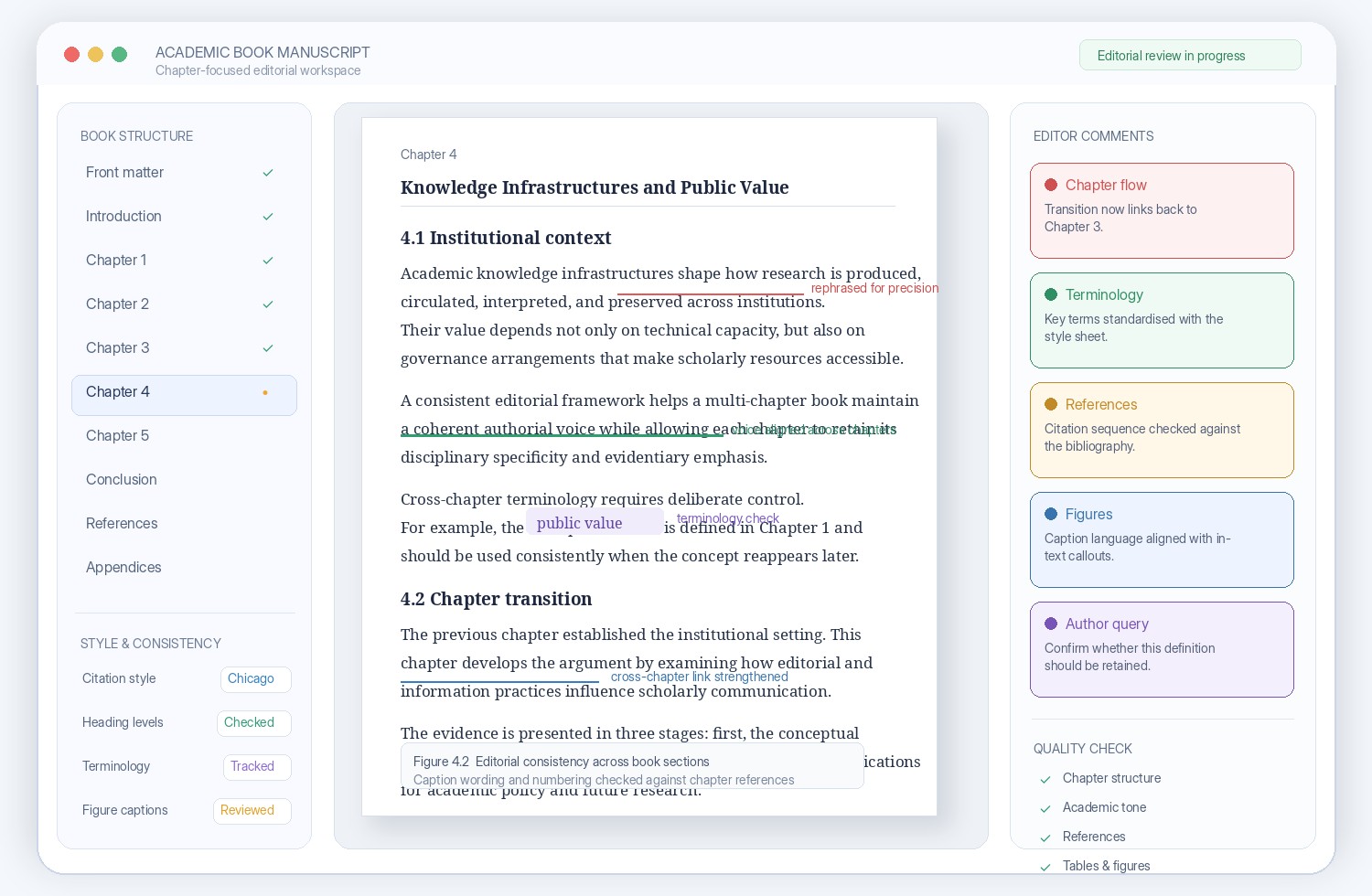
Academic book manuscript with chapter structure, tracked edits, reference checks, figure notes and editor comments
Book-level editorial viewSee chapter structure, cross-chapter terminology, references, figures, tracked revisions, and editor queries in one manuscript workflow.

Tracked Changes

Transparent editorial revisions

Confidential Handling

Unpublished work treated carefully

Chapter-Aware Review

Flow and consistency across the book

References & Figures

Presentation checked when scoped

Clean Edited File

A review-ready clean version

Built around scholarly book manuscripts
Book-manuscript-specific review
Clear editorial scope
Tracked-change transparency
Discipline-aware language
Confidential file handling
1

What Problems This Academic Book Service Solves

Academic books need consistency at two levels at once: each chapter must read clearly on its own, and the full manuscript must feel like one coherent scholarly work.

Common book-manuscript issues

  • ×Uneven academic tone or voice across chapters.
  • ×Repeated definitions, ideas, or background material.
  • ×Weak transitions between chapters or major sections.
  • ×Inconsistent terminology, abbreviations, capitalization, or spelling.
  • ×Citation, bibliography, table, figure, or caption inconsistencies.
  • ×Front matter, headings, cross-references, and back matter that do not align cleanly.

What the editorial review can cover

Language Mechanics

Grammar, spelling, punctuation, syntax, and word choice.

Chapter Flow

Transitions, sequencing, paragraph logic, and continuity.

Academic Tone

Precise, concise, discipline-appropriate expression.

Citations & References

Style and presentation consistency when included in scope.

Tables & Figures

Captions, numbering, labels, callouts, and presentation consistency.

Book Structure

Headings, front matter, chapter hierarchy, cross-references, and back matter.

Editor Queries

Comments where meaning, evidence, or author decisions need clarification.

Consistency Review

Terminology, abbreviations, style decisions, and recurring elements.

2

Service Demonstration: Annotated Academic-Book Excerpt

This illustrative excerpt shows how different editorial interventions can be made visible without changing the author's underlying claim.

128The chapter looks at examines how public institutions develop long-term knowledge infrastructures.
129The argument is grounded in a comparative analysis of three institutional settings.
130These cases demonstrate that governance choices influence both access and preservation.
131For consistency with Chapter 1, the term public value is used throughout this chapter.
132The discussion then connects these findings to the framework introduced in Chapter 2.
133References are presented in the supplied house style, with recurring author names and dates checked for consistency.
Language refinementReplace vague wording with a more precise academic verb.
DeletionRemove wording that is conversational or unnecessarily weak.
Argument clarityStrengthen phrasing without adding a new scholarly claim.
Terminology consistencyUse the same defined term across chapters.
Cross-reference checkMake the relationship between chapters explicit where useful.
3

From Draft Chapter to Tracked Edit to Clean Book Manuscript

The editing trail should make changes easy to review. The examples below are illustrative and show the difference between the working draft, transparent revision, and clean final text.

A

Before Editing

This chapter looks at knowledge infrastructures in universities. There are many different approaches and the chapter shows how institutions organise them. This is important for public value.
Issues: vague verbs • repetition • uneven academic tone • weak link to the chapter argument
B

Edited with Track Changes

This chapter looks at examines knowledge infrastructures in universities. It compares institutional approaches and explains how governance choices shape access, preservation, and public value.
Visible changes: precision • sentence structure • cohesion • terminology alignment
C

Clean Edited Manuscript

This chapter examines knowledge infrastructures in universities. It compares institutional approaches and explains how governance choices shape access, preservation, and public value.
Clean version: author-review ready • no markup shown • meaning preserved
4

Proofreading vs. Academic Book Service

Use proofreading when the book is essentially finished and needs a final surface check. Use a broader academic book review when clarity, chapter flow, consistency, and book-level presentation still need attention.

AspectProofreadingAcademic Book Service
Primary focusGrammar, spelling, punctuation, typosLanguage, clarity, chapter flow, consistency, and presentation
DepthSurface-level correctionScope can extend to sentence, paragraph, chapter, and book-level consistency
TerminologyChecks obvious inconsistenciesCan standardise recurring terms, abbreviations, capitalization, and style decisions
ReferencesFormatting consistency checkCan review citation and bibliography presentation as part of the agreed scope
Tables & figuresObvious caption/label issuesCan review numbering, captions, callouts, and presentation consistency
Chapter structureDoes not normally restructureCan flag weak transitions, repetition, hierarchy, and cross-chapter continuity
Best fitNear-final book manuscriptBook manuscript needing deeper editorial refinement before publisher-facing review
5

Academic Book Sections We Review

A book manuscript can be reviewed as a connected system, with attention to recurring style decisions and relationships between sections.

Title & Front Matter

Title presentation, preface, acknowledgements, lists, and front-matter consistency when supplied.

Introduction

Book purpose, scope, key terms, chapter map, and clarity of the opening argument.

Core Chapters

Language, paragraph flow, headings, transitions, evidence presentation, and chapter continuity.

Terminology & Style

Recurring terms, abbreviations, capitalization, spelling preferences, and discipline-specific usage.

Tables & Figures

Numbering, captions, labels, notes, callouts, and presentation consistency when included.

Citations & References

Citation and bibliography presentation against the supplied style or publisher guidance.

Conclusion

Alignment with the book's stated contribution, chapter synthesis, and clarity of concluding language.

Back Matter

Appendices, glossary, notes, and other back-matter elements where they form part of the editorial scope.

6

Our Academic Book Editorial Workflow

The exact project setup depends on manuscript scope, but the working sequence is designed to make responsibilities, editorial depth, and delivery outputs clear before editing begins.

1. Share Scope

Provide book type, manuscript length, priority concerns, style guidance, and target date.

2. Scope Review

Editorial depth, files, guidelines, and book-level requirements are clarified.

3. Editor Assignment

The project is prepared for an editor whose work is appropriate to the manuscript context.

4. Book Editing

Chapters are edited with tracked changes, consistency control, and queries where needed.

5. Quality Review

Key style decisions, consistency points, files, and agreed scope are checked before delivery.

6. Delivery

Edited and clean files are returned with relevant notes or author queries for review.

7

What You Receive

Deliverables are aligned to the agreed manuscript scope. The core goal is to make editorial changes transparent and the clean manuscript easy for the author to review.

Edited Book Manuscript

Working file with tracked changes so revisions can be reviewed individually.

Edited

Clean Edited Manuscript

Clean version with accepted editorial changes presented without visible markup.

Clean

Editor Comments & Queries

Questions where author input is needed to protect meaning or resolve ambiguity.

Queries

Consistency Notes

Relevant style decisions for terminology, capitalization, abbreviations, and recurring elements.

Style

Reference & Figure Notes

Editorial observations on references, captions, numbering, and cross-references when included in scope.

Notes

Editorial Readiness Checklist

A concise review of agreed editorial items before publisher-facing or internal submission.

Checklist
8

Quality Assurance Methodology

Quality review is layered so surface corrections do not obscure the book-level questions of clarity, continuity, references, and final presentation.

Layer 1 · Language PassGrammar · spelling · punctuation · usage
Layer 2 · Chapter & Flow PassClarity · paragraph logic · transitions
Layer 3 · Consistency PassTerminology · references · figures · style
Layer 4 · Final File ReviewScope · comments · clean-file readiness
Author intent is preserved

Meaning-sensitive changes are queried rather than silently assumed.

Clarity is improved

Wording and structure are refined for readable scholarly presentation.

Style is consistent

Recurring editorial choices are checked across the manuscript.

Final files are checked

Tracked and clean outputs are reviewed against the agreed scope.

9

Disciplines We Support

Academic book manuscripts vary by disciplinary language, evidence conventions, notation, citation practice, and use of figures. Scope should reflect those subject-specific needs.

Life Sciences
Medicine & Health
Engineering
Computer Science
Social Sciences
Business & Economics
Humanities
Environmental Science
Multidisciplinary
10

Confidentiality & File Handling

Unpublished academic books may contain sensitive research, original arguments, and pre-publication material. File handling should keep access and delivery controlled throughout the project.

Secure Handoff

Project files are transferred through the approved channel for the engagement.

Restricted Access

Manuscript access is limited to people involved in the editorial workflow.

Controlled Editing

Working files are handled within the defined project process.

Confidential Delivery

Edited files are returned through the agreed delivery route.

File Verification

Returned files are checked for completeness before project delivery.

NDA on Request

NDA requirements can be raised when the project is scoped.

Your scholarship remains yours.The service is editorial. It does not transfer authorship or ownership of your research, arguments, data, or unpublished manuscript.
11

Turnaround Options & Pricing Clarity

Academic Book Service does not have an invented fixed price or fixed turnaround on this page. Both are confirmed after reviewing the actual manuscript scope.

Turnaround: Scope First

A delivery schedule is confirmed after book length, editorial depth, file condition, complexity, and required outputs are reviewed. Priority requirements can be discussed during scoping, but no fixed number of days is promised here.

Custom Quote Based on Book Scope

The quote is tied to the manuscript actually submitted for review rather than an unsupported one-size-fits-all price.

Book word count
Editorial depth
Technical complexity
References & figures
Publisher guidelines

Clear Scope Before Work

Before the project begins, confirm the manuscript files, editorial priorities, reference or formatting requirements, delivery outputs, and schedule so the service matches the book's actual needs.

12

Why Authors Choose an Academic Book Service

Book editing is different from isolated sentence correction because decisions repeat across chapters. The value comes from treating the manuscript as a coherent scholarly whole.

Book-Level Perspective

Recurring terminology, chapter relationships, headings, references, and presentation can be considered across the manuscript.

Confidential Handling

Unpublished material is treated as confidential project content within the established file-handling process.

Author-Centred Editing

Changes are intended to strengthen presentation while preserving the author's argument, evidence, and scholarly decisions.

Publisher-Aware Scope

Supplied house style, reference requirements, formatting guidance, and submission instructions can be incorporated into the review.

13

Academic Book Service FAQs

Answers to practical questions about scope, book types, references, tracked changes, pricing, turnaround, confidentiality, and publisher guidance.

What does the Academic Book Service cover?

The service focuses on author-developed scholarly book manuscripts. Depending on the agreed scope, review can address language, chapter flow, academic tone, terminology, citations and references, tables and figures, formatting consistency, front and back matter, and publisher-facing presentation.

Is this service suitable for a complete academic monograph?

Yes. A complete monograph can be reviewed as one book-level project so terminology, chapter sequence, cross-references, style, and editorial consistency can be considered across the manuscript rather than chapter by chapter in isolation.

Can you work on an edited volume with multiple contributors?

An edited volume can be scoped for consistency across contributor chapters, including shared style, terminology, headings, citations, references, tables and figures, and editorial presentation. Contributor-specific content decisions remain with the volume editor and authors.

Does the service rewrite my academic argument?

No automatic change to your scholarship or conclusions is implied. Editorial work is intended to improve clarity, coherence, consistency, and presentation while preserving author meaning. Where a change could affect meaning, an editor query can be used instead of silently rewriting the point.

What is the difference between proofreading and the Academic Book Service?

Proofreading is a final surface-level check for errors such as spelling, punctuation, grammar, and minor consistency issues. Academic Book Service can be scoped more broadly to review chapter flow, terminology, academic expression, structural consistency, references, figures, and book-level presentation.

Can individual chapters be reviewed instead of the full book?

Yes. A chapter or selected group of chapters can be considered, but a limited scope naturally provides less visibility of cross-chapter consistency than a full-book review.

Do you check citations and references?

Citation and reference presentation can be reviewed for consistency when it is included in the agreed scope and the required style or publisher guidance is provided. Editorial review does not replace source verification or responsibility for the accuracy of the underlying scholarship.

Can tables, figures, captions, and cross-references be reviewed?

Yes, these elements can be included in the editorial scope for consistency of numbering, captions, callouts, labels, and presentation. Technical or factual validation of the underlying data remains the author's responsibility unless separately agreed.

What files should I provide for an academic book enquiry?

A useful enquiry includes the current manuscript, approximate word count, book type, subject area, target publisher or guideline if known, reference style, any figure or table requirements, priority chapters, and the date by which you need the work completed.

How is pricing determined?

There is no fixed price shown on this page. A custom quote is based on the manuscript scope, including length, editorial depth, technical complexity, references and figures, formatting requirements, and any publisher-specific instructions.

How is turnaround determined?

Turnaround is confirmed after the manuscript scope is reviewed. The schedule depends on book length, editorial depth, complexity, file condition, and the required delivery approach. No fixed turnaround is promised on this page.

Will I receive tracked changes and a clean file?

The page is structured around transparent editorial delivery, including tracked changes and a clean edited copy as core review outputs. Additional notes, queries, or consistency guidance can be included when they are relevant to the agreed project scope.

Can you follow a publisher's style guide?

Yes, publisher or house-style guidance can be used when it is supplied with the project. The editorial scope can then align headings, citations, references, captions, abbreviations, and other presentation details with those instructions.

Is my unpublished book manuscript handled confidentially?

The service page follows ContentXprtz's established confidential-handling approach for client files and unpublished material. Project access, transfer, delivery, retention, and any NDA requirement should be confirmed as part of the project setup.

14

Request an Academic Book Review

Share enough information to assess editorial depth, book-level complexity, schedule feasibility, and any publisher-specific requirements.

Book type & length

Monograph, edited volume, textbook, book chapter, or another scholarly book format, plus approximate word count.

Editorial priorities

Language, flow, chapter consistency, references, figures, formatting, terminology, or another focus.

Publisher guidance

Provide any house style, author instructions, reference style, or formatting requirements you already have.

Target date

Share the date by which you need the edited manuscript or first delivery stage.

Helpful to include: current manuscript status, approximate word count, number of chapters, subject area, target publisher if known, citation style, figures/tables, desired editorial depth, priority concerns, and target date.
Academic Book Enquiry

Tell Us About Your Book Manuscript

Submit the project details below. Pricing and turnaround are confirmed only after scope review.

Security check *Loading question…

Do not include confidential manuscript text in this message field. Project files can be exchanged through the appropriate project channel after the enquiry is reviewed.

15) Ready to Strengthen Your Academic Book Manuscript?

Request a scope review for clearer chapters, consistent scholarly language, transparent edits, and publisher-facing editorial readiness.