Technical Documentation
User guides, product documentation, implementation content, configuration guidance, and structured reference material.

Turn complex product, software, engineering, and operational knowledge into structured content that readers can understand, review, and use—from documentation and developer guides to technical articles, white papers, knowledge bases, and SOPs.
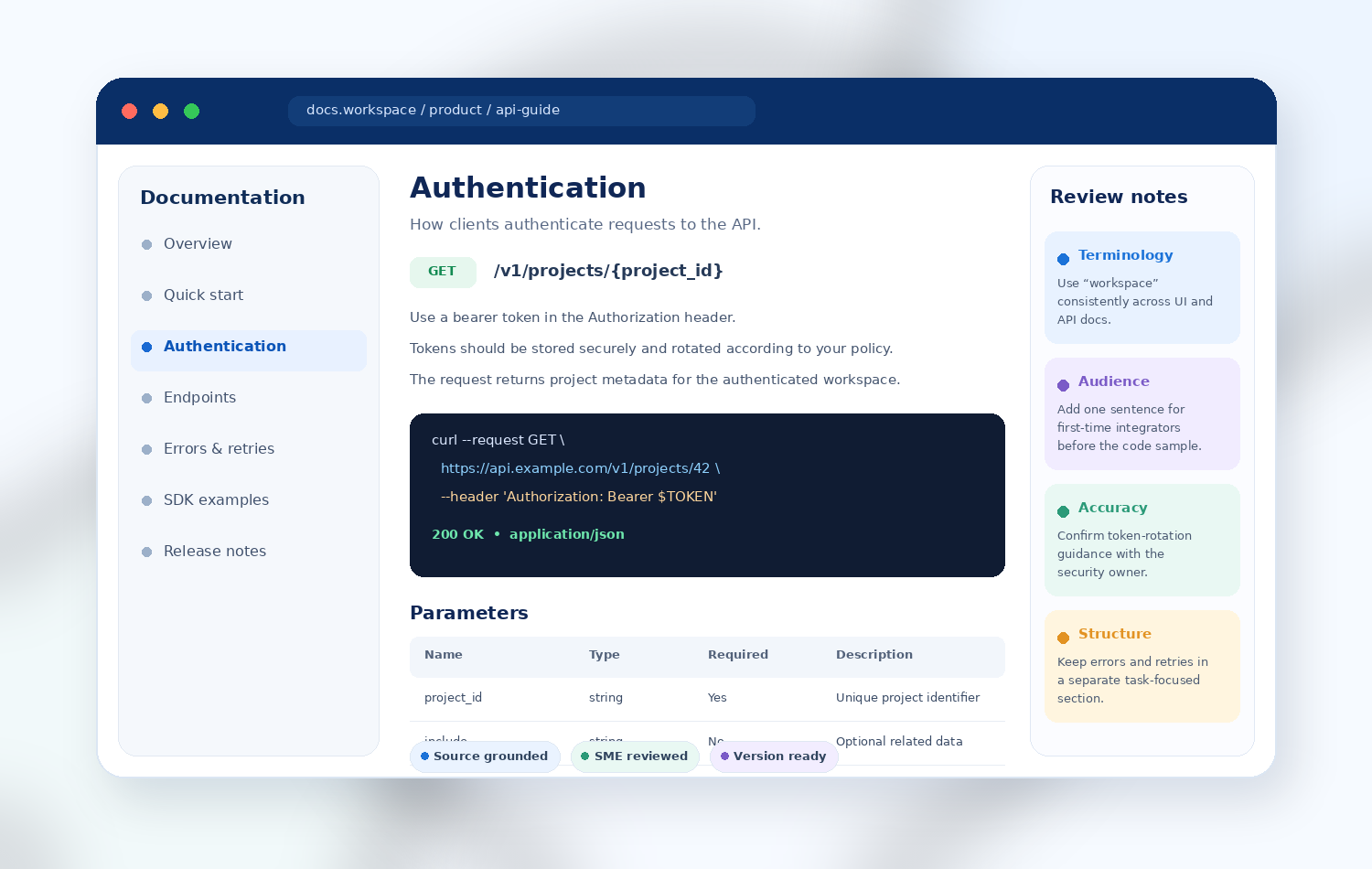
Technical content can range from one support article to an entire documentation set, so entry pricing is tied to a defined deliverable and larger programs are scoped around source complexity and SME involvement.
Project minimum
for one focused technical-content assignment
Suitable for: A short guide, technical article, documentation section, SOP, knowledge-base item, or other bounded technical deliverable based on approved source information.
API documentation, large manual sets, SME interview programs, multi-product documentation, ongoing release content, or complex research-heavy work receives a custom quotation. Faster delivery for technical content project can be considered after volume, file readiness, and specialist availability are reviewed.
Buy Service NowWhy partner with us?
Our core services
User guides, product documentation, implementation content, configuration guidance, and structured reference material.
Quick starts, integration guides, endpoint explanations, authentication guidance, examples, and developer tutorials.
Feature explanations, onboarding guidance, workflow content, release communication, and in-product support material.
Educational articles, technical explainers, solution content, tutorials, and subject-led thought leadership.
Structured long-form content that explains technologies, approaches, technical findings, workflows, or business context.
Support articles, internal process content, runbooks, operational procedures, troubleshooting material, and reusable knowledge assets.
A structured workflow keeps the brief, source material, audience, technical review, and final handoff connected from the start.
Define audience, goal, source set, constraints, and stakeholders.
Review approved references and identify technical questions or gaps.
Create the information architecture, outline, sequence, and page logic.
Write for the defined reader, task, terminology, and channel.
Resolve SME comments, consistency issues, and editorial questions.
Prepare the agreed review-ready or publishing-ready handoff.
Technical content should reflect the product context, reader knowledge, delivery channel, and terminology expected in the domain.
The exact format, source set, technical depth, and publishing workflow should be confirmed in the project brief before production begins.
Technical quality is not only grammar. It also depends on source fidelity, terminology, structure, audience fit, and an efficient review path.
The service can support customer education, developer experience, product communication, operational knowledge, and technical thought leadership.
What we create
Sample use cases
Complex content improves when source material, editorial decisions, and technical approvals are separated clearly enough for the right stakeholder to review each layer.
Approved references, product language, existing documentation, and project constraints shape the draft so technical claims are not added casually.
Open technical questions can be flagged for the appropriate subject-matter expert, product owner, engineering contact, or reviewer instead of being silently guessed.
Feedback can be consolidated into defined revision passes so terminology, factual changes, and stakeholder comments remain easier to review and resolve.
Common questions about technical content scope, source material, technical review, formats, pricing, and project planning.
A technical content service turns complex product, engineering, software, process, or domain knowledge into structured content for a defined audience. Depending on the brief, the work can include documentation, technical articles, developer content, knowledge-base material, white papers, guides, reports, or internal process content.
The scope can be shaped around product documentation, API and developer content, user guides, knowledge-base articles, technical blogs, white papers, reports, SOPs, runbooks, release communication, implementation guides, and other structured technical material that fits the project brief.
Yes. A project can begin with source documents, product notes, existing pages, screenshots, technical references, recorded or written SME input, or a structured brief. The exact source set should be agreed before drafting so the content can stay grounded in approved information.
Yes. Audience level should be defined in the brief. The same subject may need different structure, terminology, examples, and explanation depth for developers, product users, buyers, executives, support teams, or general readers.
API and developer content can be included when the project provides the necessary technical source material. Typical deliverables may include endpoint explanations, authentication guidance, request or response examples, integration tutorials, error guidance, quick starts, and developer-facing conceptual documentation.
Terminology can be controlled through an agreed glossary, naming conventions, style guidance, product labels, and repeated review checkpoints. Existing approved language should be supplied whenever it must be preserved exactly.
SME involvement can be built into discovery, source validation, draft review, and final clarification. The content workflow is designed to separate writing decisions from technical approvals so unresolved technical points can be flagged for the right stakeholder.
Yes. Share the applicable voice guide, terminology list, documentation standard, templates, examples, and formatting rules with the brief. These can then be used as working constraints throughout drafting and review.
Useful inputs include the audience, content goal, source material, technical references, required format, terminology or style rules, examples to follow, stakeholder contacts, review process, and any deadline or publishing constraints that should shape the work.
A review-ready draft can be prepared for stakeholder feedback, with comments consolidated into a revision pass. For complex projects, it is helpful to define who can approve technical accuracy, product terminology, compliance language, and final publication wording.
For Technical Content, the entry scope typically takes Typically 3–7 business days for entry projects; final timing is confirmed against the actual deliverables and complexity. A delivery plan can be confirmed after the requirements are reviewed.
The published project minimum for Technical Content is ₹5,000 for one focused technical-content assignment. Pricing is provided after the technical-content requirements and scope are reviewed so the quote can reflect the actual work requested.
Tell us what needs to be written, who will read it, what source material exists, and how your team expects to review or publish the final content.
Helpful project inputs
A useful enquiry explains the deliverable, intended audience, technical source material, review owner, publishing format, and any timing constraints. You do not need to provide sensitive files in the first message.
Share the project details below. Pricing and delivery timing can be discussed after the actual technical-content scope is reviewed.
Turn technical expertise into clear documentation, developer content, product guidance, and long-form technical communication.