
- Dense labels and weak hierarchy
- Inconsistent panel spacing
- Legends competing with the data
- Mismatched typography and colors
- Unclear export or sizing requirements
Scientific Visual Communication
Scientific Design Service for Clear, Publication-Ready Research Visuals
Turn dense research figures, workflows, tables, diagrams, and visual summaries into structured scientific graphics that are easier to read, review, present, and prepare for submission.
- Scientific Design developed from the research context, source material, labels, and intended scholarly use.
- Scientific relationships and visual hierarchy clarified without changing the underlying meaning.
- Figures, annotations, typography, panels, and visual elements refined for readability and consistency.
- High-resolution, editable, presentation-ready, or submission-ready outputs prepared as confirmed in scope.
1
Comprehensive Scientific Design: From Dense Visuals to Clear Research Communication
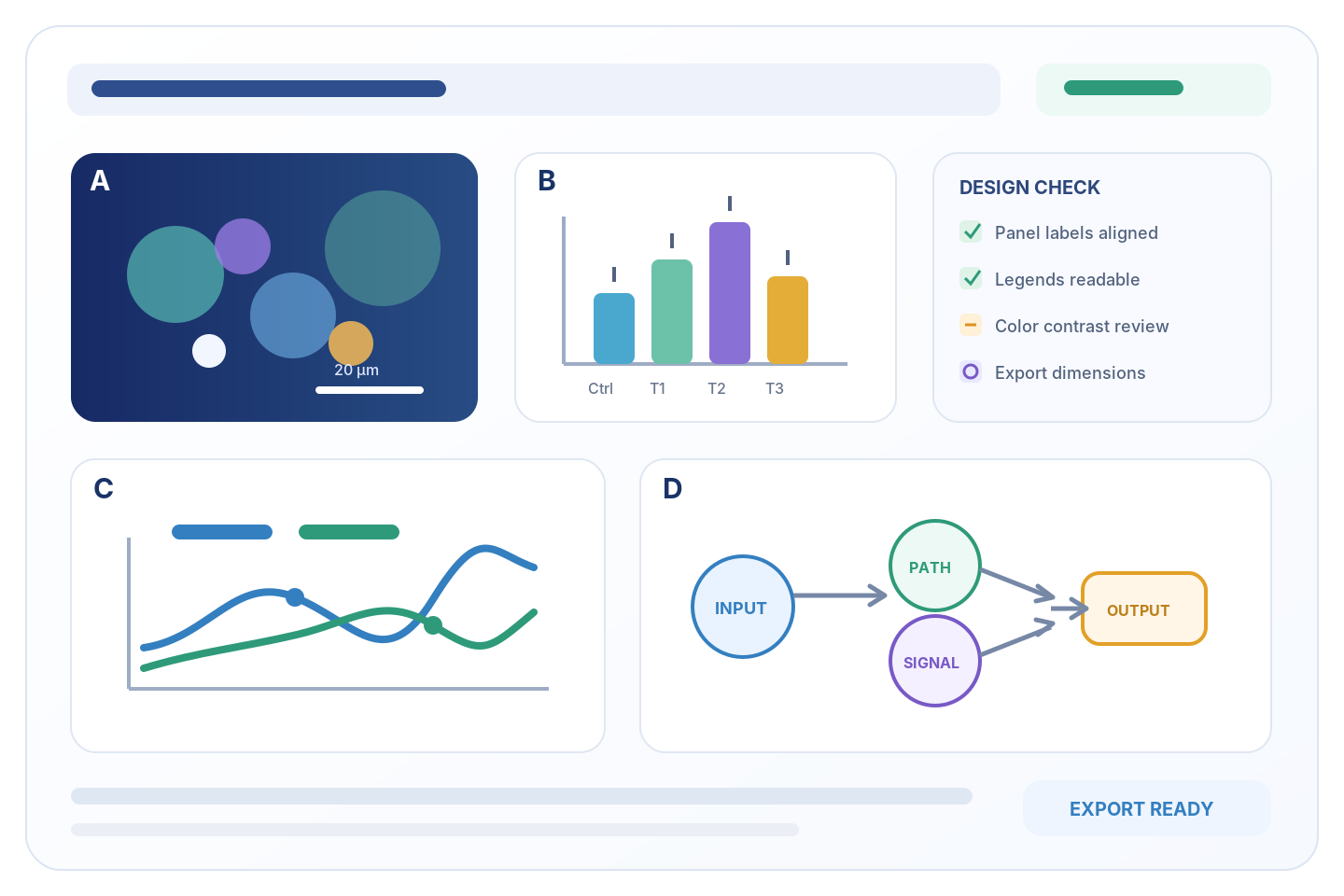
Scientific design is not decoration. It organizes research information so readers can understand panels, comparisons, mechanisms, workflows, and data relationships without losing the scientific meaning.
Our Scientific Design Transformation
| Quality Parameter | Before | After Design | Result |
|---|---|---|---|
| Visual hierarchy | Competing elements | Structured emphasis | Clear reading order |
| Panel consistency | Uneven | Aligned grid | Coherent figure |
| Labels & legends | Crowded | Readable | Less visual friction |
| Color & contrast | Uncontrolled | Purposeful palette | Stronger differentiation |
| Output readiness | Uncertain | Brief-led export | Submission-ready workflow |
- Clear panel and information hierarchy
- Consistent alignment and spacing
- Readable labels, legends, and callouts
- Deliberate color and typography system
- Output prepared around the confirmed brief
Scientific Context Review
We identify the message the visual must communicate.
Layout & Hierarchy
Panels, labels, legends, and reading order are structured.
Guideline Check
Supplied journal or publisher requirements are reflected.
Quality Assurance
Final visual consistency and export readiness are reviewed.
2
Value We Add to Every Scientific Visual
The design process works from the research message outward—clarifying the visual story first, then refining layout, labels, data presentation, styling, and final output preparation.
Clarity & hierarchy — organize the reader’s path through the visual.
Panel consistency — align grids, labels, spacing, and grouping.
Data presentation — improve chart and table readability without altering data.
Scientific illustration — structure mechanisms, workflows, and technical concepts.
Figure polish — refine legends, callouts, symbols, and annotations.
Guideline alignment — apply supplied journal or publisher specifications.
File readiness — prepare the output around the confirmed use and format.
Final quality review — check visual consistency before delivery.
Designed for Better Scientific Communication
A strong scientific visual should make the research easier to scan and interpret while maintaining the author’s data, labels, claims, and scientific meaning.
Clearer visual hierarchy across panels and elements
More readable labels, legends, captions, and callouts
Stronger consistency across multi-panel figures
Better alignment with supplied submission requirements
Outcomes You Get
Clearer research visuals
Consistent visual system
Reviewer-friendly figure structure
Prepared final files
Reusable design logic across related visuals
3
Our Proven 5-Step Scientific Design Process
Each project moves from research input to a reviewed final visual, with scientific meaning protected throughout the design workflow.
Share the visual type, source material, intended use, guidelines, output format, and deadline.
We identify the central message, required labels, panel logic, and information that must remain unchanged.
Hierarchy, panels, charts, diagrams, colors, labels, and visual flow are refined around the brief.
We review labels, alignment, consistency, supplied requirements, and export readiness before handoff.
The agreed final file set is prepared for manuscript, review, poster, presentation, or other confirmed use.
4
Project Timeline
Timeline Confirmed After Scope Review
Delivery depends on visual complexity, panel count, source quality, output requirements, and the review scope.
- Share your exact deadline and time zone.
- Include journal dimensions or specifications when available.
- Identify the number of visuals or panels.
- Provide source files early to avoid export surprises.
5
Deliverables You May Receive
Final deliverables are confirmed with the brief and can be prepared around the intended scientific communication use.
Publication- or presentation-ready visual file
Review copy for visual checking and approval
Consistent panel, label, legend, and typography system
Figure or table layout matched to the agreed composition
Final export in the format agreed before design begins
6
File Formats We Can Work With
Use the enquiry to confirm the source files you have and the format required for the final output.
Microsoft Word
PDF
TIFF / JPG
PNG / EPS
Excel Tables
Supplementary Files
7
Subjects & Disciplines We Cover
Life Sciences
Medicine & Health
Chemistry
Physics
Engineering
Environmental Sciences
Computer Science
Mathematics
Social Sciences
Business & Management
Agriculture
Interdisciplinary
8
Research Areas We Support
- Biotechnology
- Pharmacology
- Clinical Research
- Bioinformatics
- Nanotechnology
- Materials Science
- Electrical Engineering
- Mechanical Engineering
- Civil Engineering
- Artificial Intelligence
- Data Science
- Public Health
- Economics
- Education
- Psychology
- Sociology
- Political Science
- Environmental Science
- Food Science
- Marine Science
9
Scientific Visuals We Can Work On
01Graphical Abstracts
02Journal Figures & Multi-Panel Layouts
03Workflow & Method Diagrams
04Scientific Illustrations
05Charts, Data Visuals & Tables
06Conference Posters
07Presentation Research Graphics
08Existing Figure Redesign
10
Why Researchers Choose a Structured Scientific Design Workflow
Research-First Visual Logic
The design begins with the message, comparison, workflow, or mechanism the figure must communicate.
Consistent Figure Systems
Panels, typography, labels, legends, colors, and spacing are treated as one coherent visual system.
Confidential Research Handling
Unpublished figures and supporting material should remain within the designated service workflow.
Submission-Aware Preparation
Supplied journal, conference, or publisher specifications are considered during final preparation.
Output-Focused Delivery
The final file requirement is agreed before export so the design is prepared for its intended use.
Transparent Review Scope
Feedback is mapped to the agreed design brief so visual changes remain controlled and traceable.
11
Built for Research Workflows
Scientific visuals can support multiple stages of research communication when the intended audience and output are clear.
- Manuscript and journal submission figures
- Thesis and dissertation research visuals
- Conference posters and presentation graphics
- Research summaries and graphical abstracts
- Methods, process, mechanism, and workflow diagrams
12
Our Scientific Design Quality Promise
Confidential Handling
Unpublished research material is treated as project-sensitive content.
Scientific Meaning Preserved
Design changes should not alter data, findings, or conclusions.
Consistent Visual System
Panels, typography, spacing, labels, legends, and colors are checked together.
Deadline Transparency
A realistic project timeline is confirmed after the scope is reviewed.
Brief-Led Quality Review
Final checking is tied to the agreed visual, format, and submission requirements.
13
Get Started in 4 Clear Steps
Share enough information to define the scientific visual, intended use, source material, and deadline. The project can then be scoped before design begins.
Submit the Visual Brief
Upload or describe the source figure, data, sketch, manuscript section, or design requirement.
Confirm Scope
Clarify visual type, panel count, output, guidelines, deadline, and review needs.
Design & Review
The visual is structured, refined, and checked against the agreed brief.
Receive Final Files
Approved files are prepared for the confirmed manuscript, poster, presentation, or review use.
14
How to Submit Your Scientific Design Requirement
Send the visual type, research context, source files, guidelines, required output, and deadline so the project can be reviewed for scope and feasibility.
Scientific Design Enquiry
Request a Scientific Design Assessment
Share your research visual requirement below. The project can then be reviewed for scope, source-file suitability, output needs, and deadline feasibility.
15
Scientific Design Service FAQs
Answers to practical questions about scientific figure scope, journal requirements, file formats, timelines, revisions, and the information needed to begin.
What is a Scientific Design Service?
A Scientific Design Service turns research content, figures, tables, workflows, and technical concepts into clear visual material for manuscripts, posters, presentations, and other scientific communication. The design work focuses on hierarchy, readability, consistency, and the requirements supplied for the intended output.
What types of research visuals can you help design?
The scope can include graphical abstracts, research figures, multi-panel figure layouts, workflow diagrams, scientific illustrations, data-led visuals, tables, conference posters, and presentation-ready research graphics. The exact deliverables are confirmed from the project brief.
Can you redesign an existing scientific figure?
Yes. An existing figure can be reviewed for layout, label readability, panel alignment, typography, color consistency, legends, callouts, spacing, and export readiness while preserving the scientific meaning supplied by the author.
Can you work from a rough sketch or draft figure?
Yes. You can provide a sketch, manuscript excerpt, table, spreadsheet, reference image, or existing figure together with notes explaining the intended message. The design brief should identify what must remain scientifically unchanged and what can be visually reorganized.
Do you follow journal figure requirements?
If you provide the target journal or publisher requirements, the design can be prepared around supplied specifications such as dimensions, file type, resolution, panel labeling, typography, or color constraints. Final technical acceptance remains subject to the journal or publisher.
Will the design change my data or scientific conclusions?
No. Scientific design should improve presentation without changing the underlying data, claims, interpretation, or research conclusions. If a visual issue cannot be resolved safely without scientific input, it should be returned to the author for clarification.
Which file formats can I submit?
Common working inputs can include Word documents, PDFs, Excel tables, and figure files such as TIFF, JPG, PNG, and EPS. Supporting files may also be supplied where they are needed to understand labels, legends, source data, or the intended visual hierarchy.
Which file formats will I receive?
Final delivery format depends on the agreed brief and intended use. The required publication, presentation, or review format should be confirmed before design begins so the final files can be prepared appropriately.
How long does scientific design take?
The timeline depends on the number of visuals, number of panels, source-file quality, scientific complexity, target dimensions, output format, and revision scope. Share your deadline in the enquiry so feasibility and a realistic delivery date can be confirmed before work begins.
How is Scientific Design Service pricing determined?
The project can be scoped after reviewing the number and complexity of visuals, available source files, required outputs, target guidelines, and revision needs. A quote should be confirmed before work begins rather than applying an unsupported fixed price to every scientific design project.
Can you design figures for different scientific disciplines?
Scientific visuals can be prepared for a wide range of disciplines, provided the author supplies the research content, terminology, data context, and any discipline-specific conventions needed to represent the material accurately.
Can I request changes after reviewing the first design?
Review and revision requirements should be agreed as part of the project scope. Feedback is most effective when it identifies specific issues such as labels, emphasis, panel order, visual hierarchy, spacing, or guideline alignment.
What should I send with my enquiry?
Send the visual type, subject area, intended use, source files, target dimensions or guidelines, required output format, deadline, and a short note explaining the scientific message that the visual must communicate. Rough sketches and reference examples are also useful when available.