Source-Aware
Work is anchored to the technical material you provide

Turn complex source material into structured technical content that readers can understand, follow, and use. The service can support documentation, developer content, guides, SOPs, knowledge-base material, technical articles, white papers, and other information-rich technical deliverables.
Work is anchored to the technical material you provide
Structure and explanation are shaped for the intended reader
Terms, labels, steps, and references are checked across the content
Queries and action points can be surfaced clearly for resolution
Technical content is priced by a usable content unit so buyers can budget a focused article, explainer, guide section, or similar deliverable without committing to a broad retainer.
Suitable for: Best for a focused technical content requirement with a defined audience, subject, and intended format.
per up to 1,000 words of specialist technical content developed from an agreed brief and supplied or approved sources
Technical Content Service starts at ₹5,000 per up to 1,000 words of specialist technical content developed from an agreed brief and supplied or approved sources.
Buy Service NowInterview-led work, original data analysis, deep subject-matter validation, custom visuals, complex compliance review, or substantially longer deliverables are quoted according to scope.
Technical content often fails before the writing itself: source information is fragmented, the audience is undefined, terminology changes, and review feedback is spread across versions. A structured content process makes those issues visible early.
The source may be technically correct but pitched at the wrong level, leaving readers without the context they need.
Specifications, SME notes, tickets, diagrams, and legacy pages can disagree or omit the sequence required for a usable document.
Product names, field labels, acronyms, units, and technical terms can change between sections or source files.
Steps may be accurate individually but difficult to follow because prerequisites, decisions, outcomes, and exceptions are not structured clearly.
Code samples, tables, screenshots, or figures may appear without explanation, labels, prerequisites, or interpretation.
Technical comments can be scattered across email, chat, tickets, and document versions, making final consolidation difficult.
The service can be scoped from content architecture through drafting, rewriting, technical presentation, and editorial quality checks. Each component is selected according to the material you have and the output you need.
Outline information around user goals, prerequisites, workflow, reference material, and decision points.
Bring supplied specifications, notes, existing copy, examples, and SME input into a coherent working structure.
Develop or rewrite technical content for clearer sentences, stronger sequencing, and more usable explanation.
Present endpoints, authentication, parameters, code examples, errors, and response information in a reader-friendly format.
Improve labels, explanations, callouts, cross-references, and the relationship between visuals and surrounding text.
Check visible internal consistency for referenced sections, resources, citations, URLs, and document cross-references.
Standardize product terms, abbreviations, labels, capitalization, units, and repeated technical concepts.
Review structure, language, consistency, formatting, unresolved queries, and final handoff readiness.
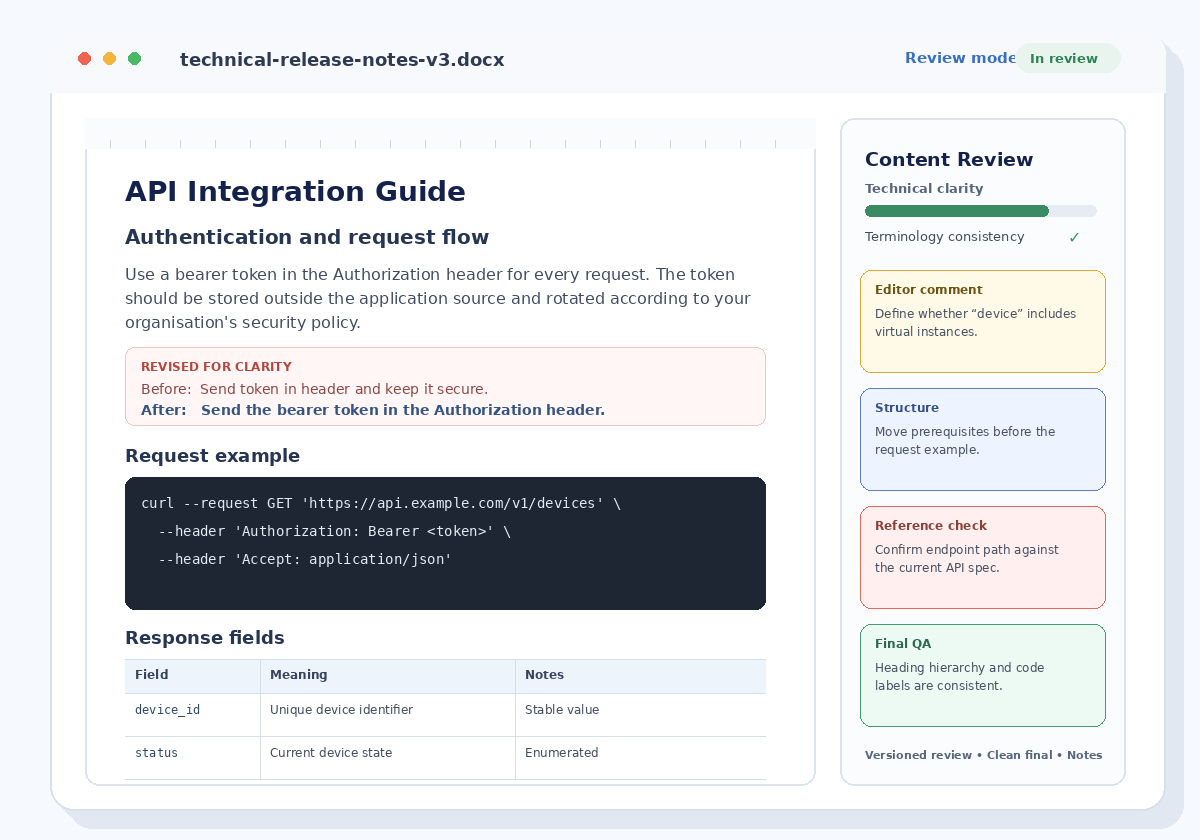
A technical content review goes beyond surface grammar. The example below shows how vague source wording can be clarified, structured, and linked to practical implementation detail without inventing technical facts.
Authentication
Send the token in the header. Keep the token secure. The API will return data if the request is correct. The endpoint can be used to get devices.
Authentication and request flow
Send the token in the header. Send the bearer token in the Authorization header for each request. Keep credentials outside application source code and follow the agreed security policy.
Authentication and request flow
Send the bearer token in the Authorization header for each request. Store credentials outside application source code and follow the security requirements confirmed for your implementation.
Choose the intervention based on what the document needs. Technical content work is the stronger fit when information architecture, technical explanation, reader flow, source consolidation, or documentation usability needs attention.
| Focus | Proofreading | Copy Editing | Technical Content Service |
|---|---|---|---|
| Primary purpose | Final language and presentation check | Sentence-level clarity, style, and consistency | Structure, technical clarity, audience usability, and content development or rewriting |
| Content architecture | Limited | Usually limited | Yes, when required by the scope |
| Technical source consolidation | No | Limited | Can consolidate supplied specifications, notes, legacy content, examples, and SME input |
| Examples, code, tables, figures | Presentation consistency | Clarity and style consistency | Placement, explanation, labels, context, and reader flow |
| Technical queries | Obvious issues only | Where wording is unclear | Queries can be raised for missing, conflicting, or technically ambiguous source information |
| Best for | Near-final documents | Structurally complete content needing language refinement | Complex documentation or technical communication that needs clearer structure, explanation, and usability |
The appropriate structure depends on the reader and the delivery channel. Typical technical content formats include task-based documentation, reference material, implementation content, long-form technical explanation, and operational guidance.
Endpoint explanations, authentication, request/response content, errors, examples, and implementation guidance.
User guides, administrator guides, setup instructions, feature documentation, onboarding, and configuration content.
Operational procedures, workflows, responsibilities, exceptions, checklists, and handoff instructions.
Long-form technical explanations, research-led articles, solution overviews, technical briefs, and thought-leadership content.
Architecture notes, integration guidance, deployment content, runbooks, configuration instructions, and technical handbooks.
How-to articles, known-issue guidance, diagnostic steps, FAQs, decision trees, and support documentation.
Technical reports, methods descriptions, data narratives, tables, figures, terminology, and evidence-led explanations.
Release notes, migration guidance, change summaries, deprecation notices, and technical update communication.
A defined workflow keeps source review, content structure, drafting, technical questions, editorial checks, and final handoff connected instead of treating them as separate writing tasks.
Confirm the content purpose, intended reader, required output, source material, and priority technical questions.
Assess what is available, identify gaps or conflicts, and separate confirmed information from items requiring clarification.
Create or refine the content hierarchy, headings, task flow, prerequisites, examples, and reference sections.
Develop the technical narrative with clear language, consistent terminology, and practical sequencing.
Flag ambiguous source points, conflicting terminology, missing steps, or details that require SME confirmation.
Review clarity, logic, consistency, cross-references, examples, labels, and formatting across the document.
Check unresolved comments, heading hierarchy, terms, links, tables, figures, code labels, and final delivery consistency.
Deliver the agreed file set and clearly distinguish clean content from any remaining author or technical action items.
Deliverables are matched to the agreed scope rather than assumed. The items below show the types of outputs that may be included when they are relevant to the project.
A working document or content file reflecting the agreed drafting or rewriting scope.
A clean version prepared after the agreed review cycle and resolution of confirmed changes.
Visible questions where source material is unclear, contradictory, incomplete, or needs technical confirmation.
An outline, hierarchy, or content map when the project requires architecture before detailed drafting.
A practical record of repeated terms, labels, naming decisions, or style choices when useful to the project.
The final combination of files is agreed for the project and may include formatting-ready or publishing-ready content.
Technical content quality is checked at several levels: source alignment, audience usability, terminology consistency, document presentation, and final delivery readiness.
Check that the content stays anchored to the supplied technical information and clearly flags unsupported assumptions.
Check definitions, sequencing, context, examples, and level of detail against the intended reader.
Check terminology, labels, capitalization, units, headings, repeated concepts, and cross-references.
Check code labels, tables, figures, captions, links, lists, headings, and visible reference consistency.
Check open comments, clean-copy integrity, document flow, and agreed delivery requirements before handoff.
Technical content methods can be applied across different subject areas. The key requirement is usable source information, a defined audience, and a clear purpose for the final document or content channel.
Developer docs, product guides, integration content, knowledge bases, release communication, and technical onboarding.
Process documentation, technical handbooks, implementation instructions, configuration guides, and operational content.
Model or data documentation, technical explainers, implementation guidance, methods, governance content, and data-product documentation.
Research-led technical material, methods, protocols, instrument guidance, technical reports, and evidence-based documentation.
SOPs, internal procedures, control documentation, runbooks, process maps, training support, and workflow guidance.
Technical service descriptions, product documentation, process content, integration guides, controls material, and implementation communication.
Setup, configuration, maintenance, troubleshooting, specification-led instructions, and user-facing technical documentation.
Technical learning material, structured explainers, onboarding guides, job aids, and reference content for defined user groups.
Technical projects can contain sensitive operational, product, research, or engineering material. The project brief should define the source files required, the people who need to review them, and any specific handling requirements.
Turnaround is confirmed after the scope and deadline are reviewed. Delivery timing is therefore confirmed only after the content scope, source readiness, technical complexity, review dependencies, and required output are understood.
A realistic schedule should account for both writing work and the technical clarification needed to resolve source gaps or review comments.
The value of technical content is not simply polished wording. It is the combination of usable structure, clear explanation, technical consistency, practical examples, and a review trail that helps readers act on complex information.
Technical content is organized around what the intended reader needs to understand or do, not simply around the order of the source material.
Repeated terms, labels, units, headings, concepts, and references are reviewed so the document reads as one coherent system.
Confirmed source information remains distinct from assumptions, and unclear points can be surfaced for technical confirmation.
Code, examples, steps, tables, captions, and reference information are placed where they help the reader complete the task or understand the concept.
Queries and editorial decisions can be surfaced clearly instead of being buried across informal review channels.
The content can be shaped for the agreed destination, such as a guide, knowledge base, developer portal, internal procedure, report, or long-form technical page.
These questions cover scope, source material, technical review, documentation types, turnaround planning, pricing logic, delivery, and what to include with an enquiry.
The service can cover content planning, structure, drafting or rewriting, technical clarity, terminology consistency, examples, tables, captions, links, formatting direction, and editorial review. The exact scope is confirmed from your brief and source material.
Typical projects include API and developer documentation, product and software guides, standard operating procedures, technical articles, white papers, implementation guides, knowledge-base content, troubleshooting material, release notes, and research-led technical content.
Yes. Source material may include outlines, product notes, SME comments, specifications, existing pages, research material, code examples, process maps, or a previous document. The usable source set should be identified before the scope is confirmed.
Not always. Many projects can be completed from supplied source material, screenshots, specifications, sample outputs, and SME input. When direct system access is genuinely required, the access and handling approach should be agreed before work begins.
Terminology is reviewed for consistent naming, capitalization, abbreviations, units, labels, and repeated technical concepts. Where meaning is unclear or source material conflicts, the issue can be flagged for author or SME confirmation rather than silently guessed.
Yes. The content can be reorganized around the intended audience, with clearer sequencing, definitions, examples, headings, and explanations. Technical accuracy should still be anchored to the source material and confirmed information.
Developer-facing content can include endpoint explanations, authentication guidance, request and response descriptions, code-example presentation, error guidance, prerequisites, and workflow documentation, provided the required technical source information is supplied.
Yes. Existing content can be reviewed for outdated structure, inconsistent terminology, unclear steps, duplicated information, weak navigation, formatting drift, and areas that need rewriting or expansion.
Turnaround is confirmed after reviewing the content volume, source readiness, technical complexity, required deliverables, review dependencies, formatting needs, and any fixed deadline. Turnaround is confirmed after scope review.
Technical Content Service starts at ₹5,000 per up to 1,000 words of specialist technical content developed from an agreed brief and supplied or approved sources. Interview-led work, original data analysis, deep subject-matter validation, custom visuals, complex compliance review, or substantially longer deliverables are quoted according to scope.
The delivery format is agreed with the project scope. Depending on the work, this may include an editable reviewed file, a clean final version, comments or queries requiring technical confirmation, and supporting consistency notes where they are useful.
Send the content type, target audience, source material available, approximate length, required output format, deadline, technical references or style requirements, and any priority issues such as structure, clarity, terminology, examples, or formatting.
Tell us what you are creating, who needs to use it, what source material exists, and where the content will be published or delivered. The more context you provide, the easier it is to assess the required content depth.
List specifications, notes, existing documents, links, examples, screenshots, or SME input available.
Describe who will read the content and what they should understand or complete after reading it.
Specify developer docs, guide, SOP, article, white paper, knowledge base, report, or another technical format.
Share the required deadline and whether SME review, technical validation, or staged delivery is needed.
Share your contact details and project brief below so the content type, technical depth, source readiness, delivery requirement, and quote can be assessed.