Structured Chapters
A clear hierarchy from opening to final takeaway

Turn source material, ideas, notes, or an existing draft into a coherent ebook with a deliberate chapter journey, consistent voice, stronger readability, and a cleaner path to final digital formatting.
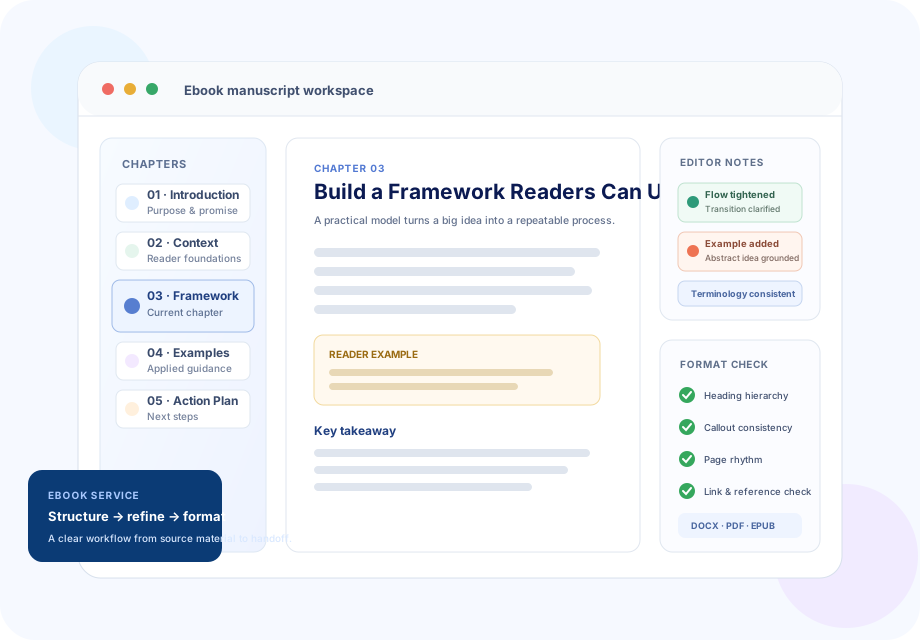
Ebook projects can combine writing, editing, design, and formatting, but charging one low headline price for all four would be misleading. The starting engagement below covers one defined editorial or production workstream and can be expanded into a multi-stage ebook project.
Best suited for: Authors or businesses that already know the immediate next step—such as editing, design refinement, or formatting—and want a clear entry project.
Scope & inclusions
A strong ebook needs more than clean sentences. It needs a defined reader, deliberate sequence, consistent depth, and a format that makes the content easy to navigate.
An Ebook Service connects the editorial and production decisions that are often handled separately. The project can begin with an outline, research, presentations, existing long-form content, or a partial manuscript.
The first priority is to establish what the reader should understand, feel, or be able to do after each chapter. That reader journey then guides chapter order, depth, examples, transitions, and recurring terminology.
During development, content is refined for clarity and progression while repeated ideas, abrupt jumps, thin explanations, and inconsistent framing are flagged or resolved within the agreed scope.
Before handoff, the document is checked for presentation consistency, including heading hierarchy, lists, callouts, figure or table placement where relevant, and final-file requirements.
The exact combination is confirmed after the source material is reviewed. The service can be scoped from focused refinement to broader ebook development.
Purpose, audience, chapter sequence, section hierarchy, and progression across the book.
Development of missing sections or expansion of source material where that work is included in scope.
Sentence clarity, paragraph flow, tone, repetition, terminology, and continuity between sections.
Headings, lists, callouts, captions, tables, figures, spacing, and layout conventions reviewed together.
Visible references, citations, source notes, internal links, and cross-references checked where relevant to the ebook.
Captions, labels, placement, callouts, and explanatory text reviewed for consistency with the surrounding content.
Title page, contents, introduction, acknowledgements, author information, notes, and resource sections where required.
Final document cleanup and agreed ebook-file preparation for the confirmed publishing workflow.
A realistic example shows how an ebook project can move beyond correction into reader-focused development, stronger transitions, clearer examples, and more consistent framing.
The original draft may explain an idea accurately but take too long to reach the practical point. An ebook version can surface the reader benefit earlier, then use a short example to show how the principle works in context.
Instead of repeating the same definition in multiple sections, the chapter can define the term once, then use consistent language whenever it returns. That makes the chapter easier to scan and reduces unnecessary cognitive load.
A final paragraph can also connect the lesson to the next chapter, giving the reader a clear sense of progress rather than an abrupt stop.
The level of intervention depends on what you provide. This example shows a broader development workflow rather than simple proofreading.
The source material contains the right concepts, but the chapter starts broadly, repeats background points, changes terminology, and ends without a clear next step.
Sections are reordered, repeated material is consolidated, examples are positioned where they help comprehension, and the chapter’s key terms are standardised.
The chapter now has a defined purpose, logical progression, consistent terminology, purposeful subheadings, and a final takeaway that leads naturally to the next section.
Choose proofreading for a nearly finished ebook that only needs final language correction. Choose a broader Ebook Service when structure, development, reader flow, or formatting still needs meaningful work.
| Aspect | Proofreading | Full Ebook Service |
|---|---|---|
| Primary focus | Grammar, spelling, punctuation, typos | Reader journey, structure, content depth, editing, consistency, formatting |
| Structural work | Usually not included | Can include chapter sequence, section hierarchy, transitions, and content gaps |
| Content development | No substantive development | Can include development or expansion where confirmed in scope |
| Tone & terminology | Minor consistency checks | Consistent voice, terminology, framing, and examples across chapters |
| Formatting | Basic presentation corrections | Format-aware review of headings, lists, callouts, figures, tables, and final files |
| Best stage | Near-final manuscript | Outline, partial draft, source material, or manuscript needing broader development |
The ebook is treated as a connected reading experience, so front matter, chapters, examples, transitions, conclusions, and supporting elements are reviewed in relation to one another.
Positioning, promise, subtitle, introduction, and reader expectations.
Purpose, sequence, hierarchy, pacing, and continuity.
Clarity, logic, tone, examples, transitions, and reader guidance.
Figures, tables, captions, labels, and explanatory callouts.
Key takeaways, examples, exercises, checklists, and highlighted guidance.
Closing synthesis, next steps, calls to action, and chapter-to-chapter handoff.
Visible reference presentation, resource lists, links, notes, and back matter.
Each project begins with scope. The workflow then moves from reader goals and structure through development, editorial review, formatting, quality control, and final handoff.
Review audience, objective, existing files, draft status, word count, and required outputs.
Define chapter order, section purpose, reader progression, and content gaps.
Develop, expand, consolidate, or reorganise material according to the confirmed scope.
Improve clarity, flow, tone, transitions, consistency, and reader-facing explanation.
Review hierarchy, callouts, lists, visuals, references, links, and document-wide consistency.
Deliver the agreed file set with a clear distinction between editable, review, and final-format files.
Final deliverables depend on the confirmed scope. The file set can combine editable manuscript files, clean review copies, formatting outputs, and clear handoff notes.
A working manuscript file suitable for author review and future content updates.
A clean manuscript reflecting the agreed editorial decisions and final chapter structure.
Comments or action points where author confirmation, source checking, or a content decision is still required.
A fixed-layout review copy where PDF proofing is part of the confirmed project scope.
An ebook-format output can be included where EPUB or another required digital format is confirmed in scope.
A concise record of key consistency, formatting, and unresolved author-action items at delivery.
Quality control moves from the broad reader journey to the small presentation details so the ebook is coherent at both chapter and sentence level.
The editorial approach should match the purpose of the ebook. Reader education, thought leadership, lead generation, practical guidance, and professional reference content all require different structures and levels of depth.
Position an argument, framework, or point of view.
Teach a topic through clear progression and examples.
Turn a process into practical, sequenced guidance.
Organise reference material for repeat use.
Translate research and evidence into accessible long-form content.
Build a focused reader journey around a practical topic or offer.
Structure process, policy, or knowledge content for teams.
Develop connected chapters around a central message or framework.
Your manuscript, instructions, personal details, and unpublished materials should be handled as confidential service information through the designated submission and delivery process.
Project files enter through the designated service workflow.
Unpublished content is treated as confidential service material.
Work remains inside the agreed editorial and production process.
Versions and required outputs are checked before final handoff.
Agreed deliverables are returned through the designated workflow.
You receive the agreed final files and outstanding action notes.
No fixed delivery time is assumed for Ebook Service. Timing should be confirmed after reviewing length, source quality, development depth, formatting complexity, revision needs, and deadline.
Appropriate when there is room for structured development, review, and normal project coordination.
Can be discussed when the scope is defined, source material is organised, and an earlier delivery target is important.
Requires feasibility review first; suitability depends on length, content condition, requested depth, and required file outputs.
Common questions about source material, writing depth, editorial scope, formatting, file types, confidentiality, turnaround, pricing, and what to include in your enquiry.
The service can cover ebook planning, chapter structure, content development or refinement, editorial review, consistency, reader flow, and ebook-format preparation. The confirmed scope depends on the material you provide and the type of ebook you want to create.
Yes. Source material can be reviewed at the start of the project so the work can be scoped around what already exists, what needs to be developed, and what should remain unchanged.
An outline can be used as the starting point. The enquiry should explain your topic, intended reader, desired length, available source material, and any sections you already know you want included.
The service is designed to improve structure, clarity, consistency, and reader experience without changing the intended message. Where meaning is uncertain, editorial notes can flag points that need your decision.
Proofreading is narrower than a full Ebook Service. A full ebook project may require planning, structure, content development, editing, consistency, and formatting in addition to final language checks.
Formatting can be included in the confirmed project scope. Typical checks include heading hierarchy, paragraph styling, callouts, lists, tables or figures where relevant, and consistent presentation across chapters.
The final file set should be agreed during scoping. Editable manuscript files, review PDFs, and ebook-ready formats such as EPUB can be discussed based on the publishing destination and project requirements.
Share the current state of your material. If the content already exists, the focus may be refinement and formatting. If major sections still need to be developed, the project may require a broader ebook-development scope.
Turnaround should be confirmed after the ebook length, source-material quality, required depth, formatting needs, revision expectations, and deadline are reviewed. Turnaround is confirmed after scope review.
Pricing is scope-based. The quote should reflect the current condition of the material, approximate word count, content-development depth, editing needs, formatting requirements, and any special delivery requirements.
Your manuscript, instructions, personal details, and unpublished materials should be handled as confidential service information through the designated submission and delivery process.
Send or describe the topic, intended audience, current word count or target length, source files, draft status, desired output, preferred deadline, references or brand guidance, and any examples that show the style you want.
The page is designed around scope clarity: understand what material exists, define what the ebook still needs, and match the editorial and production work to that requirement.
The current draft, source material, target length, and required outputs are reviewed before the project is priced.
Unpublished manuscript material and instructions are treated as confidential service information through the workflow.
Changes are organised around reader flow, clarity, consistency, and the agreed purpose of the ebook.
Text, headings, callouts, visuals, references, and page-level presentation are considered as one reading system.
The handoff is reviewed for obvious inconsistencies, missing elements, and unresolved author-action items.
Editable, review, and ebook-format files can be separated clearly according to what was included in the confirmed scope.
Share what you have now and what you want the finished ebook to do. The enquiry can then be assessed for scope, file requirements, turnaround feasibility, and pricing.
Useful project details make it easier to distinguish between proofreading, editing, content development, formatting, and a broader end-to-end Ebook Service.
Provide enough detail to assess the current state of your material and the type of support required.
Start with your current material. The scope can be matched to the work the ebook actually needs.