Applicant-Led Voice
Your experiences and intended meaning stay central.

Your experiences. Your voice. A stronger way to present them.
Turn your notes, draft, and application prompt into a focused admissions narrative. Our support helps you choose the right details, build a coherent story, strengthen reflection, and polish the language without inventing experiences or replacing your authentic perspective.
A structured path from application prompt to final review, designed to make each stage purposeful and transparent.
We read the exact prompt, word limit, application context, and any instructions you provide.
Identify the experiences, motivations, values, and evidence that best answer the prompt.
Build a focused opening, logical sequence, reflection points, and a purposeful conclusion.
Develop or strengthen the draft using only the facts and experiences you provide.
Improve paragraph order, transitions, focus, pacing, and connections between ideas.
Refine language so the essay is clear, natural, concise, and consistent with your voice.
Correct grammar, punctuation, repetition, wordiness, and presentation issues.
Review prompt fit, word or character limits, consistency, and final-read readiness.
Admission writing works best when it is specific, reflective, concise, and clearly connected to the exact prompt—not when it simply repeats a résumé.
Choose support based on the document and prompt you are preparing. Each service is adapted to the application context rather than treated as a generic essay template.
Shape an applicant-led narrative around experience, motivation, values, and future direction.
Discuss this serviceConnect academic preparation, interests, program fit, and future goals in a focused structure.
Discuss this serviceTurn a meaningful experience or idea into a concise, reflective application story.
Discuss this servicePresent preparation, motivation, research or professional direction, and program relevance.
Discuss this serviceClarify leadership experiences, professional decisions, career goals, and school-specific fit.
Discuss this serviceBuild a truthful case around achievement, motivation, impact, need, values, or future contribution.
Discuss this serviceAnswer school-specific questions without repeating the same content across every response.
Discuss this serviceExplain lived perspective, community contribution, values, or formative context with specificity.
Discuss this serviceOrganize motivation, qualifications, fit, and next-step goals in a clear professional letter format.
Discuss this serviceCheck language, consistency, prompt compliance, word limits, and final presentation before submission.
Discuss this serviceThe goal is not to manufacture a dramatic story. It is to make genuine information easier to understand, more specific, and more relevant to the application prompt.
Before: “I have always wanted to help people and study healthcare.”
After: “Volunteering at a neighborhood clinic showed me how a short conversation can change whether a patient trusts the next step in care.”
Why it changed: The revision uses an applicant-provided experience to make motivation concrete rather than relying on a broad claim.
Before: “The project was difficult, but I learned a lot from it.”
After: “When our first prototype failed, I learned that asking better questions mattered more than defending my first solution.”
Why it changed: The sentence identifies the lesson and shows how the applicant's thinking developed.
Before: “This university is the perfect place for me to achieve my dreams.”
After: “I now want training that combines responsible design with applied research, so I can test whether the systems I build solve the problems users actually describe.”
Why it changed: The revision replaces an unsupported superlative with a clear academic or professional direction that can then be connected to a specific program.
Strong admissions writing is not just polished English. It requires judgment about what to include, what to leave out, how much context a reader needs, and where reflection should carry the narrative forward.
Use these page sections to understand scope, document type, process, revision depth, and what to prepare before you enquire.
Use your prompt, audience, and application goal to choose one central story rather than a résumé-style list.
ExploreUnderstand whether the application expects academic intent, personal motivation, or a blend of both.
ExploreReview the discovery-to-finalise process and how each stage supports a coherent narrative.
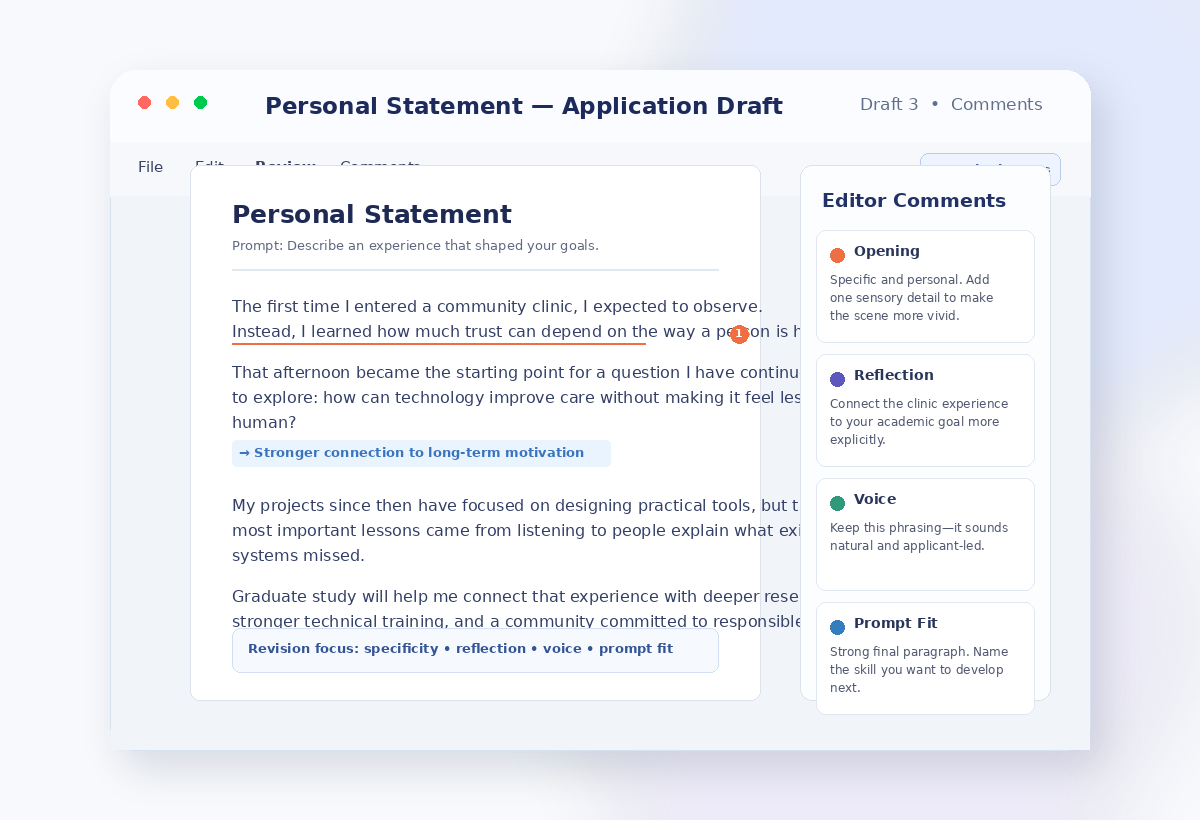
ExploreSee how specificity, reflection, transitions, and voice can be strengthened without inventing facts.
ExploreUse the final review points to check prompt fit, length, language, and factual consistency.
ExploreRead practical guidance on scope, drafts, multiple prompts, pricing, timing, and final review.
ExplorePricing and turnaround are confirmed after the actual scope is reviewed.
Your enquiry is reviewed against the work actually required rather than mapped to an unrelated writing plan.
Providing complete information at the start makes it easier to assess scope and confirm a realistic delivery plan.
Answers to common questions about scope, authenticity, personal statements, statements of purpose, revision, pricing, timing, and final submission review.
The service can support prompt interpretation, story selection, narrative structure, paragraph flow, clarity, tone, concision, and final language review. The work should remain grounded in your own experiences, goals, and truthful application information.
A personal statement usually gives more space to the experiences, motivations, values, and turning points that shaped you, while a statement of purpose generally places more emphasis on academic preparation, professional direction, program fit, and future goals. Always follow the wording and requirements of the specific application prompt.
Yes. You can provide the application prompt, your notes, relevant experiences, goals, and any supporting information you want reflected. The service can help organize those materials into a coherent narrative plan and develop a draft from the information you provide.
No. Admissions writing should be based on accurate information supplied by the applicant. The service can help present genuine experiences more clearly and persuasively, but it should not fabricate credentials, events, research, employment, awards, or personal circumstances.
Yes. An existing draft can be reviewed for prompt fit, focus, structure, transitions, specificity, reflection, tone, word economy, grammar, and overall readability. Revisions can be made while preserving the central meaning and applicant voice.
Yes, where the prompts genuinely overlap. Each version should still be checked against the exact question, word limit, program context, and evidence required by that application rather than simply reusing one generic essay unchanged.
The service can be used for a range of application-writing needs, including undergraduate essays, postgraduate personal statements, statements of purpose, MBA essays, scholarship essays, transfer essays, and program-specific supplemental responses.
Yes. Language review can focus on clarity, grammar, sentence flow, word choice, and concision while keeping the wording consistent with the applicant's intended voice. The aim is a polished essay that still sounds like the person whose experiences it describes.
Send the exact essay prompt or question, the word or character limit, your current draft or notes, the program or application type, your deadline and time zone, and any background information you want considered. If you have multiple prompts, label them clearly.
Pricing and turnaround are confirmed after the scope is reviewed. Factors may include the number of essays or prompts, current draft quality, required level of writing or revision, total word count, application instructions, and deadline. Pricing and turnaround are confirmed after scope review.
No. Admissions and scholarship decisions depend on many factors outside the writing service, including academic record, experience, recommendations, test scores where applicable, institutional priorities, and the applicant pool. The service focuses on improving the clarity and presentation of the written application materials.
Yes. A final review can check grammar, punctuation, spelling, consistency, prompt compliance, word or character limits, obvious repetition, and presentation issues. You should still perform your own final factual review before submission.
Tell us what you are applying for, what the prompt asks, what material you already have, and where you need help. The enquiry can then be reviewed for scope, deadline feasibility, and the most appropriate support.
Paste the exact question and include the word or character limit.
Describe whether you have notes, an outline, a partial draft, or a complete draft.
Share the real experiences, goals, achievements, and context the essay may draw from.
Provide your exact requested submission date and time zone for feasibility review.
Use the form below to describe your application writing needs. Do not include sensitive personal information that is not necessary for a first scope review.
Bring your prompt, notes, experiences, and current draft. We can help you turn them into a clearer, more focused application narrative.