Donor Opportunity Assessment
Review the call, eligibility conditions, priorities, evaluation criteria, mandatory sections and attachments before committing to a proposal direction.

Develop stronger funding applications with a structured proposal process that connects donor priorities, programme logic, evidence, results, budgets and compliance requirements into one coherent submission package.
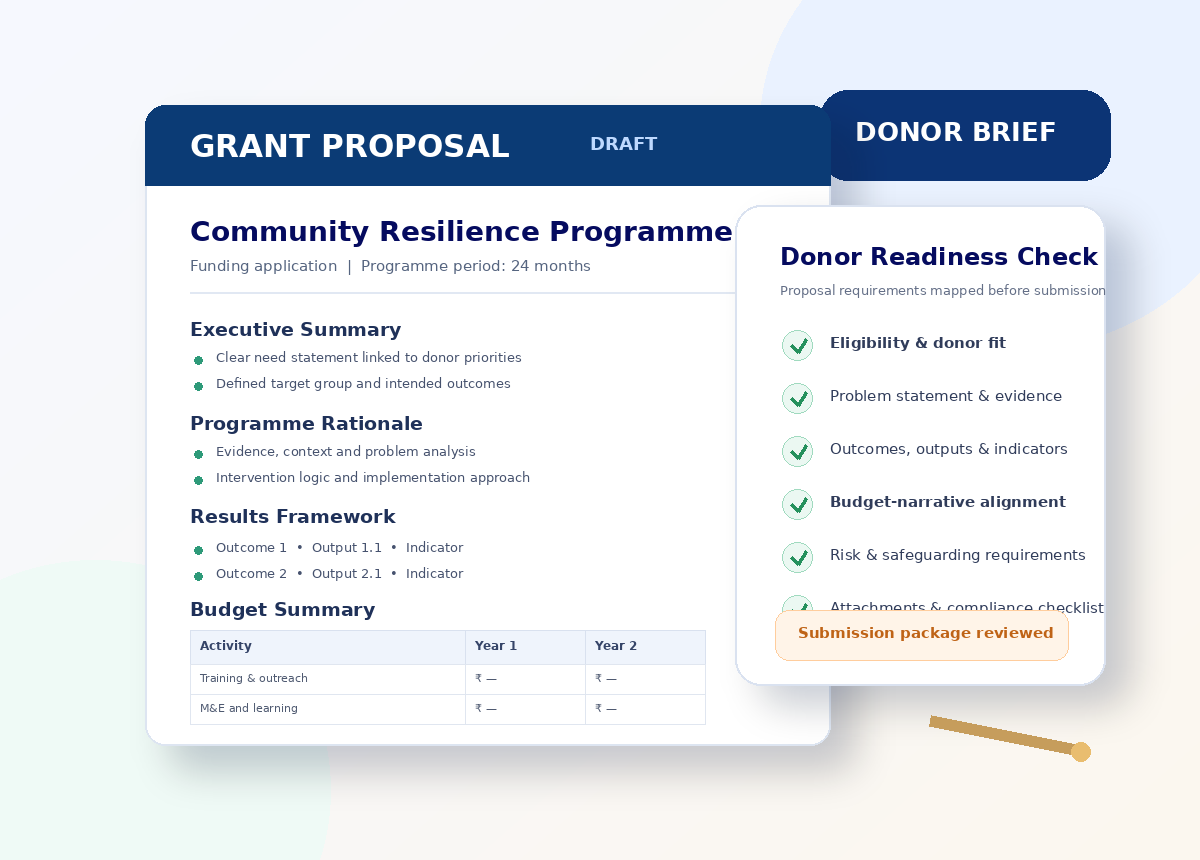
Requirements mapped to the application structure
Need, intervention and results connected clearly
Activities, costs and written justification kept consistent
Proposal material treated as client-confidential content
Funding-application project minimum
Full funding applications vary sharply by donor template and supporting components. The entry point therefore covers a genuine concept-note or defined application assignment, while larger proposals remain scope-based.
for one defined donor application or concept-note scope
Best fit: NGOs and institutions preparing a new funding application that need donor-requirement mapping, narrative development and a review-ready submission draft.
When the quote changes: Long-form RFPs, multi-partner bids, extensive research, full logframes, detailed budgets, multiple annexes and very short donor deadlines are quoted after document review.
From assessing a donor opportunity to checking the final submission package, the service is organised around the components that make institutional grant proposals easier to understand, evaluate and review.
Review the call, eligibility conditions, priorities, evaluation criteria, mandatory sections and attachments before committing to a proposal direction.
Clarify the funding ask, target population, geography, programme positioning, partnership logic and strongest fit with the donor's stated priorities.
Develop a coherent donor-facing narrative covering the problem, intervention, beneficiaries, implementation approach, sustainability and organisational role.
Structure activities, outputs, outcomes, indicators, assumptions and causal links so the programme logic is explicit and internally consistent.
Connect activities and cost categories to the written proposal, clarify budget assumptions and check that narrative explanations match the funding logic.
Develop results-oriented indicators, data sources, review points and learning language that fit the proposal's outcomes and donor requirements.
Cross-check the application against supplied donor instructions for mandatory content, formats, declarations, supporting documents and submission conditions.
Review coherence across narrative, logframe, budget, indicators and attachments, then flag gaps or inconsistencies for the client's final approval.
The process follows the logic of the supplied donor opportunity, moving from fit and requirements through narrative development, review and final handover.
Clarify mission, programme idea, funding need and organisational context.
Review donor fit, eligibility, criteria, instructions and deadlines.
Define the proposal angle, target group, results and evidence plan.
Map sections, logframe, workplan, budget logic and attachments.
Develop the narrative using supplied facts, evidence and programme inputs.
Check clarity, consistency, donor alignment, evidence and compliance.
Resolve gaps, align supporting components and prepare the final package.
Provide the completed material for client approval and submission.
A strong proposal does more than polish sentences. It connects the need, intervention, results and donor priorities so the reader can follow why the programme matters and how it will work.
“We want to train communities so they can improve their livelihoods and become more resilient.”
“The programme will combine skills training, market linkage and follow-up mentoring for the defined target group, with outputs and outcome indicators linked to the donor's stated resilience objective.”
The revised version identifies the intervention components, intended group, results logic and connection to donor priorities without inventing evidence or outcomes that the organisation has not supplied.
Proposal development combines narrative work with programme design, results logic, donor compliance, evidence and supporting documents. The exact mix depends on the funding opportunity.
Use the page sections below to understand the service, review the proposal workflow or share a specific donor opportunity for a scoped discussion.
Proposal work is handled through a clear, professional process designed to support institutional decision-making without overstating what a funding application can guarantee.
Practical answers about proposal scope, donor requirements, budgets, timelines, confidentiality and what the service can—and cannot—promise.
The service supports the development and refinement of donor-facing funding applications, including opportunity fit, proposal structure, problem statement, programme logic, outcomes and outputs, workplan, monitoring and evaluation content, budget narrative, risk and compliance checks, and final submission-readiness review.
Yes. A donor call, RFP, concept note template, application form, or guideline document can be used to map the required sections, eligibility conditions, evaluation criteria, attachments, and submission requirements before drafting begins.
Yes. Existing drafts can be reorganised and strengthened for donor alignment, clarity, evidence, logical flow, consistency across sections, and compliance with the application instructions you provide.
Yes. The service can support concise concept notes and longer proposals. The exact structure follows the donor template or application requirements supplied for the opportunity.
Yes. Proposal support can include a logical framework, Theory of Change, results chain, outcome/output structure, indicators, assumptions, and links between activities and expected results where these are required by the donor.
The service can help align the written proposal with the budget structure, cost categories, activity logic, and budget narrative. Financial figures and organisational approvals remain the client's responsibility.
The proposal workflow can include a checklist against the donor documents you provide, covering eligibility, mandatory sections, attachments, formatting, declarations, and other stated submission requirements. This is a document-alignment service and not legal or regulatory advice.
Useful inputs include the donor guideline or application link, organisation background, programme idea, target geography and beneficiaries, evidence or baseline information, proposed activities, expected results, budget assumptions, existing documents, partnerships, and the submission deadline.
Contentxprtz grant and donor proposal projects start from ₹25,000 for one defined application or concept-note scope. Full proposals are quoted according to donor requirements, length and supporting components; typical starter-scope delivery is 7–12 business days.
Contentxprtz grant and donor proposal projects start from ₹25,000 for one defined application or concept-note scope. Full proposals are quoted according to donor requirements, length and supporting components; typical starter-scope delivery is 7–12 business days.
No. Funding decisions are made by donors and depend on factors outside the writing process. The service focuses on making the application clearer, better aligned to the supplied requirements, internally consistent, and ready for the client's final approval and submission.
Client proposal materials are handled as confidential working documents and should be shared only through channels your organisation is authorised to use.
Share the donor opportunity, proposal stage, funding objective and submission deadline. The information below helps determine the likely scope and the components that may need development or review.
The more complete the starting information, the easier it is to assess the proposal work accurately.
Provide enough information to understand the donor opportunity and the stage of your application. Do not submit confidential material unless you are authorised to share it through this channel.