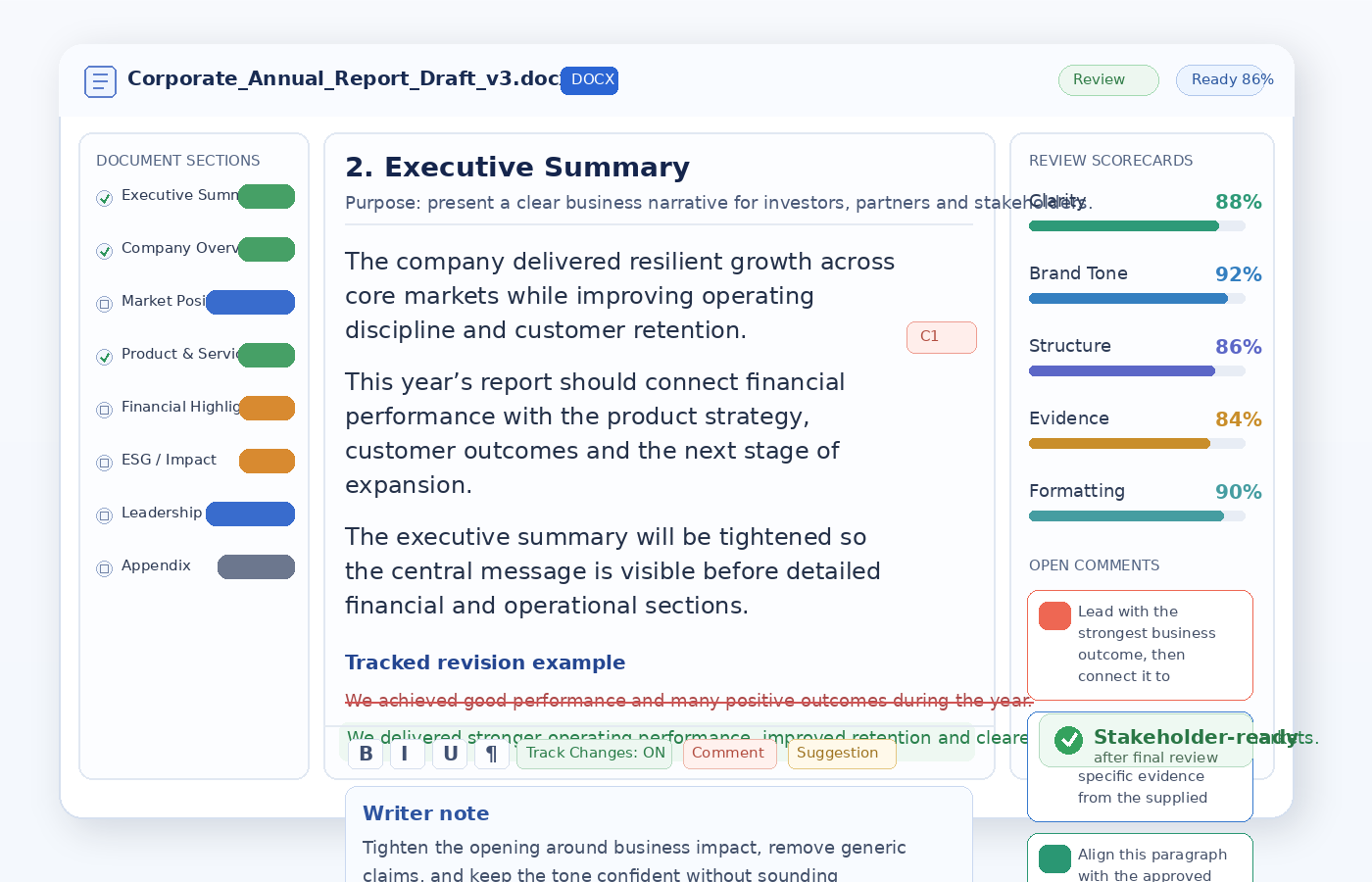
Corporate Writing Service for Clear, Credible Business Communication
★★★★★4.8 rating from Researchers, Authors, Students, and Scholars
Turn briefs, source material, existing drafts, and business inputs into structured corporate content that is easier to read, easier to review, and better aligned with its audience, purpose, and brand voice.
Audience-first structure and message hierarchy for business-facing documents
Professional corporate tone, terminology, and brand-voice alignment
Writing, rewriting, and refinement for reports, web copy, sales content, and campaigns
Clear review notes and tracked changes when an existing draft is revised
Business-focused supportWriting shaped around audience and purpose
Confidential handlingInternal and unpublished material treated carefully
Structured reviewClarity, consistency, tone, and presentation checks
Clear deliverablesClean copy with review notes where relevant
Project pricing · scope · delivery
Corporate Writing Service Project Pricing
The commercial starting point for Corporate Writing Service is a project minimum, not an unbounded custom quote. It covers an initial scope for this requirement: A defined corporate-writing engagement for one substantial business document or a small coordinated set of business content assets.
Initial Project Scope
Projects from ₹10,000
for a defined initial engagement
Suitable for: A defined corporate-writing engagement for one substantial business document or a small coordinated set of business content assets.
Brief, audience and business-objective review
Content structure and message plan
Writing of the agreed document or asset set
Editorial quality and terminology consistency review
Final clean copy in the requested working format
Typical deliveryTypical focused engagement: 5–8 business days
Common writing problems can make an otherwise strong business message feel generic, fragmented, difficult to approve, or hard for the intended reader to act on.
Unclear Purpose or Audience
The document tries to say too much without a clear reader, business goal, or decision in mind.
Weak Message Hierarchy
Important points are buried, repeated, or presented without a logical order that guides the reader.
Inconsistent Brand Voice
Different sections sound as if they were written by different teams, creating an uneven corporate tone.
Vague or Generic Claims
Statements rely on broad adjectives instead of specific context, evidence, examples, or business relevance.
Poor Data-to-Story Connection
Facts, figures, product information, or source material appear without a clear narrative or explanation.
Review & Formatting Friction
Stakeholder comments, terminology, headings, references, and presentation details are not aligned before delivery.
2
What This Corporate Writing Service Covers
The exact workflow depends on your brief, but corporate writing typically moves from audience and message definition through structure, drafting, refinement, consistency checks, and final delivery.
1
Brief & Audience
2
Purpose & Message
3
Source Inputs
4
Outline & Structure
5
Executive Summary
6
Draft Development
7
Brand Voice
8
Product / Service Messaging
9
Report Narrative
10
Sales & Campaign Copy
11
Editing & Rewriting
12
Data & Evidence Context
13
Terminology & Consistency
14
Formatting & Presentation
15
Final Delivery
Ready to move forward with Corporate Writing Service?Purchase the service and continue with your project brief, files, and delivery requirements.
A corporate writing engagement can move from rough, internally focused material to a structured draft with review notes and then to clean, stakeholder-ready business copy.
Before — Rough Internal Draft
“We had a good year and launched many things. Customers liked our services and we improved a lot. The company is growing and we expect more opportunities next year.”
Generic claims without business context
No clear stakeholder audience
Weak connection between outcomes and strategy
No hierarchy for the key message
→
During — Annotated Corporate Draft
During the year, the company strengthened performance across priority markets while improving customer retention and operating discipline.
The revised opening links business outcomes to the strategic priorities explained in the following sections.
The next paragraph should identify the most relevant evidence from the supplied report instead of repeating broad growth language.
Comment: clarify the strongest business outcome.Suggestion: connect the claim to supplied evidence.Refinement: align wording with approved brand tone.
→
After — Clean Final Copy
“The company strengthened performance across priority markets while improving customer retention and operating discipline. The year’s progress reflects a sharper focus on core services, customer outcomes, and the priorities guiding the next stage of growth.”
Clearer business message
Stronger hierarchy and flow
More professional corporate tone
Better connection between outcomes and strategy
4
What Makes This Different from Proofreading or Language Editing
Corporate writing addresses the business message and document architecture as well as language quality. The comparison below shows the typical difference in depth.
Support Dimension
Proofreading
Language Editing
Corporate Writing Service
Purpose & audience framing
×
×
✓
Message hierarchy & document structure
×
Limited
✓
Draft development from briefs or source material
×
×
✓
Corporate tone & brand-voice alignment
Limited
✓
✓
Product, service, sales & campaign messaging
×
×
✓
Executive-summary and report narrative development
×
×
✓
Grammar, syntax, punctuation & clarity
✓
✓
✓
Terminology & document-wide consistency
Basic
✓
✓
Formatting / presentation consistency
Basic
As scoped
As scoped
Best for
Final correctness check
Language polish
Complete business-content development or rewrite
5
Corporate Documents and Content We Support
The service is designed for business-facing writing where clarity, structure, professional tone, messaging, and presentation matter.
Corporate Reports
Structured reporting content with clear section logic, concise explanation, and stakeholder-focused narrative.
Brochures & Corporate Profiles
Company, capability, and service content shaped around audience needs, positioning, and readable presentation.
Website & Landing-Page Copy
Business-facing web copy that explains services, value, proof points, and next actions in a clear hierarchy.
Product & Service Messaging
Clear descriptions, positioning language, benefits, supporting context, and sales-facing communication.
Sales & Business-Development Copy
Persuasive business communication for outreach, service presentation, proposals, and conversion-oriented materials.
Email & Campaign Copy
Professional campaign and email content with a defined message, audience, sequence, and call to action.
Executive Summaries & Briefs
Concise high-level summaries that surface key messages, implications, priorities, and decision-relevant context.
Corporate & Brand Communication
Professional content that keeps tone, terminology, messaging, and presentation consistent across business materials.
Ready to move forward with Corporate Writing Service?Purchase the service and continue with your project brief, files, and delivery requirements.
A structured workflow keeps the business objective, source material, writing depth, review requirements, and final deliverable aligned from the start.
1
Submit Brief & Materials
Share the objective, audience, source material, existing draft, brand guidance, and deadline.
2
Scope & Audience Review
The brief is reviewed to clarify purpose, reader expectations, content stage, and required depth of support.
3
Writer / Editor Allocation
The work is allocated according to the document type, communication goal, and required writing or revision depth.
4
Content Architecture
A logical hierarchy is established for headings, sections, message flow, and the reader journey.
5
Draft Development
Content is drafted, rewritten, expanded, condensed, or reorganised according to the confirmed brief.
6
Review & Refinement
Clarity, tone, flow, repetition, messaging, and stakeholder-facing readability are refined.
7
Consistency & Presentation Check
Terminology, headings, formatting, supplied references, tables, and presentation details are checked where relevant.
8
Final Delivery
The clean corporate document is prepared for handoff, with review notes or tracked changes where applicable.
7
What You Need to Share and What You Receive
Better source material and clearer instructions help keep the corporate writing accurate, efficient, and aligned with your organisation’s expectations.
What You Need to Share With Us
✓Business objective and target audience
✓Existing draft, rough notes, outline, or source material
✓Approved facts, figures, references, links, and supporting documents
✓Brand guidelines, tone examples, preferred terminology, or style notes
✓Required document format, headings, template, or presentation rules
✓Stakeholder comments or revision instructions, where applicable
✓Target deadline and any internal review milestones
✓Priority concerns such as clarity, structure, tone, concision, or messaging
What You Receive
✓Clean corporate draft prepared for your next review or use
✓Tracked changes when an existing document has been revised
✓Writer or reviewer comments where clarification or stakeholder action is needed
✓Improved structure, message flow, headings, and content hierarchy where in scope
✓Corporate tone and terminology consistency across the document
✓Formatting and supplied-reference consistency checks where requested
W
Ready to move forward with Corporate Writing Service?Purchase the service and continue with your project brief, files, and delivery requirements.
A multi-stage review checks the document from business purpose and structure through language, consistency, formatting, and final delivery readiness.
1
Brief & Audience Check
Checks the purpose, intended reader, source inputs, and requested output before drafting begins.
2
Structure Review
Checks hierarchy, sequence, section purpose, transitions, and the overall logic of the document.
3
Corporate Tone Pass
Refines clarity, concision, professional tone, brand language, and reader-appropriate wording.
4
Source & Data Consistency
Cross-checks supplied facts, labels, terminology, tables, and source references for internal consistency.
5
Formatting & Reference Check
Reviews headings, numbering, formatting, links, citations, and reference presentation when they are part of the brief.
6
Final Verification
A final pass checks readability, obvious errors, requested revisions, and delivery readiness.
Review Complete
9
Corporate Content Contexts and Confidential File Handling
Corporate writing often involves internal business information, draft messages, unpublished reports, brand materials, and stakeholder comments. The working process should treat these materials as confidential service information.
Corporate Content Contexts
Leadership & Company Messaging
Reports & Corporate Publications
Product & Service Communication
Sales & Business Development
Website & Landing-Page Copy
Email & Campaign Communication
Brochures & Profile Content
Brand Tone & Terminology
Confidentiality & File Handling
Share internal or unpublished material only through the designated service and document-submission process.
Clearly identify sensitive sections, confidential source files, or information with restricted internal circulation.
Access to working documents should be limited to people involved in the service workflow.
Source material should be used only to complete the requested writing, rewriting, review, and delivery work.
Final facts, regulated claims, financial statements, legal language, and public disclosures remain subject to your organisation’s approval.
Ready to move forward with Corporate Writing Service?Purchase the service and continue with your project brief, files, and delivery requirements.
Turnaround, Custom Quote and Frequently Asked Questions
Because corporate writing scope can vary substantially by document stage, source material, length, review depth, and deadline, the delivery schedule and quote are confirmed after the brief is reviewed.
Turnaround Planning
Share the date you need the content and the stage it is currently in. Feasibility is assessed against the required writing depth and source-material complexity.
Share DeadlineProvide target date, time zone, and internal milestones.
Assess ScopeLength, inputs, writing depth, and review needs are evaluated.
Confirm ScheduleA realistic delivery plan is agreed before work begins.
Custom Scope Factors
The published pricing above covers the stated entry scope; larger requirements are quoted after reviewing the actual workload.
Total word count, pages, or content volume
Current stage: notes, outline, partial draft, or developed document
Depth of writing, rewriting, or restructuring required
Amount and complexity of source material to synthesise
Brand, stakeholder, formatting, or reference requirements
Number of content components, tables, or supporting elements
1. What does the Corporate Writing Service include?+
The service can support corporate content planning, structure, drafting, rewriting, tone refinement, message hierarchy, clarity, consistency, and final presentation. The exact scope is confirmed from your brief, source material, document stage, audience, deadline, and required deliverable.
2. How is corporate writing different from proofreading?+
Proofreading is mainly a final-stage correctness check for spelling, grammar, punctuation, and obvious consistency issues. Corporate writing can go much further by developing or reorganising content, strengthening message hierarchy, refining brand voice, and shaping the document around a business audience and purpose.
3. Can you work from rough notes or an existing draft?+
Yes. A brief may begin with notes, source material, an outline, a partial draft, or an established corporate document that needs rewriting. The level of writing support depends on how complete the existing material is and what the final document needs to achieve.
4. What kinds of corporate documents can be supported?+
Typical business-facing needs include reports, brochures and profiles, website and landing-page copy, product and service messaging, sales and business-development content, email and campaign copy, executive summaries, and broader corporate communication.
5. Can the writing follow our brand voice?+
Yes, when you provide brand guidelines, tone examples, terminology preferences, approved messaging, or comparable company materials. These inputs help the writer maintain a more consistent corporate voice across the document.
6. Do you rewrite existing corporate content?+
Yes. Existing material can be rewritten for clarity, concision, flow, audience fit, tone, message hierarchy, and consistency while preserving the underlying business meaning and supplied facts.
7. Can you help make technical or complex information easier to read?+
The writing can be reorganised and explained more clearly for the intended business audience, provided the necessary technical source material and context are supplied. Subject-matter accuracy remains dependent on the information and approvals provided by your team.
8. Will you verify every business fact or claim?+
The service can check consistency against the source material you provide, but it should not be treated as an independent audit, legal review, financial verification, or factual certification. Your organisation remains responsible for approving final facts, claims, figures, and regulated statements.
9. How is pricing calculated?+
A custom quote is based on factors such as document length, current content stage, writing depth, source-material complexity, number of content components, formatting needs, requested review depth, and deadline. The published Corporate Writing Service project minimum above is ₹10,000 for a defined initial engagement; larger or more complex requirements are confirmed after scope review.
10. How long will the work take?+
Turnaround is confirmed after reviewing the document length, amount of source material, level of drafting or rewriting required, formatting requirements, stakeholder review needs, and requested deadline. Share your target date with the enquiry so feasibility can be assessed.
11. What will I receive at delivery?+
Depending on the confirmed scope, delivery may include a clean editable corporate document, tracked changes when an existing draft has been revised, and concise writer or reviewer notes where clarification or stakeholder action is needed.
12. How should I submit confidential or unpublished business material?+
Use the designated enquiry and document-submission process and clearly flag sensitive or unpublished material. Corporate files and instructions should be handled as confidential service information through the working and delivery process.
Request a Corporate Writing Quote
Tell us what you are creating, who will read it, what material already exists, and when you need the final content. This helps define the appropriate writing depth and delivery plan.
Purpose & audienceExplain what the document needs to achieve and who will read or approve it.
Source materialDescribe the notes, existing draft, references, data, brand guidance, or templates available.
Writing depthIndicate whether you need drafting from source material, major rewriting, or focused refinement.
Deadline & deliverableShare your target date, required file format, and any internal review milestones.
Ready to Strengthen Your Corporate Communication?
Share your brief, draft, source material, audience, and deadline. We’ll use those details to scope the writing support your document requires.