Goal Discovery
Clarify the target programme, role, fellowship, scholarship, or career objective.

Professional writing, editing, structure, and presentation support for the documents that shape academic and career decisions—from statements of purpose and personal statements to academic CVs, resumes, cover letters, research statements, teaching statements, bios, and recommendation-letter materials.
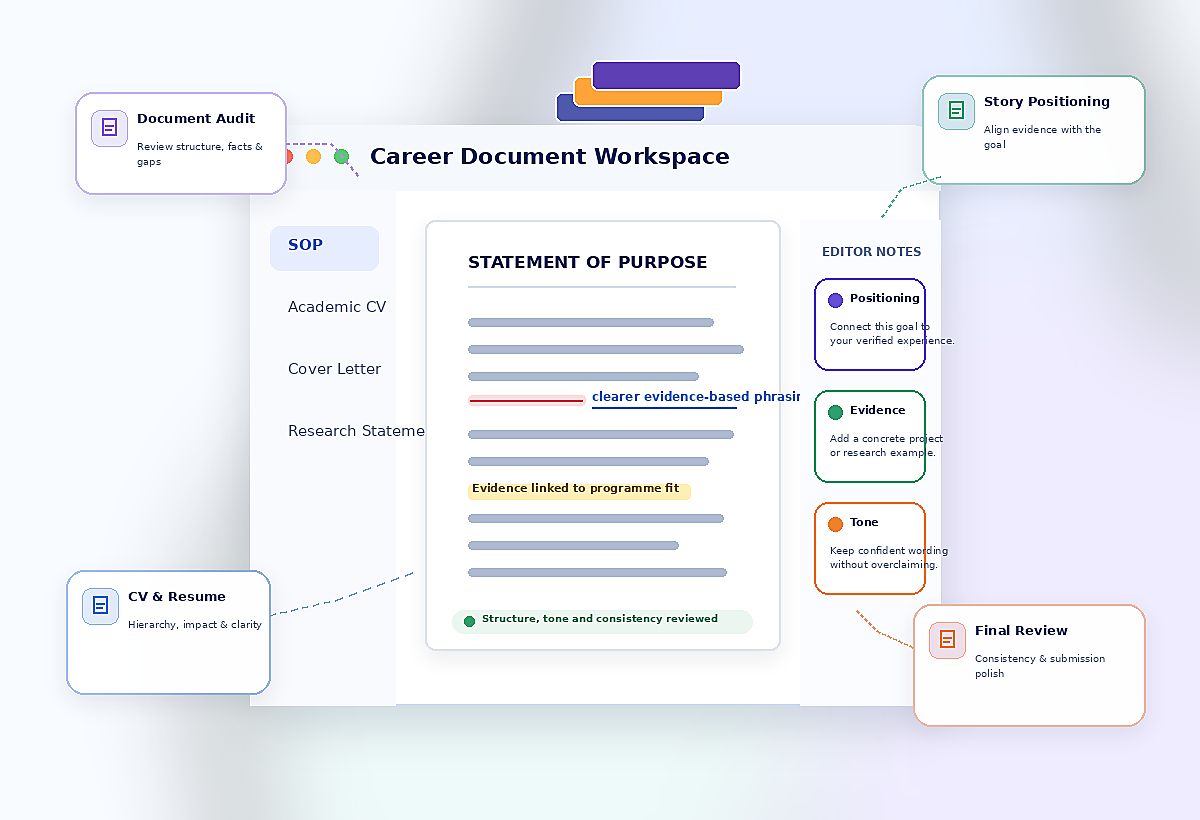
A structured workflow moves from your target opportunity and verified background to a clear, coherent, application-ready document set.
Clarify the target programme, role, fellowship, scholarship, or career objective.
Review the current draft, prompt, requirements, gaps, overlap, and factual inputs.
Identify the education, projects, research, skills, outcomes, and experiences that support the application.
Organise the document around a logical narrative, hierarchy, or section sequence.
Develop or reshape content using the verified facts, goals, and source material you provide.
Refine clarity, concision, confidence, transitions, and professional or academic tone.
Check section order, spacing, dates, terminology, headings, and cross-document consistency.
Complete a final clarity and presentation check before the document is returned for your review.
Academic career documents have different purposes, but they all need a clear link between your real background, the target opportunity, and the evidence that supports your fit.
Choose the document you need help with, or submit a set of related materials when the application requires a consistent story across multiple documents.
Structure education, research, publications, presentations, awards, teaching, service, and relevant academic experience clearly.
Discuss your CV →Present relevant experience, responsibilities, skills, and outcomes in a concise, role-focused professional format.
Discuss your resume →Connect your preparation, interests, goals, evidence, and programme fit in a coherent statement with a clear narrative direction.
Discuss your SOP →Shape an authentic account of your experiences, perspective, motivation, growth, and suitability for the opportunity.
Discuss your statement →Explain why the opportunity matters, what you bring, and how it connects to your next academic or professional step.
Discuss your letter →Build a focused case for fit by connecting your experience and evidence to a specific role, institution, or opportunity.
Discuss your cover letter →Organise your research focus, methods, contributions, trajectory, and future agenda for academic or research-facing applications.
Discuss your research statement →Present your teaching philosophy, methods, evidence, inclusion practices, course experience, and approach to student learning.
Discuss your teaching statement →Create a concise professional biography for academic pages, conferences, speaking engagements, publications, or programme profiles.
Discuss your bio →Improve structure, evidence prompts, clarity, and presentation while keeping the final recommendation grounded in the recommender's authentic assessment.
Discuss LOR materials →Strong application documents are not built from generic claims. They use clear evidence, purposeful structure, and wording that matches the actual target and the applicant's verified experience.
“I have always been passionate about research and want to study at a good university.”
After“My work on a final-year materials project led me to focus on surface characterisation, and I now want graduate training that connects experimental methods with applied materials research.”
“Worked on data analysis for a research project.”
After“Analysed survey data for a faculty-led project, prepared summary tables, and documented the workflow used for the team's internal review.”
“I believe I am a good fit for this position and have relevant skills.”
After“The role's emphasis on stakeholder research aligns with my experience synthesising interview findings into recommendations for a cross-functional project team.”
Examples are illustrative. Final wording should always reflect the applicant's real experience, verified facts, and target requirements.
The work is centred on clarity, evidence, authentic voice, and document purpose—not generic templates or exaggerated claims.
Share the document type, target opportunity, and the support you need.
Discuss Your RequirementUse the page sections below to identify the document type, support level, and information that will help make your enquiry specific.
Review what belongs in an academic CV and how the hierarchy differs from a short professional resume.
Explore →See how a statement of purpose connects preparation, evidence, goals, and programme fit.
Explore →Understand how personal evidence, context, motivation, and growth can be organised without generic claims.
Explore →Review the core elements used to explain research direction, contributions, methods, and future trajectory.
Explore →See how a cover letter can connect your evidence directly to the priorities of a particular role.
Explore →Review the ethical boundary between improving presentation and preserving the recommender's authentic assessment.
Explore →Answers to common questions about scope, documents, source material, authenticity, formatting, and the enquiry process.
The service can support document strategy, structure, drafting or rewriting, language refinement, evidence presentation, consistency, and final presentation for relevant academic and career application documents. The exact work depends on the document, its current stage, and the requirements you provide.
Common documents include academic CVs, professional resumes, statements of purpose, personal statements, motivation letters, cover letters, research statements, teaching statements, academic bios, and recommendation-letter materials.
Yes. You can submit an existing draft for review, restructuring, rewriting, language refinement, or final presentation support depending on what the document needs.
You can provide verified facts, achievements, target details, and notes so the document can be planned and structured around your actual background and application goal.
No. The service should work from accurate information you provide and strengthen how genuine experience, evidence, goals, and qualifications are communicated.
Yes, when you provide the relevant prompt, role description, programme information, or application instructions, the document can be aligned to those requirements while remaining accurate to your background.
The service can support structure, evidence prompts, clarity, and language for recommendation-letter materials, but the final letter should reflect the recommender's authentic assessment and verified knowledge of the applicant.
Yes. Related application documents can be reviewed for consistent facts, dates, terminology, positioning, and complementary messaging without making every document sound identical.
Yes. Formatting support can improve hierarchy, section order, spacing, consistency, readability, and presentation while keeping the document appropriate to its purpose.
Useful materials include the current draft, verified education and experience details, achievements, target programme or role, application prompt, required length, relevant instructions, and any concerns you want addressed.
The service is designed to improve clarity, structure, and presentation while keeping the document grounded in your facts, intent, and authentic professional or academic voice.
Use the enquiry form on this page and describe the document type, target opportunity, current stage, relevant requirements, and the help you need. Include enough detail for the request to be assessed accurately.
Tell us what document you are preparing, the target opportunity, the current stage of your draft, and the specific support you need.
Academic CV, SOP, personal statement, resume, cover letter, research statement, teaching statement, bio, or LOR material.
Share the university, programme, role, scholarship, fellowship, research position, or other application context.
Tell us whether you have a full draft, partial draft, outline, notes, or verified background information only.
Include relevant education, projects, research, work, skills, achievements, and outcomes that can support the document.
Provide the deadline, word or page limit, prompt, formatting instruction, or application requirement where applicable.
Highlight the areas that need attention: structure, evidence, tone, clarity, concision, consistency, formatting, or final review.
Share your contact details and requirements below so the request can be reviewed in the context of your document type and target opportunity.
Bring your draft, notes, verified background, and target requirements. We can help turn them into a clearer, more coherent document set.