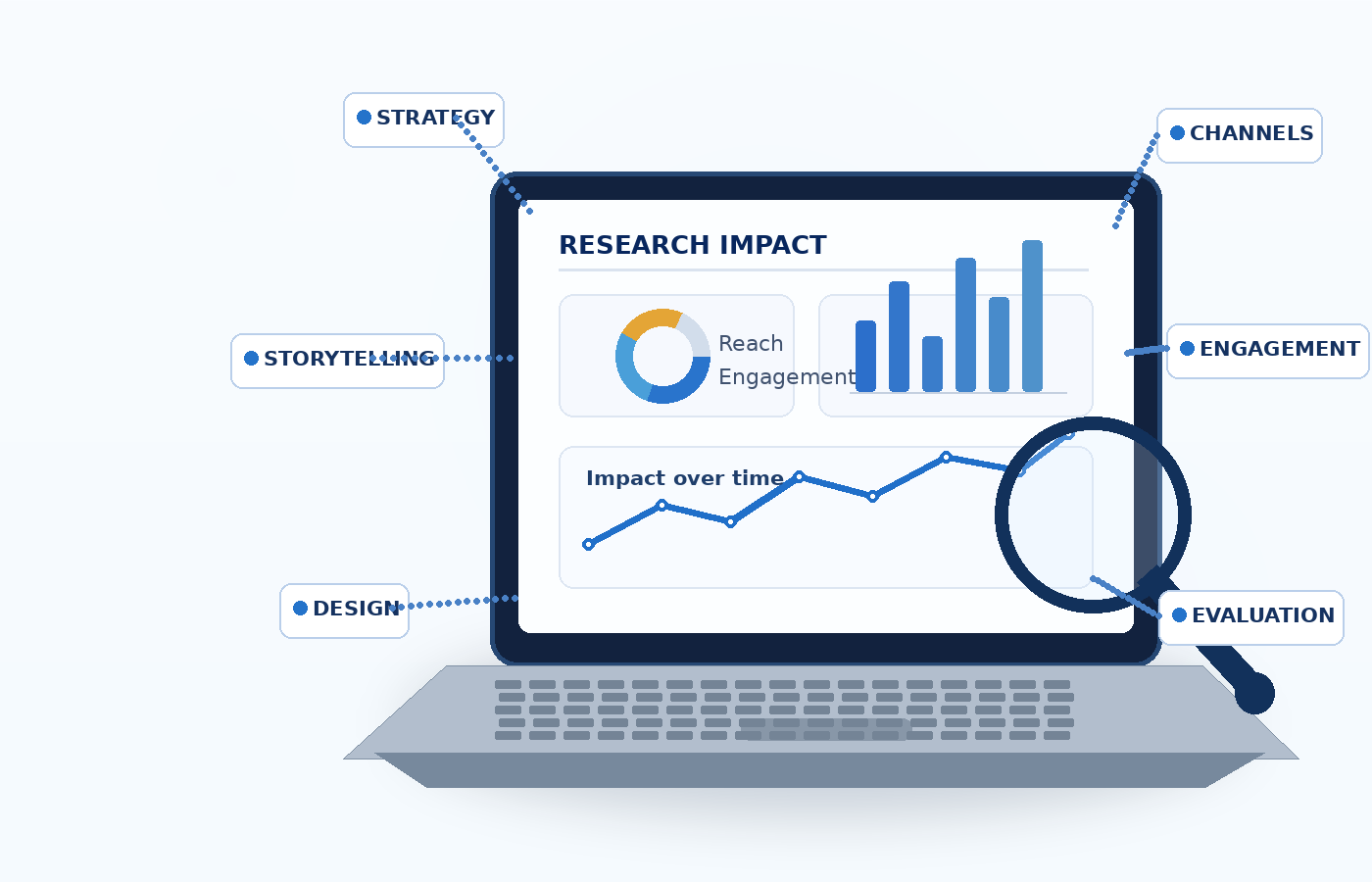
What is a Research Communication & Impact Service?+
It is a structured service that helps turn research findings, evidence and technical information into clear audience-ready communication, distribute it through appropriate channels, and measure how the communication performs.
Who is this service designed for?+
It supports researchers and academics, universities and research institutes, NGOs and non-profits, government and public agencies, foundations and donors, science and health organizations, think tanks and policy groups, and industry and innovators.
What types of research content can you create?+
Deliverables can include research summaries, plain-language briefs, impact stories, case studies, infographics, data visualizations, posters, reports, whitepapers, fact sheets, presentations, pitch decks, web content, landing pages, social content, campaigns, press kits, media materials and impact reports.
Can you translate technical research for non-specialist audiences?+
Yes. Message and narrative development, scientific writing and editing, and visual communication can translate complex evidence into clearer content for specific audiences without losing the intended research meaning.
Do you support research dissemination across multiple channels?+
Yes. Distribution can be planned across websites and blogs, email campaigns, social media, webinars and events, media outreach, reports and publications, conferences and partnerships.
Can you help define an impact measurement framework?+
Yes. The service can define suitable measures, collect and interpret communication data, and report on outputs, outcomes and impact using an input-to-impact framework.
What is the six-stage process?+
The process covers discovery, research and analysis, strategy, creation, distribution and evaluation so communication is planned from audience understanding through to measurement and optimization.
Which tools and capabilities are used?+
Capabilities include data analysis, visualization, infographics, illustration, presentation design, content systems, SEO and analytics, and CRM and outreach. Tools may include Tableau, Power BI, Illustrator, InDesign, Canva Pro, Figma, WordPress, Google Analytics and Mailchimp.
What engagement models are available?+
The service can be structured as project-based, retainer-based, campaign-based or a strategic partnership, depending on whether the need is one-time, ongoing, event-led or long-term.
How does a typical engagement progress?+
The supplied engagement model begins with discovery and research in weeks 1–2, strategy and planning in weeks 3–4, content creation and design in weeks 5–8, distribution and launch in weeks 9–10, followed by ongoing evaluation and optimization.
Can the service support policy, funding or public-awareness objectives?+
Yes. Use cases include policy and advocacy communication, grants and funding support, public awareness, academic visibility, health and science communication, and corporate or ESG communication.
What information should I provide for an enquiry?+
Share your research topic, target audiences, communication objective, available evidence or source material, priority channels, desired deliverables, important dates and any brand, funder or publication requirements.