Structured Page Systems
Grids, margins, spacing, and repeatable templates

Turn approved content into a clear, consistent publication with purposeful page architecture, typography, visual hierarchy, tables, figures, front and back matter, pagination, and production-focused export preparation.
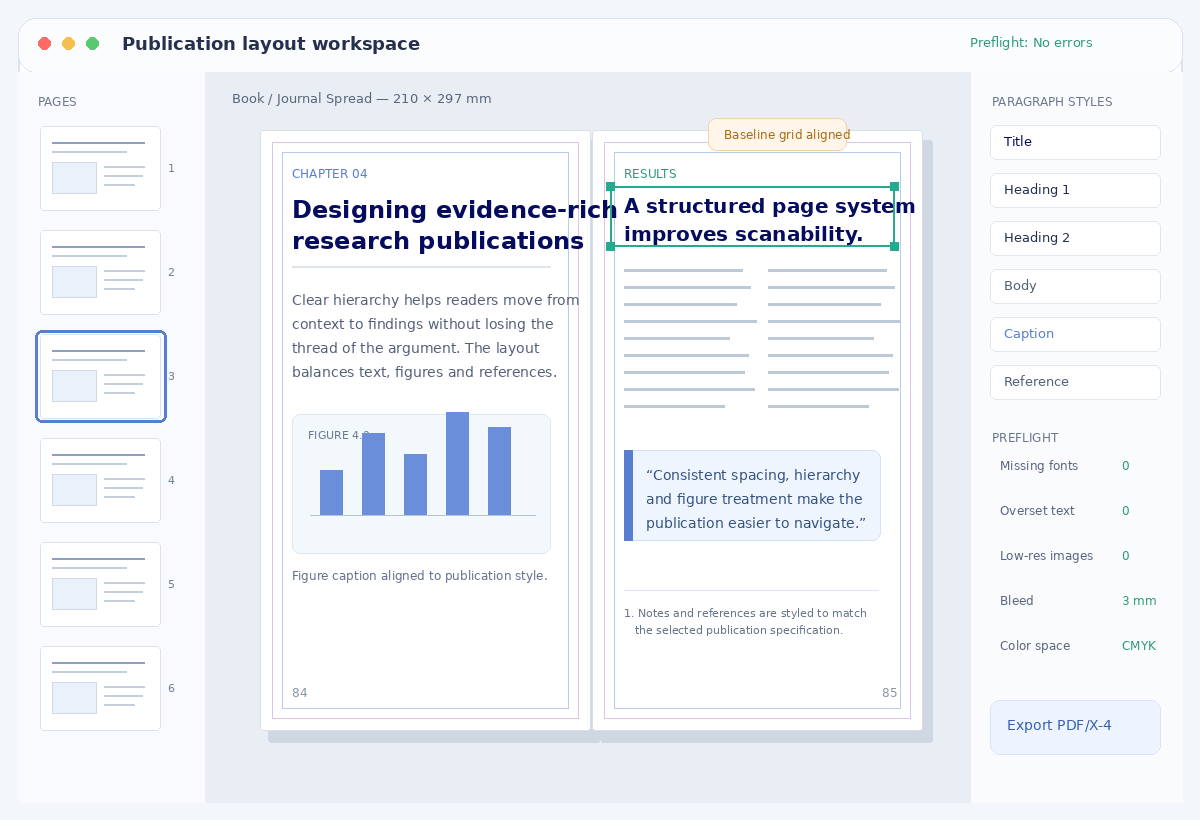
Grids, margins, spacing, and repeatable templates
Clear title, heading, body, caption, and note styles
Consistent placement, captions, numbering, and visual treatment
Production checks aligned to the agreed delivery format
Publishing design solves the presentation problems that appear when long-form content grows beyond a simple document and needs a consistent visual system.
Headings, body text, notes, and captions compete visually.
Page breaks, white space, widows, and orphans disrupt flow.
Visual elements do not align with the page grid or caption system.
Print and digital files need different production considerations.
Contents, prelims, appendices, references, or indexes need structure.
Repeated elements gradually lose consistency across pages.
Define grids, templates, margins, and repeatable layout rules.
Assign disciplined styles for titles, headings, body, captions, and notes.
Place tables and figures with consistent scale, labels, and captions.
Manage pagination, section starts, spreads, and recurring page elements.
Apply publisher, university, journal, brand, or production rules when provided.
Package the agreed files with visual and preflight checks before handoff.
A publication is treated as a connected system—from page size and hierarchy to figures, pagination, proof review, and final file preparation.
Review document type, audience, output format, brand or publisher rules, and source files.
Establish page size, margins, columns, baseline rhythm, and repeatable page structures.
Define hierarchy for title, heading, body, caption, note, reference, and supporting styles.
Style visual content for consistent placement, labels, numbering, captions, and spacing.
Flow content through templates, manage section starts, spreads, callouts, and page balance.
Structure title pages, contents, prelims, references, appendices, notes, and related matter.
Check visual consistency, page flow, repeated elements, cross-references, and proof comments.
Prepare the agreed print, PDF, digital, or editable source-file package for delivery.
Choose publishing design when the document needs a visual system and page architecture—not only surface formatting or final language correction.
| What you get | Publishing Design Service | Document Formatting | Proofreading |
|---|---|---|---|
| Page architecture & grid | Yes — built as a repeatable design system | Usually limited to existing structure | No |
| Typography hierarchy | Yes — coordinated styles and visual hierarchy | Basic style application | No |
| Tables, figures & captions | Designed for consistency and page integration | Positioning and basic presentation | Only language/caption corrections if in scope |
| Front & back matter | Structured within the publication system | Existing sections can be formatted | No design restructuring |
| Pagination & spread balance | Yes — managed as part of layout | Basic pagination | No |
| Print / digital output preparation | Prepared to the agreed production requirements | Limited export support | Not a design deliverable |
| Language editing | Not included unless separately agreed | No | Yes — final-stage language corrections |
| Primary outcome | A coherent, designed publication package | A consistently formatted document | A language-correct final text |
The visual system can extend across the entire publication so readers encounter consistent structure from the opening pages to the final references and appendices.
Publication title, subtitle, author, imprint, institutional, and series information.
Contents, foreword, preface, acknowledgements, abbreviations, and introductory matter.
Chapter openers, article sections, body pages, subsection hierarchy, and recurring elements.
Headings, rules, alignment, notes, repeated headers, and consistent numerical presentation.
Placement, scale, labels, figure numbering, legends, source notes, and caption hierarchy.
Quotes, key points, case boxes, definitions, warnings, and supporting visual emphasis.
Reference lists, endnotes, footnotes, hanging indents, spacing, and section presentation.
Supplementary tables, extended methods, forms, technical notes, and supporting documents.
Page numbers, section markers, publication identifiers, and recurring header or footer logic.
About pages, contributor details, closing matter, export profiles, and final packaged files.
A well-designed publication keeps the document, style system, visual elements, page structure, and preflight checks connected instead of treating each page as a one-off layout.
The workflow keeps design decisions traceable from the initial brief through proof review and the final handoff package.
Share content, visuals, output needs, and relevant specifications.
Confirm publication type, page system, visual complexity, and required deliverables.
Set typography, hierarchy, page grid, recurring elements, and sample layouts.
Flow approved content into structured templates and compose the publication.
Style and place tables, figures, captions, callouts, and supporting elements.
Share proofs for consolidated feedback on design, flow, and repeated styles.
Check page consistency, links, fonts, image quality, spacing, and output settings.
Deliver the agreed final outputs and editable source package when included.
The strongest design handoff starts with current source files and clear specifications, then ends with organised outputs that match the agreed publishing scope.
Quality checks focus on the repeated design rules that determine whether a long document feels consistent from first page to last.
Margins, columns, baseline rhythm, page templates, and section starts.
Heading levels, body styles, captions, notes, references, and spacing.
Figures, tables, labels, captions, numbering, placement, and resolution.
Pagination, widows, orphans, running elements, section continuity, and balance.
Fonts, links, overset text, output settings, page count, and handoff completeness.
Publishing design can be adapted to different reading contexts, page structures, visual densities, and output formats.
Before the final package is handed off, the publication is reviewed for the design and file issues most likely to affect presentation or output quality.
Confirm required fonts are available or packaged and paragraph, character, caption, and reference styles are applied consistently.
Review trim size, margins, columns, bleed settings where applicable, master pages, and recurring page elements.
Check placement, scaling, link status, resolution suitability, captions, labels, and figure numbering.
Review section starts, page numbering, blank-page logic, widows and orphans, running heads, and page balance.
Check the agreed export settings, linked assets, editable source files when included, and final delivery-file organisation.
Publishing design works best when authors, editors, designers, and production stakeholders know which decisions belong to content, design, and final approval.
Your approved text, research, arguments, and intellectual content remain yours. The design service focuses on presentation and visual organisation within the agreed scope.
Unpublished documents, visual assets, specifications, and production files should be handled as confidential service materials through the designated workflow.
The design scope should be confirmed from the actual document, visual complexity, output requirements, source-file condition, and supplied publication specifications before production begins.
The emphasis is on a coherent publication system—so typography, layout, visual elements, pagination, and handoff files work together.
Repeatable grids and templates instead of page-by-page improvisation.
Clear hierarchy for long-form reading and structured navigation.
Tables, figures, captions, and callouts are designed within the page system.
Repeated elements are checked across sections, pages, and matter types.
Final checks cover visual consistency and the agreed output preparation requirements.
Receive organised final files and editable source assets when included in scope.
Answers to common questions about layout, source files, visual elements, print and digital outputs, and design handoff.
It focuses on the visual and structural presentation of a publication. Depending on the agreed scope, that can include page architecture, typography, hierarchy, page templates, tables and figures, captions, front and back matter, pagination, and preparation of production-ready output files.
The service can be used for books, monographs, research reports, theses and dissertations, journal-style manuscripts, conference proceedings, white papers, handbooks, and other long-form professional or academic publications.
No. Proofreading concentrates on final language correctness. Publishing design concentrates on how approved content is organised and presented visually. If language correction is required, it should be handled as a separate editorial scope.
Yes. A structured Word document can be used as source material for layout development. The quality of styles, headings, tables, figures, captions, and reference formatting in the source file can affect how much preparation is needed before design begins.
Yes, when the applicable specifications are provided. The design can be aligned to supplied requirements for page size, margins, typography, headings, captions, references, colour usage, figure placement, and other relevant presentation rules.
Cover or title-page design can be included when it is part of the agreed publishing-design scope. The exact deliverables should be confirmed with the document type, final format, publication channel, and any supplied brand or publisher requirements.
Yes, visual treatment can include consistent table styling, figure placement, caption hierarchy, numbering, spacing, and alignment. Redrawing complex scientific illustrations or creating new data visualisations should be confirmed separately if required.
Editable source files can be part of the agreed handoff when that is required for future updates. The requested application, version compatibility, linked assets, fonts, and packaging requirements should be specified before final delivery.
The design can be adapted for print and digital outputs when both formats are included in scope. Print production and screen reading have different requirements, so page size, colour mode, image resolution, hyperlinks, bookmarks, and export settings may need separate treatment.
Revision rounds should be based on the confirmed design scope and feedback on the supplied proofs. Consolidated comments are most efficient because they allow hierarchy, pagination, figures, captions, and repeated style changes to be updated consistently.
Provide the latest content file, images or figures, tables, references, branding assets where relevant, and any publisher, journal, university, print, or digital specifications. If a previous edition or sample layout exists, include it as a visual reference.
Use the enquiry form on this page and describe the document type, approximate page or word count, number of tables and figures, required output formats, applicable design guidelines, and any source-file or cover requirements. The scope can then be reviewed before work begins.
Tell us what you are publishing, which files you already have, and which final formats you need so the design scope can be reviewed against the actual document.
Book, report, thesis, journal-style manuscript, white paper, handbook, or another publication.
Share approximate counts and whether visuals are final, editable, or still being prepared.
Include publisher, university, journal, printer, brand, trim-size, or digital-output requirements.
Identify print PDF, digital PDF, editable source package, cover files, or other agreed outputs.
Provide enough information to review the document structure, visual complexity, source files, and final output requirements.