Strategic Message Structure
Organise the announcement around purpose, facts, context, impact, and next steps.

Shape important company news into a clear, audience-aware announcement with the right message structure, tone, review path, and release-ready communication assets.
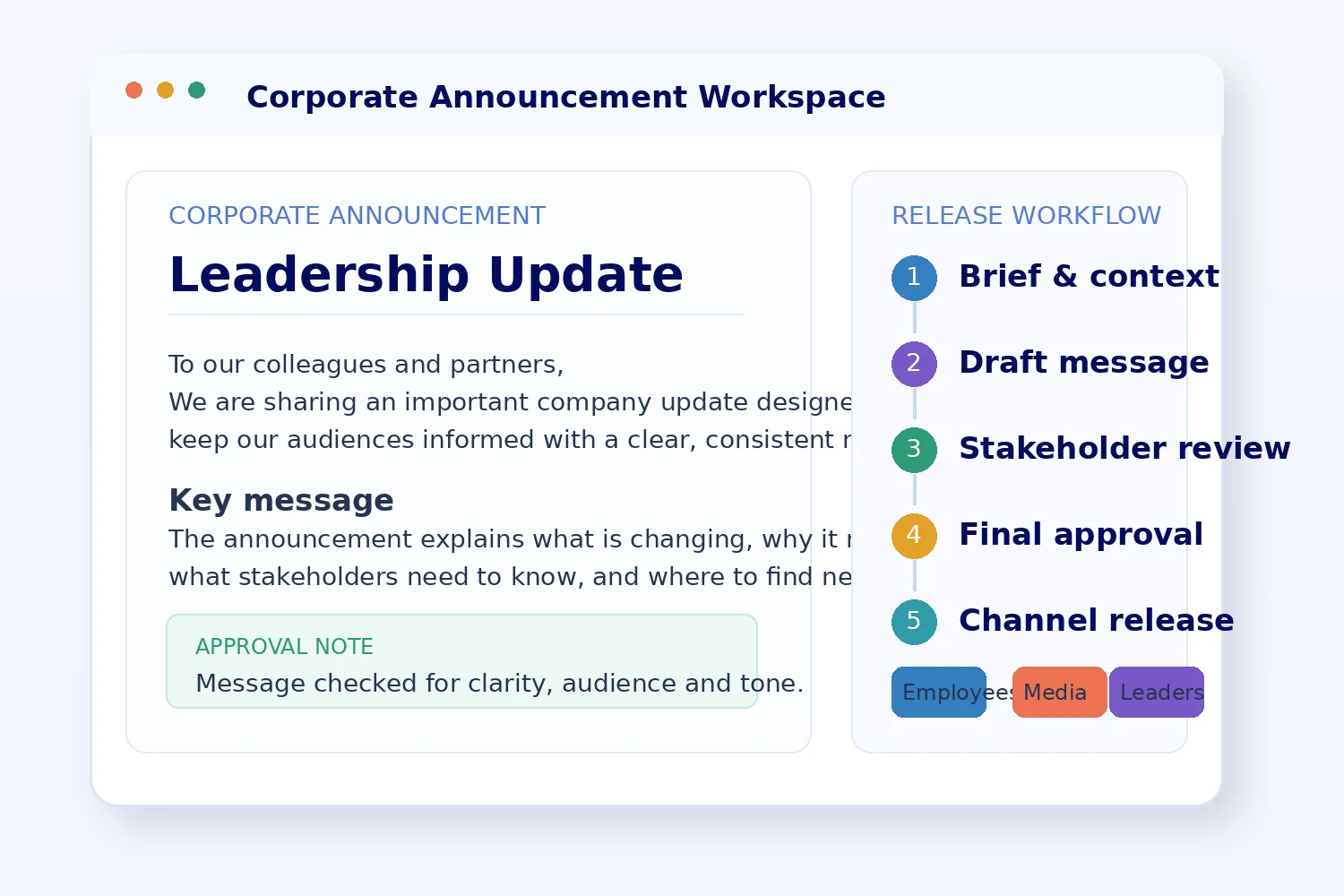
Organise the announcement around purpose, facts, context, impact, and next steps.
Adjust tone and detail for the people who need to understand and act on the message.
Prepare clean draft versions that make stakeholder review and final approval easier to manage.
Package the approved message for the channels and formats included in the scope.
A complete corporate announcement engagement starts with the approved facts and turns them into one controlled message package for the audiences and channels defined in the brief.
From ₹12,000
for one corporate announcement communication package
Suitable forA business milestone, policy update, organisational change or leadership announcement requiring coordinated messaging.
Large multi-audience rollouts, investor or regulatory communications, extensive research, additional assets and compressed release schedules are scoped separately.
An important announcement has to do more than state news. It should help each audience understand what happened, why it matters, what changes for them, and what comes next.
Turn complex business information into a focused announcement with a clear hierarchy of key messages.
Frame the information around what different stakeholders need to know, understand, or do.
Prepare the core announcement so it can be adapted cleanly across the channels in the release plan.
Keep facts, terminology, tone, and key points consistent as the communication moves through review.
Connect the announcement to the action, understanding, confidence, or response the communication is intended to support.
Define useful indicators for reach, engagement, response, or follow-up so communication can improve over time.
A structured workflow keeps the message, approvals, and release assets connected from the first brief to final delivery.
Announcement-focused communication deliverables.
A practical route from brief to release-ready communication.
Clarify the announcement objective and desired audience response.
Separate approved facts from assumptions, open items, or draft inputs.
Identify who needs the message and what context each group requires.
Prioritise headline, context, impact, proof points, and next steps.
Write the main announcement in the agreed tone and level of detail.
Shape the core message for the formats included in the brief.
Prepare review-ready drafts with clear areas for comment or approval.
Consolidate agreed changes while protecting message consistency.
Review clarity, tone, names, dates, terminology, and channel alignment.
Deliver clean, final communication assets for the approved release plan.
Choose only the channels relevant to your announcement.
Corporate announcements can support many business situations, but the communication should always be grounded in the confirmed facts and the needs of the intended audience.
Deliverables are selected to match the agreed announcement scope.
Examples of situations where a structured corporate announcement can be useful.
Appointments, transitions, role changes, or leadership updates.
Company-wide changes that require clear explanation and next steps.
Restructuring, operating-model, team, or business-unit updates.
Company milestones, new programs, launches, or strategic initiatives.
Service, location, system, continuity, or operating updates that affect stakeholders.
New collaborations, alliances, or partner-facing business communication.
Teams responsible for important company communication.
Use the service for a single important announcement or a coordinated set of release assets, depending on the communication need.
Choose the shape of support that fits the brief.
Keep the core message aligned while adapting format and detail for each channel.
The communication journey moves from awareness to understanding and action. The right measurement depends on the announcement objective and channels used.
A practical way to think about what the message should enable.
Select measures that match the purpose of the announcement.
Build the communication package around the formats you actually need.
The service is built around disciplined message development: understand the facts, structure the communication, adapt it for audiences, and prepare it for review and release.
Connect communication choices to the purpose and stakeholder needs behind the announcement.
Shape the same business facts into the level of detail and tone each audience requires.
Use structured drafts, defined message hierarchy, and clean versions to make review easier.
Keep names, facts, terminology, tone, and key messages aligned across the package.
Build communication around what the audience should know, understand, or do after release.
Use these examples to define the brief, then review the FAQs for common questions about audience versions, sensitive announcements, deliverables, and scope.
Examples of how the service can be framed without prescribing one fixed format.
Introduce the appointment, explain the role and context, and prepare audience-specific communication for employees and external stakeholders.
Explain what is changing, who is affected, when the change applies, and where people can find more detailed guidance.
Structure the message around the change, business rationale, employee or stakeholder impact, transition points, and next steps.
Introduce the initiative, clarify the objective, define why it matters, and tailor the message for the channels included in the launch plan.
Answers are specific to corporate announcement support.
A corporate announcement service supports the planning, writing, refinement, and release preparation of important company messages for defined internal or external audiences.
Typical needs include leadership updates, organizational changes, policy notices, partnerships, business milestones, operational updates, employee communications, and stakeholder-facing announcements.
Yes. The core message can be structured first and then adapted for employees, leaders, customers, partners, media, investors, or other stakeholder groups where the brief requires different context and tone.
Provide the purpose of the announcement, the confirmed facts, intended audiences, desired tone, required approvals, channels, timing constraints, and any supporting material that the message must reflect.
The service can be scoped for internal communication, external communication, or a coordinated set of messages where the same announcement needs audience-specific versions.
Yes. An existing draft can be refined for clarity, structure, tone, audience needs, key-message emphasis, and consistency across supporting communication.
Sensitive announcements benefit from a clear fact base, careful language, defined approval ownership, audience sequencing, and a review process before release. Final legal, regulatory, or policy approval remains with the client where required.
Where the brief calls for media communication, the announcement can be shaped into a media-facing format and aligned with the core corporate message.
The communication package can include concise leadership talking points, key-message summaries, or Q&A support when those deliverables are part of the requested scope.
Corporate Announcement Service starts at ₹12,000 for one corporate announcement communication package. Larger or more complex requirements are quoted after the brief and deadline are reviewed. Typical delivery for the starting scope is 5–7 business days. Larger, approval-heavy or urgent requirements may need a different schedule, confirmed before work begins.
Share the confirmed facts, intended audiences, communication objective, desired channels, and any review or timing requirements.
The more complete the fact base, the easier it is to create a clear announcement and prepare review-ready versions.
Provide enough detail for the communication need to be understood and scoped appropriately.