Method-Aware Analysis
Study design, variables, and research questions guide the analytical approach.

Turn a research dataset into a structured analysis workflow with data-quality checks, appropriate statistical methods, transparent diagnostics, clear tables and figures, and interpretation support aligned with your research question.
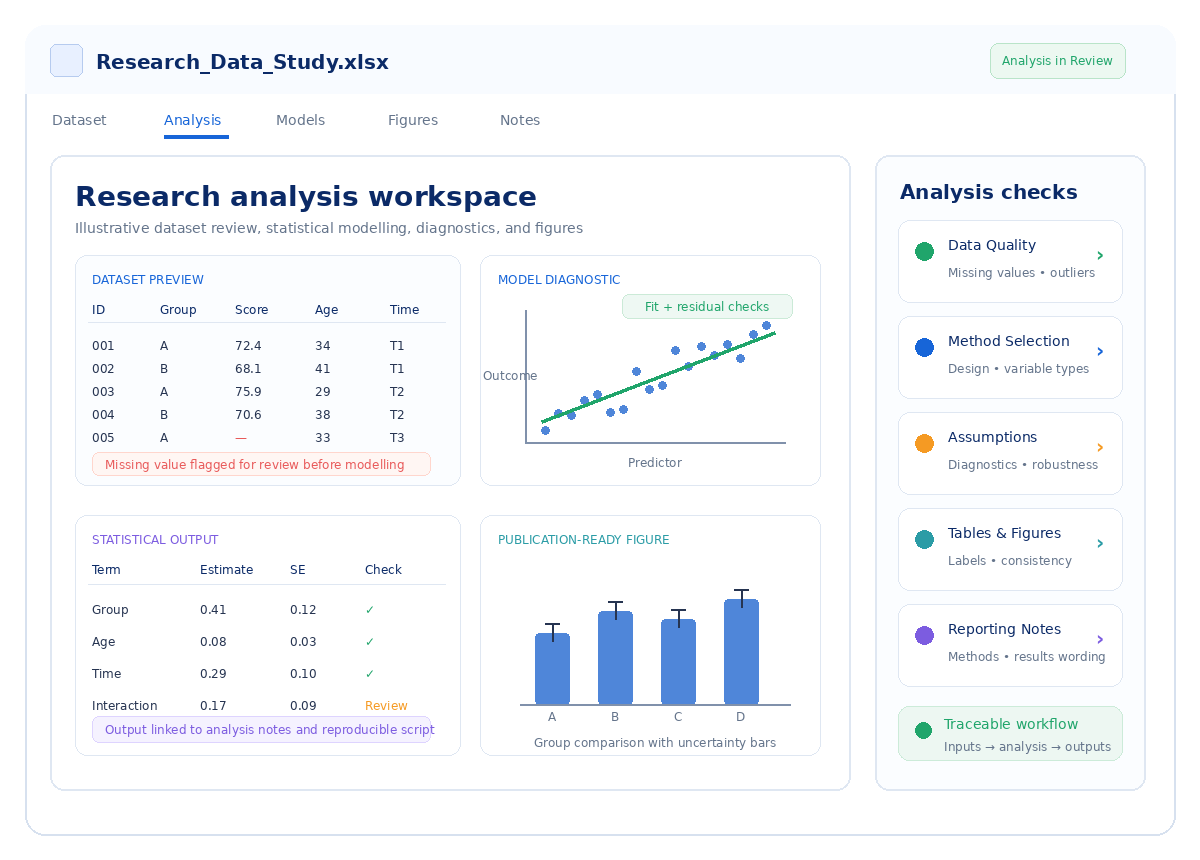
Study design, variables, and research questions guide the analytical approach.
Research data and unpublished materials are handled as confidential service information.
Tables, figures, diagnostics, and summaries are organised around the agreed reporting goal.
Analysis decisions, checks, and outputs can be documented for review and revision.
A defined Research Data Analysis Service engagement starts at ₹6,000 for one defined analysis or interpretation module. At this level, the work includes analysis-goal and dataset scoping and method or software support planning, plus the service-specific checks listed below.
The starting price covers a defined entry scope. Larger or multi-stage requirements involving method accuracy, statistical terminology, results interpretation and transparent table/figure reporting are quoted after the materials and deadline are reviewed. A shorter deadline for Research Data Analysis Service can be assessed after the working files and requested scope are reviewed; accelerated delivery is confirmed only when feasible for that assignment.
Many analysis problems begin before the final statistical test is run. Data condition, study design, variable setup, assumptions, and reporting choices can all affect whether the results are clear and defensible.
Missing values, duplicates, impossible values, inconsistent coding, or incorrect data types can distort later analysis.
A test or model that does not match the research question, variable types, or design can produce misleading conclusions.
Distributional, independence, variance, fit, or other assumptions may need checking before results are interpreted.
Ambiguous labels, reference groups, scales, units, derived variables, or category coding can undermine reproducibility.
Undocumented filtering, transformations, recoding, or repeated manual steps make the analysis harder to verify.
Results can become difficult to review when tables, figures, effect estimates, uncertainty, and interpretation are inconsistent.
A complete analysis journey can be scoped from initial dataset review through statistical modelling and final research-ready outputs, while keeping the research question and study design central.
Files, variables, structure, labels
Missingness, types, recoding
Outcomes, predictors, groups
Distributions, summaries, patterns
Tests, models, alternatives
Diagnostics and robustness
Estimation, testing, model fit
Clear visual and tabular outputs
What estimates and checks mean
Methods, results, revisions
The analytical value is not just a final p-value or chart. A strong workflow makes the data condition, modelling choices, checks, and final outputs understandable at each stage.
| ID | Group | Score | Age |
|---|---|---|---|
| 001 | A | 72.4 | 34 |
| 002 | B | 68.1 | 41 |
| 003 | A | — | 29 |
| 004 | b | 70.6 | 38 |
| Term | Estimate | SE | Check |
|---|---|---|---|
| Group | 0.41 | 0.12 | ✓ |
| Age | 0.08 | 0.03 | ✓ |
| Time | 0.29 | 0.10 | ✓ |
| Interaction | 0.17 | 0.09 | Review |
Projects differ in depth. The table below shows common ways research data analysis support can be scoped according to the work required.
| Aspect | Data Review & Analysis Plan | Full Research Data Analysis | Advanced / Custom Modelling |
|---|---|---|---|
| Primary focus | Check data structure and define an analysis path | End-to-end analysis for agreed research questions | Complex models, sensitivity work, or custom analytical requirements |
| Data-quality review | ✓ Included | ✓ Included | ✓ Included |
| Cleaning / coding | Issues identified and documented | Scope-specific cleaning and recoding | Extended transformations and derived variables where required |
| Statistical methods | Method recommendation and analysis plan | Tests or models selected for the agreed design | Advanced, multivariable, repeated, hierarchical, or custom methods as scoped |
| Diagnostics | Key assumptions identified | Relevant assumption and model checks | Extended diagnostics, robustness, or sensitivity analyses as scoped |
| Tables & figures | Output plan | Research-ready tables and figures where included | Extended or custom visualisation and model-output presentation |
| Interpretation support | Method and output guidance | Results interpretation notes | Detailed interpretation across complex models or scenarios |
| Best fit | Researchers who need a defensible plan before analysis | Most studies needing complete statistical analysis | Projects with complex designs, models, or reporting needs |
These are common engagement patterns rather than fixed commercial plans. Final scope should be confirmed after reviewing the dataset, study design, research questions, required software or files, and expected outputs.
Analysis can begin from raw structured data, an existing codebook or analysis plan, statistical output, figures, or a draft methods/results section, depending on the project stage.
Questionnaire responses, scales, categories, and grouped variables
Groups, conditions, repeated observations, and measured outcomes
Cross-sectional, cohort, registry, or other non-experimental structures
Repeated time points, trends, within-subject structures, and change
Variable definitions, units, labels, categories, and study documentation
Prior scripts, model output, test results, or partially completed analysis
Descriptive summaries, model outputs, comparisons, and visual reporting
Analysis descriptions, result narratives, and reporting consistency
Model summaries, diagnostics, logs, exported results, or syntax output
Journal, thesis, report, presentation, or reviewer-response output needs
A staged process keeps the work aligned with the research question and makes analytical decisions easier to review, explain, and revise.
Research question, study design, dataset, and required outputs
ReceivedClarify design, questions, variables, software, and constraints
In ReviewCheck structure, missingness, coding, labels, and data integrity
In ReviewDefine methods, comparisons, models, diagnostics, and outputs
PlanPrepare variables, transformations, exclusions, and analysis datasets
In ProgressRun the agreed statistical tests, models, and diagnostic checks
In ProgressCross-check analysis setup, outputs, diagnostics, and consistency
Quality CheckDeliver agreed files, outputs, notes, and revision-ready materials
DeliveredDeliverables depend on the agreed scope. The goal is to make the final analysis understandable, reviewable, and usable for your research reporting workflow.
Quality control should check more than whether software produced an output. The setup, data, method, diagnostics, presentation, and traceability all matter.
The analytical method should follow the study design rather than the discipline label alone. Support can be scoped across research areas when the dataset, design, variables, and required outputs are clear.
Comparing outcomes across independent or related groups with methods matched to the design and data.
Exploring relationships and modelling outcomes with appropriate covariates, diagnostics, and interpretation.
Analyses that account for repeated observations, time, clustering, or other dependent structures.
Projects where event timing, follow-up, censoring, or duration-based outcomes require specialised handling.
Structured survey datasets, composite measures, reliability questions, categories, and response patterns.
Checking current analyses, outputs, tables, figures, model choices, or reporting for consistency and clarity.
Research datasets can contain unpublished, sensitive, or proprietary material. The project should be scoped so only necessary files and information are shared through the designated workflow.
Your delivery schedule is confirmed after the dataset and analysis requirements are reviewed, so the timeline reflects the actual work rather than a generic turnaround promise.
Pricing is determined from the actual project scope. A quote can be prepared after reviewing the dataset, analytical depth, required outputs, and revision needs.
Answers to common questions about data types, statistical methods, cleaning, diagnostics, tools, deliverables, turnaround, pricing, interpretation, and confidentiality.
The scope can include dataset review, cleaning and coding checks, exploratory analysis, statistical test or model selection, assumption checks, statistical analysis, tables and figures, and interpretation support. The exact work should be agreed from your research question, study design, data structure, and required outputs.
The service can be scoped for structured quantitative datasets such as survey, experimental, observational, repeated-measures, longitudinal, categorical, continuous, and mixed-variable data. Suitability depends on the dataset format, study design, and analysis required.
Yes. Method selection can be reviewed against the research question, outcome and predictor types, study design, distributional features, dependence structure, and other relevant assumptions. The final method should be documented so the reasoning is transparent.
Data-quality review can cover missing values, coding consistency, duplicates, impossible values, variable labels, data types, and other issues that may affect analysis. Any cleaning or transformation steps should be documented as part of the agreed scope.
Yes. Where relevant, the analysis can include assumption checks and diagnostic review appropriate to the selected method, with notes on issues that may require an alternative specification, transformation, sensitivity analysis, or researcher decision.
Tables and figures can be included when they are part of the agreed deliverables. Outputs may include descriptive summaries, model-result tables, comparison plots, distributions, confidence-interval displays, or other visuals suited to the analysis and reporting goal.
Interpretation support can explain what the estimates, uncertainty, test results, model terms, and diagnostics mean in the context of the analysis. The researcher remains responsible for the scientific or domain conclusions drawn from the evidence.
Tooling can be discussed during scope review. If a specific software environment, script format, output file, or reproducibility requirement matters to your project, include it in the enquiry so compatibility can be confirmed before work begins.
Yes. You can provide an existing dataset, analysis plan, code, output, tables, figures, or draft results section for review. The scope can focus on checking, extending, reproducing, or presenting the existing analysis rather than starting from the beginning.
Turnaround depends on the condition and size of the dataset, the number and complexity of analyses, the required outputs, documentation needs, and revision scope. A delivery schedule should be confirmed after the project materials and requirements are reviewed.
Pricing is determined from the actual project scope. Relevant factors include dataset size and condition, cleaning effort, method complexity, number of analyses or models, figures and tables, documentation, and revision requirements.
Research data, instructions, contact details, and unpublished materials should be handled as confidential service information through the designated submission, analysis, and delivery process. Share only the data and documentation necessary for the agreed work.
Share enough information to assess the dataset, study design, analysis questions, required outputs, software constraints, and deadline so the scope, quote, and delivery schedule can be reviewed.
A clear project brief helps determine whether the requested analysis is feasible and what files or documentation are needed next.
File format, approximate rows and variables, number of files, and current data condition.
Primary outcomes, predictors, groups, repeated measures, sampling, or other design features.
Tests, models, comparisons, existing plan, or questions about method selection and diagnostics.
Tables, figures, code, statistical output, methods/results notes, and any required software environment.
Target date, time zone, milestones, and whether revisions or reviewer responses may follow.
Provide your contact details and a concise research-data brief. Sensitive files do not need to be attached to this form; file-sharing requirements can be discussed after the enquiry is reviewed.