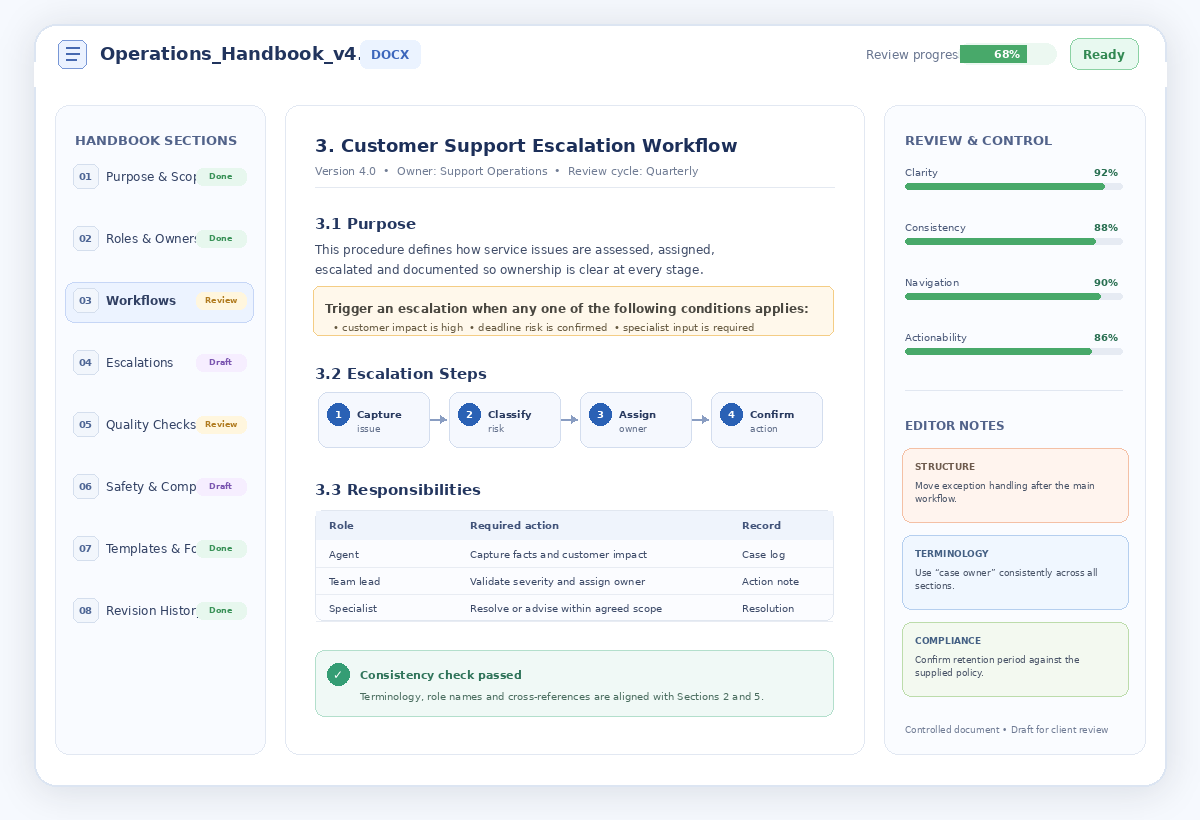
Manuals & Handbooks Service for Clear, Usable Business Documentation
★★★★★4.8 rating from Researchers, Authors, Students, and Scholars
Turn policies, procedures, process notes, existing documents, and subject-matter input into a logically structured manual or handbook that people can navigate, understand, and use in day-to-day work.
Structured sections, numbering, navigation, and document hierarchy
Clear procedures, responsibilities, workflows, checklists, and escalation paths
Consistent terminology, cross-references, revision control, and presentation
Development from rough source material or revision of an existing manual
Built around your audience, source material, and document purpose
Confidential File Handling
Internal materials handled through the designated service process
Structured Documentation
Hierarchy, workflows, roles, navigation, and consistency working together
Clear Deliverables
Review-friendly drafts and final files aligned with the agreed brief
Project pricing · scope · delivery
Manuals & Handbooks Service Project Pricing
Because Manuals & Handbooks Service may combine several specialist tasks, pricing begins with a defined project minimum. The entry scope is designed for this situation: A defined documentation engagement covering creation, improvement or reorganisation of a business manual or handbook.
Initial Project Scope
Projects from ₹18,000
for a defined initial engagement
Suitable for: A defined documentation engagement covering creation, improvement or reorganisation of a business manual or handbook.
Document purpose, users and source-material review
Recommended information architecture
Development or refinement of agreed sections
Consistency of instructions, roles and terminology
Final editable document after structured review
Typical deliveryTypical focused engagement: 8–12 business days
Internal documentation often fails not because information is missing, but because it is scattered, inconsistent, difficult to navigate, or written without a clear user journey.
Unclear Audience or Scope
The document tries to serve everyone, making responsibilities, boundaries, and intended use difficult to understand.
Inconsistent Terminology
Different teams use different names for the same roles, systems, steps, forms, or approval points.
Missing Process Logic
Instructions exist as paragraphs, but triggers, sequence, ownership, exceptions, and escalation points are not explicit.
Weak Navigation
Long pages, inconsistent headings, and poor cross-references make routine answers slow to find.
Compliance or Policy Gaps
Required wording may be absent, outdated, duplicated, or disconnected from the operating procedure it is meant to govern.
No Revision Control
Users cannot tell which version is current, what changed, who owns the document, or when it should be reviewed again.
2
What This Manuals & Handbooks Service Covers
The service can support the complete documentation journey—from organising source material and defining document architecture to building procedures, review controls, and final appendices.
1
Title & Document Identity
Purpose, owner, version and status
2
Audience & Purpose
Who uses it and why
3
Scope & Boundaries
Included and excluded areas
4
Roles & Responsibilities
Ownership and accountability
5
Policies & Rules
Approved requirements in context
6
Procedures & SOPs
Clear step-by-step instructions
7
Workflows & Decisions
Sequence, triggers and branches
8
Escalations & Exceptions
What happens outside the norm
9
Checklists & Forms
Action aids and records
10
Tables & Visual Aids
Structured reference information
11
Safety / Compliance Notes
Client-supplied controls and notices
12
Terminology & Glossary
Consistent names and definitions
13
Cross-References
Links between related sections
14
Revision Control
Version, review and change history
15
Appendices & Tools
Templates, resources and supporting material
3
See the Documentation Transformation
A useful manual makes instructions easier to follow without changing the underlying business rule. The example below shows the shift from rough internal notes to a structured, reviewable procedure.
Before — Rough Notes
Unstructured Internal Instruction
“If a customer issue is serious, the agent should tell a senior person. The team should keep notes and make sure someone handles the issue quickly. Some cases may need a specialist.”
No defined trigger for escalation
No named owner or hand-off point
No required record or evidence
No exception or review logic
During — Structured Draft
Procedure + Editorial Review
Escalation trigger: escalate when customer impact is high, deadline risk is confirmed, or specialist input is required.
Owner: team lead validates severity and assigns the case owner.
Review note: confirm whether the policy requires a named response-time threshold before this wording is finalised.
After — Clean Handbook Section
Actionable, Controlled Procedure
3.2 Escalation Steps 1. Capture the issue and customer impact. 2. Classify risk against the approved criteria. 3. Assign a case owner and specialist where required. 4. Record the action and outcome in the designated case log.
Clear trigger and sequenceDefined ownershipRequired record identifiedReady for review against supplied policy
Ready to move forward with Manuals & Handbooks Service?Purchase the service and continue with your project brief, files, and delivery requirements.
Manual and handbook development addresses document architecture and usability as well as language and presentation. The table shows how the scope can differ from narrower review services.
Support Dimension
Formatting Review
Proofreading
Full Manuals & Handbooks Service
Audience, purpose & scope definition
×
×
✓
Information architecture & section hierarchy
Limited
×
✓
Procedure sequencing & workflow logic
×
×
✓
Roles, ownership & escalation clarity
×
×
✓
Terminology & cross-document consistency
Partial
Partial
✓
Grammar, spelling & language correctness
×
✓
✓
Heading, numbering & visual consistency
✓
Partial
✓
Checklists, tables & action aids
Format only
×
✓
Revision-control structure
Format only
×
✓
Best for
Presentation clean-up
Final language check
Complete manual / handbook development or revision
5
Manual and Handbook Types Supported
The same documentation method can be adapted to different audiences and operating contexts, from employee-facing guidance to process-heavy operational reference material.
Employee Handbooks
Workplace guidance, policies, responsibilities, and employee reference content.
Operations Manuals
Processes, hand-offs, controls, roles, escalation logic, and operating routines.
Policy & Procedure Manuals
Policies paired with practical procedures, ownership, records, and exceptions.
Training Manuals
Structured learning material, tasks, checklists, examples, and reference steps.
Onboarding Guides
Role context, first-step processes, systems, responsibilities, and new-starter guidance.
Customer Support Playbooks
Case handling, response logic, escalation, quality checks, and service consistency.
Quality & Compliance Manuals
Controlled processes, checks, responsibilities, records, and client-supplied standards.
Administrative Handbooks
Routine procedures, forms, approvals, records, office processes, and internal guidance.
Ready to move forward with Manuals & Handbooks Service?Purchase the service and continue with your project brief, files, and delivery requirements.
A staged workflow keeps the document grounded in supplied source material while separating structural decisions, drafting, review, consistency checks, and final delivery.
1
Submit Brief & Materials
Share source documents, goals, audience, template, and constraints.
2
Scope Review
Assess document condition, depth, sections, and requirements.
3
Architecture Plan
Define hierarchy, sequence, navigation, and information flow.
4
Section Development
Structure policies, procedures, roles, checklists, and guidance.
5
SME / Client Review
Flag unclear content and capture required subject-matter decisions.
6
Consistency Review
Align terminology, cross-references, numbering, and control data.
7
Formatting & QA
Check presentation, navigation, language, and document usability.
8
Final Delivery
Provide agreed review and clean files with final document controls.
7
What You Share and What You Receive
Better source material produces a more reliable manual. The project starts with your approved information and ends with a structured set of files aligned with the confirmed brief.
What We Need From You
Share whatever is available; gaps can be identified during scope review.
Document purpose, audience, owner, and intended useExisting manual, policies, SOPs, notes, and process documentsApproved terminology, role names, systems, forms, and templatesCompliance, legal, safety, HR, or quality wording supplied by your organisationReviewer or subject-matter-expert comments, if availablePreferred format, branding, revision controls, and requested deadline
What You Receive
Exact deliverables are confirmed before work begins and can be adapted to the project.
Structured manual or handbook draft aligned to the agreed architectureReview comments or queries where source information needs clarificationConsistent headings, numbering, terminology, tables, and cross-referencesRevision-control structure when required by the briefEditable and review-friendly file formats as agreed for deliveryClean final version after agreed review actions are resolved
DOC
8
Quality Assurance and Review Methodology
The review checks more than grammar. It tests whether the document is organised, internally consistent, actionable, reviewable, and aligned with the source material supplied for the project.
1
Structure Review
Hierarchy, sequence, headings, navigation, and section purpose.
2
Clarity Pass
Instructions, sentences, labels, definitions, and action language.
3
Process Logic Pass
Triggers, sequence, ownership, records, exceptions, and escalation.
4
Consistency Check
Terminology, role names, numbering, cross-references, and formatting.
5
Source Alignment
Check content against supplied policies, templates, and approved material.
6
Final Verification
Review resolved comments, document controls, and final presentation.
Ready to move forward with Manuals & Handbooks Service?Purchase the service and continue with your project brief, files, and delivery requirements.
The service is designed around practical document use: readers should be able to locate the right instruction, understand who owns the action, and follow the process without unnecessary ambiguity.
Structure Before Decoration
Document architecture, sequence, navigation, and content purpose are established before presentation details are polished.
Process-Focused Writing
Procedures are developed around triggers, steps, ownership, records, exceptions, and escalation rather than dense narrative alone.
Review-Friendly Drafting
Unclear or conflicting source material can be surfaced as comments or questions instead of being silently interpreted as fact.
Maintainable Documentation
Version, ownership, review-date, glossary, cross-reference, and revision-history structures can be built in where the project requires them.
10
Business Areas and Confidential File Handling
Manual and handbook projects often span multiple functions. The content can be organised around the teams and operational areas relevant to the source material you provide.
Use the designated service process for unpublished internal materialShare access, NDA, retention, or deletion requirements at project startFlag restricted sections or information that should be handled separatelyKeep legal, HR, safety, regulatory, and specialist approval with the authorised client reviewersResolve source ambiguities through review comments rather than unsupported assumptions
11
Turnaround Planning and Custom Quote Logic
The published Manuals & Handbooks Service project minimum above is ₹18,000 for a defined initial engagement; larger or more complex requirements are confirmed after scope review. Scope, source-material condition, complexity, and review requirements determine the quote and delivery plan.
Turnaround Planning Options
Availability is confirmed after the document and requirements are reviewed.
Standard PlanningFor well-planned projects with normal review cycles
Priority RequestFor tighter deadlines where scope and capacity allow
Expedited RequestAssessed case by case after complexity review
Custom Quote Factors
A personalised quote can reflect the actual work required rather than a generic flat-rate package.
Document length, number of sections, procedures, and appendicesCondition and completeness of the source materialRequired restructuring, process logic, tables, checklists, and workflow elementsTechnical complexity, terminology, and amount of subject-matter reviewFormatting, template, branding, revision-control, and file-format requirementsRequested deadline and number of review rounds in the confirmed scope
Answers to common questions about source material, document scope, manual types, workflow elements, review responsibilities, pricing, turnaround, file formats, version control, and confidentiality.
What does the Manuals & Handbooks Service cover?+
The service can cover document planning, information architecture, section structure, policy and procedure presentation, role definitions, numbered workflows, checklists, tables, terminology consistency, navigation, revision control, and final document preparation. The exact scope is confirmed from the material and requirements you provide.
Can you create a manual or handbook from rough notes and existing policies?+
Yes. Source material can include policies, SOPs, process notes, training content, templates, internal guidance, existing manuals, reviewer comments, and subject-matter-expert inputs. The material is organised into a clearer document structure before drafting and refinement.
What types of manuals and handbooks can be supported?+
Typical projects can include employee handbooks, operations manuals, policy and procedure manuals, onboarding guides, training manuals, customer-support playbooks, quality manuals, safety handbooks, administrative manuals, and other structured internal documentation.
How is this different from proofreading or formatting?+
Proofreading focuses mainly on final language correctness, while formatting focuses on presentation. Manuals and handbook development goes further by organising information, clarifying sequence and ownership, improving navigation, standardising terminology, structuring procedures, and making the document easier to use in practice.
Can you revise an existing manual instead of creating a new one?+
Yes. An existing manual can be reviewed for outdated sections, duplicated content, weak navigation, inconsistent terminology, unclear procedures, version-control gaps, and opportunities to simplify or reorganise information.
Can the document include workflows, checklists, tables, and decision steps?+
Yes, when they are useful for the material. Process steps, responsibility tables, escalation paths, checklists, decision points, callouts, and simple workflow treatments can be incorporated to make instructions easier to follow.
How do you handle technical or department-specific terminology?+
Terminology is standardised against the source material, glossary, approved naming conventions, and subject-matter guidance you provide. Where meaning is unclear or conflicting, the draft can flag the point for client clarification instead of silently changing the intended meaning.
Can you follow our organisation template or brand style?+
Yes, when a template, style guide, sample document, heading system, branding rules, or formatting requirements are supplied. The document can be structured to align with those instructions within the confirmed scope.
What should we provide before work begins?+
Useful inputs include the intended audience, purpose, source documents, current policies and procedures, existing manual or template, required sections, terminology preferences, compliance or legal wording supplied by your organisation, reviewer feedback, and any deadline or formatting requirements.
Do you provide legal or regulatory approval for handbook content?+
No legal or regulatory approval is implied by this service. Contentxprtz can organise and present the policies, rules, standards, and compliance language supplied for the project, but the client remains responsible for obtaining any required legal, HR, regulatory, safety, or specialist approval.
How is pricing for manuals and handbooks determined?+
A custom quote can be based on factors such as document length, condition of the source material, number of procedures or sections, technical complexity, required restructuring, tables or workflow elements, formatting needs, revision requirements, and requested delivery timing. The published Manuals & Handbooks Service project minimum above is ₹18,000 for a defined initial engagement; larger or more complex requirements are confirmed after scope review.
How is turnaround determined?+
Turnaround is confirmed after the source files and scope are reviewed. Document length, source-material quality, number of procedures, technical complexity, review cycles, formatting requirements, and urgency can all affect the delivery plan. Turnaround is confirmed after scope review.
What file formats can be prepared?+
Depending on the agreed brief, delivery can be prepared in editable and review-friendly formats such as DOCX and PDF, with tracked or commented working files where appropriate. Confirm any specific template or file-format requirement before the project starts.
Can version and revision-control information be included?+
Yes. Where needed, the document can include version numbers, ownership, approval fields, revision history, review dates, document-control notes, and consistent cross-references so future updates are easier to manage.
How are confidential internal documents handled?+
Project files should be shared through the designated service process and handled as confidential client material. If your organisation has specific access, NDA, retention, or deletion requirements, include them in the enquiry so they can be reviewed before work begins.
13
Discuss Your Manuals & Handbooks Requirement
Share the document type, intended audience, current source material, approximate size, required sections, review requirements, and deadline so the scope can be assessed before a quote is prepared.
Helpful Project Details
What to Include in Your Enquiry
You do not need a perfect brief. Existing documents, rough notes, screenshots, policy files, templates, reviewer comments, or an outdated manual can all help define the starting point.
Document type and audience
Employee handbook, operations manual, training guide, policy manual, playbook, or another structured document.
Source material
Existing manual, policies, SOPs, process notes, templates, checklists, and subject-matter input.
Deadline and review cycle
State the requested delivery date, time zone, and whether internal reviewers need staged drafts.
Formatting and document-control needs
Share template, branding, numbering, revision-history, glossary, cross-reference, or file-format requirements.
Important: include any legal, HR, safety, quality, regulatory, or compliance wording that must remain exact, and identify the authorised reviewers responsible for final approval.
Manuals & Handbooks Enquiry
Request a Scope Assessment
Share your contact details and a short description of the documentation requirement. The enquiry will be reviewed for scope, source-material needs, delivery planning, and quotation.
Ready to Strengthen Your Manual or Handbook?
Share what you have. We’ll help turn it into clearer, more structured, and easier-to-use documentation within the agreed scope.