PR & Communication • Media Briefing

Media Brief Service for Clear, Confident Media Conversations

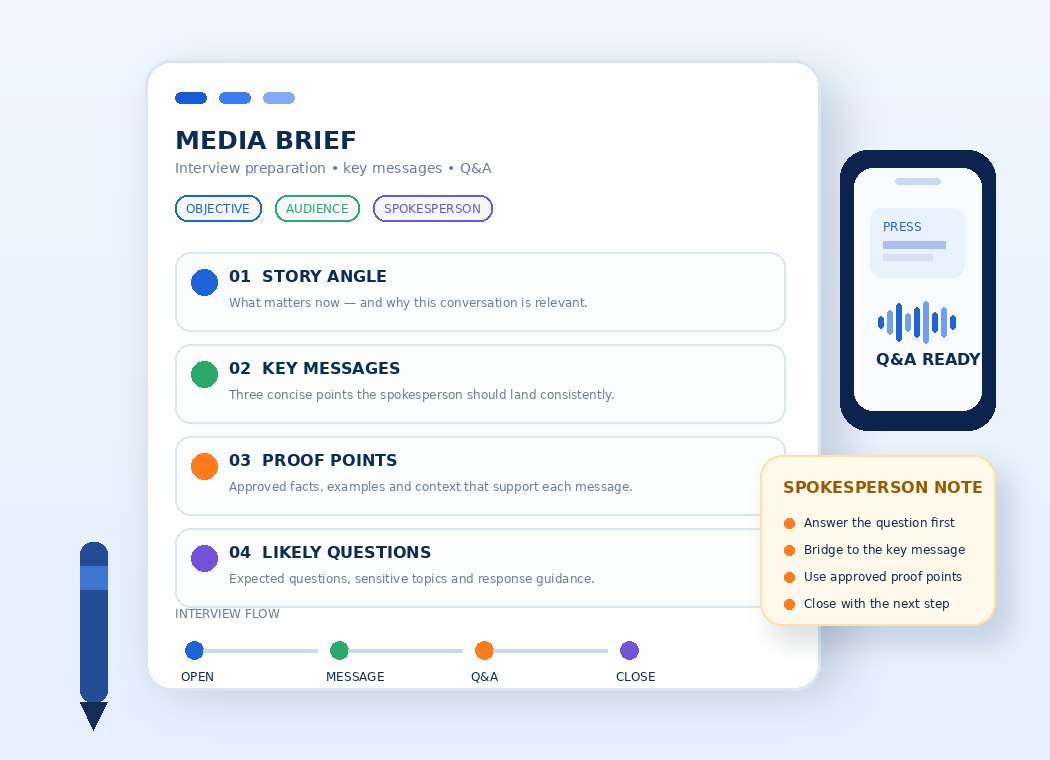
Turn scattered inputs into one practical briefing document that helps spokespeople understand the objective, audience, story angle, key messages, proof points, likely questions, sensitivities and follow-up actions before a media interaction.

  • Key messages and approved talking points organised in one place
  • Journalist, outlet and audience context translated into a practical briefing lens
  • Anticipated questions, sensitive areas and response guidance prepared in advance
  • Spokesperson notes, proof points and next actions shaped for the specific media moment
Media briefing document showing story angle, key messages, proof points, anticipated questions and spokesperson notes
StructuredClear sections and priorities
Audience-awareBuilt around the media context
Message-alignedFocused on approved points
ActionableUseful before and during prep
The power of a strong media brief

One briefing document. Better alignment before the conversation.

A well-structured media brief helps teams move from background information to a clear communication plan for the specific interview, announcement or media opportunity.

Align the Spokesperson

Give the speaker a clear objective, context and message path.

Sharpen Key Messages

Prioritise what must be said, supported and remembered.

Anticipate Questions

Prepare for expected, difficult and follow-up questions before they arrive.

Protect Consistency

Keep language, proof points and sensitivities aligned across stakeholders.

Prepare Evidence

Place approved facts, examples and context close to the messages they support.

Focus the Outcome

Connect the media moment to a defined communication objective and next step.

Purpose-ledStarts with the communication objective
Source-ledBuilt from the material you provide
Audience-awareShaped for media and stakeholder context
Scenario-readyIncludes questions and sensitivities
Review-friendlyStructured for stakeholder input
01 • Our Media Brief Service

Briefing support shaped around the media moment

Choose the structure that fits the type of conversation, announcement or stakeholder interaction you are preparing for.

Interview BriefSpokesperson preparation for journalist interviews and media conversations.
Announcement BriefMessages, proof points and Q&A around launches, updates and news moments.
Press Meeting BriefStructured preparation for press meetings, roundtables and briefings.
Issue & Crisis BriefSensitive-topic preparation, holding points, likely questions and escalation notes.
Executive BriefConcise briefing for leaders who need context, messages and decision points quickly.
Panel & Event BriefSession objective, audience lens, message themes and possible questions.
Stakeholder BriefPrepare for analyst, partner, community or specialist stakeholder conversations.
Follow-Up BriefCapture action items, promised information and follow-up communication points.
02 • Our 8-Step Media Brief Process

From source material to spokesperson-ready brief

A structured workflow keeps the brief focused on what the speaker needs to know and communicate.

01Define the ObjectiveClarify the media moment, desired outcome and primary audience.
02Review Source MaterialWork through approved facts, drafts, background and existing communication.
03Map Media ContextOrganise outlet, journalist, audience and topic context where available.
04Build the Message PathPrioritise key messages, supporting proof points and examples.
05Prepare Q&AAnticipate likely, difficult and follow-up questions.
06Flag SensitivitiesIdentify topics, wording and claims that need careful handling.
07Stakeholder ReviewConsolidate comments and align the final language.
08Finalise the BriefDeliver a clear, scannable briefing structure for spokesperson preparation.
03 • Inputs & Signals

Source material we can work from

The service can be shaped around the information already available to your team.

Press releases & draftsApproved or working communication material.
Background documentsCompany, product, project or issue context.
Timing & agendaInterview format, event schedule and deadlines.
Approved facts & proofFigures, examples and evidence cleared for use.
Spokesperson contextRole, expertise, voice and preparation needs.
Past coverage & questionsUseful context for likely themes and follow-ups.
04 • What We Deliver

A practical briefing pack

The final structure is tailored to the media situation and the inputs available.

Communication objective and media context
Key messages and supporting proof points
Likely questions and response guidance
Sensitive topics, boundaries and escalation notes
Spokesperson preparation and follow-up points
05 • Where Media Briefs Help

Use cases across sectors and communication settings

The briefing structure can be adapted to the organisation, topic, spokesperson and audience.

Technology & SaaS
Healthcare & Pharma
FinTech & BFSI
Education & EdTech
E-commerce & Retail
Manufacturing
Startups & Scaleups
Real Estate & Construction
Lifestyle & Consumer
Non-profit & Government
06 • Who We Help

Built for teams of different sizes

Startups
Growth-stage companies
Enterprises
Agencies
Public sector & NGOs
Communication & leadership teams
07 • Engagement Models

Flexible ways to use the service

Choose a one-off brief or make briefing support part of an ongoing communication workflow.

08 • Communication Channels

Align the brief with the wider communication mix

The same core messages may need different emphasis across media and stakeholder channels.

Traditional MediaPrint, TV, radio and news interviews
Digital PROnline publications and digital newsrooms
Social Media PRMessage continuity after the media moment
Influencer RelationsCreator and opinion-leader conversations
Internal CommsEmployee and leadership alignment
Investor RelationsStakeholder-focused message preparation
09 • Media Brief Impact Funnel

From context to confident delivery

The brief turns background material into a simple preparation path for the spokesperson and review team.

CONTEXT
ALIGNMENT
PREPARATION
DELIVERY
FOLLOW-THROUGH
10 • Key Quality Checks

What we check before the brief is finalised

Communication objective is clear
Key messages are distinct and concise
Proof points are linked to the right messages
Audience and media context are reflected
Likely questions and sensitivities are covered
Spokesperson guidance is practical and usable
Follow-up actions are easy to identify
11 • What You Get

A complete briefing structure

Media context & objective

The purpose of the interaction, the audience lens and available media context.

Key messages & proof points

Prioritised communication points with the facts or examples that support them.

Anticipated Q&A

Likely questions, difficult topics and response guidance organised for preparation.

Spokesperson preparation notes

Practical reminders about emphasis, transitions, boundaries and communication flow.

Risk & sensitivity flags

Topics or wording that may need careful review, escalation or approved language.

Follow-up action list

Promised information, references, approvals or next steps to track after the interaction.

Why Clients Choose a Structured Media Brief

Strategic FocusStarts with the communication objective.
Media ContextConnects the message to the actual conversation.
Spokesperson-readyDesigned to scan quickly during preparation.
Question-awareIncludes likely and sensitive areas in advance.
Source-ledOrganises supplied facts rather than inventing claims.
Actionable OutputEnds with clear follow-up points and owners.
12
What We Need From You & How We Review

Give us the context; we organise it into a usable brief

The strongest brief starts with approved source material, a clear purpose and the right review contacts. The final structure can then be tailored around the spokesperson and media situation.

What We Need From You

Provide the material that defines the communication and any boundaries we should respect.

Source materialDrafts, approved facts, releases, decks or background notes.
Spokesperson detailsRole, expertise, tone and preparation needs.
Media contextOutlet, journalist, audience or event details when known.
Success objectiveWhat the conversation should clarify, reinforce or achieve.
SensitivitiesIssues, claims, words or topics requiring careful handling.
TimingInterview date, review window and any internal approval deadlines.

Quality & Review Process

Review is designed to make the brief concise, aligned and easy for the spokesperson to use.

Source checkKeep facts and claims tied to supplied or approved information.
Message checkRemove duplication and make the priority points distinct.
Spokesperson checkKeep wording usable for the person who will deliver it.
Q&A checkCover the questions most likely to affect preparation.
Sensitivity checkFlag areas requiring legal, policy or stakeholder approval.
Final usability checkEnsure the brief is scannable, ordered and action-oriented.
13
Illustrative Briefing Scenarios

How the brief changes with the communication situation

These examples show how the structure can shift depending on the purpose of the media interaction; they are not client case studies or performance claims.

Product launch interview

Launch story, proof and differentiation

The brief centres on the launch objective, audience need, key product messages, supporting facts, likely comparison questions and what the spokesperson should avoid overclaiming.

  • Launch narrative
  • Three key messages
  • Proof points and examples
  • Competitive/difficult questions
Funding or growth announcement

Context, significance and stakeholder lens

The brief connects the announcement to business context, approved numbers, leadership messages, likely questions about use of funds or growth, and follow-up information.

  • Announcement context
  • Approved figures
  • Leadership talking points
  • Questions on plans and priorities
Issue-response media request

Facts, boundaries and sensitive Q&A

The brief prioritises verified facts, approved language, questions that may arise, issues that need escalation and a clear closing or follow-up position.

  • Verified chronology
  • Approved response points
  • Sensitive questions
  • Escalation and follow-up

Preparing for a media interview, announcement or press conversation?

Share the context, source material and timing. We can shape it into a structured media brief for the spokesperson and review team.

14
Frequently Asked Questions

Media Brief Service FAQs

Common questions about media briefing documents, source material, spokesperson preparation, Q&A and service scope.

What is a media brief?

A media brief is a structured preparation document that brings together the communication objective, audience and media context, key messages, proof points, anticipated questions, sensitivities and spokesperson guidance for a media interaction or announcement.

When should I use a media brief?

It is useful before interviews, press meetings, announcements, launches, issue-response activity, panels, events and other situations where spokespeople need clear and consistent communication guidance.

What do you need from me to prepare the brief?

Useful inputs include the communication objective, draft or approved source material, spokesperson details, target media or audience, approved facts, timing, sensitivities and any existing messages or Q&A.

Can you prepare a brief for a senior executive or spokesperson?

Yes. The structure can be tailored around the spokesperson, the communication objective, the likely audience and the type of media interaction involved.

Can a media brief include anticipated questions and difficult topics?

Yes. A brief can organise likely questions, sensitive areas, response guidance, approved proof points and topics that require careful handling or escalation.

Can you work from an existing press release or communications plan?

Yes. Existing releases, communication plans, background notes, decks, approved facts, prior Q&A and relevant coverage can be used as source material for the brief.

Is a media brief the same as a press release?

No. A press release is outward-facing communication for publication or distribution. A media brief is primarily a preparation tool that helps the spokesperson and internal team understand what to communicate and how to handle likely questions.

Can the brief cover more than one audience or market?

It can be structured for multiple audiences or markets when the source material clearly identifies the differences in context, messages, proof points or sensitivities that need to be reflected.

How do you handle facts, figures and claims?

The brief should rely on supplied or approved information. Facts, figures and claims that require verification or approval should be identified for review rather than invented or assumed.

Can stakeholders review the brief before it is finalised?

Yes. The workflow can include review input from communication, leadership, subject-matter, legal, policy or other relevant stakeholders before the briefing document is finalised.

Do you provide a fixed price or turnaround for Media Brief Service?

This page does not publish a fixed price or turnaround. Scope and delivery timing can be confirmed after reviewing the number of briefing requirements, source materials, stakeholders and revision needs.

How do I request a media brief?

Use the enquiry form below and share the type of media interaction, spokesperson, timing, available source material and any priority messages or sensitive areas. That information can be used to assess the scope.

15
Media Brief Enquiry

Request a Media Brief

Tell us what media interaction you are preparing for, who the spokesperson is, what source material is available and when the brief is needed.

Media moment & timing

Share the interview, announcement, event or press activity and the relevant date or deadline.

Spokesperson & audience

Tell us who will speak and which audience, journalist, outlet or stakeholder group matters.

Source material

Note the press release, messaging, deck, facts, background or prior Q&A available for review.

!
Priority & sensitivity

Flag must-land messages, difficult questions, sensitive topics and internal approval requirements.

Helpful to include: media format, spokesperson, objective, target audience/outlet, interview or launch date, available source documents, approved facts, key messages, known questions and any sensitive topics.
PR & Communication Enquiry

Share Your Media Brief Requirement

Provide enough context for the briefing scope to be reviewed. You can share detailed source documents after the enquiry moves forward.

Security check *Loading question…

Do not place confidential or highly sensitive material in the form. Use the enquiry to describe the scope; detailed source documents can be shared through the appropriate service process.

Confidential & Professional
Responsive Communication
Global Service Context
Structured Deliverables