Environmental & Sciences
Environmental Sciences Research
This sample image could not be loaded. Please try again.
Environmental & Sciences

Expert academic editors refine your language, chapter flow, clarity, consistency, formatting, and references—while preserving your voice, ideas, and research intent.
The minimum practical scope for Thesis Editing Service is ₹10,000 per chapter up to 5,000 words. It includes chapter-level language and argument flow and cross-chapter terminology and voice consistency, so the advertised price maps to usable work rather than an open-ended estimate.
Longer documents, heavier rewriting, specialist subject review, complex chapter coherence, methodology, analysis, cross-references and university-specific submission standards, additional revision rounds, or accelerated delivery can increase the final quote. A shorter deadline for Thesis Editing Service can be assessed after the working files and requested scope are reviewed; accelerated delivery is confirmed only when feasible for that assignment.
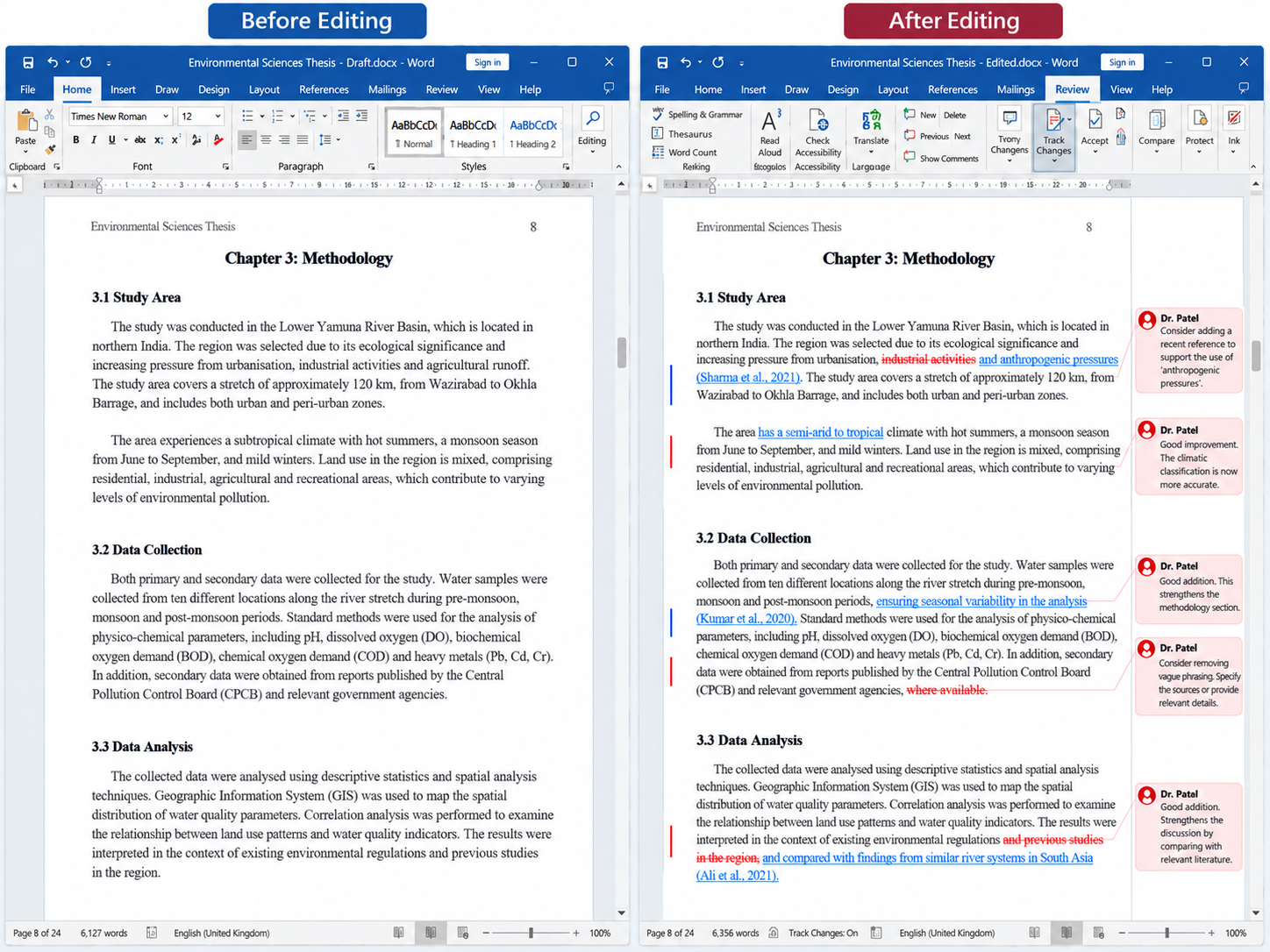
Choose a subject field on the left to view its corresponding before-and-after thesis sample. Each sample demonstrates reviewable improvements in language, structure, presentation and academic clarity while keeping the researcher’s original work and meaning central.
Environmental Sciences Research
Choose support around the full thesis, selected chapters, or specific stages of revision and submission preparation.
Thesis editing addresses the language, consistency, flow, presentation, and final-stage quality issues that often become visible only when a long document is reviewed as one complete manuscript.
Need deeper structural or developmental editing? Include that requirement in your enquiry so the appropriate level of support can be discussed before work begins.
Editing can be planned across the full thesis architecture so terminology, tone, transitions, headings, references, tables, and formatting remain consistent from the opening pages to the appendices.
A realistic thesis-editing pass can combine tracked wording changes with editor comments that explain clarity, methodological wording, grammar, transitions, tables, and citation presentation.
The data was collected using a survey which was distributed distributed among 200 participants. The responses were collected and analysed using SPSS software. It shows that Most respondents agreed with the statement.
In addition, interviews were conducted with 15 experts from different hospitals to gain in-depth insights. Table 3.2 summarises the demographic characteristics of the respondents.
| Characteristic | Category | Frequency (n) | Percentage (%) |
|---|---|---|---|
| Gender | Male | 120 | 60.0 |
| Female | 80 | 40.0 | |
| Age (years) | 20–30 | 70 | 35.0 |
| 31–40 | 90 | 45.0 | |
| 41+ | 40 | 20.0 |
Tracked changes let you see the editorial intervention; the clean copy shows how the passage reads once accepted changes are incorporated.
The aim of this study is to find out the impact of social media on students. Many students use social media in their daily life. It has many effects on them. Some effects are good and some are bad. This study will discuss these effects in detail.
The aim of this study is to find out is to investigate the impact of social media use on students in their daily life. Social media has many effects exerts both positive and negative effects on students. This study will discuss these effects in detail.
This study investigates the impact of social media use on students. Social media exerts both positive and negative effects on students. This study examines these effects in detail.
Use this comparison to understand the depth of intervention. Thesis editing provides a broader language-and-consistency review than proofreading, while full structural or developmental support goes further when the thesis needs major reorganisation.
| Focus Area | Thesis Editing (Core Service) | Proofreading (Light Final Check) | Developmental / Structural Support (Available on Request) |
|---|---|---|---|
| Grammar, spelling, punctuation | ✓ Comprehensive | ✓ Light check | ✓ Indirect |
| Sentence clarity & refinement | ✓ In-depth | △ Minimal | ✓ In-depth |
| Chapter flow & transitions | ✓ Supported | × No | ✓ Comprehensive |
| Argument presentation | ✓ Improved expression | × No | ✓ Deep improvement |
| Structure & organisation | △ Consistency / limited adjustment | × No | ✓ Full restructuring |
| Formatting & style alignment | ✓ Aligned | △ Basic check | ✓ In-depth |
| Tables, figures & captions | ✓ Cleaned & aligned | △ Basic check | ✓ In-depth |
| Editorial comments & suggestions | ✓ Targeted comments | × No | ✓ Extensive comments |
A clear seven-step workflow keeps the scope, chapter sequence, editor comments, consistency checks, and final delivery organised from the first review to the clean final file.
Upload your thesis and share any instructions or concerns.
We assess your draft and confirm scope, depth, and timeline.
Your project is matched with an academic editor for the confirmed scope.
Detailed editing with tracked changes and editorial comments.
Style, terminology, references, and formatting are aligned.
Final review for accuracy, consistency, and polish.
Receive tracked changes plus clean final files and included notes.
Clear source files and instructions help define the correct scope, turnaround, citation style, and university-specific presentation requirements before editing starts.
Send the latest editable version, preferably in Word format.
Share formatting, thesis template, or departmental instructions when available.
Identify the required citation and reference system for presentation checks.
Provide your required delivery date so feasibility can be confirmed.
Flag language, flow, tone, structure, references, formatting, or other focus areas.
Include relevant revision comments when the work involves response-to-examiner support.
Your confirmed scope determines the final file set. The service presentation includes tracked and clean documents plus supporting notes or review outputs where applicable.
All edits and comments visible for review.
Polished, clean file ready for your final submission check.
Chapter-wise feedback and suggestions where included.
Layout, heading, style, and formatting review notes.
Citation checks and style-consistency observations where included.
Final checklist and readiness summary according to scope.
We refine the expression—not the ideas. You retain full ownership of your research, data, analysis, and conclusions.
The workflow separates the primary edit from consistency, formatting/reference review, and final verification so long-document issues are checked at more than one level.
A thesis-focused editing pass for clarity, flow, tone, and academic presentation.
Review across terminology, style, citations, and formatting.
Verification of obvious inconsistencies in citations, references, tables, and layout.
Final review for overall quality and submission readiness.
Your thesis is unpublished academic work. The service design includes confidentiality, limited access, secure handling, NDA availability, and respect for your ownership of the research.
The thesis-editing workflow can be applied across a wide range of academic disciplines and thesis formats, with the exact scope confirmed before editing begins.
| Discipline | Master’s Thesis | PhD Dissertation | Journal-Based Thesis | Chapter-Level Editing | Response-to-Examiner Revision Support |
|---|---|---|---|---|---|
| Medicine & Health Sciences | ✓ | ✓ | ✓ | ✓ | ✓ |
| Life Sciences & Biology | ✓ | ✓ | ✓ | ✓ | ✓ |
| Engineering | ✓ | ✓ | ✓ | ✓ | ✓ |
| Computer Science & IT | ✓ | ✓ | ✓ | ✓ | ✓ |
| Social Sciences | ✓ | ✓ | ✓ | ✓ | ✓ |
| Business & Economics | ✓ | ✓ | ✓ | ✓ | ✓ |
| Humanities & Languages | ✓ | ✓ | ✓ | ✓ | ✓ |
| Education | ✓ | ✓ | ✓ | ✓ | ✓ |
| Environmental Studies | ✓ | ✓ | ✓ | ✓ | ✓ |
Thesis editing is quoted by scope rather than a fixed package price. Timing and cost depend on the size, condition, complexity, and depth of editing required.
Turnaround depends on word count, document condition, complexity, and service depth.
Ideal for well-structured drafts with minor to moderate editing needs.
Faster delivery for moderate to high editing requirements.
For urgent needs with focused scope and high urgency.
Larger and more complex requirements are quoted after scope review. We offer transparent, scope-based quotes.
Share your details and we’ll respond within 24 hours.
The service is designed around the practical realities of long academic documents: chapter consistency, tracked revisions, institutional presentation requirements, references, confidentiality, and author control.
Editing considers chapter-level continuity and whole-document consistency instead of treating the thesis as isolated pages.
Review the editorial changes transparently, then work from a clean file once accepted revisions are incorporated.
The goal is to refine expression and presentation while preserving your research, data, analysis, conclusions, and authorship decisions.
Presentation checks can include citations, references, headings, tables, figures, and captions according to the supplied requirements.
Unpublished thesis material is treated as sensitive academic work, with limited access and NDA availability when requested.
Word count, chapter count, language condition, deadline, formatting complexity, and editing depth determine the confirmed scope.
Answers to common questions about editing depth, chapter-level support, formatting, citations, turnaround, pricing, confidentiality, and deliverables.
The service can cover language clarity, sentence refinement, academic tone, coherence and flow, chapter transitions, terminology consistency, grammar and spelling, punctuation and syntax, formatting alignment, headings, citations and references, tables, figures, captions, and final polish according to the confirmed scope.
No. Proofreading is a light final check for surface-level language and presentation issues. Thesis editing can work more deeply on clarity, sentence quality, chapter flow, consistency, academic tone, formatting, and editorial comments. Structural or developmental support is a separate deeper level that can be discussed when needed.
Yes. Chapter-level editing is supported, and the scope can be planned around individual chapters or the complete thesis depending on word count, document condition, deadline, and editing depth.
The editing process is designed to refine expression, clarity, consistency, and presentation while preserving your ideas, research intent, data, analysis, and conclusions. Author decisions remain with you.
Citation and reference presentation can be checked for consistency with the supplied style or institutional requirements. The confirmed scope determines how extensively citations, references, cross-references, and formatting are reviewed.
Yes, when the relevant university or department guidelines are supplied. Formatting alignment can include headings, layout consistency, tables, figures, captions, citations, and reference presentation within the confirmed scope.
Yes. Tables, figures, captions, labels, and related presentation can be checked for language clarity and consistency when they are included in the agreed thesis-editing scope.
Typical deliverables shown for this service include an edited thesis with tracked changes, a clean final manuscript, editorial comments or notes, formatting observations, a reference consistency report where applicable, and a submission-readiness summary according to the confirmed scope.
Turnaround depends on word count, document condition, complexity, and service depth. The displayed options are Standard at 7–10 business days, Priority at 4–6 business days, and Express at 2–3 business days, subject to scope confirmation.
This service starts from ₹10,000 per chapter up to 5,000 words; larger scopes use a custom, scope-based quote. The quote can depend on word count, chapter count, current language condition, turnaround, citation and formatting complexity, and the editing depth required.
Yes. The service supports master’s theses, PhD dissertations, journal-based theses, chapter-level editing, and response-to-examiner revision support across multiple academic disciplines.
NDA availability and confidential manuscript handling are part of the service information. If you need a specific confidentiality arrangement, include that requirement when requesting a quote.
Send the document details needed to review scope, turnaround, citation or formatting complexity, and the editing depth required.
The more specific the information, the easier it is to assess the editing level and turnaround realistically.
Share your contact details and thesis requirements. We’ll review the information and respond using the email or phone number you provide.