
Academic Language & Journal Readiness

Journal Manuscript Editing Service for Clearer, Stronger Submission

Refine a developed research manuscript for language clarity, academic tone, sentence flow, terminology consistency, citation and reference presentation, journal formatting, and submission readiness—while preserving the author's intended meaning.

  • Tracked changes and editor comments for transparent review
  • Journal-aware language, terminology, references, tables, figures, and formatting checks
  • Clean final manuscript plus revision-ready supporting notes where required
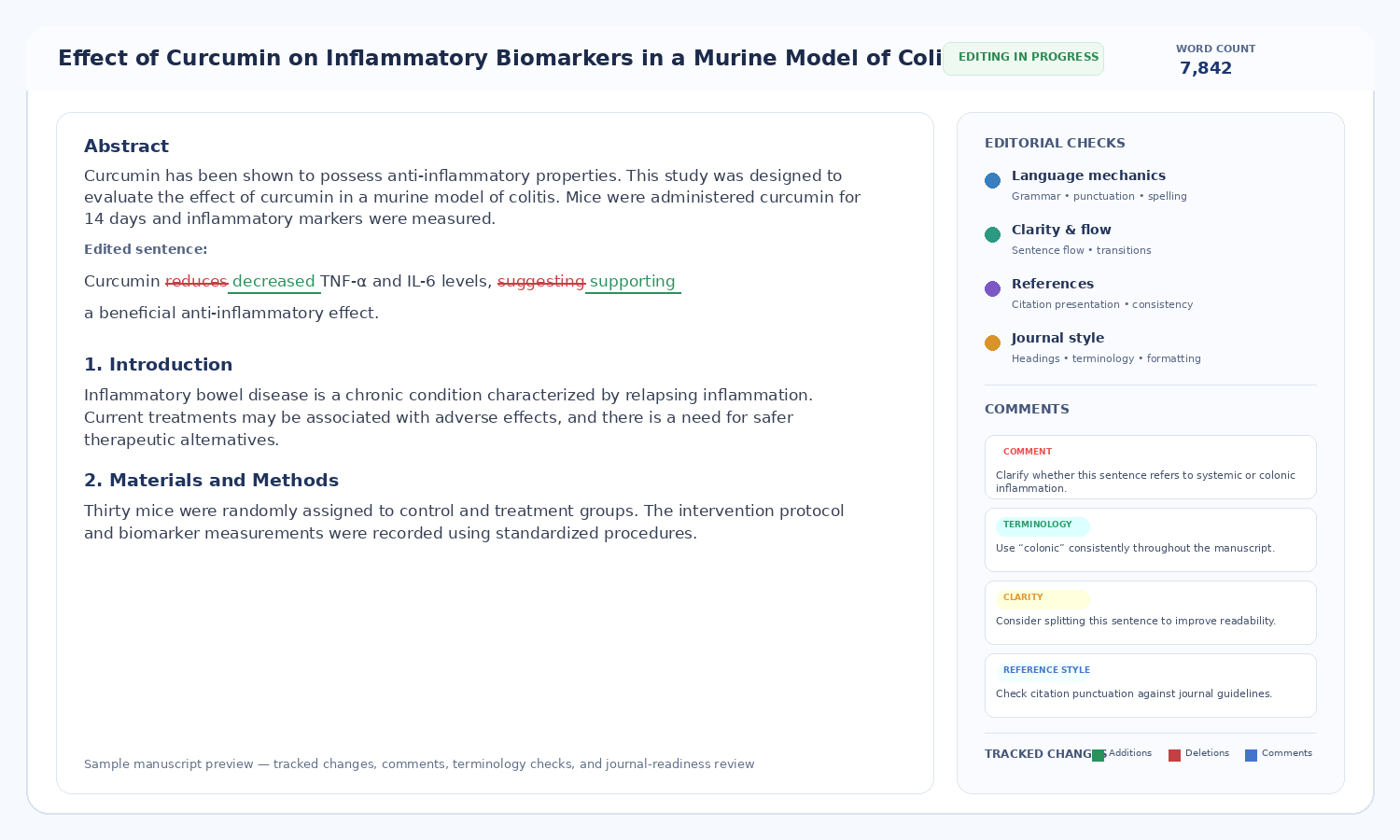
Academic journal manuscript with tracked changes, editor comments, terminology checks, citation review, and journal formatting checks
Illustrative editing view Sample manuscript interface showing tracked changes, editorial comments, language checks, and journal-facing consistency review.
Track Changes IncludedSee revisions clearly and review each editorial change.
Confidential File HandlingManuscript handling follows the confidentiality workflow shown below.
Journal-Aware EditingLanguage and presentation can be aligned to supplied journal guidance.
Clean + Edited FilesWork with a tracked manuscript and a clean final version.
What Problems This Service Solves
Awkward phrasing and wordiness

Sentences that are grammatically possible but difficult to read, repetitive, or imprecise.

Grammar and sentence-construction errors

Problems with syntax, punctuation, tense, articles, agreement, and sentence structure.

Inconsistent terminology

Terms, abbreviations, capitalization, units, or labels that vary across the manuscript.

Citation and formatting issues

Inconsistent references, headings, captions, numbering, and style presentation.

Unclear sentences and logical gaps

Wording or transitions that make the intended relationship between ideas harder to follow.

Journal-style mismatches

Presentation that does not consistently follow the supplied journal or publisher guidance.

The aim of this study was to investigate the effect of curcumin on inflammation in mice. Curcumin is a natural compound which is has different properties. Mice were treated with curcumin and the levels of inflammatory cytokines were measured.
↳ Example: wording and Vancouver-style presentation need editorial review.
What Journal Manuscript Editing Covers
Language MechanicsGrammar, spelling, punctuation, usage
Clarity & ReadabilityClear, concise, easy-to-understand sentences
Sentence FlowSmooth transitions and logical flow
Academic ToneObjective, precise, discipline-aware expression
Terminology ConsistencyConsistent terms, abbreviations, and labels
References & CitationsFormatting and presentation consistency
Tables & FiguresCaptions, labels, terminology, presentation
Journal FormattingStyle compliance when guidelines are supplied
Abstract RefinementStructured, clear, concise, and impactful
Cover & Response LettersEditorial review when included in scope
1

Service Demonstration: Annotated Manuscript Excerpt

A journal manuscript edit should make the intervention visible. The example below shows additions, deletions, replacements, comments, terminology guidance, and formatting notes in context.

128
129
130
131
132
133
134
135
136
137

The results of this study demonstrates demonstrate that curcumin has the ability to reduce inflammatory cytokines.

This effect was observed in all treated groups and was more pronounced in the high-dose group.

In addition, histological analysis showed a significant improvement showed significant improvement in colonic architecture.

These data suggests data suggest that curcumin may serve as a promising therapeutic agent for colitis.

However, further studies are needed to determine the long-term safety and optimal dosage.

(Smith et al., 2018; Johnson, 2019)

Additions Deletions Replacements Comments Formatting

Before editing, tracked changes, and clean final manuscript

2Before Editing

The goal of this study was to look at the effect of curcumin in mice with colitis. We gave curcumin to the mice for two weeks. We measured some markers.

The results showed that curcumin decreased TNF-α and IL-6. It can be said that curcumin is good for colitis.

3Edited With Track Changes

The aim objective of this study was to look at evaluate the effect of curcumin in a murine model of colitis.

Mice were administered curcumin for two weeks, and inflammatory biomarkers were measured.

The results showed that curcumin significantly reduced TNF-α and IL-6 levels. These findings suggest that curcumin may have beneficial effects in this model.

4Clean Final Manuscript

The objective of this study was to evaluate the effect of curcumin in a murine model of colitis.

Mice were administered curcumin for two weeks, and inflammatory biomarkers were measured.

The results showed that curcumin significantly reduced TNF-α and IL-6 levels. These findings suggest that curcumin may have beneficial effects in this model.

5

Proofreading vs. Journal Manuscript Editing

Proofreading is a final-stage correctness check. Manuscript editing is a deeper language and presentation intervention for developed research that needs stronger clarity, flow, consistency, and journal-facing polish.

AspectProofreadingJournal Manuscript Editing
FocusGrammar, spelling, punctuation, typographical issuesClarity, flow, structure, academic tone, terminology, and presentation
DepthSurface-level correctionSentence-level refinement and paragraph-level readability improvement where needed
TerminologyBasic consistency checksConsistent use of discipline-specific terms, abbreviations, capitalization, and labels
ReferencesFormatting consistency where includedCitation and reference presentation, style, punctuation, ordering, and consistency within scope
Tone & StyleMinimal adjustmentsAcademic tone, precision, concision, and discipline-appropriate wording
ScopeDoes not normally restructure sentences extensivelyCan rewrite sentences and improve transitions while preserving intended meaning
Best ForNear-final papers requiring a careful final checkDeveloped journal manuscripts that need stronger language and submission-facing presentation
6

Manuscript Sections We Review

Editing can be applied across the core manuscript and supporting material, with attention tailored to the purpose and language demands of each section.

Title

Clarity, accuracy, fit, and concise wording

Abstract

Structure, clarity, wordiness, completeness

Introduction

Background, rationale, aim, and flow

Methods

Clarity, detail, consistency, and ethics wording

Results

Clarity, logic, and data presentation language

Discussion

Interpretation, flow, and implications

Conclusion

Clarity, consistency, and alignment with findings

References

Presentation consistency and journal style

Tables / Figures

Captions, labels, terminology, and ordering

Supplementary

Clarity, labeling, references, and consistency

7

Our Editorial Workflow

The workflow moves from manuscript intake to editing, consistency review, quality verification, delivery, and optional clarification after you review the edits.

01

Submit Manuscript

Share manuscript details and requirements.

02

Scope Review

Review length, language condition, journal needs, and deadline.

03

Editor Assignment

Match the manuscript to appropriate editorial expertise.

04

Line-by-Line Editing

Edit language, clarity, flow, tone, and consistency.

05

Consistency Review

Check terminology, abbreviations, style, and references presentation.

06

QA Verification

Run final checks for quality, consistency, and completeness.

07

Delivery

Provide tracked changes, clean copy, and agreed notes.

08

Clarification

Address optional author questions about editorial changes.

8

What You Receive

Deliverables are organized so you can review revisions, see editor queries, work from a clean manuscript, and keep submission-readiness notes together.

DOCX

Edited Manuscript

Microsoft Word manuscript with tracked changes visible for review.

TRACKED
DOCX

Clean Final Manuscript

Clean edited version prepared after the tracked-edit stage.

CLEAN
DOCX

Editor Comments & Notes

Queries, clarifications, and editorial guidance where author input is needed.

NOTES
PDF

Journal-Style & Formatting Notes

Notes on style, presentation, headings, references, tables, figures, and captions where included.

STYLE
XLSX

Query Sheet

Optional consolidated clarification list when multiple author decisions are required.

QUERIES
PDF

Submission-Readiness Checklist

Final review points covering language and presentation items within the agreed editing scope.

CHECKLIST
9

Quality Assurance Methodology

A layered review helps separate language correction from clarity, reference and formatting consistency, and final verification before delivery.

Layer 1 — Language PassGrammar • spelling • punctuation • usage
Layer 2 — Clarity & Flow PassSentence structure • transitions • readability
Layer 3 — References & Formatting PassCitations • tables • figures • style consistency
Layer 4 — Final VerificationConsistency • open queries • completion check
1
Author intent preserved

Editors improve language without deliberately changing the research claim; ambiguous points can be queried instead.

2
Clarity and redundancy reviewed

Sentences are checked for unnecessary wordiness, awkward structure, and weak transitions.

3
Reference and journal-style presentation checked

Where guidelines are supplied, citation and presentation details can be checked for consistency with the requested style.

4
Final quality check

The manuscript is reviewed for unresolved editorial issues, consistency, and completeness within the agreed scope.

10

Disciplines We Support

Journal manuscript editing can be scoped for research across a broad range of academic and professional disciplines, with terminology and style handled in context.

Life Sciences
Medicine & Health
Engineering
Computer Science
Social Sciences
Business & Economics
Humanities
Environmental Science
Multidisciplinary Research
11

Confidentiality & File Handling

The service workflow is structured around controlled handling of unpublished research and related manuscript files.

Secure UploadEncrypted transfer of your files
Restricted AccessHandled by editors under confidentiality
Editing ProcessWork performed in a secured environment
Confidential DeliveryFiles delivered securely to you
File VerificationFiles reviewed for final handoff
File RetentionFiles retained for a limited period
NDA AvailableNon-disclosure agreement on request
12

Turnaround Options & Pricing Clarity

Because “Journal Manuscript Editing Service” is not an exact named plan in the supplied service catalogue, this page does not invent a fixed price or turnaround. The visible service model uses qualitative delivery options and a custom scope-based quote.

Standard

Balanced quality and turnaround. Timing depends on manuscript length, complexity, formatting needs, and confirmed service scope.

Priority

Faster turnaround with the same scope review. Availability depends on manuscript length, complexity, and editor capacity.

Express

Shortest possible delivery option for suitable manuscripts. Feasibility depends on scope, technical complexity, and deadline.

Custom Quote Based on Manuscript Scope

Pricing is determined after reviewing the manuscript requirements rather than applying an unsupported fixed amount.

Word CountLength of manuscript and related material
Language ConditionCurrent clarity and level of editorial intervention
Technical ComplexityDiscipline, terminology, notation, and content density
Service DepthLanguage-only versus broader journal-facing review needs
Formatting NeedsJournal style, references, tables, figures, captions
DeadlineRequested delivery window and availability

We provide a scope-based quote after a brief manuscript review.

13

Who This Service Is For

The service is intended for authors with developed academic manuscripts that need professional language and journal-facing refinement before submission or resubmission.

PhD Students

Preparing thesis-derived papers or journal submissions that need stronger clarity and academic language.

Faculty Authors

Strengthening developed manuscripts for journal review and publication-facing presentation.

Researchers & Postdocs

Improving clarity, consistency, terminology, references, and supporting manuscript elements.

Lab Teams

Creating consistency across co-authored manuscripts, sections, terminology, tables, figures, and captions.

Multilingual Authors

Refining English academic expression while preserving the intended research meaning and discipline context.

Resubmission Authors

Addressing language and presentation issues identified during peer review, where relevant to the editing scope.

14

Frequently Asked Questions

Answers to common questions about scope, files, tracked changes, journal guidelines, turnaround, pricing, and confidentiality.

What does journal manuscript editing include?

It can include language, clarity, sentence structure, academic tone, terminology consistency, citation and reference presentation, table and figure language, journal formatting, abstract refinement, and editor comments within the agreed scope.

Do you preserve the technical meaning of my work?

The editing process is designed to improve clarity and readability while preserving the author's intended meaning. Where wording is ambiguous or a change could affect meaning, the editor can flag a query rather than silently rewriting the point.

Do you edit references and citations?

Citation and reference presentation can be checked for consistency, formatting, punctuation, ordering, and alignment with supplied journal or style requirements. This does not replace source verification or fact checking.

What file formats do you accept?

The service is designed around editable manuscript files, especially Word documents where tracked changes and comments can be reviewed. Supporting journal guidelines, tables, figures, references, and supplementary files may also be provided where relevant.

Will I receive tracked changes and a clean file?

The service presentation includes a tracked-changes manuscript and a clean final manuscript so authors can review revisions and work from a polished version after accepting the changes.

How is journal manuscript editing different from proofreading?

Proofreading is primarily a final-stage correctness check. Journal manuscript editing can go deeper by refining clarity, sentence flow, academic tone, terminology consistency, paragraph-level readability, references presentation, and journal-facing formatting.

Can you follow my target journal guidelines?

Yes, when the applicable journal instructions are supplied. The editor can use them for relevant language and presentation checks such as headings, terminology, references, tables, figures, captions, and formatting conventions.

Do you edit tables, figures, and captions?

The service can review the language, labels, captions, terminology, abbreviations, and presentation consistency of tables and figures when they are included in the agreed scope.

Can you help with the abstract and cover or response letters?

Abstract refinement is part of the service coverage shown on this page. Cover and response letters can also be reviewed when they are included in the agreed manuscript-editing scope.

How long does journal manuscript editing take?

Turnaround depends on manuscript length, language condition, technical complexity, service depth, formatting needs, deadline, and editor availability. Standard, Priority, and Express options are considered according to the confirmed scope.

How is pricing calculated?

Pricing is provided as a custom quote based on manuscript scope, including factors such as word count, language condition, technical complexity, service depth, formatting needs, and deadline.

How do you handle confidentiality?

The service workflow presented on this page includes secure upload, restricted access, confidential handling during editing and delivery, file verification, defined retention handling, and NDA availability where required.

15

Why Researchers Choose This Editing Approach

The service emphasizes visible revisions, comprehensive manuscript review, clear scope, confidential handling, and journal-focused presentation rather than opaque or generic editing.

Transparent Edits

Clear, visible revisions through tracked changes and editor comments.

Comprehensive Review

Language, clarity, style, and journal-readiness are considered together.

Scope-Based Quote

Pricing is tied to manuscript scope rather than an unsupported fixed amount.

Confidential Handling

The manuscript workflow includes controlled handling and confidentiality measures.

Journal-Focused

Editing can be aligned to supplied journal language and presentation requirements.

16   Ready for the Next Draft?

Ready to Strengthen Your Manuscript Before Submission?

Share your manuscript details, target journal requirements, word count, deadline, and priority concerns. The scope can then be reviewed for the most appropriate editing approach and turnaround option.

Track Changes Custom Scope Confidential Handling Journal-Ready Presentation
Journal Manuscript Editing Enquiry

Request a Scope Review & Quote

Provide enough information to assess editorial depth, deadline feasibility, and journal-facing requirements. Manuscript files and supporting guidelines can be shared through the appropriate follow-up channel after the initial enquiry.

Security check *Loading question…

Include your manuscript type, research area, approximate word count, target journal or style guide, deadline, and the editing concerns you want prioritized.