Inconsistent Corporate Tone
Different sections can sound as if they were written by different organisations or teams.

Refine the language, narrative flow, terminology, captions, tables, cross-references, and presentation of your annual report while preserving approved facts, figures, disclosures, and corporate meaning.
This editing price reflects the heavier consistency burden of annual reports while remaining aligned with Contentxprtz’s existing professional editing and finance-proofreading positioning.
Suitable for: Developed annual-report drafts that need stronger corporate language, consistency, readability, and cross-section editorial control before stakeholder review.
The price can increase for substantially longer reports, fragmented source files, heavy restructuring, multilingual copy, or compressed reporting deadlines.
Annual reports are assembled from many contributors, sections, data points, and review cycles. Editorial friction often appears when language and presentation are not harmonised before final design and approval.
Different sections can sound as if they were written by different organisations or teams.
Long sentences, repetition, and abstract phrasing can hide the intended message.
Acronyms, business-unit names, and key terms may change across sections or review versions.
Tables, figures, notes, and callouts may use labels that do not align with the surrounding text.
Section, page, note, figure, or table references can become outdated as the report changes.
Small editorial inconsistencies can remain when content, design, and stakeholder reviews converge at the end.
The editorial review can be scoped across the complete report or focused on selected sections. The work is language- and presentation-focused and does not replace accounting, audit, legal, or regulatory review.
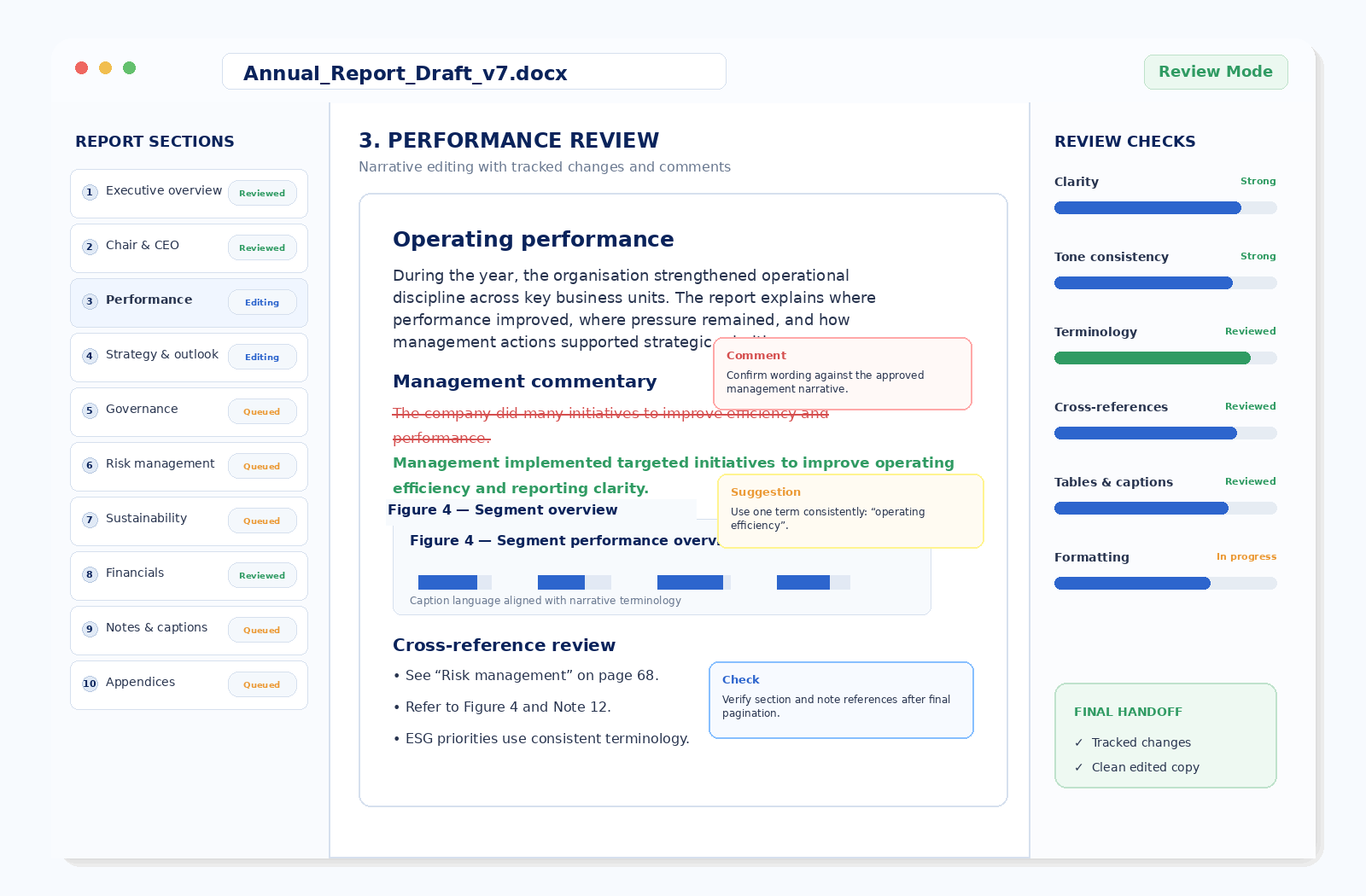
This illustrative example shows the difference between a rough corporate narrative, an annotated editorial pass, and a clean final draft. It does not introduce or validate company facts.
“The year was challenging and the company did many initiatives to improve operations. Performance improved in some areas and costs were managed. We are also focusing on sustainability and digital transformation and these are important for the future.”
The year was challenging and the company did many initiatives to improve operations.
During the year, the organisation strengthened operational discipline across key business units.
Management’s review explains where performance improved, where pressure remained, and how cost actions supported the year’s priorities.
The report also presents progress on sustainability initiatives and digital transformation in a consistent narrative.
CommentDuring the year, the organisation strengthened operational discipline across key business units. Management’s review explains where performance improved, where pressure remained, and how cost actions supported the year’s priorities. The report also presents progress on sustainability initiatives and digital transformation in a consistent narrative.
Formatting review and final proofreading each solve useful but narrower problems. Full annual report editing adds deeper narrative, tone, terminology, section-flow, and report-wide consistency support.
| Support Dimension | Formatting Review Layout & presentation checks |
Language Proofreading Grammar & typo correction |
Full Annual Report Editing End-to-end editorial coherence |
|---|---|---|---|
| Grammar, spelling & typographical correction | Limited | ✓ | ✓ |
| Corporate tone & readability | × | Partial | ✓ |
| Section flow & narrative coherence | × | × | ✓ |
| Terminology & acronym consistency | Partial | Partial | ✓ |
| Headings, captions, tables & figure presentation | ✓ | Partial | ✓ |
| Cross-reference & numbering review | ✓ | Partial | ✓ |
| Management narrative refinement | × | × | ✓ |
| Governance / risk / ESG language consistency | × | × | ✓ |
| Tracked changes and editor comments | As scoped | As scoped | ✓ |
| Best for | Presentation cleanup | Final language polish | Whole-report editorial consistency |
The editorial approach can be adapted to different corporate-reporting documents, with the exact scope confirmed from the draft and the organisation’s requirements.
A structured editorial workflow helps keep report-wide language and presentation consistent while leaving factual validation and formal approvals with the organisation’s responsible reviewers.
Share the latest report draft and editorial requirements.
Confirm sections, depth, file condition, and deadline.
Use supplied brand, terminology, and prior-report references.
Refine clarity, tone, flow, concision, and consistency.
Review headings, transitions, repeated concepts, and sequencing.
Check presentation consistency, captions, labels, and apparent links.
Check language, formatting consistency, and unresolved comments.
Receive tracked changes and a clean edited copy.
The editorial pass is organised into distinct checks so language, narrative, terminology, references, and final presentation receive focused attention.
Check section logic, repetition, sequencing, and transitions.
Improve concision, sentence clarity, readability, and emphasis.
Harmonise corporate voice, naming, acronyms, and key terms.
Flag apparent mismatches across captions, labels, notes, and cross-references.
Review headings, numbering, tables, figures, and presentation consistency.
Review unresolved comments and prepare the tracked and clean handoff files.
Annual report drafts can contain sensitive unpublished material. The editorial workflow should therefore combine useful report context with controlled handling of the documents supplied for review.
The service can be scoped around the report format and the sections actually supplied for editing.
The published starting price above covers the defined entry scope for Annual Report Editing. Larger, deeper, or faster-turnaround requirements are quoted after the actual materials and deliverables are reviewed. Scope, schedule, and quote are confirmed from the actual report.
Choose the scheduling pathway that best describes your situation. Availability is confirmed after the file and scope are reviewed.
The quote is personalised to the actual annual report rather than copied from an unrelated service plan.
Practical answers about scope, tracked changes, annual report sections, figures, cross-references, turnaround, pricing, and confidentiality.
The service focuses on language, clarity, tone, consistency, narrative flow, headings, captions, terminology, cross-references, tables and figure presentation, and editorial comments where the draft needs clarification. The exact scope is agreed after the report draft and requirements are reviewed.
Both approaches are possible. You can request a complete report edit or limit the work to selected narrative sections such as the chair or CEO message, performance review, governance, risk, sustainability or ESG, or appendices.
No. Editorial review is not an audit, accounting review, legal review, or regulatory assurance service. Editors can flag apparent inconsistencies between narrative, labels, captions, tables, figures, and cross-references, but the organisation remains responsible for validating the underlying figures and disclosures.
Yes. When you provide a style guide, prior-year report, glossary, brand language, or approved terminology, the edit can be aligned to those materials while improving readability and consistency.
Yes. The standard editorial handoff on this page is presented as an edited Word document with tracked changes together with a clean edited copy so reviewers can inspect revisions and read the refined text.
Yes, where those items are included in the supplied editable material. The review can check presentation consistency, labels, terminology, captions, heading hierarchy, numbering, and apparent cross-reference mismatches.
These sections can be included in the editorial scope. The service focuses on language, structure, consistency, and presentation rather than validating the underlying claims, metrics, legal obligations, or regulatory compliance.
Share the latest draft, approximate word or page count, required deadline, the sections to be edited, any brand or style guide, approved terminology, previous report if relevant, and any formatting or review instructions.
The published starting price above covers the defined entry scope for Annual Report Editing. Larger, deeper, or faster-turnaround requirements are quoted after the actual materials and deliverables are reviewed. A custom quote can be based on report length, editorial depth, file complexity, tables and figures, cross-reference or formatting needs, stakeholder review requirements, and deadline.
The page offers Standard, Priority, and Express scheduling options as service pathways, but For the published starting scope, typical delivery is 4–6 business days. Delivery feasibility is confirmed only after the report length, file condition, editorial depth, and deadline are reviewed.
A PDF can be useful for reference, but an editable Word or similar source file is preferable for tracked changes and efficient text revision. If only a PDF is available, describe the file format in your enquiry so the practical editing approach can be assessed.
Unpublished annual-report material should be handled through the designated project workflow. Mention any NDA, access, retention, deletion, or other file-handling requirements in the enquiry before sensitive files are submitted.
Tell us about the report, current draft, approximate length, sections to be edited, file format, deadline, and any style, terminology, board, design, or review requirements.
Share the annual report type and the sections you want reviewed.
Include approximate word or page count and whether the source is DOCX, PDF, or another editable format.
State whether you need language polish, deeper narrative refinement, report-wide consistency, or a final editorial pass.
Mention any corporate style guide, glossary, approved terms, or prior-year report that should guide the edit.
Flag any important caption, numbering, cross-reference, or design-stage requirements.
Share the required completion date and any internal management, board, design, or publication reviews.
Share your contact details and report requirements so the project can be assessed for editorial scope, scheduling feasibility, and a custom quote.
Share the scope and deadline so the editorial approach can be matched to your report.