Improve Clarity & Readability
Refine awkward sentences, vague phrasing, repetition, and wordiness so the reader can follow the point more easily.

Improve the language, clarity, academic tone, paragraph flow, consistency, citation presentation, and formatting of an assignment you have already written—without replacing your ideas, analysis, evidence, or intended meaning.
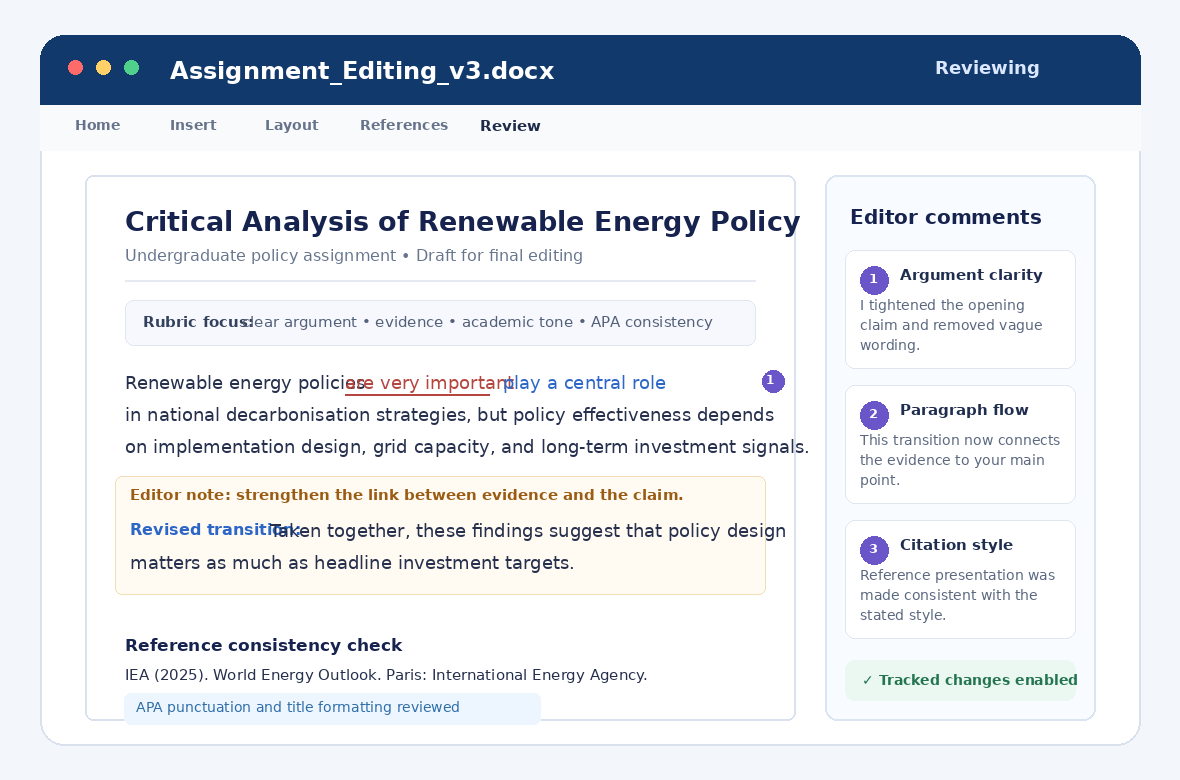
Your assignment remains your work. The service focuses on refining an existing draft and keeping editorial changes transparent.
A defined Assignment Editing Service engagement starts at ₹5,500 for up to 2,500 words. At this level, the work includes clarity against the assignment brief and paragraph flow and analytical progression, plus the service-specific checks listed below.
Longer documents, heavier rewriting, specialist subject review, complex assignment brief, rubric alignment, evidence, structure and final presentation, additional revision rounds, or accelerated delivery can increase the final quote. A shorter deadline for Assignment Editing Service can be assessed after the working files and requested scope are reviewed; accelerated delivery is confirmed only when feasible for that assignment.
A strong draft can still lose clarity when wording is vague, paragraphs do not connect, the tone shifts, or presentation rules are inconsistent. Editing helps you inspect those issues before the final submission.
Refine awkward sentences, vague phrasing, repetition, and wordiness so the reader can follow the point more easily.
Review transitions, sequencing, and logical connections so each paragraph supports the wider assignment purpose.
Use the brief, rubric, citation style, and formatting guidance you supply as a reference for presentation consistency.
Tracked edits and comments make it easier to inspect changes, resolve questions, and prepare the version you intend to submit.
The workflow starts with your draft and instructions, moves through in-depth language and presentation editing, and ends with a final quality review that keeps the changes transparent.
Receive your draft, brief, rubric and deadline.
Review scope, document condition and instructions.
Prioritise language, flow, consistency and presentation.
Clearer, more precise academic expression.
Consistent formatting and document presentation.
Transparent changes you can accept, reject or revise.
“The policy is very important because it has many effects and this shows that governments should do more about renewable energy.”
“The policy is significant because its effects extend across investment, grid planning, and long-term emissions reduction, strengthening the case for coordinated government action on renewable energy.”
The revision removes vague wording, identifies the specific effects being discussed, and creates a clearer link between the evidence and the conclusion.
Depending on scope, recognised language, reference-management and similarity-checking tools may support the human editing workflow.
Assignment editing can be scoped around the document type, academic level, marking instructions, and the level of language or structural intervention your draft needs.
Answers to common questions about scope, tracked changes, assignment briefs, citations, turnaround, pricing, and what to send before editing begins.
Assignment editing improves the language, clarity, organisation, academic tone, consistency, and presentation of a draft you have already written. The aim is to make your work easier to read and review while keeping your ideas, evidence, and intended meaning under your control.
This page is for editing, not ghostwriting. Your assignment should contain your own ideas, analysis, evidence, and conclusions. Editing focuses on how that existing work is expressed, organised, and presented.
Typical documents include essays, reports, case studies, literature reviews, reflective assignments, coursework, lab or technical reports, business assignments, project reports, and other academic submissions that already have a developed draft.
Edits are made to improve clarity and flow without intentionally replacing your argument. Where a sentence is ambiguous or a larger change could affect meaning, editor comments can flag the point for your review.
Yes, you can provide the assignment brief, marking rubric, style guide, or lecturer instructions so the editor can check presentation and wording against the requirements you supply.
Citation and reference presentation can be reviewed for consistency when you provide the required style or institutional guidance. Editing does not replace your responsibility to verify that every source is accurate, appropriate, and correctly represented.
The editing workflow is designed around visible revisions, editor comments where useful, and a clear final review process so you can understand what changed before submission.
Yes, when the requested scope calls for it, editing can address paragraph order, transitions, repetition, heading logic, and the connection between claims and supporting material in addition to sentence-level language.
Turnaround should be confirmed after the assignment length, editing depth, deadline, formatting requirements, and supplied instructions have been reviewed. This page does not publish a fixed turnaround for Assignment Editing Service.
A fixed Assignment Editing Service price is not displayed on this page. Request a quote with your approximate word count, deadline, and editing requirements so the scope can be assessed before pricing is confirmed.
Share the exact deadline and time zone in your enquiry. Feasibility can then be assessed against the document length and the level of editing required before any delivery commitment is made.
Send the draft plus any assignment brief, marking rubric, citation style, formatting instructions, lecturer comments, word-limit information, and your deadline. The more complete the instructions, the easier it is to scope the edit accurately.
The service can be scoped more accurately when the editor has both the draft and the instructions that define how the assignment should be presented.
Tell us what you need improved so the assignment can be reviewed for scope, deadline feasibility, and the most suitable editing approach.