Tracked changes included
Review visible edits and understand where wording was changed.

Expert polishing for essays, research papers, dissertations, and scholarly assignments—focused on language accuracy, clarity, coherence, academic tone, and citation consistency while preserving your intended meaning.
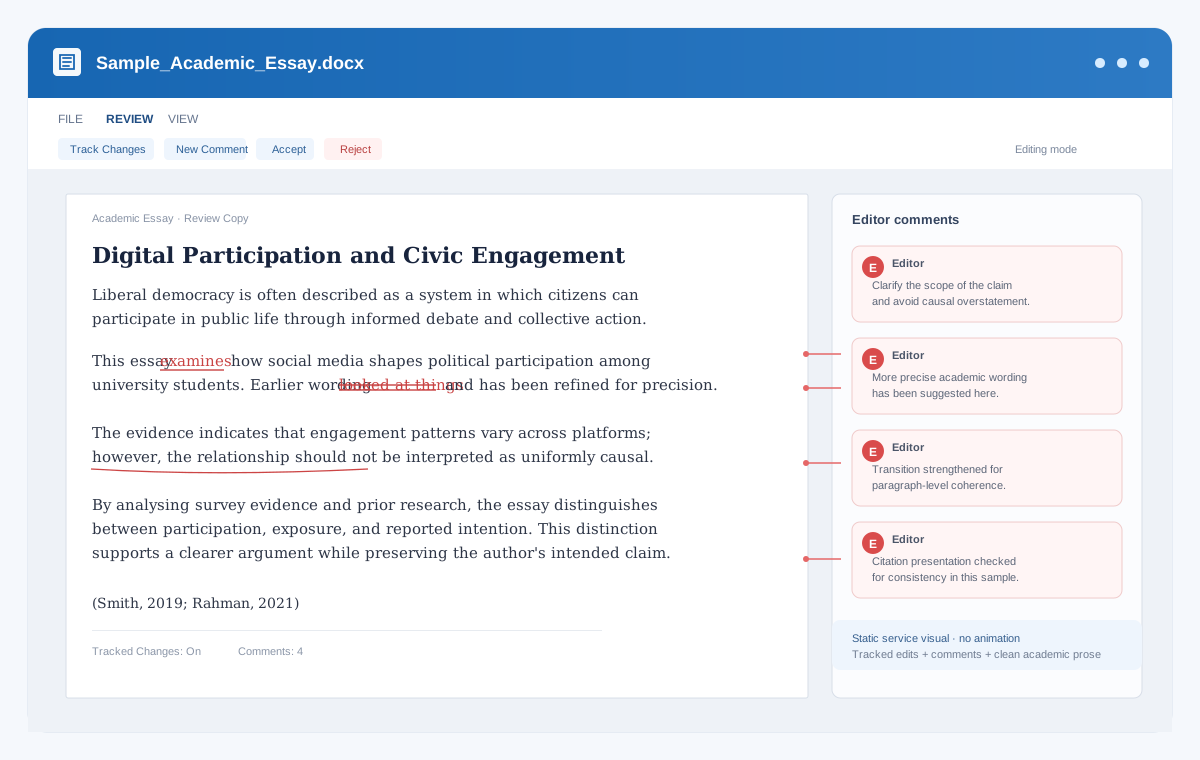
Review visible edits and understand where wording was changed.
A polished version supports final author review after tracked edits are assessed.
Language and presentation are adapted to the academic context.
Timing is assessed from length, complexity, editing depth, and deadline.
The starting price for Academic Essay Editing Service is ₹5,000 for up to 2,000 words. It provides a practical first scope for sentence-level clarity and concision and academic tone without flattening the writer’s voice without forcing larger assignments into a fixed package.
Longer documents, heavier rewriting, specialist subject review, complex essay argument, paragraph logic, source use and citation presentation, additional revision rounds, or accelerated delivery can increase the final quote. A shorter deadline for Academic Essay Editing Service can be assessed after the working files and requested scope are reviewed; accelerated delivery is confirmed only when feasible for that assignment.
From grammar to scholarly precision, the editing pass identifies language and consistency problems that can make an otherwise sound argument harder to read.
“The results shows that…”
↓Subject–verb disagreement
“It is important to note that…”
↓Wordy or vague phrasing
“student’s” in one place, “students” elsewhere
↓Lack of consistency
“However, the data is limited, therefore…”
↓Comma splice
“(Smith, 2019)” vs “Smith (2019)” used inconsistently
↓Citation-style inconsistency
“the Theory Of planned Behavior”
↓Incorrect capitalization
“This study looks at how things affect other things.”
↓Unclear and imprecise
A comprehensive edit can examine language at sentence level while also checking consistency, tone, argument presentation, and the document’s scholarly structure.
Grammar, spelling, punctuation, syntax, and obvious typographical issues.
Readability, concise wording, transitions, and sentence restructuring where needed.
More precise, formal, and discipline-appropriate expression without changing your intended claim.
Paragraph flow, sequence, emphasis, and logical connections are reviewed within the agreed editing depth.
Style presentation, punctuation, obvious mismatches, and consistency can be checked where included.
Headings, lists, numbering, tables, captions, and document presentation are reviewed for consistency.
This illustrative example shows how editing can tighten wording, clarify relationships between ideas, and improve scholarly tone without replacing the author’s central meaning.
This paper aims to examine the role of social media in our political participation among young people. Social media is have changed how people engage in politics; however, there are still many questions remains.
The study was conducted using a survey that was distributed online to 200 participants. The result shows that most respondents are reported that they use social media for political information.
Smith (2018) argues that digital platforms can increase civic engagement.
This paper examines the role of social media in political participation among young people. Social media has changed how people engage in politics; however, many questions remain.
The study used an online survey distributed to 200 participants. The results show that most respondents reported using social media for political information.
Smith (2018) argues that digital platforms can increase civic engagement.
Proofreading is a final surface-level check. Academic essay editing can go deeper into clarity, tone, flow, and presentation depending on the condition of your draft and the agreed scope.
| Aspect | Proofreading | Academic Essay Editing |
|---|---|---|
| Focus | Surface-level errors and final polish | Language, clarity, coherence, tone, and structure where included |
| Grammar, Spelling & Punctuation | Yes | Yes, with deeper sentence-level attention |
| Consistency | Basic document consistency | Terminology, capitalization, style, and presentation consistency |
| Clarity Improvements | Minor | More substantial where wording or sentence logic is weak |
| Sentence Restructuring | Rare | Used where needed to improve readability while preserving meaning |
| Flow & Coherence | Limited | Paragraph and section connections can be reviewed within scope |
| Argument Presentation | Normally outside scope | Logic, sequencing, and emphasis can be flagged or refined within scope |
| Academic Tone | Minimal | Enhanced for precision, formality, and discipline-appropriate expression |
| References & Citations | Basic presentation check | Consistency and presentation review where included |
| Best Fit | A strong draft needing final correction | A draft needing clearer, more coherent, academically polished expression |
The exact depth depends on the confirmed editing brief; this comparison does not imply that every academic editing project includes unrestricted rewriting or content development.
The review adapts to the document type. Research-oriented sections such as methods, results, tables, or figures are considered only when they are present or required by your assignment format.
Clarity & relevance
Purpose & summary
Context & direction
Sources & synthesis
Design & explanation
Accuracy of presentation
Interpretation & links
Key findings & implications
Style & consistency
Labels, captions & references
Small language decisions matter. The editor checks how grammar, transitions, abbreviations, punctuation, and citation presentation work together inside the paragraph.
The purpose of this study is to investigate the effect of social-media exposure on academic performance among undergraduate students. The results of the study indicate that students who experience high levels of screen time report lower GPAs.
These findings are consistent with previous research (Lee, 2020), which suggests that excessive platform use may reduce focused study time. Therefore, the discussion distinguishes association from causation and avoids overstating what the evidence can establish.
Clauses are adjusted when the relationship between ideas is unclear.
Vague or conversational wording is refined for academic precision.
Terminology, capitalization, numbers, and abbreviations are harmonized.
Expression is made more formal and precise without forcing unnatural wording.
A structured workflow keeps the editing brief, manuscript condition, tracked changes, consistency review, and final handoff aligned from start to finish.
Share the editable essay and relevant instructions.
Assess language condition, length, needs, and deadline.
Match the work to an appropriate academic editing context.
Revise wording, clarity, tone, grammar, and flow with tracked edits.
Check terminology, style, citations, headings, and formatting patterns.
Run a final read-through for language, presentation, and requested checks.
Receive tracked edits, clean copy, and included editor notes.
The deliverables are designed to make revisions transparent and final author review easier: one version showing the edits, one clean version, plus notes where clarification is useful.
Visible edits, revision marks, and editor comments allow you to review what changed and why.
A polished version with accepted edits integrated for a clearer final review and submission workflow.
Clear queries, explanations, and author-action suggestions where wording or meaning needs your input.
Editing decisions vary by field. The service can be adapted to different academic conventions, terminology, evidence styles, and document structures.
Literature, history, philosophy & more
Sociology, political science, psychology & more
Management, economics, finance & marketing
Mechanical, civil, electrical & chemical
AI, data science, software & computing
Curriculum, policy, pedagogy & learning sciences
Biology, ecology, biotechnology & related fields
Nursing, public health, clinical research & more
Quality control is layered: language is addressed first, then consistency and presentation checks are applied before a final editorial verification pass.
Read through the edited document for clarity, flow, completeness, and obvious remaining presentation issues within the confirmed scope.
Review reference and citation presentation, headings, captions, lists, and formatting consistency where included in the brief.
Check terminology, abbreviations, capitalization, spelling choices, numbering, and style patterns across the document.
Address grammar, punctuation, spelling, sentence construction, word choice, academic tone, and readability.
Academic drafts often contain unpublished work. The document-handling approach is designed around privacy, controlled access, editorial discretion, and only the sharing needed to complete the agreed work.
Your document is handled within a privacy-conscious editorial workflow.
Files are handled with controlled access appropriate to the editing workflow.
Editorial comments are limited to the document and requirements being reviewed.
Only the materials needed to complete the confirmed editing work should be used in the workflow.
Academic Essay Editing Service is not an exact named plan in the supplied editing catalogue, so this page does not invent a fixed price or turnaround. Scope is assessed from the manuscript itself.
A tailored quote can be prepared after the document condition and requested editing depth are reviewed.
Timing is confirmed only after the manuscript and requested scope are assessed.
Typical turnaround based on the manuscript scope confirmed for the project.
Faster delivery may be assessed where capacity and manuscript condition allow.
Large, complex, or multi-part projects use a timeline agreed after scope review.
A complete brief helps the scope review focus on the right issues from the start and reduces avoidable back-and-forth before editing begins.
Your complete essay or paper in an editable format; DOCX is preferred for tracked changes.
APA, MLA, Chicago, Harvard, or another required style if specified.
Your requested delivery date or submission date.
University, course, journal, rubric, or marking criteria that affect the brief.
Specific sections or language issues you want the editor to focus on, if any.
Tables, figures, datasets, templates, assignment instructions, or prior feedback where relevant.
Common questions about academic essay editing scope, tracked changes, citations, confidentiality, turnaround, and the files needed to begin.
Yes. Academic essay editing is intended to improve language, clarity, consistency, tone, and presentation without replacing your subject-specific meaning. Where a term may be ambiguous or a change could affect meaning, the editor can flag it for your review rather than silently guessing.
The editing scope can include citation and reference presentation, style consistency, obvious in-text/reference-list mismatches, capitalization, punctuation, and cross-reference consistency. It does not imply independent verification of every source or claim unless that is separately agreed.
The page workflow is built around a tracked-changes version for transparency and a clean edited version for final review. Editor comments or notes can also be included where a point needs clarification or author attention.
The service is designed for academic writing across humanities, social sciences, business, engineering, computer science, education, life sciences, medicine, and related fields. Editorial decisions should be adapted to the document context rather than forcing one generic style onto every discipline.
Turnaround is assessed from the manuscript length, current language condition, required editing depth, subject complexity, formatting or reference requirements, and your requested deadline. A timeline should be confirmed after the scope is reviewed rather than assumed from a generic fixed promise.
Editor comments are used to explain important changes or flag author-action points. If you need clarification after delivery, you can contact Contentxprtz with the relevant passage or comment so the question can be reviewed against the confirmed editing scope.
The supplied service workflow emphasizes private document handling, controlled file access, editorial discretion, and avoiding unnecessary sharing. Only the material needed to complete the agreed editing work should be handled within the workflow.
Yes. The service can address grammar, sentence construction, word choice, transitions, academic tone, clarity, and consistency while preserving the intended argument and subject-specific meaning.
Proofreading focuses mainly on final-stage surface errors such as grammar, spelling, punctuation, typos, and minor consistency issues. Academic essay editing can go further into sentence clarity, academic tone, paragraph flow, coherence, terminology, and structural presentation depending on the agreed scope.
Send the editable document, your deadline, required citation style, university or journal guidelines when relevant, and any areas you want the editor to focus on. Supporting tables, figures, feedback, templates, or assignment instructions can also be helpful when they affect the editing brief.