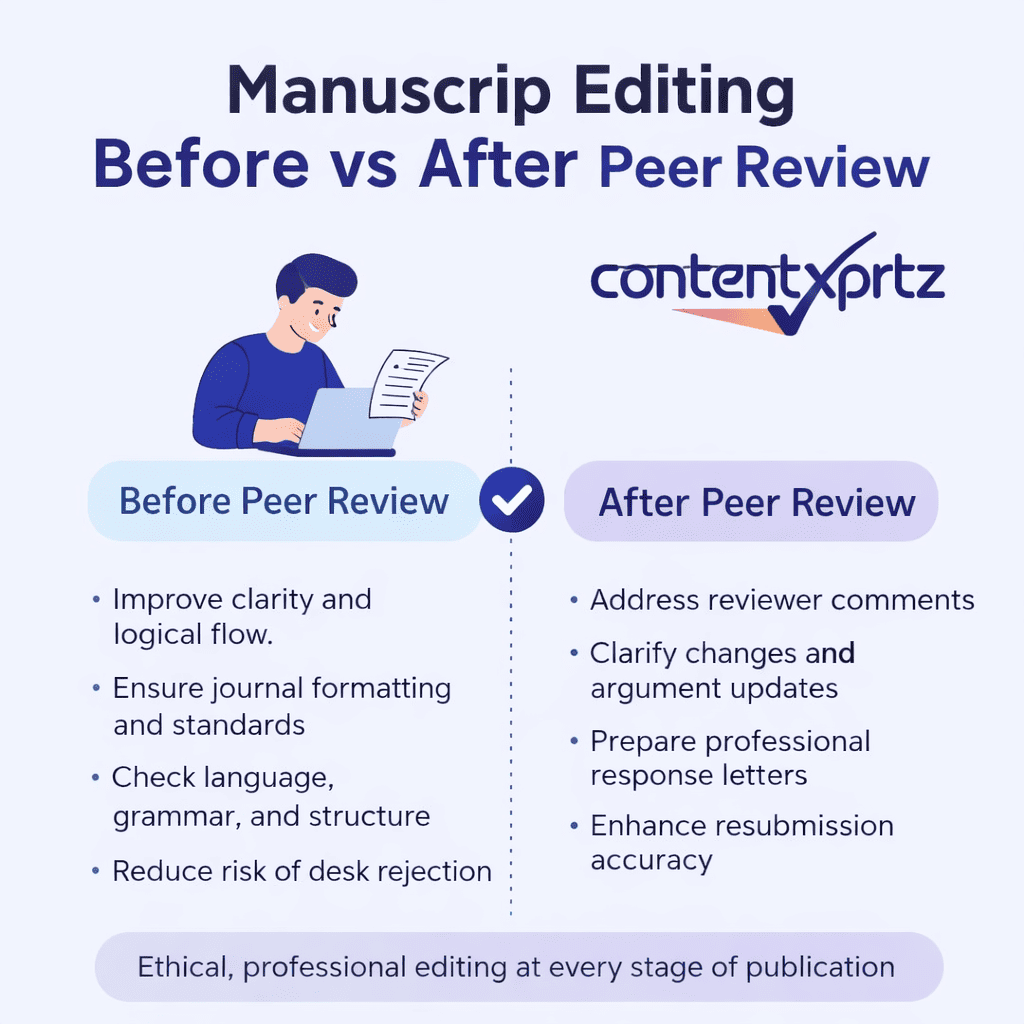

Manuscript Editing Before vs After Peer Review: What Authors Should Edit, When, and Why
By Dr. Aanya Mehta
Research Writer & Professional Business Communicator
For many researchers, the question of manuscript editing before vs after peer review appears deceptively simple: should you invest substantial effort in editing before journal submission, or wait until reviewers identify what needs to change?
In most cases, the strongest approach is not to choose one stage over the other. Manuscript editing before peer review and editing after peer review serve different purposes. Before submission, editing should make the manuscript sufficiently clear, coherent, complete, accurate, and journal-appropriate for editors and reviewers to evaluate the research fairly. After peer review, editing becomes more targeted: the authors must respond to editorial and reviewer comments, integrate scientific revisions, maintain consistency across the paper, and prepare a revised manuscript that clearly reflects what has changed.
This distinction matters because peer reviewers are not primarily language editors. Their role is generally to assess the scholarly work presented to them. If unclear sentences, inconsistent terminology, poor organization, missing methodological explanations, or avoidable formatting problems make the study difficult to understand, those issues can interfere with evaluation. Several publisher resources therefore encourage authors to ensure manuscripts are clearly written before submission, while also making clear that professional language editing does not guarantee selection for peer review or acceptance.
At the same time, trying to perfect every sentence before review can become inefficient. Peer reviewers may recommend reorganizing the discussion, adding methodological explanation, tempering conclusions, revising tables, expanding limitations, conducting additional analyses, or removing material. Extensive polishing of text that is later rewritten may therefore create unnecessary work.
The practical goal is stage-appropriate editing.
Before peer review, edit enough to ensure that the manuscript communicates the study accurately and professionally. After peer review, revise the intellectual and methodological substance first, then edit the changed manuscript for clarity, consistency, and submission readiness.
For PhD scholars, early-career researchers, ESL authors, and first-time journal authors, understanding this sequence can make the revision process considerably more manageable.
Quick Answer: Should You Edit a Manuscript Before or After Peer Review?
You should normally edit a manuscript both before and after peer review, but the emphasis should be different at each stage.
Before peer review, editing should focus on making the manuscript ready for meaningful evaluation. Check the structure, argument, title, abstract, methods description, results presentation, terminology, grammar, references, journal requirements, tables, figures, and reporting completeness. The goal is not cosmetic perfection. It is to prevent avoidable communication problems from obscuring the quality of the research.
After peer review, the priority changes. First address the editor’s and reviewers’ substantive comments. Decide which scientific, analytical, methodological, interpretive, or structural changes are justified. Then edit the revised manuscript so that new material integrates naturally with the original text and no inconsistencies have been introduced.
A useful rule is:
Before peer review: edit for evaluation.
After peer review: revise for response, then edit for coherence.
Professional language or manuscript editing can be useful at either stage, particularly when authors are too close to their own text to notice gaps or when English-language clarity is a concern. However, responsibility for the research, evidence, interpretations, citations, methodological decisions, and final submission remains with the authors.
Key Takeaways
- Editing before peer review helps reviewers evaluate the research rather than struggle with avoidable communication problems.
- Editing after peer review should follow substantive revision, because reviewer comments may change entire sections of the manuscript.
- Pre-review editing commonly focuses on structure, clarity, language, reporting completeness, journal requirements, references, tables, and figures.
- Post-review editing should also check whether revisions have created inconsistencies between the abstract, methods, results, discussion, tables, and response letter.
- Reviewers’ suggestions should not be accepted mechanically; authors remain responsible for deciding whether proposed changes are scientifically appropriate.
- Professional editing can improve communication, but it cannot guarantee peer review, acceptance, publication, citation impact, or favorable reviewer decisions.
- The most efficient workflow is often substantive author revision → manuscript editing → final author verification at both major submission stages.
What This Page Covers
This guide explains:
- The difference between editing before and after peer review
- What should be edited before initial journal submission
- What should wait until reviewer feedback arrives
- How to revise a manuscript efficiently after peer review
- How editing and reviewer-response preparation work together
- Common mistakes researchers make at both stages
- Practical examples, a comparison table, and submission checklists
Table of Contents
- What manuscript editing actually includes
- Manuscript editing before vs after peer review
- Why editing before peer review matters
- What to edit before initial submission
- What not to over-edit before peer review
- What changes after peer review
- How to edit a revised manuscript step by step
- Editing the response to reviewers
- Which stage deserves more editing effort?
- Practical examples
- Common mistakes
- Manuscript editing checklist
- When professional academic editing may help
- Summary
- Frequently asked questions
- About the Author
- Conclusion
Methodology and Academic Sources
The guidance in this article is based on established scholarly publishing practices, journal revision workflows, publication-ethics principles, and guidance made available by academic publishers and research organizations.
Useful references include the ICMJE Recommendations on authors and contributors, which distinguish authorship from activities such as writing assistance, technical editing, language editing, and proofreading.
For post-review revision workflows, PLOS guidance on revising manuscripts illustrates the common expectation that authors respond specifically to reviewer comments and provide appropriate revised manuscript files.
Researchers in health and related disciplines may also consult the EQUATOR Network reporting-guideline library to identify reporting standards relevant to their study design.
Publisher-specific requirements vary considerably. Always check the current instructions for authors, editorial decision letter, reporting requirements, and revision instructions for your target journal.
Manuscript Editing Before vs After Peer Review: The Core Difference
The main difference is the purpose of the editing.
Before peer review, no external reviewer has yet told you which scientific or presentation issues require attention. Your task is therefore preventive: remove weaknesses that could interfere with the manuscript’s evaluation.
After peer review, you have external feedback. Editing becomes responsive and integrative. You know which sections the editor or reviewers found unclear, incomplete, unsupported, inconsistent, or insufficiently explained.
| Aspect | Before Peer Review | After Peer Review |
|---|---|---|
| Main purpose | Make the manuscript ready for evaluation | Integrate reviewer-driven revisions clearly |
| Primary input | Authors’ manuscript, journal guidelines, reporting standards | Decision letter, reviewer reports, revised research content |
| Structural editing | Often useful | Often needed where reviewers request reorganization |
| Language editing | Important for clarity | Important after new material has been added |
| Methods checking | Ensure sufficient reporting | Add clarification or changes requested during review |
| Results presentation | Check accuracy and consistency | Update if analyses or presentation change |
| Discussion | Ensure balanced interpretation | Revise in response to criticism or new analysis |
| Formatting | Meet reasonable submission requirements | Follow revision and resubmission requirements |
| Response letter | Not applicable | Usually central to revision workflow |
| Final objective | Facilitate fair editorial and reviewer assessment | Demonstrate a careful, coherent response to peer review |
The practical takeaway is simple: pre-review editing prepares the manuscript to be reviewed; post-review editing prepares the revised manuscript to be reconsidered.
Why Manuscript Editing Before Peer Review Matters
A journal manuscript should be understandable enough for editors and reviewers to evaluate the research itself.
A well-edited submission does not need to be stylistically flawless. It does, however, need to communicate fundamental information without forcing readers to decipher avoidable ambiguity.
Springer Nature guidance emphasizes accuracy, readability, clear explanation of the study’s background, rationale, and main conclusions, while noting that language and manuscript preparation services are optional and do not imply acceptance or even selection for peer review.
Similarly, Elsevier’s manuscript-preparation guidance encourages researchers to refine text before submission for readability while emphasizing that authors remain responsible for their research content.
Pre-review editing is therefore particularly valuable when it helps answer questions such as:
- Can an editor understand the contribution from the title and abstract?
- Does the introduction lead logically to the research question?
- Are the methods described sufficiently clearly?
- Are results reported consistently across text, tables, and figures?
- Does the discussion distinguish evidence from interpretation?
- Are limitations acknowledged appropriately?
- Are technical terms used consistently?
- Are sentences understandable without repeated rereading?
- Have journal-specific requirements been checked?
- Have relevant reporting guidelines been considered?
These are communication and reporting questions, not predictions about whether a journal will accept the work.
What Should Be Edited Before Peer Review?
1. The Manuscript’s Overall Structure
Begin with the large-scale organization before correcting individual sentences.
Ask whether each section has a clear function and whether the sequence reflects the logic of the study.
For a conventional empirical research article, this often means checking whether:
- The introduction establishes the problem and rationale
- The research question or objective follows logically
- Methods correspond to the research question
- Results answer the questions investigated
- The discussion interprets rather than merely repeats the results
- Conclusions remain within the boundaries of the evidence
Structural editing before submission can prevent you from spending hours polishing paragraphs that later need to be moved, combined, rewritten, or removed.
2. Title and Abstract
Editors frequently encounter the title and abstract before examining the complete manuscript in detail. These elements therefore need particularly careful attention.
Check whether the title:
- Accurately reflects the study
- Avoids claims stronger than the evidence supports
- Uses important terminology consistently
- Is appropriately specific
Check whether the abstract:
- Accurately represents the full paper
- Includes the necessary study context
- States the objective clearly
- Reflects the actual methods
- Reports key results accurately
- Does not introduce conclusions absent from the paper
An abstract should not function as promotional copy. Its purpose is scholarly communication.
3. Introduction and Research Rationale
A strong introduction should tell the reader what problem the study addresses and why the particular investigation was undertaken.
During editing, look for:
- Excessive background information
- An unclear research gap
- Unsupported generalizations
- A weak transition from literature to research question
- Objectives that do not match the study
- Redundant citation clusters
- Claims requiring references
The objective is not necessarily to make the introduction longer. Often, effective editing makes it more focused.
4. Methods and Reporting Completeness
Language correction cannot compensate for missing methodological information.
Before submission, researchers should ask whether another knowledgeable reader can understand what was done, how data were obtained or generated, how variables or concepts were operationalized where applicable, and how analyses were conducted.
In fields covered by formal reporting guidelines, the EQUATOR Network provides a searchable collection that includes established guidance for randomized trials, observational studies, systematic reviews, protocols, diagnostic studies, qualitative research, economic evaluations, and other research designs.
A language editor can identify unclear descriptions, but methodological decisions must remain under the researchers’ control.
5. Results
Results require particularly careful consistency checking.
Compare:
- Numbers in the text with numbers in tables
- Percentages with underlying totals
- Figure references with actual figures
- Table numbering with in-text citations
- Terminology across all results
- Statistical labels and abbreviations
- Results reported in the abstract with results reported in the main manuscript
An editor should flag apparent inconsistencies rather than silently reinterpret or reconstruct the authors’ data.
6. Discussion and Conclusions
The discussion is frequently where overstatement appears.
Editing should examine whether the manuscript:
- Clearly distinguishes findings from interpretation
- Avoids claiming causation when the design supports only association
- Compares results with relevant literature fairly
- Discusses important limitations
- Avoids introducing major new results
- Keeps conclusions proportional to the study design and evidence
The goal is not to make claims sound more impressive. It is to make their meaning more precise.
7. Academic Language and Readability
Language editing may include:
- Grammar
- Sentence structure
- Word choice
- Academic tone
- Punctuation
- Article and preposition use
- Verb tense
- Transitions
- Redundancy reduction
- Consistent terminology
- Ambiguous pronouns
- Unnecessarily complex sentences
For ESL researchers in particular, this can help ensure that readers evaluate the intended scientific meaning rather than struggle with its expression.
8. References, Tables, and Figures
Before submission, perform a consistency check rather than assuming reference software has eliminated every problem.
Check:
- In-text citations against the reference list
- Duplicate references
- Missing reference details
- Table titles and notes
- Figure legends
- Units and abbreviations
- Sequential numbering
- Journal-specific presentation requirements
References must be authentic and traceable. Editing must never involve inventing missing sources.
What Should You Avoid Over-Editing Before Peer Review?
Not every manuscript needs exhaustive line-by-line perfection before the first submission.
The reason is practical: reviewers may ask for substantial changes.
A manuscript could undergo:
- Reorganization of the discussion
- Removal of a secondary analysis
- Addition of a sensitivity analysis
- Expansion of the methods
- Rewriting of the abstract
- New limitations
- Shortening of background material
- Replacement of figures
- Revision of terminology
- Changes to conclusions
If you spend disproportionate time polishing every sentence in sections likely to change, some of that effort may be lost.
A sensible pre-review approach is to make the manuscript clear, credible, coherent, accurate, and submission-ready without treating the first submitted version as the final typeset article.
Journal requirements also differ. Some journals permit relatively flexible formatting at initial submission, while later stages may have stricter requirements. Authors should therefore follow the actual instructions of the target journal rather than assume that every formatting detail must be finalized before peer review.
What Changes After Peer Review?
After peer review, editing becomes part of a larger revision process.
That distinction is important.
A reviewer may write:
The rationale for excluding participants with incomplete follow-up is unclear.
This is not merely a sentence-level editing problem.
The authors must determine:
- Why those participants were excluded
- Whether the exclusion was methodologically justified
- Whether the manuscript originally reported it accurately
- Whether additional explanation or analysis is needed
- Whether related sections also require revision
Only after those questions have been resolved should the new wording be polished.
PLOS revision guidance, for example, asks authors to address reviewer and editor comments specifically, list changes made to the manuscript, and provide the revised files required by the journal.
This illustrates why post-review editing should not begin as a superficial proofreading exercise.
Scientific revision comes first. Linguistic refinement follows.
How to Edit a Manuscript After Peer Review: Step by Step
Step 1: Read the Editor’s Decision Separately From the Reviewer Reports
The editor’s letter may indicate which issues are especially important.
Do not immediately start changing sentences as you read comments one by one. First understand the overall decision.
Identify:
- Mandatory editorial requirements
- Major scientific concerns
- Requests for clarification
- Suggested additional analyses
- Structural recommendations
- Language or presentation comments
- Formatting requirements
This prevents fragmented revision.
Step 2: Create a Reviewer-Comment Matrix
A simple working table can be extremely useful.
| Comment | Type of Issue | Action Needed | Manuscript Location | Response Status |
|---|---|---|---|---|
| Reviewer 1, Comment 1 | Methods clarification | Expand sampling description | Methods | Completed |
| Reviewer 1, Comment 2 | Interpretation | Temper causal wording | Discussion | Completed |
| Reviewer 2, Comment 1 | Additional analysis | Co-authors to assess feasibility | Results/Methods | Under review |
| Editor comment | Word limit | Reduce discussion | Entire manuscript | Pending |
This is especially helpful for multi-author papers.
Step 3: Separate Scientific Decisions From Language Decisions
Reviewer comments are recommendations to evaluate, not automatic instructions to implement without thought.
If a reviewer recommends:
- A new experiment
- Additional statistical analysis
- Removal of a subgroup
- A different theoretical interpretation
- Changes to inclusion criteria
- A stronger or weaker conclusion
the researchers must decide how to respond based on scholarly and methodological reasoning.
An editor can help communicate that response clearly. The editor should not make the scientific decision on the author’s behalf.
Step 4: Make the Major Revisions First
Do not proofread sentences that are about to be rewritten.
A practical revision order is:
- Methodological or analytical revisions
- Changes to results
- Structural revisions
- Discussion and interpretation
- Introduction changes
- Abstract updates
- Title adjustments
- Language editing
- Reference and cross-document checking
- Final proofreading
This sequence reduces duplicated work.
Step 5: Recheck the Entire Manuscript, Not Only Changed Paragraphs
This is one of the most important post-review editing principles.
A new analysis added to the results may require changes to:
- Methods
- Abstract
- Tables
- Discussion
- Conclusions
- Supplementary material
- Response letter
A new limitation may affect the tone of the conclusion.
A revised sample size may appear in several sections.
Changing only the paragraph mentioned by the reviewer can therefore create internal contradictions.
Step 6: Edit New Text Into the Existing Voice
Post-review manuscripts often contain obvious “revision seams.”
You may notice:
- New paragraphs that use different terminology
- Sudden changes in writing style
- Repeated explanations
- Contradictory transitions
- Duplicated citations
- Different abbreviations for the same term
This is particularly common when several co-authors respond to different reviewers.
A whole-manuscript edit helps integrate the revised material into one coherent document.
Step 7: Verify the Abstract Again
After substantial peer-review revision, the abstract should be treated as potentially outdated.
Check whether it still accurately reflects:
- Sample or dataset
- Methods
- Analysis
- Numerical results
- Main findings
- Interpretation
- Conclusions
Never assume that revisions elsewhere automatically remain consistent with the abstract.
Step 8: Complete a Clean Proofread Only at the End
Once the substantive revision is stable, proofread for:
- Grammar
- Typographical errors
- Punctuation
- Numbering
- References
- Tables
- Figures
- Terminology
- Abbreviations
- Cross-references
- Reviewer-response accuracy
This is the stage where detailed sentence-level polishing produces the greatest value.
Editing the Response to Reviewers
The response letter is not a secondary administrative document. It helps the editor and reviewers understand exactly how the authors handled the feedback.
PLOS guidance recommends a point-by-point response addressing reviewer and editor comments and identifying manuscript changes.
A useful response structure is:
Reviewer comment:
[Full or clearly identifiable comment]
Response:
Thank you for raising this point. We have clarified the sampling procedure in the Methods section and now explain the exclusion criterion and its rationale.
Change in manuscript:
[Relevant revised wording or precise section/page/line location, according to journal practice]
When disagreeing with a reviewer, remain professional and evidence-based.
A disagreement can be academically legitimate.
For example:
Reviewer comment:
Please remove the sensitivity analysis because it is unnecessary.
Possible response:
We appreciate the reviewer’s concern. We have retained the sensitivity analysis because it addresses the potential influence of [specific issue]. We have, however, shortened its presentation and clarified its purpose in the Methods and Results sections.
The important point is not to “win” the disagreement. It is to explain the authors’ reasoning clearly enough for the editor to evaluate it.
Which Stage Deserves More Editing: Before or After Peer Review?
There is no universal answer because the appropriate level of editing depends on the manuscript’s condition and the likely scale of revision.
A practical decision framework is:
Invest more heavily before peer review when:
- English-language clarity is currently weak
- The argument is difficult to follow
- The manuscript has been written by multiple authors with inconsistent styles
- The abstract does not clearly represent the study
- Methods reporting is difficult to understand
- The target journal has specific submission requirements
- Previous submissions have received comments about presentation or language
- The manuscript has undergone substantial internal revision and needs consolidation
Reserve some intensive editing for after peer review when:
- The manuscript is already clear and professionally written
- Large substantive changes are reasonably likely
- The journal permits flexible initial formatting
- The authors expect reviewer-requested analyses
- The paper contains sections that may change substantially
- The revision deadline will allow adequate language review
For many researchers, the most efficient compromise is:
Thorough structural and language editing before initial submission + focused whole-manuscript editing after substantive peer-review revision.
Practical Example 1: ESL Researcher Preparing a Biomedical Manuscript
Situation
A doctoral researcher has completed an observational study and drafted the manuscript in English as an additional language.
The methods and data are complete, but the paper contains:
- Long sentences
- Inconsistent terminology
- Repeated background information
- Unclear transitions
- Several abbreviations introduced inconsistently
Weak approach
Submit immediately and assume reviewers will identify what needs fixing.
Better approach
Before submission, the researcher:
- Checks the relevant journal instructions
- Reviews any applicable study-reporting guideline
- Confirms that the methods and results are complete
- Edits the manuscript for structural clarity
- Standardizes terminology
- Refines the title and abstract
- Performs language editing
- Verifies references, tables, and figures
If peer reviewers later request an expanded limitations section and clarification of confounding variables, the author makes those substantive changes first and then edits the revised paper again.
Why this works
The first edit improves the manuscript’s evaluability. The second ensures that reviewer-driven changes do not reduce clarity or create inconsistencies.
Practical Example 2: Major Revision After Peer Review
Situation
A management research article receives a “major revision” decision.
Reviewer comments ask the authors to:
- Clarify the theoretical framework
- Explain participant recruitment more fully
- Temper a conclusion
- Add two important limitations
- Reorganize part of the discussion
Common mistake
The authors make isolated sentence changes exactly where comments were placed.
The resulting paper contains a revised discussion that no longer aligns fully with the abstract and conclusion.
Better approach
The authors create a reviewer-response matrix, revise the conceptual and methodological issues first, and then review the complete paper.
They discover that the revised interpretation affects:
- One sentence in the abstract
- Three paragraphs in the discussion
- The conclusion
- One statement in the response letter
A final consistency edit catches all four.
Why this works
Peer-review revisions often have consequences beyond the section explicitly identified by the reviewer.
Practical Example 3: When the Author Disagrees With a Reviewer
Situation
A social-science reviewer recommends changing an objective and performing an analysis that the authors believe is inappropriate for their research design.
Weak approach
Change the objective simply because a reviewer requested it.
Better approach
The research team evaluates the request carefully, discusses it among the co-authors, and decides that the proposed analysis would not answer the original research question appropriately.
They prepare a respectful response explaining:
- What they understood the reviewer’s concern to be
- Why they did not implement the exact proposed change
- What clarification they added instead
- Where the manuscript was revised
An editor then helps ensure the explanation is concise and professional without changing the methodological reasoning.
Why this works
Peer review informs author revision, but scholarly responsibility remains with the authors.
Practical Example 4: Desk Rejection Before External Peer Review
Situation
A manuscript is rejected by the editor without external peer review because it does not fit the journal’s scope.
Does this count as post-peer-review editing?
No external peer review occurred.
The manuscript may require retargeting rather than reviewer-driven revision.
Before submitting to another journal, the authors should:
- Reassess journal fit
- Read the new journal’s aims and scope
- Update formatting where necessary
- Rewrite the cover letter
- Check title and abstract positioning
- Review word limits
- Revise journal-specific terminology
- Perform another manuscript check before resubmission
The lesson is that not every editorial decision requires the same revision strategy.
Common Mistakes in Manuscript Editing Before and After Peer Review
Mistake 1: Treating peer review as free proofreading
Reviewers should not be expected to repair basic grammar, organization, or clarity problems that the authors could reasonably address before submission.
Better approach: submit a manuscript that communicates the research clearly enough to be evaluated.
Mistake 2: Chasing stylistic perfection before the first review
Over-polishing unstable sections wastes effort if they are later replaced.
Better approach: prioritize clarity, coherence, accuracy, and submission readiness.
Mistake 3: Proofreading before making major revisions
Correcting punctuation in a paragraph scheduled for major rewriting is inefficient.
Better approach: revise substance first and language second.
Mistake 4: Responding only to reviewer comments without rereading the full manuscript
Local changes may produce global inconsistencies.
Better approach: complete a whole-paper consistency review.
Mistake 5: Accepting every reviewer suggestion automatically
Not every suggested change is methodologically appropriate.
Better approach: assess each request academically and explain justified disagreements respectfully.
Mistake 6: Updating the manuscript but not the response letter
The response may claim a change that is absent or located elsewhere.
Better approach: cross-check every response against the final revised manuscript.
Mistake 7: Updating results but forgetting the abstract
This can leave the most visible summary inconsistent with the manuscript.
Better approach: verify the abstract after every substantial revision.
Mistake 8: Allowing an editor to make intellectual decisions
Language and structural support should not replace researcher judgment.
ICMJE guidance distinguishes writing assistance, technical editing, language editing, and proofreading from the contributions required for authorship, reinforcing the distinction between editorial assistance and author responsibility.
Mistake 9: Assuming editing guarantees acceptance
It does not.
Nature-related author guidance explicitly notes that professional language editing does not guarantee selection for peer review or acceptance.
Mistake 10: Ignoring the journal’s own revision instructions
Submission systems and required files vary.
Better approach: use the specific decision letter and current journal instructions as your operational checklist.
Manuscript Editing Checklist Before Peer Review
Before initial submission, ask:
- Does the title accurately represent the study?
- Does the abstract match the complete manuscript?
- Is the research problem or rationale clearly established?
- Are the research questions, hypotheses, or objectives stated accurately where applicable?
- Are the methods understandable and sufficiently reported?
- Have relevant reporting guidelines been checked where applicable?
- Are all results reported consistently?
- Do tables and figures agree with the text?
- Is the discussion logically structured?
- Are conclusions proportionate to the evidence?
- Are important limitations acknowledged?
- Is terminology consistent?
- Are abbreviations defined and used consistently?
- Has grammar and sentence clarity been reviewed?
- Are citations and references consistent?
- Have all references been verified as authentic?
- Does the manuscript meet the target journal’s essential requirements?
- Have all authors reviewed the final version?
Manuscript Editing Checklist After Peer Review
Before resubmitting a revision, ask:
- Have all editor comments been addressed?
- Have all reviewer comments been addressed individually?
- Are substantive scientific changes complete before final language editing?
- Is every response in the response letter consistent with the actual manuscript?
- Have disagreements with reviewers been explained professionally?
- Have changes to the methods been reflected elsewhere where necessary?
- Have updated results been incorporated into the abstract and discussion?
- Are revised conclusions still supported by the evidence?
- Has new text been integrated into the manuscript’s existing terminology and style?
- Have duplicated explanations created during revision been removed?
- Have references been added or removed correctly?
- Have tables and figures been updated?
- Has the complete manuscript—not merely changed paragraphs—been reread?
- Have marked and clean copies been prepared if required?
- Have the journal’s current resubmission instructions been followed?
- Have all authors approved the revised manuscript and responses?
When Can Professional Manuscript Editing Help?
Professional editing may be useful when the research itself is substantially complete but the manuscript needs an independent communication review.
Researchers may seek support for:
- Language clarity
- Academic tone
- Sentence structure
- Logical flow
- Section organization
- Terminology consistency
- Abstract refinement
- Journal-specific formatting
- Reference consistency
- Reviewer-response clarity
- Final revision proofreading
Contentxprtz describes its academic-support work as covering editing, proofreading, research-paper support, journal-manuscript editing, publication assistance, reviewer-response support, citation and referencing support, and journal-specific formatting.
For authors who already have a completed research manuscript but want a professional communication review before submission or after reviewer revisions, the Contentxprtz research paper editing service is the most directly relevant option.
Researchers needing broader manuscript-level language and structural refinement can also review academic editing support, while authors navigating journal processes may find journal publication services relevant to their situation.
Professional support should preserve the researcher’s intellectual contribution. Authors remain responsible for their:
- Data
- Methods
- Results
- Interpretations
- Claims
- Citations
- Ethical compliance
- Reviewer responses
- Final manuscript
- Submission decisions
Institutional and journal policies concerning editing assistance may differ, so researchers should check applicable requirements.
Summary: Manuscript Editing Before vs After Peer Review
Manuscript editing before peer review and editing after peer review solve different problems.
Before peer review, the objective is to produce a manuscript that editors and reviewers can evaluate without unnecessary communication barriers. The manuscript should be logically structured, sufficiently reported, internally consistent, readable, and appropriate for the target journal.
After peer review, the objective is different. Authors first need to interpret the editor’s decision and reviewer reports, decide what substantive changes are academically justified, implement those revisions, and prepare a clear response. Only then should the revised manuscript undergo detailed language editing, consistency checking, and proofreading.
The most reliable sequence is:
Before submission:
Research verification → structural review → language editing → consistency check → author approval → submission
After peer review:
Review comments → scientific decisions → substantive revision → response preparation → whole-manuscript editing → proofreading → author approval → resubmission
Neither stage eliminates the need for the other.
Pre-review editing improves readiness for evaluation. Post-review editing ensures that the revised manuscript remains coherent after substantial change.
Frequently Asked Questions
1. Is manuscript editing better before or after peer review?
Neither stage is universally “better” because the two edits serve different purposes. Before peer review, editing should make the manuscript clear and sufficiently polished for evaluation. After peer review, editing should refine a manuscript that has already been substantively revised in response to external feedback.
If the manuscript currently contains serious clarity, grammar, structural, or consistency problems, waiting until after peer review may be unwise because those weaknesses can interfere with how editors and reviewers understand the research.
However, there is little value in obsessively polishing text that is likely to change substantially during review. A balanced approach is usually preferable: complete a thorough pre-submission edit, then perform another focused whole-manuscript edit after reviewer-driven revisions.
2. What is the main difference in manuscript editing before vs after peer review?
The main difference in manuscript editing before vs after peer review is the source of the revision priorities.
Before review, priorities come from the authors’ own critical reading, co-author feedback, journal instructions, reporting guidelines, and language or manuscript evaluation. The goal is to present the research accurately and clearly.
After peer review, priorities also come from the editor’s decision letter and reviewers’ reports. Authors may need to clarify methods, revise interpretations, conduct justified additional analyses, reorganize sections, expand limitations, or change tables and figures.
Because these substantive revisions can alter several sections simultaneously, final language editing should generally follow them rather than precede them.
3. Should I professionally edit my paper before submitting it to a journal?
Professional editing can be useful if communication problems remain after the authors’ own revision, but it is not a universal requirement.
It may be particularly helpful when:
- English is an additional language
- Multiple authors have created inconsistent writing styles
- The paper has undergone many rounds of rewriting
- The argument is difficult to follow
- The target journal has detailed language or presentation expectations
- Previous editorial feedback has identified recurring writing problems
Authors should first ensure that the scientific content is substantially stable. Professional editing should improve communication without inventing evidence, changing data, creating references, or replacing author judgment.
4. Should I wait for reviewers before fixing the language?
Usually, no. A manuscript should already be understandable when submitted.
Reviewers need to evaluate the study, and unclear language may make that process harder. Publisher guidance commonly encourages authors to ensure that manuscripts communicate their research clearly before submission, although language editing does not guarantee favorable editorial decisions.
You do not necessarily need publication-stage perfection. Concentrate first on errors and ambiguities that could change meaning or interfere with evaluation.
After peer review, repeat the language check because revisions may introduce new problems.
5. Should I edit the manuscript immediately after receiving reviewer comments?
Start by analyzing the comments rather than line-editing the manuscript immediately.
Read the editor’s decision and all reviewer reports in full. Group comments into categories such as methodology, additional analysis, interpretation, structure, reporting, language, and formatting.
Then resolve substantive matters first.
If you proofread early and later rewrite large sections, you will duplicate work. Once the scientific and structural revisions are reasonably stable, perform the detailed language and consistency edit.
This sequence is particularly valuable for major revisions.
6. Do I have to accept every reviewer suggestion?
No. Authors should consider every reviewer comment seriously, but they do not have to implement a suggestion they believe is methodologically inappropriate, unsupported, impossible, or inconsistent with the study’s purpose.
A disagreement should be explained respectfully and specifically.
Describe the concern, state what you considered, explain your reasoning, and indicate whether you made an alternative clarification or revision.
The editor ultimately evaluates the response. A professional, evidence-based explanation is therefore more useful than either automatic compliance or defensive rejection.
7. Should I edit the response-to-reviewers letter?
Yes. The response letter should be clear, complete, consistent, and easy to navigate.
Its purpose is to help the editor and reviewers understand how every material comment was handled. PLOS revision guidance, for example, asks authors to address specific reviewer and editor points and list the corresponding manuscript changes.
Check the final response letter against the manuscript. Page numbers, line numbers, quotations, section references, analyses, and stated changes should match the version actually being resubmitted.
8. Can manuscript editing change my research findings?
An editor may flag ambiguous wording, logical inconsistencies, apparent numerical discrepancies, missing explanations, or unsupported claims, but substantive research decisions belong to the authors.
An editor should not invent results, change data to make findings appear stronger, add fabricated references, alter conclusions without author review, or make methodological decisions independently.
If editing reveals a possible scientific problem, the correct response is to flag it for the research team.
The authors then investigate and decide whether the manuscript, analysis, data, or interpretation requires correction.
9. How much editing should I do after minor revision?
A minor revision may require less substantive restructuring, but the entire manuscript still deserves a final consistency check.
Even a small change can affect multiple locations. For example, clarifying one methodological criterion may require updating the methods, abstract, discussion, table footnote, and response letter.
After addressing the requested changes:
- Review every changed passage
- Search for related terminology throughout the manuscript
- Check the abstract and conclusion
- Verify tables, figures, and references
- Proofread the clean final version
The label “minor revision” should not be interpreted as permission to skip final quality control.
10. When should I seek expert academic editing support?
Consider professional editing when you can identify a communication problem that independent editorial support could realistically solve.
Examples include recurring grammar problems, unclear paragraph organization, inconsistent terminology, an unfocused abstract, difficult transitions, extensive co-author revisions, or a major post-review rewrite that needs a final consistency check.
Before seeking support, complete as many scientific decisions as possible. Provide the editor with the correct manuscript version, relevant journal instructions, and—after peer review—the editor’s and reviewers’ comments where appropriate.
The researcher should review every editorial change before submission and remain responsible for the final manuscript.
About the Author
Dr. Aanya Mehta
Research Writer & Professional Business Communicator
Dr. Aanya Mehta is a research-oriented writer and professional communicator with a strong focus on accuracy, clarity, and evidence-based insight. Her work combines analytical thinking with accessible writing, helping readers understand complex business topics through well-researched, credible, and practical content.
Conclusion: Edit for the Stage Your Manuscript Is In
The most useful way to think about manuscript editing is not before or after peer review, but what kind of editing does the manuscript need at this particular stage?
Before peer review, your responsibility is to ensure that the manuscript represents the study clearly enough for meaningful editorial and scholarly evaluation. That means checking its structure, methods reporting, results presentation, discussion, language, references, figures, tables, and basic compliance with the target journal’s requirements.
You do not need to predict every reviewer comment. Nor should you spend unlimited time polishing text that may later change.
After peer review, the process becomes more targeted. Read the decision carefully, evaluate each comment, make the necessary scientific and structural revisions, and document your responses. Once those substantive changes are stable, edit the entire manuscript again—not merely the paragraphs that reviewers mentioned.
This second edit is essential because revisions have ripple effects. A changed method can affect the results. A changed result can affect the discussion. A changed interpretation can require revisions to the abstract and conclusion.
For some experienced researchers, careful self-editing and co-author review will be sufficient. For others—particularly authors dealing with complex revisions, language barriers, multiple co-authors, or persistent manuscript-clarity problems—independent research paper editing support can provide an additional communication-focused review.
Whatever route you choose, retain intellectual ownership of the paper. Verify every change, every reference, every interpretation, and every reviewer response before submitting the final manuscript.
“At Contentxprtz, we don’t just edit; we help ideas reach their fullest potential.”
