Grammar & Agreement
OriginalThe results of the study indicates that...
CorrectionThe results of the study indicate that...

Strengthen a near-final journal manuscript with a structured pre-submission review of grammar, clarity, academic tone, consistency, references, tables, figures, captions, formatting, and journal-facing presentation.
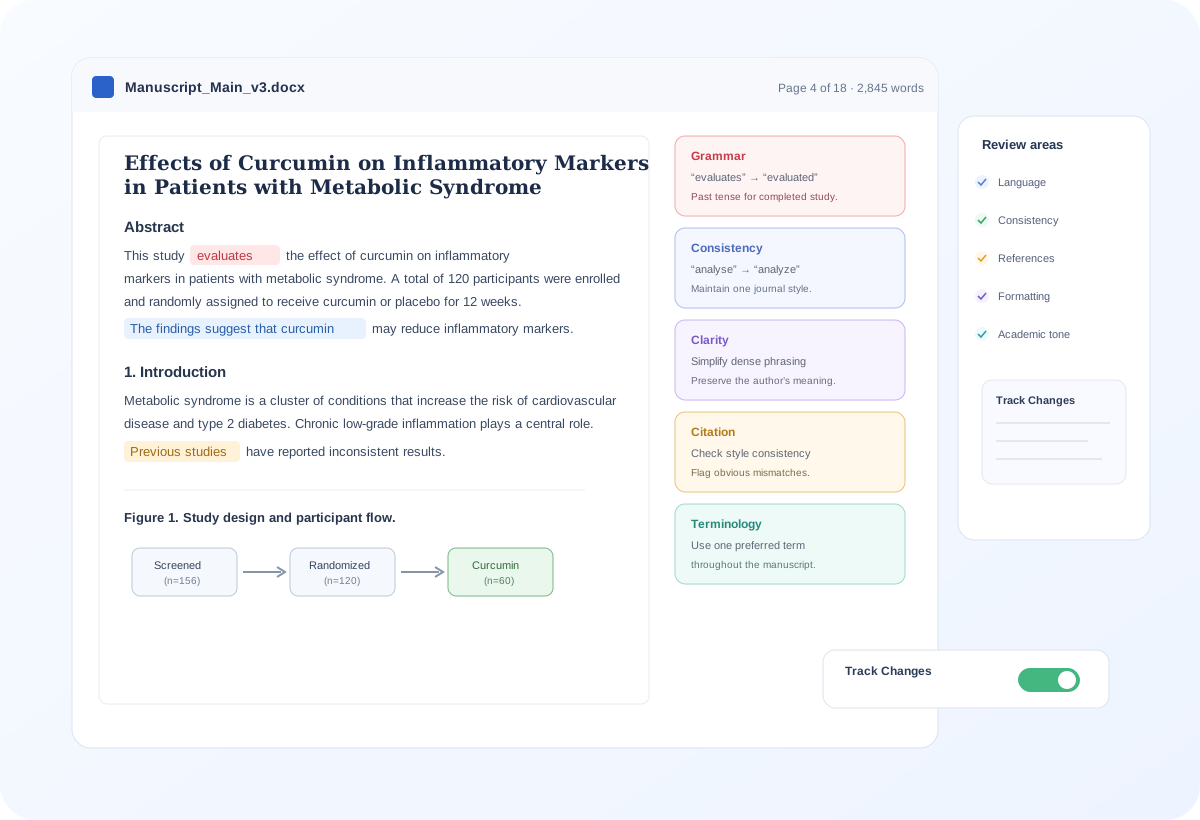
For a standard entry requirement, Journal Manuscript Pre-submission Review starts from ₹7,500 for one manuscript up to 7,000 words. The included scope centres on manuscript-level readiness review and section logic and reporting checks, with further requirements quoted against the actual materials.
A second specialist reviewer, extensive statistical assessment, line editing, journal-selection research, or rapid review requires a separate scope. A shorter deadline for Journal Manuscript Pre-submission Review can be assessed after the working files and requested scope are reviewed; accelerated delivery is confirmed only when feasible for that assignment.
Small issues can distract reviewers and weaken the final presentation of otherwise strong research. The review targets recurring language and consistency problems without turning a final-stage proofread into a full rewrite.
OriginalThe results of the study indicates that...
CorrectionThe results of the study indicate that...
OriginalHowever the results were inconsistent across groups.
CorrectionHowever, the results were inconsistent across groups.
OriginalThe data shows in that there is a significant increase.
CorrectionThe data show a significant increase.
Originalpatients with diabetes... diabetic patients...
Correctionpatients with diabetes... patients with diabetes...
OriginalSeveral studies (1,2,3), have reported...
CorrectionSeveral studies (1–3) have reported...
A section-by-section quality pass aligned with the manuscript’s final presentation needs and, where supplied, the target journal’s visible author instructions.
Grammar, spelling, punctuation, word choice, articles, prepositions, sentence correctness, and obvious typographical issues.
Conciseness, readable phrasing, clear relationships between ideas, and light sentence-level refinement where meaning is already established.
Objective, precise, formal, and discipline-appropriate wording for scholarly communication without changing the research contribution.
Terminology, abbreviations, capitalization, spelling variants, symbols, units, numbers, labels, and repeated manuscript conventions.
Headings, numbering, page-level presentation, lists, table and figure callouts, and visible formatting patterns within the supplied document.
Presentation consistency, obvious in-text/reference-list mismatches, punctuation, ordering, and journal-style formatting where instructions are supplied.
Captions, labels, numbering, in-text callouts, consistency of units and terminology, and obvious presentation issues.
Review of visible requirements in supplied author instructions, such as structure, headings, references, figures, tables, ethical statements, and reporting details.
Choose the service and continue to checkout to begin your project.
A transparent workflow shows the original wording, the tracked review, and the final corrected text so authors can see what changed and why.
The pre-submission review is intended for manuscripts that are already well developed. If the paper needs deeper rewriting, argument development, or structural work, an editing service may be more appropriate.
Best when the research, structure, and argument are already established and the manuscript needs a careful final quality pass.
More suitable where language, flow, paragraph structure, or organisation needs material improvement beyond final-stage proofreading.
Every section is checked with a reviewer’s expectations in mind, while keeping the author responsible for the scientific content, interpretation, and final submission decisions.
Clarity, structure, terminology, concision, and consistency with the manuscript.
Background clarity, rationale, transitions, terminology, and readable academic phrasing.
Detail, sequence, terminology, units, abbreviations, labels, and internal consistency.
Clarity, data reporting language, table/figure callouts, units, and terminology consistency.
Interpretation language, transitions, logic, qualifications, citation presentation, and overstatement flags.
Take-home message, clarity, consistency with stated findings, and concise closing language.
Style consistency, ordering, punctuation, presentation, and obvious in-text/reference-list mismatches.
Captions, labels, numbering, units, terminology, callouts, and visible data-presentation consistency.
A controlled workflow moves the manuscript from intake and scope review through detailed checking, consistency review, and final delivery.
Share the near-final manuscript and relevant journal instructions.
We assess length, condition, deadline, and requested checks.
A suitable reviewer is matched to the confirmed manuscript scope.
Language, references, tables, figures, and formatting are checked.
Terminology, abbreviations, notation, and presentation are cross-checked.
Comments flag unclear points or items that need author confirmation.
Receive reviewed and clean files with a concise proofreading summary.
The review can correct small language errors, improve a sentence where necessary for clarity, standardise terminology, and flag presentation issues while preserving the author’s intended scientific meaning.
Clear deliverables give you a transparent view of the corrections made and a clean document for your final author review.
All visible corrections retained for review.
Accepted corrections presented in a clean version.
Notes for unclear wording, missing context, or author action.
Concise summary of major checks and recurring issues.
Purchase the service now and share your manuscript details for scope confirmation.
Multiple review layers help maintain accuracy and consistency across language, terminology, formatting, references, and the final file presentation.
Grammar, spelling, punctuation, syntax, and word choice.
Terminology, tense, abbreviations, units, numbers, and style.
Citations, references, headings, tables, figure captions, and obvious mismatches.
Cross-check recurring issues and document-wide consistency patterns.
Independent review of completeness, accuracy, and clean-file readiness.
The service can be applied across a wide range of research disciplines and manuscript types when the document is sufficiently developed for final-stage language and presentation review.
Biology, biochemistry, genetics, microbiology
Clinical research, public health, nursing
Mechanical, electrical, civil, materials
AI, data science, software, systems
Psychology, sociology, education, policy
Management, finance, economics, marketing
History, literature, philosophy, linguistics
Ecology, climate, sustainability, environmental policy
Pre-submission review starts from ₹7,500 for one manuscript up to 7,000 words, with typical delivery in 5–7 business days. Longer or specialist reviews are quoted from manuscript condition, journal requirements, review depth, and deadline.
Balanced review timing for manuscripts without an urgent deadline.
Faster delivery may be considered when the deadline requires accelerated scheduling.
Expedited delivery may be assessed for urgent submissions, subject to scope and reviewer availability.
Continue to checkout to secure the service and move your manuscript forward.
Unpublished manuscripts and related submission files should be treated as confidential service material throughout intake, review, delivery, and project completion.
Use the designated submission workflow for manuscript and supporting files.
Files should be accessible only to the people required for the confirmed service workflow.
Manuscript content, author instructions, and unpublished research are handled as confidential service information.
Final files are returned through the service process, with document handling completed according to the agreed workflow.
Practical answers about scope, tracked changes, journal instructions, references, scientific accuracy, revisions, confidentiality, and choosing the right level of support.
The review can cover grammar, spelling, punctuation, sentence clarity, academic tone, terminology consistency, abbreviations, citations and reference presentation, headings, tables, figures, captions, and journal-facing formatting where relevant instructions are supplied.
Pre-submission review is positioned as a final or near-final quality pass. Advanced editing is more suitable when the manuscript needs deeper sentence rewriting, paragraph-flow improvement, or broader language development before final checks.
Yes. The workflow shown on this page uses tracked changes so you can review corrections and editorial decisions. A clean corrected manuscript is also supplied alongside the reviewed version.
Comments are used when a point cannot be safely resolved without author input, such as ambiguous wording, unclear terminology, missing context, or a presentation issue that requires a decision from the author.
Yes, where journal instructions are provided. The review can check relevant visible requirements such as manuscript structure, headings, references, figures, tables, captions, ethical statements, and formatting expectations within the agreed scope.
No. The pre-submission review focuses on language, consistency, presentation, and journal-facing checks. It does not replace scientific peer review, source verification, statistical validation, or the author’s responsibility for research accuracy.
It can include reference and citation presentation checks for consistency and obvious mismatches within the agreed scope. It does not confirm that every source is correct, complete, or scientifically appropriate.
Yes. Captions, labels, numbering, in-text callouts, terminology, units, and visible presentation consistency can be checked. The service does not independently validate the underlying data or statistical calculations.
You can raise questions about the reviewed file or clarify editorial comments. Any additional revision request that changes the original scope should be assessed separately before further work is confirmed.
The page does not claim a fixed price or turnaround for this service. Timing and quotation depend on word count, manuscript condition, requested checks, journal requirements, number of tables or figures, and the deadline.
Your manuscript, author instructions, personal details, and unpublished research materials should be handled as confidential service information through the designated submission and delivery workflow.
Research articles, review papers, short communications, case reports, technical notes, and similar journal-bound manuscripts can be suitable when the content and structure are already substantially complete and the main need is final-stage language and presentation review.
Share the manuscript type, word count, target journal or author guidelines, deadline, and the areas you want reviewed so the scope can be assessed accurately.
Provide the document type and approximate total word count.
State the exact required date and time so delivery feasibility can be assessed.
Include the journal name or author guidelines if journal-facing checks are required.
Highlight language, references, tables, figures, formatting, consistency, or other specific concerns.
Share your contact details and review requirements below so the manuscript can be assessed for scope, timing, and the appropriate level of service.