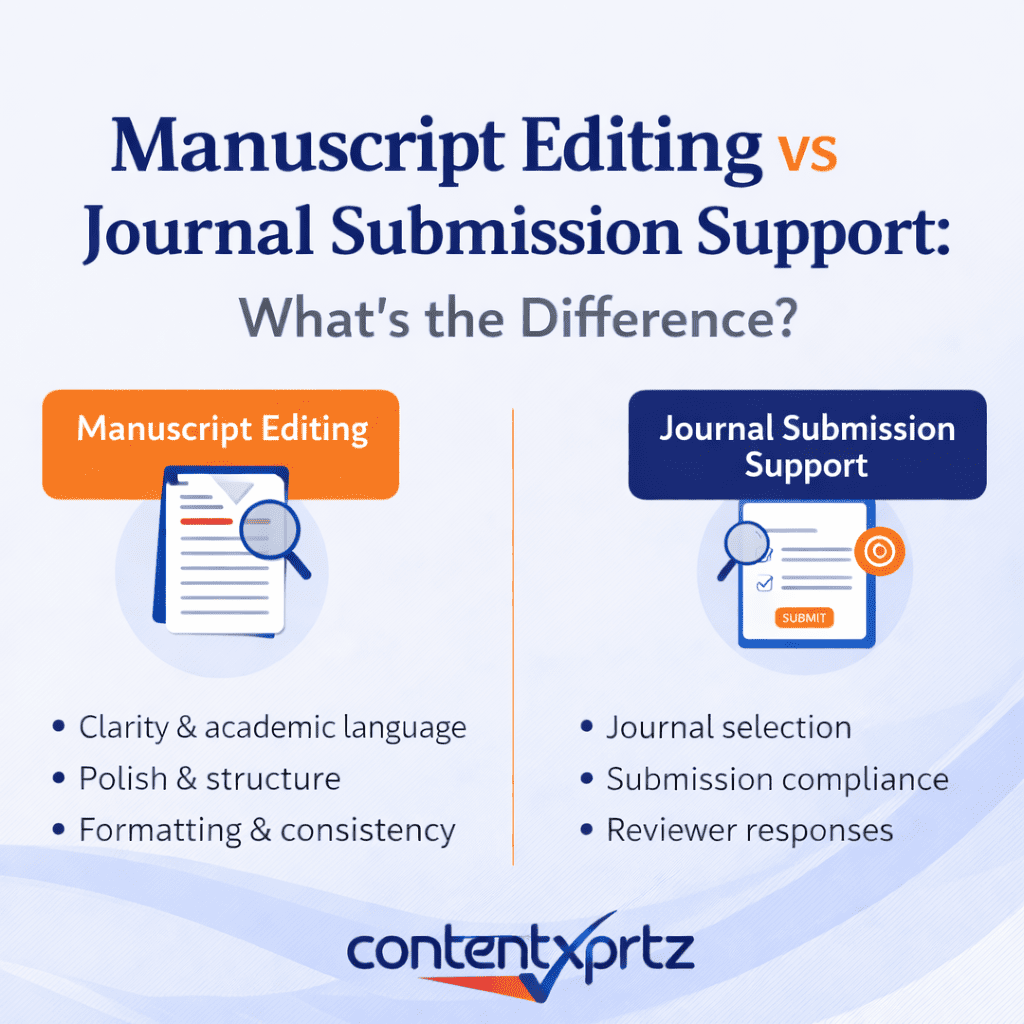

Manuscript Editing vs Journal Submission Support: What’s the Difference?
By Dr. Aanya Mehta
Research Writer & Professional Business Communicator
If you are searching for manuscript editing vs journal submission support whats the difference, you are probably close to an important point in the publication journey: your research is substantially complete, but you are unsure what kind of professional help you actually need before sending it to a journal.
The confusion is understandable. “Editing,” “publication support,” “submission assistance,” “journal formatting,” and “pre-submission review” are sometimes used as if they mean the same thing. They do not.
Manuscript editing primarily improves the manuscript itself. Journal submission support primarily helps prepare and manage the manuscript and associated materials for a particular journal’s submission process. Editing focuses on clarity, academic language, structure, consistency, argument presentation, terminology, grammar, and sometimes journal-specific style. Submission support focuses on requirements such as journal instructions, file preparation, cover letters, declarations, submission-system fields, supplementary documents, and administrative checks.
A researcher may need one service, the other, both, or neither.
For example, a technically strong paper written by an experienced academic may need only journal-specific submission preparation. An ESL researcher with a complete study but a manuscript containing unclear sentences, inconsistent terminology, and difficult-to-follow discussion sections may benefit from editing before submission support. A first-time corresponding author may need both: first to strengthen the communication of the research, and then to ensure that the final submission package follows the target journal’s requirements.
The distinction matters because journal submission is not simply a matter of uploading a Word document. Journals may have requirements relating to authorship information, anonymization, figures, supplementary files, reporting checklists, declarations, cover letters, ethical statements, and online submission fields. At the same time, perfectly completing those administrative steps cannot repair a manuscript whose research argument is unclear.
This guide explains where manuscript editing ends, where journal submission support begins, how the two can overlap, what ethical professional assistance should and should not do, and how to decide what your paper actually needs.
Quick Answer: Manuscript Editing vs Journal Submission Support
Manuscript editing improves how your research is communicated. Journal submission support helps make the completed manuscript and related files ready for a specific journal’s submission process.
Manuscript editing may address academic language, sentence clarity, logical flow, terminology, consistency, grammar, scholarly tone, section organization, references, and journal style. Depending on the level of editing requested, an editor may also flag unclear claims, unexplained transitions, inconsistent terminology, or places where the manuscript does not adequately connect methods, results, and discussion.
Journal submission support generally begins once a manuscript is close to submission-ready. It may involve reviewing the target journal’s author instructions, checking article type and required files, preparing or reviewing a cover letter, checking anonymization, ensuring figures and supplementary materials are correctly organized, reviewing declarations, and assisting with the practical submission workflow.
Editing asks: “Is the manuscript clear, coherent, accurate in presentation, and professionally written?”
Submission support asks: “Is this submission package correctly prepared for this particular journal?”
Neither service can ethically guarantee acceptance, publication, favorable peer review, or a particular editorial decision.
Key Takeaways
- Manuscript editing works primarily on the content and presentation of the paper itself.
- Journal submission support works primarily on journal requirements and the submission package or process.
- A manuscript can be well edited but still incorrectly prepared for a target journal.
- A submission can be technically complete while the manuscript itself still needs substantial language or structural improvement.
- Editing should normally happen before final submission preparation, because later edits can change word counts, references, tables, declarations, or formatting.
- Authors remain responsible for their research, data, claims, citations, ethical declarations, authorship information, and final submission.
- Neither professional editing nor submission support can legitimately guarantee journal acceptance.
What This Page Covers
This guide explains:
- What manuscript editing normally includes
- What journal submission support normally includes
- The practical differences between the two services
- When you may need editing, submission support, both, or neither
- How journal formatting differs from substantive editing
- Common mistakes researchers make before submission
- How to evaluate ethical academic publication support
- Practical scenarios involving first-time authors, ESL researchers, revisions, and journal transfers
Table of Contents
- What Is Manuscript Editing?
- What Is Journal Submission Support?
- Manuscript Editing vs Journal Submission Support: The Main Differences
- Where the Two Services Overlap
- What Manuscript Editing Can and Cannot Do
- What Journal Submission Support Can and Cannot Do
- What Happens Before Journal Submission?
- Journal Formatting vs Manuscript Editing
- How to Decide Which Service You Need
- Practical Researcher Examples
- Common Mistakes to Avoid
- Ethical and Responsible Academic Support
- Pre-Submission Checklist
- How Contentxprtz Can Support Researchers
- Summary
- Frequently Asked Questions
- About the Author
- Conclusion
Methodology and Academic Sources
This guide reflects established scholarly publishing practices while recognizing that journal requirements vary considerably by discipline, publisher, article type, and individual journal.
Researchers should always read the instructions for authors of their intended journal rather than relying on a generic submission checklist.
For medical and biomedical publishing, the International Committee of Medical Journal Editors recommendations provide widely used guidance on manuscript preparation, authorship, responsibilities, disclosures, and publication ethics. The current recommendations were updated in January 2026.
The ICMJE also provides detailed guidance on preparing a manuscript for submission.
For health research, the EQUATOR Network explains how reporting guidelines help authors include the information needed for readers to understand and evaluate particular study designs.
Publisher instructions also demonstrate why journal-specific preparation matters. For example, Nature requires corresponding authors to manage communication with the journal and ensure authors are aware of and agree to submission, while individual journals may specify particular file and formatting requirements.
These examples should not be treated as universal rules for every discipline. Your target journal’s current author guidelines remain the controlling source for that submission.
What Is Manuscript Editing?
Manuscript editing is the professional review and improvement of how a scholarly paper communicates its research.
Its purpose is not to create findings or replace the researcher’s intellectual contribution. Instead, editing helps ensure that the author’s existing research, reasoning, and conclusions are expressed clearly, consistently, and appropriately for an academic audience.
Depending on the service level, manuscript editing may address several layers.
Language editing
Language editing focuses on issues such as:
- Grammar
- Sentence structure
- Word choice
- Punctuation
- Academic tone
- Awkward or ambiguous phrasing
- Article usage
- Verb tense
- Subject–verb agreement
- Concision
- Repetition
This can be particularly useful for ESL researchers whose scientific or scholarly ideas are strong but whose English expression may obscure those ideas.
Structural and substantive editing
A deeper edit may examine whether the manuscript communicates its argument logically.
An editor may flag questions such as:
- Does the introduction establish the research problem clearly?
- Is the study objective stated consistently?
- Does the methods section provide a coherent account of what was done?
- Are results presented in an understandable sequence?
- Does the discussion interpret rather than merely repeat the results?
- Are limitations appropriately communicated?
- Do conclusions remain consistent with the evidence presented?
The researcher must still decide how to address substantive scientific or scholarly questions.
Consistency editing
Academic manuscripts frequently accumulate inconsistencies during drafting.
An editor might identify:
- Different spellings of the same technical term
- Abbreviations defined more than once or not defined at all
- Changing terminology for the same variable or participant group
- Inconsistent capitalization
- Inconsistent table labels
- Citation inconsistencies
- Differences between terminology used in the abstract and main text
These appear minor individually but can make a paper harder to follow.
Journal-focused manuscript editing
Editing may also be undertaken with a target journal in mind.
This can involve checking the manuscript against requirements relating to:
- Article length
- Abstract structure
- Heading conventions
- Reference style
- Terminology
- Table presentation
- Figure citations
- Keywords
- Required manuscript sections
However, journal-focused editing is still not identical to managing the full submission process.
What Is Journal Submission Support?
Journal submission support helps an author prepare the final manuscript package for a specific journal and navigate the administrative requirements surrounding submission.
The focus shifts from improving prose to making sure the submission is appropriately assembled.
Depending on the agreed scope, support may include:
- Reviewing instructions for authors
- Checking article type
- Reviewing submission requirements
- Checking manuscript components
- Reviewing title-page information
- Preparing or reviewing a cover letter
- Checking required declarations
- Checking anonymization for double-anonymous review
- Organizing figures and tables
- Reviewing supplementary-material requirements
- Checking required reporting checklists
- Ensuring required files are present
- Reviewing references against journal requirements
- Helping organize submission-system information
- Supporting journal transfer or resubmission preparation
The exact requirements can be surprisingly detailed.
For example, Taylor & Francis notes that required submission files may include the manuscript, title-page information, an anonymized main document where applicable, figures, tables, supplementary files, and other materials depending on the journal.
Springer Nature similarly advises authors to review a journal’s submission guidelines before entering its manuscript submission system.
This illustrates the central purpose of submission support: matching your paper and submission materials to the actual requirements of the selected journal.
Manuscript Editing vs Journal Submission Support: What’s the Difference in Practice?
The easiest way to understand the distinction is to compare what each service is trying to solve.
| Aspect | Manuscript Editing | Journal Submission Support |
|---|---|---|
| Main goal | Improve scholarly communication | Prepare the paper for a specific submission |
| Primary focus | Manuscript text | Journal requirements and submission package |
| Language correction | Usually yes | Usually not the main purpose |
| Structural clarity | May be included | Normally limited |
| Journal formatting | May be included | Commonly included or checked |
| Cover letter | Sometimes separate | Often included or reviewed |
| Submission files | Usually not managed | Commonly checked |
| Online submission fields | Usually not included | May be supported |
| Figures/supplements | Textual consistency may be checked | File requirements may be checked |
| Reporting checklist | May be flagged | Often checked where required |
| Authorship/declarations | Usually outside editing scope | May be checked for completeness |
| Journal selection | Separate advisory task | Sometimes offered before submission |
| Peer-review response | Separate editing task | May be part of broader publication support |
| Acceptance guarantee | Never legitimate | Never legitimate |
The practical takeaway is simple: editing makes the paper easier and more appropriate to read; submission support makes it easier to submit correctly.
Where Do Manuscript Editing and Submission Support Overlap?
The services overlap around journal readiness.
Suppose a journal requires a 250-word structured abstract with Background, Methods, Results, and Conclusions headings.
An editor might:
- Reduce a 310-word abstract
- Improve clarity
- Remove repetition
- Refine wording
- Ensure conclusions match the manuscript
Submission support might:
- Confirm that 250 words is the current journal limit
- Confirm the required subheadings
- Check whether the abstract entered into the submission system matches the file
- Verify that the correct manuscript version has been uploaded
Both activities concern the abstract, but they solve different problems.
The same distinction applies to references.
An editor may correct inconsistent citation presentation. Submission support may verify that the journal uses a specific reference style and that required submission fields are completed.
The overlap is therefore real, but scope should be clearly defined before work begins.
What Manuscript Editing Can—and Cannot—Do
Good manuscript editing can significantly improve communication, but it has ethical limits.
Manuscript editing can help you:
- Express complex arguments more clearly
- Improve academic English
- Reduce unnecessary repetition
- Strengthen transitions
- Improve paragraph organization
- Make terminology consistent
- Correct grammatical errors
- Improve title and abstract clarity
- Identify unclear statements
- Flag apparent contradictions for author review
- Improve scholarly tone
- Check language in tables and figure legends
- Align presentation with stated journal conventions
Manuscript editing should not:
- Invent data
- Fabricate citations
- Create nonexistent findings
- Manipulate results
- Conceal research limitations
- Make unsupported scientific claims
- Change the intellectual ownership of the work
- Add authors who do not meet relevant authorship requirements
- Guarantee publication
- Guarantee favorable peer review
A responsible editor distinguishes between improving communication and making research decisions on the author’s behalf.
For researchers specifically seeking language, clarity, structural, and journal-oriented improvement before submission, Contentxprtz provides a dedicated research paper editing service.
What Journal Submission Support Can—and Cannot—Do
Journal submission support can reduce administrative confusion, particularly for first-time authors, but it cannot control editorial decisions.
Submission support can help with:
- Understanding journal instructions
- Identifying required files
- Checking the correct article category
- Reviewing journal formatting requirements
- Preparing submission materials
- Reviewing a cover letter
- Checking declarations for completeness
- Organizing supplementary information
- Checking anonymization requirements
- Reviewing reporting-checklist requirements
- Preparing a clean submission package
- Supporting resubmission after transfer to another journal
Submission support cannot ethically:
- Guarantee editor approval
- Guarantee external peer review
- Guarantee acceptance
- Influence reviewers improperly
- Misrepresent the authors’ qualifications
- Supply false declarations
- Invent conflicts-of-interest information
- Provide false ethical-approval details
- Submit inaccurate author information
- Bypass journal policies
- Promise indexing in a particular database
The corresponding author and coauthors remain responsible for verifying what is ultimately submitted.
What Happens Before Journal Submission?
A good publication workflow generally separates research completion, manuscript improvement, journal preparation, and submission into distinct stages.
A practical sequence is:
- Complete the research manuscript.
- Perform an author self-review.
- Check scientific or scholarly completeness with coauthors.
- Select or confirm the target journal.
- Read the journal’s current instructions for authors.
- Edit the manuscript for clarity, structure, and language.
- Make author-approved revisions.
- Perform journal-specific formatting and requirement checks.
- Prepare the cover letter and supplementary documentation.
- Check authorship, affiliations, declarations, figures, tables, and supplementary files.
- Complete submission-system information.
- Review the generated submission proof or PDF where applicable.
- Obtain necessary author approvals and submit.
The order matters.
If you format the entire manuscript before major editing, structural changes can undo part of the formatting. Similarly, submitting before all authors have checked the final manuscript can create avoidable problems.
Some submission systems also require a final author verification step. Elsevier’s current Editorial Manager guidance, for example, explains that authors may need to view and approve the generated submission PDF to complete the process.
Journal Formatting vs Manuscript Editing
Journal formatting changes presentation to match publication requirements. Manuscript editing improves the quality and clarity of the writing.
They often occur together, but they should not be confused.
Consider this sentence:
Before editing:
“Results of our experiment clearly proves that intervention have much better effects and thus it can be concluded that it is most effective.”
Formatting cannot solve the problems in that sentence.
Editing might produce:
After language editing:
“The results suggest that the intervention was associated with better outcomes in the study population.”
The exact revision would depend on the study design and evidence.
Formatting then addresses issues such as:
- Heading level
- Reference style
- Line numbering
- Page layout
- Table placement
- Figure specifications
- Abstract format
- Word limits
A perfectly formatted manuscript can still contain poor academic writing.
A beautifully edited manuscript can still fail a journal’s technical submission checks.
Do I Need Editing, Submission Support, Both, or Neither?
Use the following decision guide.
You probably need manuscript editing if:
- Reviewers or supervisors frequently comment on language
- Your sentences feel difficult to simplify
- The manuscript contains repeated ideas
- Academic tone is inconsistent
- Sections do not flow naturally
- Technical terminology varies
- Coauthors find the paper difficult to follow
- English is not your strongest academic language
- You have heavily revised the paper and consistency has suffered
- The paper was translated into English
- You are unsure whether the abstract accurately represents the paper
You probably need journal submission support if:
- Your manuscript is already well written
- You have selected a journal but find its author instructions confusing
- This is your first journal submission
- Several submission files are required
- The journal uses double-anonymous review
- You need help organizing supplementary materials
- You are unsure about cover-letter expectations
- The submission system requests information you do not understand
- You are transferring the paper to a different journal
- You need a final requirements check
You may benefit from both if:
- This is your first international journal submission
- The manuscript needs language improvement and journal formatting
- You are an ESL author facing complicated submission requirements
- A previously rejected paper needs both revision and preparation for a new journal
- You are working under a deadline and want a structured pre-submission review
- Your paper has multiple authors, figures, supplementary files, and reporting requirements
You may need neither if:
Your paper has already undergone strong internal review, is professionally written, follows the target journal’s requirements, and the corresponding author is comfortable handling the submission system.
Professional help should solve a real problem—not become an automatic step every researcher feels obligated to purchase.
What Should Be Edited Before a Paper Is Submitted?
A manuscript should ideally be reviewed at several levels.
1. Research-message consistency
Check whether the same research purpose appears consistently across:
- Title
- Abstract
- Introduction
- Objectives or hypotheses
- Methods
- Results
- Discussion
- Conclusion
A paper becomes difficult to assess when the abstract promises one study while the methods and results appear to answer another question.
2. Logical organization
Each major section should perform its intended function.
The introduction should establish why the question matters. The methods should explain how it was investigated. Results should report the findings. The discussion should interpret those findings in context.
Disciplinary conventions differ, so this structure should not be applied mechanically to every field.
3. Claim–evidence alignment
Editing should not strengthen a claim beyond what the study supports.
Words such as:
- causes
- proves
- demonstrates
- predicts
- improves
- leads to
can imply stronger evidence than terms such as:
- is associated with
- suggests
- indicates
- was observed
- may contribute to
The appropriate wording depends on study design and evidence, not stylistic preference alone.
4. Language and readability
Review:
- Sentence length
- Redundancy
- Ambiguity
- Pronoun references
- Tense
- Terminology
- Acronyms
- Paragraph transitions
- Unnecessary jargon
5. References
Authors should verify that references are genuine, relevant, correctly attributed, and accurately represented.
Editing can improve citation consistency, but the researcher remains responsible for validating the underlying sources and claims.
Reporting Guidelines: An Important Bridge Between Editing and Submission
For some research designs, reporting guidelines influence both manuscript preparation and submission.
The EQUATOR Network describes a reporting guideline as a structured tool outlining information researchers should include when writing particular types of health-research manuscripts.
Examples commonly encountered in relevant disciplines include reporting guidance for:
- Randomized trials
- Systematic reviews
- Observational studies
- Diagnostic studies
- Qualitative research
- Case reports
Some journals may request a completed reporting checklist or flow diagram during submission.
An editor can help identify whether required information is communicated clearly, but an editor should not invent missing methodological details simply to satisfy a checklist.
If information is absent, it should be referred back to the researcher.
Practical Example 1: The ESL Researcher With a Strong Study
Situation
A doctoral researcher has completed an experimental study and drafted a journal article in English. The statistical analysis has been reviewed by the research team, but several paragraphs are grammatically difficult and the discussion repeats the results.
What the researcher initially thinks
“I need someone to submit my paper.”
What the paper actually needs first
Manuscript editing.
Before worrying about the submission portal, the researcher should improve:
- Sentence clarity
- Academic tone
- Discussion structure
- Terminological consistency
- Abstract wording
- Repetition
Once these issues are resolved and the authors approve the edits, journal submission preparation can begin.
Why this distinction matters
Uploading a linguistically unclear paper correctly does not address its communication problems.
Correct order: manuscript editing → author review → journal-specific preparation → submission.
Practical Example 2: The Experienced Researcher Facing a New Publisher
Situation
A professor has published extensively and has a polished manuscript that has already undergone coauthor review.
However, the target journal requires:
- A specific article category
- Separate figure files
- Supplementary material
- A reporting checklist
- Author declarations
- A cover letter
- Online entry of author details
What is needed?
Primarily journal submission support, not substantive manuscript editing.
The researcher may need help converting an already strong paper into a technically complete submission package.
Why this works
The problem is not the prose. It is compliance with a new journal workflow.
Practical Example 3: A Rejected Paper Being Submitted Elsewhere
Situation
A researcher receives a rejection and decides to submit the manuscript to a different journal.
The second journal has a different audience, word limit, abstract format, reference style, and article structure.
Common mistake
The author simply changes the journal name in the cover letter and uploads the same files.
Better approach
First review whether the manuscript itself needs adaptation.
Possible manuscript changes may include:
- Shortening the introduction
- Reframing the paper for a different readership
- Revising the abstract
- Addressing useful comments from the previous review
- Changing terminology
Then perform submission preparation:
- Check the new journal’s requirements
- Reformat files where required
- Update the cover letter
- Check anonymization
- Review declarations
- Prepare required supplementary documents
Journal transfer frequently requires both editorial and submission work.
Practical Example 4: The First-Time Corresponding Author
Situation
A PhD scholar has prepared a manuscript with a supervisor and several coauthors. The paper has been internally reviewed, but the scholar has never submitted through an editorial system.
What may help?
A light manuscript check plus journal submission support.
The scholar may particularly need guidance on:
- Corresponding-author responsibilities
- Author details
- Required files
- Suggested reviewers, where requested
- Declarations
- Cover letters
- Supplementary materials
- Submission-system questions
The corresponding author should still personally understand and approve every declaration and submission field.
ICMJE guidance emphasizes that corresponding authors have responsibilities throughout submission and peer review, including timely communication with journals.
Practical Example 5: A Well-Edited Paper With the Wrong Submission Files
Situation
A manuscript has been professionally edited and reads clearly. The researcher assumes it is ready.
The journal, however, requires double-anonymous peer review.
The uploaded manuscript still includes:
- Author names
- Institutional affiliations
- Acknowledgments identifying the laboratory
- Self-identifying information in document properties
What went wrong?
The manuscript was edited, but the submission package was not checked.
Editing quality does not replace journal-specific submission preparation.
Before-and-After Examples: What Editing Actually Changes
Example 1: Overclaiming
Weak:
“Our findings prove that remote learning reduces student performance.”
Improved:
“Our findings suggest an association between remote-learning conditions and lower self-reported academic performance in the study sample.”
Why it is stronger:
The revised sentence uses wording that can be assessed against the actual design instead of automatically asserting causation.
Example 2: Unclear research contribution
Weak:
“This study is very important because no proper research has been done.”
Improved:
“This study addresses a gap in evidence concerning [specific issue] among [population/context].”
Why it is stronger:
It replaces an unsupported generalization with a claim the author can substantiate through the literature review.
Example 3: Unnecessarily complex writing
Weak:
“It can therefore be said on account of the aforementioned findings that there exists the possibility of improvement in the implementation of the intervention.”
Improved:
“These findings suggest that implementation of the intervention could be improved.”
Why it is stronger:
The meaning is clearer and the unnecessary verbal padding is removed.
What Should Journal Submission Support Check?
A useful submission review may cover several categories.
Journal fit and article type
Confirm:
- Correct journal
- Correct article category
- Current author instructions
- Relevant word limits
- Required manuscript structure
Journal selection itself requires a separate assessment of scope and fit; submission assistance should not pretend that technically correct formatting guarantees editorial suitability.
Manuscript files
Check:
- Main manuscript
- Title page
- Anonymous manuscript where required
- Figures
- Tables
- Supplementary files
- Reporting checklists
- Appendices
Author information
Verify with the authors:
- Author names
- Author order
- Affiliations
- Corresponding-author details
- ORCID information where requested
- Contributions
These details must come from the researchers, not be guessed by a support provider.
Statements and declarations
Depending on the field and journal, submission materials may request information concerning:
- Conflicts of interest
- Funding
- Ethics approval
- Informed consent
- Data availability
- Author contributions
- Previous dissemination
- Preprints
- Related manuscripts
The support provider may help organize these materials, but only the researchers can truthfully supply the underlying facts.
Cover letter
A journal cover letter usually serves a different purpose from the manuscript abstract.
Springer Nature advises checking journal-specific cover-letter requirements and generally identifying the manuscript, article type, research question, and reasons the work may be relevant to the journal.
A support provider can improve clarity and presentation, but should never include exaggerated claims or false statements about originality, ethics, competing interests, or prior submission.
Common Mistakes When Choosing Between Editing and Submission Support
Mistake 1: Paying for formatting when the real problem is writing
Formatting cannot repair an unclear argument.
Better approach: assess readability and manuscript structure before concentrating on submission mechanics.
Mistake 2: Editing without choosing a journal when journal requirements matter
Generic editing can improve the paper, but a final target-journal review may still be needed.
Better approach: when possible, confirm the target journal before the final editing round.
Mistake 3: Assuming “publication support” means guaranteed publication
No legitimate support provider controls editorial decisions or peer reviewers.
Better approach: judge a service by the quality and transparency of the work it performs, not promises about acceptance.
Mistake 4: Treating submission as an administrative task with no scholarly consequences
Choosing an incorrect article category, omitting a required checklist, or submitting an identifiable manuscript to a double-anonymous journal can create avoidable problems.
Better approach: treat submission preparation as a final quality-control stage.
Mistake 5: Allowing an external provider to make factual declarations
A service provider should not invent:
- Funding statements
- Ethics approvals
- Conflicts of interest
- Author contributions
- Data-availability information
Better approach: authors supply and approve all factual declarations.
Mistake 6: Submitting tracked changes accidentally
An edited manuscript may contain tracked edits, comments, or internal notes.
Better approach: prepare a clean, author-approved final version before submission.
Mistake 7: Failing to recheck references after editing
Moving or deleting sentences may affect citation order or reference numbering.
Better approach: perform a final citation and reference check after substantive revisions.
Mistake 8: Assuming one journal’s requirements apply to another
Submission rules vary.
Some journals permit flexible initial formatting, while others specify detailed requirements. Nature Medicine, for example, currently allows comparatively flexible initial formatting while still requiring authors to follow its submission guidelines and later formatting requirements where applicable.
Better approach: check the actual journal every time.
Should Editing Happen Before or After Journal Selection?
Ideally, broad manuscript improvement can happen before journal selection, but the final editing and formatting round is most efficient after a target journal has been identified.
A useful two-stage approach is:
Stage 1: Manuscript-quality editing
Focus on:
- Logic
- Language
- Structure
- Clarity
- Consistency
- Argument presentation
Stage 2: Journal-specific preparation
After journal selection, review:
- Abstract requirements
- Word limits
- Heading conventions
- Figures
- References
- Supplementary files
- Cover letter
- Declarations
- Submission instructions
This approach avoids forcing the intellectual development of the manuscript into the formatting requirements of a journal too early while still allowing a precise pre-submission review later.
Does Professional Editing Increase the Chance of Acceptance?
Professional editing can improve communication quality, but it cannot guarantee acceptance.
Editors evaluate factors beyond grammar, including:
- Research relevance
- Originality
- Methodological quality
- Scope
- Evidence
- Reporting completeness
- Ethical compliance
- Significance
- Fit with the journal
- Peer-review assessments
Clear writing can help editors and reviewers understand what the research actually says. It cannot turn weak methodology into strong methodology or create originality that is not present.
That distinction is essential when evaluating any academic editing or publication-support service.
Does Journal Submission Support Mean Someone Submits the Paper for You?
Not necessarily.
“Submission support” may describe anything from a checklist review to more hands-on assistance.
Possible models include:
Advisory support:
The researcher completes the submission while receiving guidance.
Preparation support:
The provider helps organize files, forms, cover-letter content, and journal requirements before the researcher submits.
Guided submission:
The researcher works through the submission system with assistance.
Whatever the model, authors should understand and approve what is submitted.
Submission credentials, authorship declarations, ethical statements, conflicts of interest, and final approvals require particular care. Institutional and journal policies may also affect what kind of third-party assistance is appropriate.
Academic Ethics: What Responsible Editing and Submission Support Look Like
Professional academic assistance should preserve author responsibility and research integrity.
Researchers remain responsible for:
- Research design
- Data
- Analysis
- Interpretation
- Claims
- Citations
- Authorship
- Ethical approvals
- Conflicts of interest
- Funding disclosures
- Final manuscript approval
- Final submission
An editor can say:
This paragraph appears to make a causal claim. Please confirm whether the study design supports causal interpretation.
An editor should not silently rewrite the paper to claim causation without evidence.
Similarly, submission support can say:
The journal requests an ethics statement. Please provide the approved wording or relevant information.
It should not invent an approval number or ethics committee.
AI-assisted academic work also requires human responsibility
Current ICMJE guidance states that humans remain responsible for submitted material produced with AI assistance and should review AI-generated material carefully because it can be inaccurate, incomplete, or biased. It also calls for transparency about AI use in the publication process in accordance with relevant policies.
COPE likewise emphasizes author responsibility for manuscript content when AI tools are used.
Therefore, whether AI is used for drafting, language assistance, or editing, researchers should:
- Check their journal’s AI policy
- Check institutional rules
- Verify every substantive statement
- Validate every citation
- Protect confidential research information
- Make required disclosures
- Retain responsibility for the final text
Manuscript Editing and Peer-Review Response Support Are Also Different
A third service often creates confusion: reviewer-response support.
This occurs after a journal has returned reviewer or editor comments.
A responsible reviewer-response workflow may involve:
- Reading every reviewer comment
- Classifying comments by issue
- Identifying required manuscript changes
- Revising the manuscript
- Preparing a point-by-point response
- Showing where each change appears
- Explaining respectfully when a recommendation is not adopted
- Checking consistency between the response letter and revised manuscript
Editing can improve the response letter’s clarity, but technical and scholarly decisions must come from the authors.
Submission support may then help prepare the revised files for resubmission.
This demonstrates why “publication support” is better understood as several distinct stages rather than one service.
A Practical Pre-Submission Decision Checklist
Use this checklist before purchasing any editing or journal-support service.
Manuscript quality
- Is the research question clear?
- Does the abstract accurately represent the manuscript?
- Can a reader follow the argument without repeatedly rereading sentences?
- Is technical terminology consistent?
- Are conclusions supported by the results?
- Have all authors reviewed the manuscript?
- Are grammar and academic tone appropriate for the intended readership?
Journal preparation
- Has the target journal been confirmed?
- Have you read its current instructions for authors?
- Have you selected the correct article type?
- Is the manuscript within relevant length requirements?
- Are all required files prepared?
- Are figures and tables supplied correctly?
- Is anonymization complete where required?
- Are supplementary materials ready?
Ethics and declarations
- Are authorship details correct?
- Have all authors approved the final manuscript?
- Are funding details accurate?
- Are conflicts of interest accurately declared?
- Is ethics information correct where applicable?
- Are data-availability statements accurate?
- Have required AI-use disclosures been checked against journal policy?
Submission package
- Is the cover letter accurate and journal-specific?
- Have reporting checklists been completed where required?
- Have references been checked after final revisions?
- Are there any remaining tracked changes or comments?
- Does the uploaded manuscript match the final approved version?
- Have you checked the final submission proof before approving it?
If most problems appear in the first section, you probably need manuscript editing.
If most problems appear in the journal-preparation and submission sections, you probably need submission support.
If problems appear throughout, a combined workflow may be more appropriate.
How Contentxprtz Can Support Manuscript Preparation
For researchers who want professional assistance, the useful question is not “Which publication package should I buy?” but “What specific problem still prevents this paper from being submission-ready?”
Contentxprtz provides academic communication support designed around different stages of that process.
If the main concern is clarity, language, consistency, structure, or scholarly presentation, researchers can explore Contentxprtz academic editing.
For research manuscripts specifically, the research paper editing service is the most directly relevant option when the manuscript itself requires editorial improvement.
Researchers working on broader research-paper development and revision can also review research paper writing and editing support.
Where the manuscript is already mature but the publication workflow, target-journal preparation, or submission requirements are creating difficulty, journal publication support may be more relevant.
Professional assistance should improve clarity, preparation, and communication while preserving the researcher’s original ideas and responsibility for the scholarship.
It should never be presented as a guarantee of acceptance, publication, indexing, supervisor approval, or favorable peer review.
Summary: Manuscript Editing vs Journal Submission Support
Manuscript editing and journal submission support solve different problems.
Manuscript editing focuses on improving the manuscript itself. Depending on the service level, this may include:
- Academic language
- Grammar
- Clarity
- Concision
- Logical flow
- Terminological consistency
- Structural presentation
- Journal-specific style
Journal submission support focuses on preparing the manuscript and related materials for a chosen journal. It may include:
- Author-instruction checks
- File preparation
- Journal formatting
- Cover-letter review
- Anonymization checks
- Supplementary-material preparation
- Reporting checklists
- Declarations
- Submission-system guidance
Editing usually comes first. Submission preparation usually follows.
You may need only editing when the paper is difficult to read but you understand the journal workflow. You may need only submission support when the manuscript is polished but the journal’s requirements are unfamiliar. First-time authors, ESL researchers, and researchers transferring papers between journals may sometimes benefit from both.
In every case, authors remain responsible for the research, evidence, citations, declarations, authorship information, and final submission.
Frequently Asked Questions
1. What is the difference between manuscript editing and journal submission support?
Manuscript editing improves the quality and clarity of the paper, while journal submission support helps prepare that paper and its associated materials for a particular journal.
Editing may correct grammar, improve scholarly tone, clarify sentences, strengthen transitions, remove repetition, and check consistency. More substantive editing may also flag unclear arguments or structural issues for author review.
Submission support generally addresses the next stage: journal instructions, article type, formatting requirements, cover letters, figures, supplementary files, declarations, anonymization, reporting checklists, and submission-system requirements.
The two services can overlap, particularly around journal-specific formatting, but they should not be treated as identical. If your paper is difficult to understand, start with editing. If the manuscript is already strong but the submission process is unfamiliar, submission assistance may be enough.
2. Manuscript editing vs journal submission support whats the difference for a first-time author?
For a first-time author, manuscript editing improves the paper itself; submission support helps you understand what must happen after the manuscript is ready.
A first-time researcher may need editing if the manuscript contains unclear academic language, inconsistent terminology, weak transitions, or structural problems.
Submission support becomes more useful when questions shift to matters such as:
- Which files should I upload?
- Do I need a separate title page?
- Should the manuscript be anonymized?
- What belongs in the cover letter?
- Which declarations are required?
- Does the journal request supplementary files?
- Which information belongs in the submission system?
Many first-time corresponding authors benefit from separating the process into two stages: final manuscript review first, submission preparation second.
3. Do I need manuscript editing before submitting to a journal?
Not necessarily. You need editing when the manuscript has communication problems that you cannot confidently resolve through self-review and coauthor review.
An experienced researcher with a clear, internally reviewed manuscript may not need professional editing. Conversely, professional editing may be useful when grammar, organization, academic tone, consistency, or readability is likely to interfere with understanding.
Before deciding, ask:
- Can colleagues follow the argument easily?
- Is the abstract accurate and concise?
- Are terminology and abbreviations consistent?
- Do the discussion and conclusion reflect the evidence appropriately?
- Has the manuscript undergone a careful language review?
If those questions reveal weaknesses, editing before submission is usually more useful than focusing immediately on formatting.
4. Does journal submission support include manuscript editing?
Sometimes, but you should never assume that it does.
A submission-support package might include a light language check, journal formatting, or consistency review, while another may strictly cover submission logistics.
Before engaging a provider, ask what level of manuscript review is actually included.
Useful questions include:
- Is grammar editing included?
- Is substantive editing included?
- Will the abstract be edited?
- Are references formatted?
- Is journal formatting included?
- Is the cover letter reviewed?
- Are figures and supplementary files checked?
- Does the service include submission-system guidance?
- Is reviewer-response support separate?
Clear scope prevents the common situation in which an author expects deep editing but receives only technical formatting.
5. Is journal formatting the same as manuscript editing?
No. Formatting changes presentation; editing changes communication.
Formatting may involve headings, citations, references, tables, line numbering, title-page layout, figure requirements, manuscript sections, and journal-specific file preparation.
Editing addresses issues such as unclear sentences, grammar, organization, terminology, repetition, scholarly tone, and logical presentation.
A manuscript can therefore be perfectly formatted but poorly written. It can also be very well written but formatted incorrectly for the target journal.
For most researchers, manuscript-quality issues should be resolved before the final formatting round, particularly when extensive editing may alter word counts, paragraphs, citations, or tables.
6. Can journal submission support improve my chances of acceptance?
Submission support can help you avoid preventable preparation errors, but it cannot guarantee or control journal acceptance.
Editorial decisions may depend on research quality, originality, journal scope, methodology, reporting, evidence, novelty, ethical compliance, reviewer assessments, and editorial priorities.
Submission support can help ensure that an otherwise suitable manuscript is not undermined by avoidable issues such as missing files, incorrect anonymization, incomplete supplementary material, or failure to follow journal instructions.
That is useful—but different from influencing the scientific judgment of editors and reviewers.
Any provider promising guaranteed publication or acceptance should therefore be approached cautiously.
7. Should I choose a journal before getting my manuscript edited?
You can begin general editing before selecting a journal, but having a target journal is useful for the final editing stage.
Early editing can focus on argument, clarity, structure, language, and consistency without depending heavily on publisher requirements.
Once a target journal is confirmed, the final review can consider:
- Word limits
- Abstract style
- Heading conventions
- Article structure
- Reference format
- Figure requirements
- Terminology preferences
- Supplementary material
This staged approach is often more efficient than formatting a manuscript intensively for one journal while major revisions are still underway.
Always verify requirements against the journal’s current instructions rather than relying on a generic template.
8. Can an editing or submission-support provider write declarations for me?
A provider can help organize or edit declarations, but factual information must come from the authors.
Statements about funding, conflicts of interest, ethics approval, participant consent, data availability, author contributions, previous publication, or related submissions involve facts that an external editor cannot legitimately invent.
A support provider can identify that a journal requires a declaration, show where it belongs, improve its language, or ask the authors to provide missing information.
The author team must then verify that the final statement is accurate.
The same principle applies to author names, affiliations, contribution statements, and ethical-approval identifiers.
9. What should I do if my manuscript was rejected and I want to submit it to another journal?
Review the manuscript before simply reformatting it for the next journal.
First determine whether the previous editorial or reviewer comments identify weaknesses worth addressing. Even after a rejection, constructive comments may reveal problems involving clarity, evidence, methods, discussion, or presentation.
Then assess the new target journal.
You may need to:
- Reframe the paper for its readership.
- Revise the manuscript.
- Edit the updated version.
- Change the abstract or word count.
- Reformat references.
- Prepare new submission files.
- Rewrite the cover letter.
- Check the new journal’s declarations and policies.
- Perform a complete final submission check.
A journal transfer is therefore one situation in which both manuscript editing and submission support may be useful.
10. When should I consider professional manuscript or publication support?
Consider professional support when a clearly identifiable communication or submission problem remains after your own review and coauthor feedback.
Editing may be useful when you struggle with academic English, manuscript organization, consistency, concision, or clear presentation of complex research.
Submission assistance may help when you are unfamiliar with journal requirements, working through a complex submission package, preparing a transferred manuscript, or submitting internationally for the first time.
Before seeking assistance, define the problem precisely. You may need only a final language edit rather than a broad publication package.
Researchers who need manuscript-focused help can review Contentxprtz’s research paper editing service.
Whatever support you use, retain responsibility for the intellectual content, data, citations, ethical statements, and final submitted version.
About the Author
Dr. Aanya Mehta
Research Writer & Professional Business Communicator
Dr. Aanya Mehta is a research-oriented writer and professional communicator with a strong focus on accuracy, clarity, and evidence-based insight. Her work combines analytical thinking with accessible writing, helping readers understand complex business topics through well-researched, credible, and practical content.
Conclusion: Choose Support Based on the Problem Your Manuscript Actually Has
The difference between manuscript editing and journal submission support becomes much clearer when you stop thinking of them as competing services.
They belong to different stages of the publication workflow.
Manuscript editing asks whether your research is communicated as clearly, consistently, and professionally as possible.
Journal submission support asks whether the final manuscript and accompanying materials are properly prepared for the particular journal receiving them.
If your academic argument is sound but the writing is unclear, editing is the priority.
If your manuscript is already polished but the journal requires multiple files, declarations, anonymization, a cover letter, supplementary information, or unfamiliar submission steps, submission support may be more appropriate.
If both sets of problems exist, address them in sequence: improve the manuscript first, obtain author approval, and then prepare the journal-specific submission.
In many cases, careful self-review, coauthor feedback, and a close reading of the journal’s author instructions will be enough. Professional help becomes useful when language, structure, journal requirements, or publication procedures create a genuine barrier.
For researchers whose main concern is preparing the manuscript itself for submission, Contentxprtz’s research paper editing service offers focused support for academic clarity and presentation while preserving the author’s responsibility for the research and final submission.
No ethical editing or publication-support service can guarantee acceptance. What responsible support can do is help researchers communicate their work more clearly, prepare it more carefully, and approach the submission process with a better understanding of what journals require.
“At Contentxprtz, we don’t just edit; we help ideas reach their fullest potential.”
