Plain-Language Editing
Replace avoidable complexity, long sentences and indirect instructions with clearer public-facing expression.

Refine reports, guidance, notices, web pages, FAQs, fact sheets and stakeholder communications so information is easier to understand, easier to scan and more consistent across public channels—without changing the intended meaning of your source material.
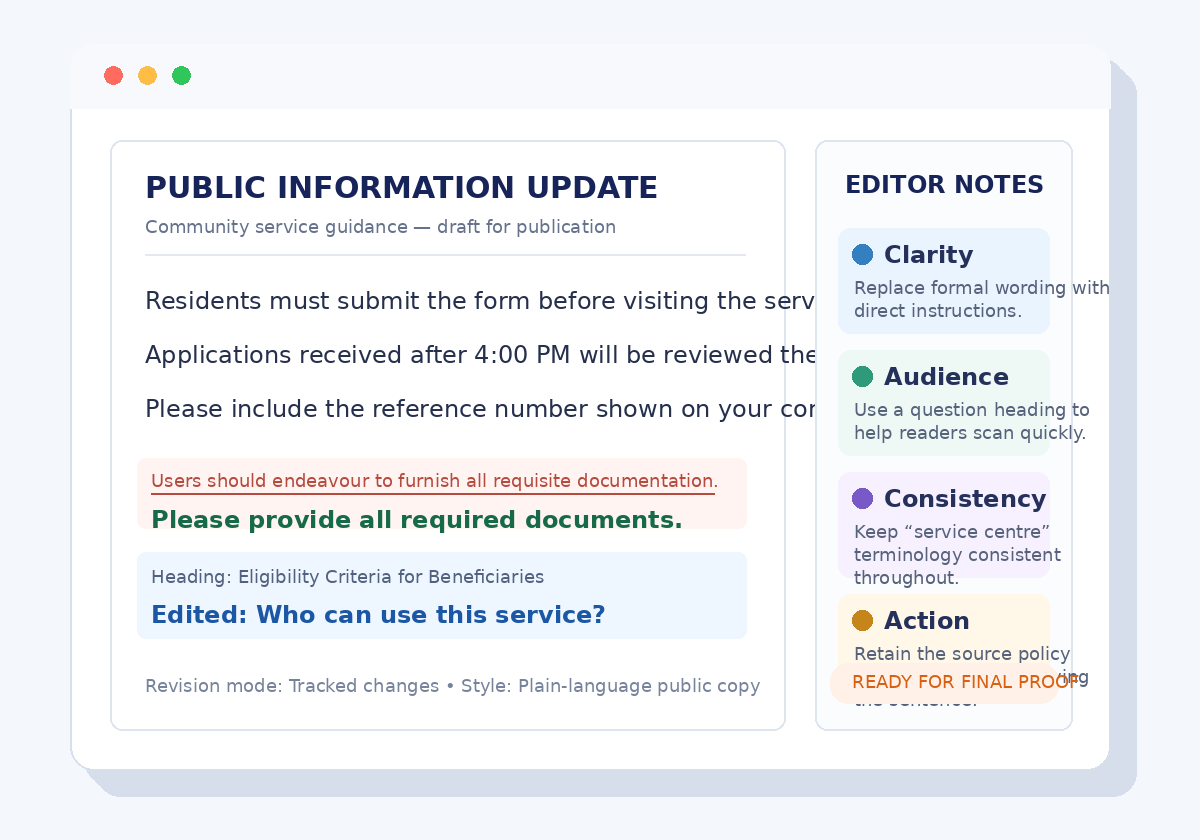
Public-facing editorial starting scope
A transparent word-count band is appropriate for public information editing because the core work is repeatable, while regulated wording or major restructuring can be scoped separately.
for up to 4,000 words
Best fit: Notices, guidance, FAQs, service information, web pages or public-facing reports that need clearer language and stronger consistency without changing approved policy meaning.
When the quote changes: Heavily regulated content, substantive rewriting, legal/policy review dependencies, large content sets or urgent publication dates require an expanded quote.
A modular editorial service for public-facing content that needs clearer language, stronger information architecture and a consistent reader experience.
Replace avoidable complexity, long sentences and indirect instructions with clearer public-facing expression.
Improve headings, sequencing, chunking and navigation so readers can locate key information quickly.
Correct grammar, punctuation, wording and awkward phrasing while improving sentence-level readability.
Align public copy to supplied brand voice, house style and approved examples without flattening useful nuance.
Standardise recurring service names, policy terms, labels, abbreviations and instructions across related content.
Improve headings, link wording, instructions and content clarity with inclusive, scan-friendly public communication in mind.
Harmonise web pages, PDFs, fact sheets, notices and supporting materials so the same information is expressed consistently.
Run a final editorial pass for typos, punctuation, formatting consistency, repeated errors and presentation issues.
The sequence keeps editorial decisions visible, preserves mandatory wording and helps related content stay coherent across channels.
Audience, purpose, channel and approval constraints.
Clarity gaps, repetition, tone and structural issues.
Reorder, group and label content for faster scanning.
Refine wording, grammar, readability and instructions.
Flag ambiguity, source conflicts and decision points.
Apply terminology, style and cross-channel consistency.
Check final language, punctuation and presentation.
Provide agreed files and revision notes for approval.
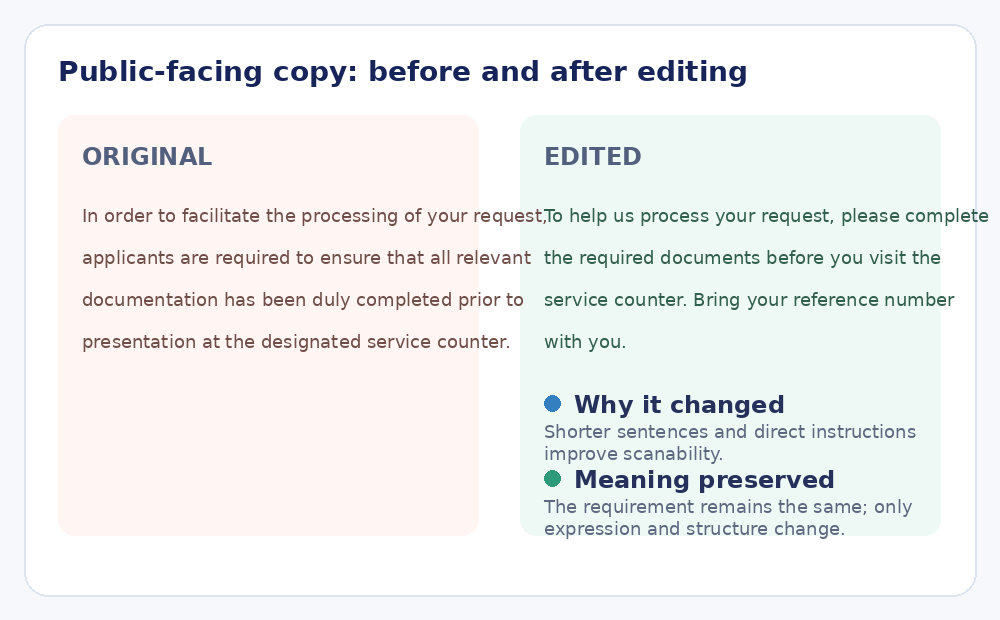
Where specialist standards or regulatory wording apply, provide the approved source or responsible reviewer so editing does not substitute for expert interpretation.
These are example scenarios, not customer testimonials or claimed project results.
Dense guidance pages are reorganised into clearer headings, direct instructions, short paragraphs and consistent service terminology while preserving mandatory wording.
A public report is edited for concise narrative flow, consistent programme terminology, clearer captions and stronger links between findings, activities and reader-facing explanations.
Technical source material is shaped into a public summary with clearer definitions, shorter sentences, signposted key messages and explicit flags where subject-matter confirmation is still required.
Share the content, intended audience, publication channel and any mandatory wording. We can assess the editorial depth needed without forcing an unrelated package or unsupported price onto the service.
Discuss Your RequirementFor regulated, legal or policy-sensitive content, final specialist approval remains with the appropriate client reviewer.
Practical answers about scope, source meaning, plain language, consistency, fact-checking and specialist approval.
It is editorial review of content intended for public audiences, focused on clarity, structure, readability, tone, terminology consistency, grammar and presentation while preserving the source meaning.
Suitable material may include public reports, guidance pages, notices, FAQs, fact sheets, brochures, web copy, stakeholder updates, consultation material, service information and similar public-facing documents.
The service is designed to improve expression and presentation, not to replace legal, policy, regulatory or subject-matter approval. Client-approved meaning and mandatory wording should be identified before editing.
Yes. Where appropriate, editing can reduce unnecessary complexity, shorten sentences, clarify headings and make instructions easier to scan without changing the intended meaning.
The service can use a transparent editing workflow with a revision trail, clean copy and editor notes where those outputs are part of the agreed scope.
Yes. A terminology list, house style or client-supplied glossary can be used to improve consistency across related content.
Editorial review can flag internal inconsistencies, unclear claims or missing context, but independent fact verification is not implied unless it is specifically included in the agreed scope and source material is provided.
Yes. Cross-channel editing can help align terminology, headings, instructions and tone across web pages, PDFs, fact sheets and related public-facing materials.
Useful inputs include the source copy, intended audience, publication channel, mandatory wording, house style, terminology list, supporting references and any approval constraints.
Contentxprtz public information content editing starts from ₹6,000 for up to 4,000 words. The starting scope includes plain-language editing, terminology and hierarchy checks, tracked changes and one consolidated revision, with typical delivery in 4–5 business days.
Editing can preserve client-supplied mandatory wording and flag passages that appear to require specialist confirmation. Final legal, compliance, policy and subject-matter approval remains with the appropriate client reviewer.
Yes. Provide a brand voice guide, style guide or examples of approved copy, and the editing can be aligned to those supplied conventions.
Tell us what you are publishing, who needs to understand it, what must remain unchanged and where the content will appear.
Who will read the information and what should they understand or do?
Website, report, notice, brochure, FAQ, PDF or multiple formats.
Identify text that is approved, regulated or not open to editorial change.
Share a house style, brand voice, glossary or approved examples if available.
Approximate word count, number of pages or number of related content items.
Provide the required delivery date and any review or publication milestones.
Share your contact details and editing requirement. The information you provide should be sufficient to understand the content type, audience and requested editorial depth.