
Where corporate reports get stuck
Common reporting problems before the writing is properly coordinated.
Turn business data, stakeholder input, source documents and existing drafts into a structured corporate report with a clear executive narrative, evidence-linked sections, review-friendly revisions and consistent final presentation.
A report becomes difficult to read when the evidence, narrative, stakeholder inputs and presentation are developed in isolation. The service helps bring those moving parts into one controlled reporting workflow.
Common reporting problems before the writing is properly coordinated.
Report development is organised around a defined structure and evidence trail.
From the initial brief through final editorial QA, each stage focuses on making the report easier to navigate, substantiate, review and approve.
Clarify audience, purpose, sources and required sections.
Build the report hierarchy and section logic.
Map supplied evidence to sections and claims.
Develop clear executive and supporting narratives.
Write captions, context and chart or table commentary.
Consolidate comments and clarify required changes.
Keep sources, citations and supporting notes organised.
Prepare clean, review-ready report files.
Corporate-report development is the right fit when the work involves structuring evidence, developing original report narrative and coordinating the document as a whole—not only polishing an existing draft.
| What you need | Corporate Report Service | Copy Writing | Editing | Proofreading |
|---|---|---|---|---|
| Depth of involvement | High — collaborative report development | Focused business or marketing content development | Improves developed content | Final surface-level check |
| Original report drafting | Yes — section-by-section narrative development | Yes, for the agreed copy asset | Generally works from an existing draft | No substantive drafting |
| Source & stakeholder synthesis | Core part of the workflow | As required by the brief | Limited to material already in the draft | Not the primary purpose |
| Report architecture | Built around audience, sections and evidence | Asset-specific structure | Can improve existing structure | No structural development |
| Data-to-narrative support | Connects supplied charts, tables and figures to explanatory text | Only where relevant to the copy brief | Clarifies existing explanations | Checks language consistency only |
| Review workflow | Designed for staged stakeholder comments | Brief-led review | Editor comments and revisions | Correction-focused review |
| Outcome | Complete, coherent corporate-report draft prepared for organisational review | Completed business copy asset | Improved version of an existing document | Near-final corrected copy |
The exact section set depends on the report type. These modules show the kinds of report content that can be structured, drafted, revised or aligned to supplied source material.
Report title, purpose statement, contents and opening context.
Concise synthesis of the report purpose, major themes and decisions.
Clear description of organisation, model, scope and reporting context.
Evidence-linked explanation of supplied operational and performance data.
Clear commentary tied to client-approved financial source material.
Structured narrative around supplied governance, risk and control information.
Organise supplied environmental, social, governance or impact evidence.
Synthesize approved research and market context where included in scope.
Titles, captions, callouts and explanatory text around supplied visuals.
Supporting notes, references, definitions and source organisation.
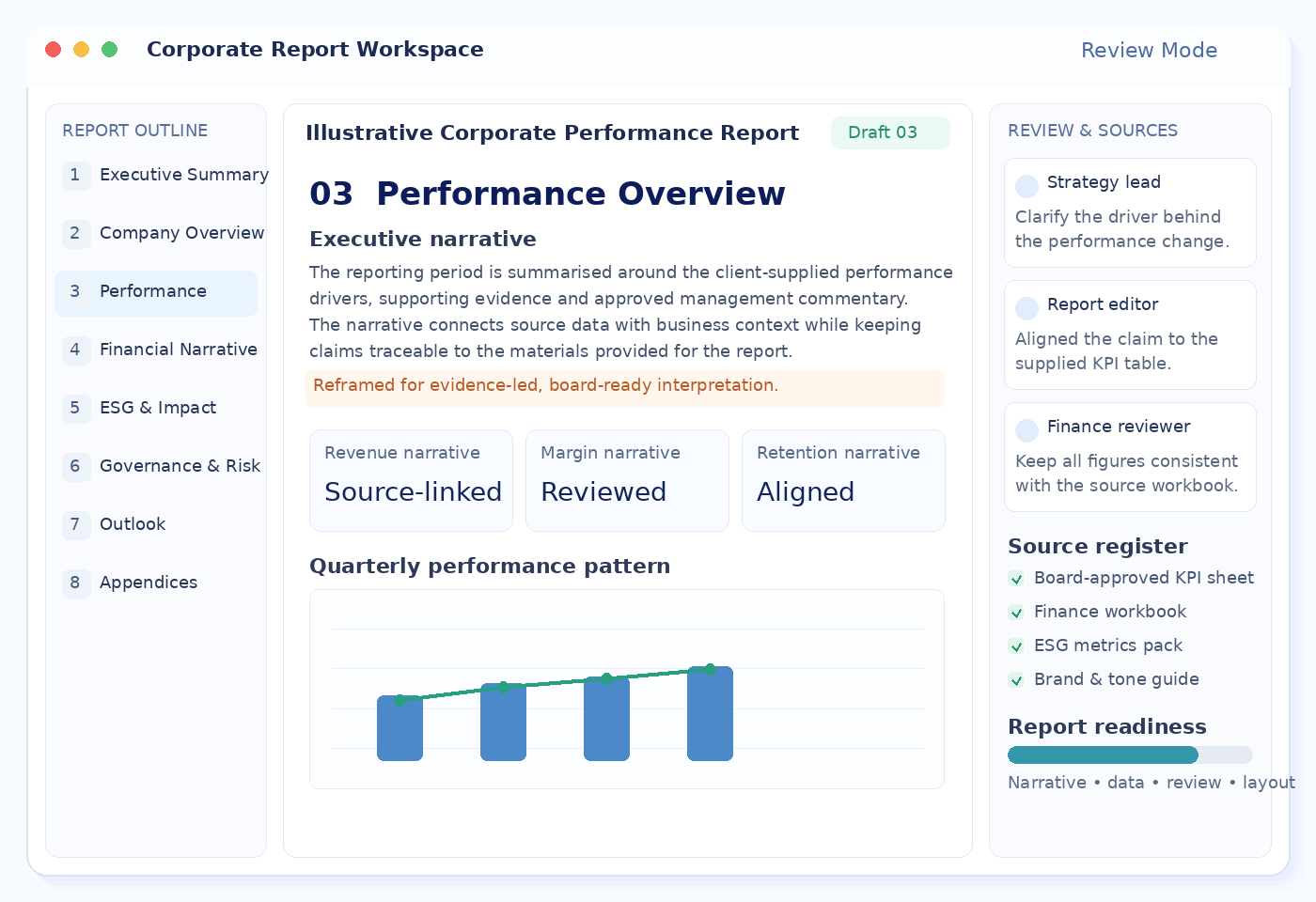
A report-development workspace keeps the outline, source trail, drafted narrative, reviewer comments and editorial actions visible in one logical process.
The performance section should help readers understand what changed, why it matters, and how the approved evidence supports the narrative. Source data is translated into concise business context without adding unsupported claims.
Editorial action: Reframe descriptive data points into an evidence-led management narrative and keep each statement traceable to an approved source.
Chart commentary
The workflow keeps drafting and review sequential so the report can move from source collection to an approved narrative without losing track of decisions or evidence.
Share objectives, audience, sources and existing files.
Confirm sections, responsibilities and review path.
Organise approved evidence against the report outline.
Develop narratives, summaries and transitions.
Align supplied tables, figures, captions and context.
Consolidate comments and resolve open points.
Check coherence, terminology, sources and presentation.
Provide the agreed clean and review-ready files.
The quality of a corporate report depends on the quality and authority of the source package. Clear inputs make it easier to keep the final narrative accurate, reviewable and aligned to your organisation.
Quality checks focus on traceability, logical flow, section consistency and presentation—not on inventing missing evidence or independently certifying business figures.
Check key statements against the supplied source set.
Review section purpose, progression and transitions.
Align terminology, voice, readability and executive clarity.
Check captions, callouts, references and style consistency.
Review unresolved comments, obvious mismatches and clean-copy readiness.
Different report types require different levels of evidence synthesis, stakeholder coordination and narrative development. The service is scoped around the document you actually need to produce.
Business performance, strategy and stakeholder-facing narrative.
Operational or management performance communication.
Narrative built around supplied ESG, sustainability and impact evidence.
Structured internal reports for leadership review and decision support.
Clear summaries of approved business developments and priorities.
Structured company, capability and organisational reporting.
Research-led business reporting where approved sources are supplied or scoped.
Progress, outcomes, activities, risks and next-step reporting.
Evidence-led narrative around supplied outcomes and impact indicators.
Process, service, KPI and business-review reporting based on approved inputs.
The reporting process should strengthen your organisation's communication without obscuring responsibility for source accuracy, approvals or final publication decisions.
Your organisation remains the accountable owner of the report, underlying evidence and final claims. The service supports drafting, structuring and editorial development from approved material.
Unpublished reports may contain strategic, financial, operational or stakeholder-sensitive material. The workflow is designed to keep shared materials tied to the specific engagement.
No fixed price or turnaround is asserted on this page. Scope and schedule depend on report length, source volume, stakeholder count, review depth and any formatting or design requirements.
A report is more than a long-form document. It must coordinate evidence, narrative, stakeholder priorities and presentation so readers can understand the organisation's message without losing the source trail.
Built around internal owners, reviewers and approved source material.
Sections are organised around reader needs, evidence and decision flow.
Claims and narratives are kept connected to the materials provided.
Supplied tables and charts are supported by clear explanatory narrative.
Comments, actions and approvals are easier to manage in staged review.
Coherence, terminology, source alignment and presentation are checked before handoff.
Answers to practical questions about scope, source material, financial-data boundaries, stakeholder review, confidentiality and final deliverables.
The service can cover report architecture, source and stakeholder-input synthesis, section-by-section drafting, executive-summary development, data-to-narrative writing, captions and table commentary, editorial review, reference consistency, and final clean-copy preparation. The exact scope is agreed from the materials and report brief you provide.
Support can be structured for annual and performance reports, board and management reports, ESG or sustainability narratives, impact reports, corporate profiles, investor and stakeholder updates, project reports, market or industry reports, and other business-reporting formats where clear evidence-led communication is required.
Yes. The workflow is designed to organise supplied source material into a coherent report structure. Clear source ownership and approved inputs are important so statements, figures, and claims can be traced back to the material provided for the engagement.
Yes. An existing draft can be used as the starting point for restructuring, section development, narrative strengthening, consistency review, and final editing. The depth of intervention depends on how complete the draft is and what the report still needs.
No independent audit, assurance, or financial verification is implied by this writing service. Financial and operational figures should come from client-approved source material. We can check narrative consistency against supplied files, flag obvious mismatches, and help present the information clearly, but the organisation remains responsible for the accuracy and approval of the underlying figures.
Yes. Where the underlying data and chart or table are supplied, the service can help develop titles, captions, explanatory narrative, trend descriptions, contextual interpretation, and section transitions that make the visual evidence easier to understand.
Yes. If you provide brand, tone, terminology, formatting, or publication guidelines, those requirements can be incorporated into the report structure and editorial review.
The report can be developed through staged review points so stakeholder comments are consolidated and applied section by section. Revision depth and the number of review cycles should be defined in the agreed project scope before work begins.
A useful starting package includes the report objective, intended audience, preferred structure or prior report, source files, approved figures, stakeholder notes, brand guidance, required sections, references or citations where relevant, and any fixed submission or publication requirements.
No fixed turnaround is stated on this page. The delivery schedule is confirmed after reviewing the report type, expected length, volume and condition of source material, number of stakeholders, review requirements, and any layout or formatting complexity.
Corporate-report materials can contain unpublished business, financial, strategic, or operational information. The page follows the same ContentXprtz confidentiality-focused service approach used across the reference design, with controlled handling and a workflow that keeps source materials tied to the agreed report engagement.
Depending on the agreed scope, delivery can include an editable report draft, a clean final copy, tracked or commented revisions where review transparency is needed, and organised notes or source references used during development. Final design-production files are included only when that requirement is explicitly part of the engagement.
Share the report type, purpose, audience, existing source material, approximate length, key sections, stakeholder-review needs and any fixed publication constraints. The enquiry can then be assessed for scope and delivery planning.
What the report must communicate and to whom.
Drafts, spreadsheets, research, notes and approved evidence.
Who comments, approves and owns key sections.
Internal review, board, publication or submission milestones.
Provide enough detail for the team to understand the report, source package and review requirements. No fixed price or turnaround is implied until the scope is reviewed.