Terminology Consistency Review
Find competing names, spelling variants, capitalization drift and inconsistent technical phrasing.

Identify inconsistent terms, conflicting names, acronym drift, unit and notation variations, and glossary mismatches across technical content—without replacing terminology blindly or changing intended technical meaning.
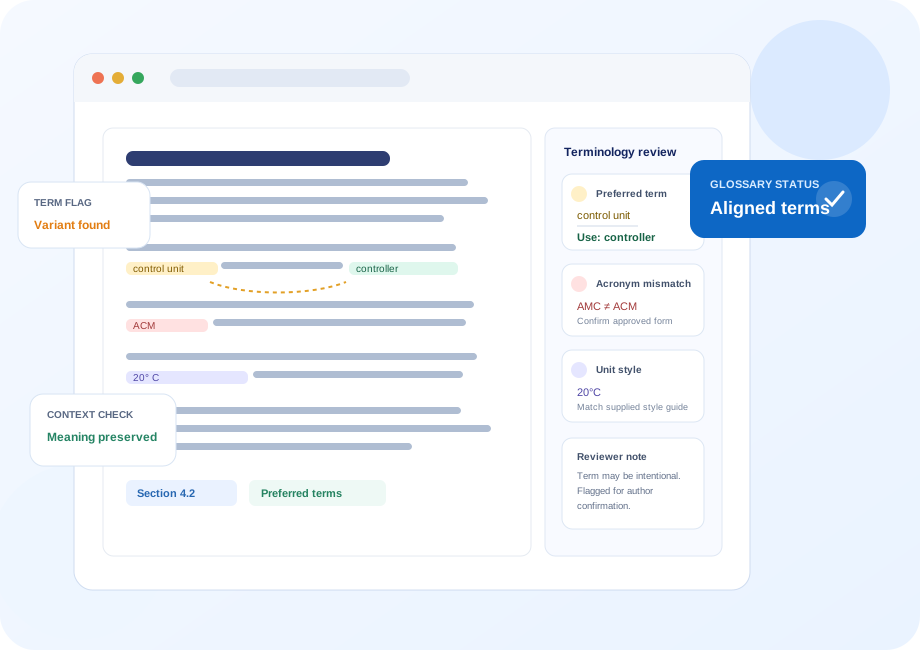
Terminology review is driven by the number of terms, documents, variants, and decision points rather than raw prose word count, so it is offered as a scoped review project.
Project minimum
for one compact terminology-review batch
Suitable for: A technical document set or product-content batch that needs preferred-term, acronym, unit, symbol, and naming consistency checked against supplied guidance.
Building a large termbase from scratch, multilingual terminology management, domain research, product-wide inventories, or ongoing governance is quoted as a larger engagement. Faster delivery for technical terminology review can be considered after volume, file readiness, and specialist availability are reviewed.
Buy Service NowWhy use terminology review?
Our core review services
Find competing names, spelling variants, capitalization drift and inconsistent technical phrasing.
Compare content with supplied glossaries, approved naming rules and controlled vocabulary.
Check introduction, expansion, shortened forms and repeat usage across the document set.
Review units, notation, symbols, labels and technical names against the required convention.
Compare manuals, specifications, procedures, product content and related materials for term drift.
Explain conflicts that need subject-owner confirmation instead of making unsupported replacements.
Receive the content, glossary, style guide, naming rules and review priorities.
Identify repeated technical terms, acronyms, abbreviations, units and naming variants.
Check whether each variant is inconsistent, intentional, domain-specific or context-dependent.
Compare usage against supplied references and across the complete document set.
Recheck preferred terms, definitions, acronyms, units and unresolved reviewer flags.
Return the reviewed content with terminology findings, decisions and usable follow-up notes.
The review can be centered on one technical file or a related document set, with terminology decisions presented in a way that stays visible and explainable.
Terminology review examples
Terminology review is not a global search-and-replace. The goal is to identify inconsistencies, compare them with the intended terminology source and leave contextual decisions visible.
“Install the control unit. The controller must be restarted after configuration.”
Use the approved preferred term consistently if both phrases refer to the same component.
“Advanced Motion Controller (AMC)” is later shortened to “ACM”.
Flag the mismatch and confirm the approved acronym before standardizing the document.
“20° C”, “20°C” and “20 degrees C” appear in the same document set.
Align the format to the supplied technical or house convention and document the chosen form.
Frequently asked questions
It is a focused review of the terms used throughout technical content to identify inconsistent, conflicting, ambiguous or non-preferred terminology and align usage with the supplied glossary, style guide, product language or reference material.
Terminology review concentrates on the controlled use of technical terms, acronyms, abbreviations, units, symbols, nomenclature and related variants. Copy editing is broader and may also address grammar, sentence clarity, punctuation and general style.
Yes. An existing glossary, approved-term list or terminology reference can be used as the primary comparison source, with conflicts and missing or uncertain entries flagged for review.
Yes. The review can check whether acronyms, abbreviations, units, symbols and notation are introduced and used consistently, while following any supplied house, product, industry or publication conventions.
Yes. Related documents can be compared to find inconsistent naming, preferred-term drift and variations between manuals, specifications, product content, SOPs, reports and other technical materials.
The review should not force a replacement when a distinction may be intentional. Ambiguous cases are flagged with context so the correct preferred usage can be confirmed.
Yes. Supplied style guides, product naming rules, approved terminology, controlled vocabulary and reference documents can be used to guide the review.
The primary purpose is terminology consistency rather than broad rewriting. Wording that affects the interpretation of a term can be flagged or clarified, while wider rewriting should be agreed as a separate editing requirement.
Provide the technical content to be reviewed and, where available, the approved glossary, style guide, product naming rules, reference documents, existing term lists and any known terminology concerns.
Yes. Stabilizing source-language terminology before localization can make preferred terms and naming decisions clearer for downstream translation and localization teams, although terminology review is not a substitute for translation or localization.
Send your document set, glossary or style guide, and priority terminology concerns so the review scope, pricing and delivery timing can be confirmed for your requirement.
Share your Technical Content Terminology Review Service requirement. We will review the scope, content type, delivery needs, and any language or market context before confirming the next step.