Contracts & Agreements
Commercial agreements, NDAs, service agreements, licensing terms, schedules, exhibits and related contractual content.

Translate contracts, policies, compliance materials, corporate records, legal notices, case documents, and legal-facing digital content while preserving defined terms, clause relationships, references, tone, and document structure.
Legal translation is a linguistic service and does not replace legal advice from qualified counsel in the relevant jurisdiction.
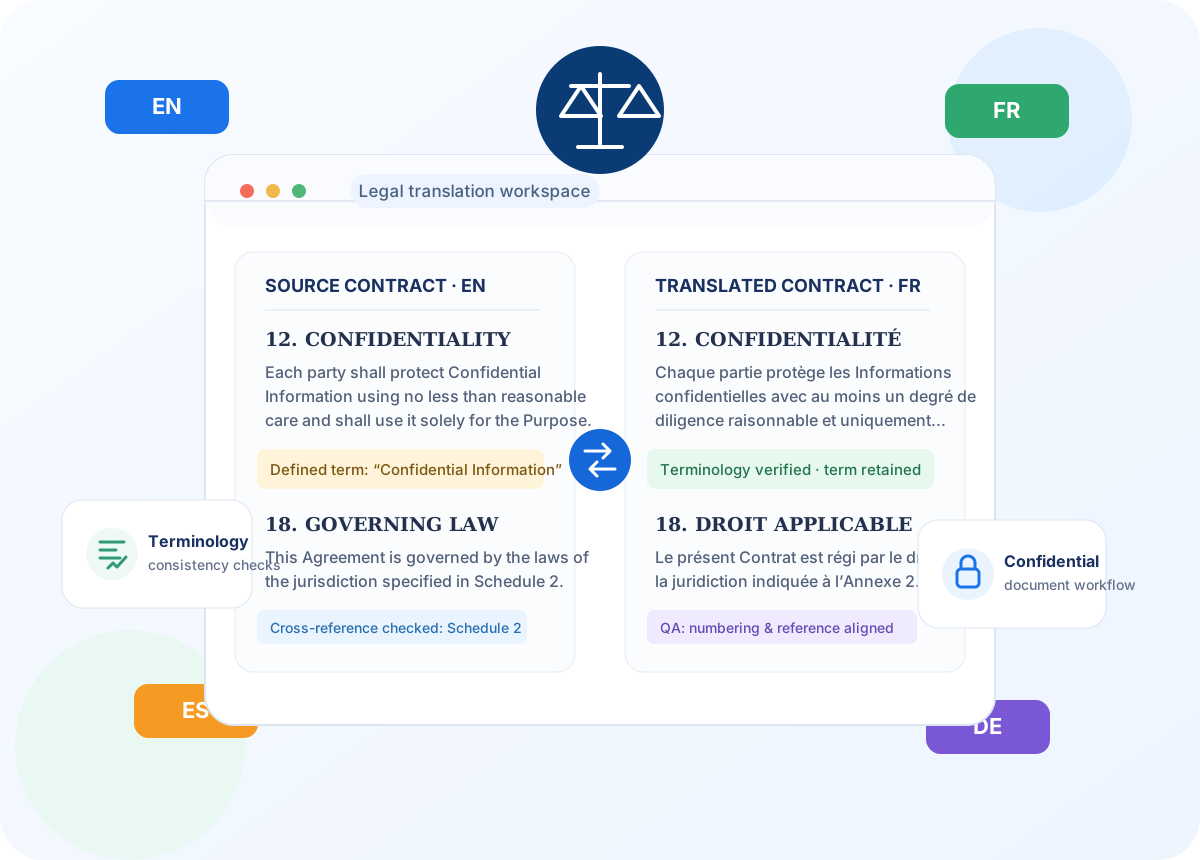
Legal translation starts above general translation because defined terms, clause relationships, formal register, and potential downstream use require specialist language handling and closer review.
Starting price
per 1,000 source words
Suitable for: Contracts, agreements, policies, legal correspondence, memoranda, compliance material, and standard legal documents requiring non-certified professional translation.
Certified/sworn translation, notarization, court-specific requirements, rare language pairs, handwritten evidence, jurisdictional legal review, or urgent filing work is quoted separately. Faster delivery for legal translation can be considered after volume, file readiness, and specialist availability are reviewed.
Buy Service NowWhy Partner With Us?
Jurisdiction-specific requirements: certified, sworn, notarized, legalized, or authority-specific translations can have different rules. Share the destination country and receiving authority so the required format can be confirmed before work begins.
Commercial agreements, NDAs, service agreements, licensing terms, schedules, exhibits and related contractual content.
Privacy policies, terms of use, legal notices, disclaimers, consent language and customer-facing legal content.
Board materials, corporate policies, governance documents, resolutions, shareholder communications and internal legal records.
Compliance materials, regulatory notices, codes of conduct, risk disclosures and supporting policy documentation.
Pleadings, correspondence, exhibits, witness materials, case summaries and document sets prepared for multilingual review.
Legal website pages, localized legal help content, client communications, portal text and multilingual legal-facing UX copy.
A six-stage workflow designed to preserve meaning, terminology, document logic, formatting and multilingual consistency from source file to final handoff.
Review document type, purpose, language pair, jurisdiction context, file format and project instructions.
Build or import glossaries, defined-term lists, reference files, style guidance and translation memory where available.
A native-language translator works clause by clause with attention to legal terminology, tone and source meaning.
Review focuses on linguistic accuracy, readability, recurring terms, omissions, additions and consistency across the document.
Check numbering, names, dates, defined terms, references, units, locale formats, formatting and glossary compliance.
Provide the translated file in the agreed format, with project notes or tracked review information where part of the scope.
From clause-heavy contracts to legal-facing websites, the workflow can be configured around the document type, receiving audience, jurisdiction context and required file format.
Legal content has little tolerance for loose terminology, missing references or inconsistent defined terms. The workflow is built around the controls that matter most in multilingual legal documents.
Glossaries, defined-term lists, recurring clause language and client-approved references help keep legal wording consistent across long documents and document families.
Review covers headings, numbering, cross-references, party names, schedules, exhibits and clause relationships instead of treating each sentence as isolated text.
Project setup can incorporate NDA requirements and controlled document workflows, with sensitive file handoff separated from the initial public enquiry form.
Frequently Asked Questions
The service can be scoped for contracts and agreements, policies and terms, corporate and governance documents, compliance and regulatory content, litigation or case-related documents, legal notices, employment documents, intellectual-property materials, and legal-facing digital content.
The workflow can use a project glossary, defined-term list, translation memory, reference documents, and document-wide QA so recurring legal terms, party names, headings, numbering, and cross-references remain consistent.
The linguistic goal is to preserve the source meaning, clause relationships, defined terms, references, tone, and document structure as closely as the target language allows. The service does not provide legal advice or rewrite the underlying legal position.
Certification, sworn-translation, notarization, legalization, and authority-specific requirements vary by country and receiving institution. Share the destination jurisdiction and authority so the required format and available service scope can be confirmed before you proceed.
Confidentiality requirements should be identified before document handoff. The service workflow emphasizes controlled handling, NDA-aware processes, secure workflows, and limited use of sensitive content in enquiry forms.
Where the file type permits, the translation workflow can preserve headings, clause numbering, tables, captions, footnotes, references, defined-term formatting, and other structural elements while adapting text expansion and locale-specific formatting.
The supplied translation-services capability covers 100+ languages. Common requests include English, Spanish, French, German, Chinese, Japanese, Arabic, Russian, Portuguese, Italian, and Korean, with additional language pairs scoped on request.
Yes. Existing glossaries, clause libraries, translation memories, approved bilingual references, style guides, and client terminology can be incorporated into the project instructions and QA process.
Yes, these can be included as legal-facing digital content. The scope can account for recurring terminology, locale conventions, linked content, interface strings, and coordination between website copy and formal legal text.
A specific turnaround is confirmed after reviewing the language pair, document length, legal complexity, formatting, reference materials, review requirements, and requested delivery date. For Legal Translation, the stated entry scope typically takes 4–7 business days for up to 5,000 words; final timing is confirmed against volume, complexity, and workflow requirements.
Pricing is confirmed after the source files and project requirements are reviewed. Factors can include language pair, volume, document complexity, formatting, terminology preparation, review requirements, and deadline. The published starting price for Legal Translation is ₹5,000 per 1,000 source words.
No. Legal content translation is a linguistic service intended to communicate source content accurately in another language. It does not replace advice from a qualified lawyer in the relevant jurisdiction.
Legal Translation Enquiry
Tell us what needs to be translated, the source and target languages, the destination jurisdiction or receiving authority when relevant, the document format, approximate length, and requested delivery date.
Identify the document type, intended use, destination jurisdiction and receiving audience or authority.
Share the source language, target language and any country or locale requirements.
Include approximate word count or page count and the required delivery date and time zone.
Mention any glossary, approved bilingual contract, style guide, translation memory or terminology list that should be followed.
Provide enough information to assess scope and feasibility. The published starting price for Legal Translation is ₹5,000 per 1,000 source words. For Legal Translation, the stated entry scope typically takes 4–7 business days for up to 5,000 words; final timing is confirmed against volume, complexity, and workflow requirements.
Discuss your documents, language pair, terminology requirements, format and destination jurisdiction with the Contentxprtz team.