Contracts & Agreements
Localize master agreements, statements of work, vendor contracts, service terms, amendments, and supporting schedules while preserving defined terms and clause relationships.

Localize contracts, policies, compliance materials, terms, notices, and other legal-facing content without losing defined terminology, clause structure, cross-references, or the context readers need in each market.
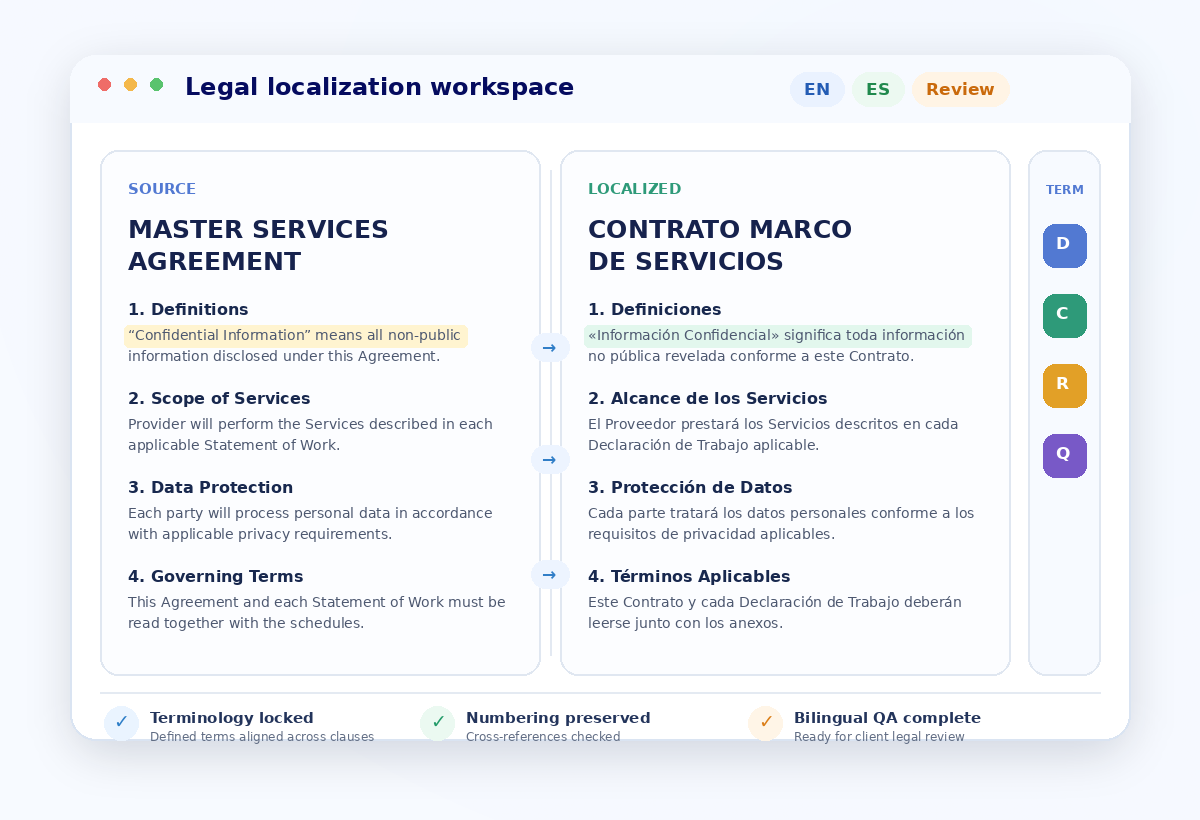
Legal localization adds target-market language conventions and document usability to specialist translation, so it is priced for higher terminology control and contextual review.
Starting price
per 1,000 source words for one target locale
Suitable for: Policies, terms, compliance material, contracts, legal websites, and cross-border legal content requiring locale-aware adaptation.
Localization does not replace jurisdiction-specific legal advice. Certified translations, court/filing formats, notarization, complex DTP, or counsel validation are separately scoped. Faster delivery for legal localization can be considered after volume, file readiness, and specialist availability are reviewed.
Buy Service NowLegal localization requires more than replacing one language with another. The wording, defined terms, references, numbering, formatting, and market context all need to stay aligned with the source and the instructions supplied for the target audience.
Localize master agreements, statements of work, vendor contracts, service terms, amendments, and supporting schedules while preserving defined terms and clause relationships.
Localize internal policies, codes of conduct, compliance guidance, operational standards, and regulated communications for multilingual teams and stakeholders.
Adapt terms of use, legal notices, consumer disclosures, privacy-facing language, disclaimers, and customer-facing legal content for target-language readers.
Localize legal pages, consent language, user terms, cookie notices, policy screens, help-center legal content, and product-facing compliance text.
Support multilingual board materials, governance policies, procurement documents, vendor requirements, corporate notices, and related business-legal content.
Localize licensing terms, rights notices, IP-related business content, commercial provisions, and accompanying explanatory materials using controlled terminology.
A structured workflow protects meaning before translation begins, applies consistent terminology during localization, and finishes with bilingual and formatting checks before files are returned for client or counsel review.
Review file types, source content, target markets, instructions, and legal-language risks.
Set language pairs, terminology rules, reviewer roles, file handling, and delivery requirements.
Translate and adapt content using the approved glossary, defined terms, style, and target-market context.
Perform bilingual review for meaning, legal-language consistency, terminology, and readability.
Check clause numbering, cross-references, names, dates, formatting, glossary use, and file integrity.
Return the localized files, review notes where applicable, and materials needed for final client validation.
Legal content often sits inside commercial, regulatory, product, employment, procurement, and customer workflows. Localization is planned around both the language pair and the operating context of the document.
The quality process combines human language expertise with terminology controls, review checkpoints, and tool-assisted consistency. Technology supports the workflow; it does not replace the judgment needed for legal meaning and context.
The service can support standalone legal documents as well as legal content embedded in websites, apps, customer journeys, procurement systems, compliance programs, and multinational operations.
The localization workflow is designed to reduce avoidable language and formatting risk, make reviewer decisions visible, and give your legal or compliance team a clean target-language file for final business or jurisdictional validation.
Repeated legal concepts, capitalization, labels, and glossary-approved wording are managed consistently across sections and related files.
Clause numbers, headings, dates, exhibit labels, table references, cross-references, and related document structure are reviewed during QA.
Questions, terminology decisions, and client feedback can be documented so later revisions use the same approved language and context.
Answers to common questions about scope, legal terminology, client review, confidentiality, languages, file structure, certified or sworn requirements, delivery planning, and quote preparation.
Legal content localization adapts legal-facing text for a target language and audience while preserving meaning, defined terminology, clause relationships, references, formatting, and the context needed to use the content in another market.
Ordinary translation may focus mainly on linguistic equivalence. Legal localization also considers defined terms, repeated clauses, document structure, formatting, dates, locale conventions, user-facing context, and consistency across related files.
The service can support contracts, agreements, schedules, policies, compliance materials, legal notices, disclosures, privacy-facing content, terms of use, procurement documents, governance materials, licensing content, and legal text used in websites or applications.
Yes. Defined terms, capitalization rules, clause numbers, section headings, references, labels, and related structural elements can be tracked as part of terminology and QA controls when they are present in the source files.
The localization workflow includes language and quality review, but that is not the same as jurisdiction-specific legal advice. If a document requires review by qualified legal counsel in the target jurisdiction, that requirement should be handled separately or identified when the project is scoped.
Yes. Client-approved glossaries, prior translations, defined-term lists, style guides, counsel instructions, and preferred wording can be used to guide the project and improve consistency across current and future documents.
Confidential documents should be handled through controlled submission, access, review, and delivery processes. If your organization has specific NDA, access-control, retention, or security requirements, include them in the project brief so the workflow can be assessed before work begins.
The supplied localization service information covers 100+ languages. Availability for a specific legal project depends on the source and target language pair, subject matter, document complexity, and reviewer requirements.
Right-to-left language support and locale-aware formatting can be included where the file type and project requirements allow. Complex documents should be reviewed after localization to confirm numbering, tables, references, alignment, and reading order.
Certified, sworn, notarized, or court-accepted translation requirements vary by language pair, country, authority, and intended use. State the exact destination and requirement in your enquiry so availability and the correct workflow can be assessed rather than assumed.
The published starting price for Legal Localization is ₹6,000 per 1,000 source words for one target locale. For Legal Localization, the stated entry scope typically takes 4–7 business days for up to 5,000 words; final timing is confirmed against volume, complexity, and workflow requirements. A quote and delivery schedule can be confirmed after reviewing the language pair, word count, document type, formatting complexity, terminology requirements, review depth, and deadline.
Share the source and target languages, document type, approximate word count, deadline and time zone, file format, intended use, target market, approved glossary or prior translation if available, and any confidentiality, legal-review, formatting, or certification requirements.
Tell us what needs to be localized, the target language or markets, the file format, the deadline, and any terminology, confidentiality, formatting, certification, or legal-review requirements.
Legal localization is easier to scope when the intended use is clear. A customer-facing terms page, internal compliance policy, cross-border agreement, procurement template, and certified filing can require different workflows.
Share enough detail for the team to assess scope, language availability, workflow, and delivery feasibility. Files can be provided through the appropriate secure channel once the enquiry moves forward.
The approved Contentxprtz service framework references information-security, quality-management, and translation-service standards as part of the wider controls used for document handling and localization delivery.
Share your document type, language pair, target market, and review requirements. We can help you scope a localization workflow that protects terminology, structure, and readability from source file to final handoff.