Structured Layout
Page systems built around report hierarchy and reading flow.

Turn dense technical material into a report that is easier to scan, understand and use. The design workflow focuses on visual hierarchy, page architecture, typography, figures, tables, navigation and output consistency while keeping your technical meaning central.
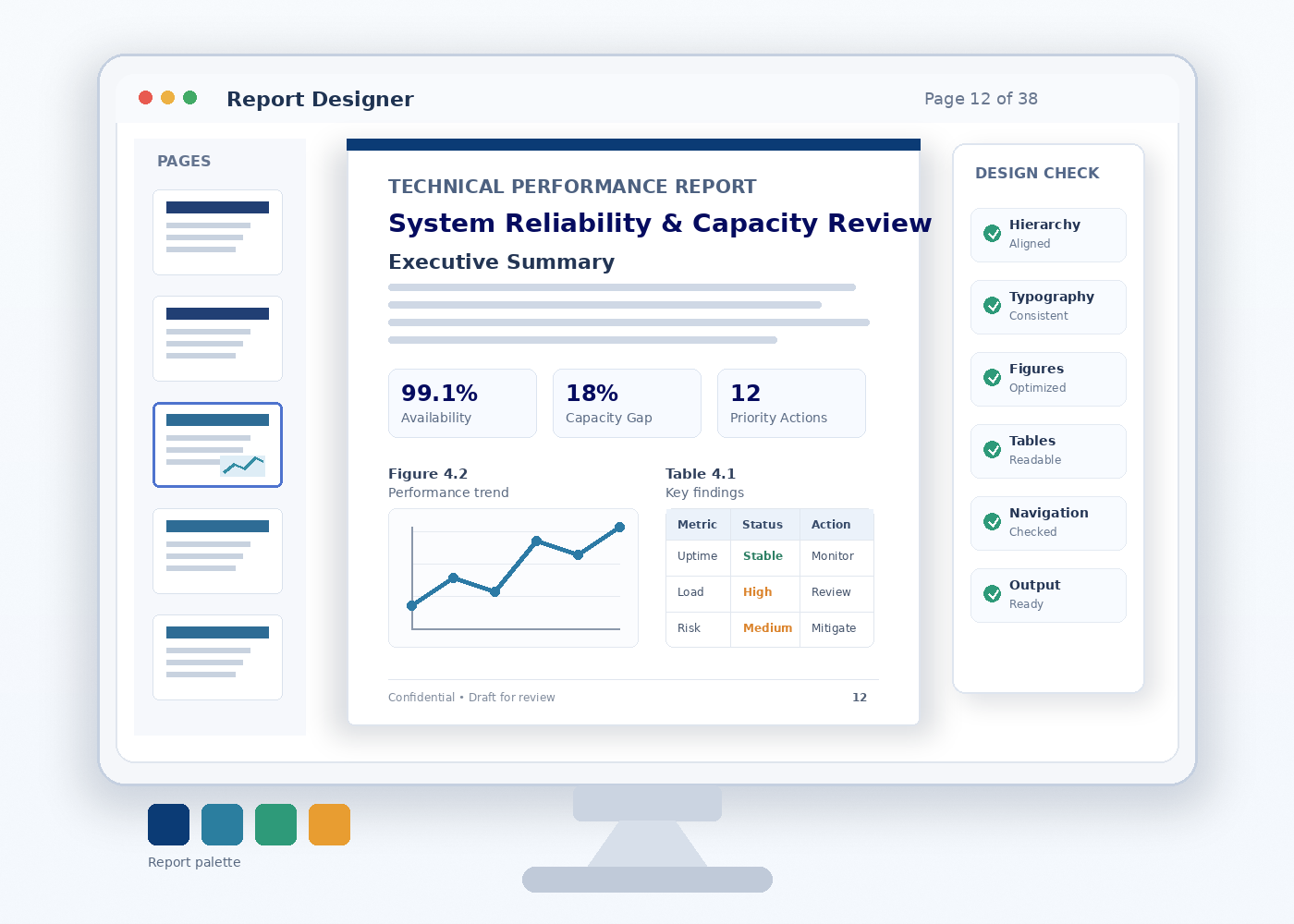
Page systems built around report hierarchy and reading flow.
Figures and tables styled for clarity and consistency.
Client documents and unpublished material handled through the service workflow.
Layout, navigation and export consistency checked before delivery.
A page-bounded project minimum keeps straightforward technical report production accessible while allowing data-heavy or publication-grade work to scale appropriately.
Suitable for: Best for a finished report draft that needs professional hierarchy, charts/tables treatment, and a polished PDF-ready layout.
for design and layout of a technical report up to 12 pages using supplied final content and brand assets
Technical Report Design Service starts at ₹18,000 for design and layout of a technical report up to 12 pages using supplied final content and brand assets.
Buy Service NowCustom illustration, complex data visualization, more than twelve pages, print-production specifications, unstable copy, or multiple brand versions require a separate design quotation.
Strong technical content can still be difficult to navigate when the document has weak hierarchy, dense pages, inconsistent visual treatment or unclear presentation of figures and tables.
Long text blocks and tight spacing make key findings difficult to scan and reduce visual separation between sections.
Headings, subheadings, callouts and summary points may look too similar, making the report structure harder to understand.
Inconsistent labels, crowded legends, uneven widths or weak caption treatment can interrupt technical interpretation.
Fonts, spacing, numbering, page breaks and section styles can drift across a long report assembled from multiple contributors.
Late-stage exports can expose clipped content, bad page breaks, inconsistent headers, broken navigation or image-quality issues.
The service moves from design brief to final document quality control, keeping the visual system connected across every major report element.
Report, audience, output and guidelines.
Grid, sections, spacing and navigation.
Visual consistency and readable presentation.
Heading levels, body styles and captions.
Brand, template or publication rules.
Page breaks, labels, callouts and continuity.
Agreed editable and export formats.
The design goal is not decoration. It is a controlled visual system that makes hierarchy, findings and technical evidence easier to follow.
These activities solve different problems. Use the comparison to clarify whether your main need is basic document cleanup, visual report design, or separate editorial improvement.
| Focus | Basic Formatting | Technical Report Design Service | Editorial Editing |
|---|---|---|---|
| Typography & spacing | ✓ Basic consistency | ✓ Full visual system | ◐ Usually secondary |
| Page hierarchy & architecture | ◐ Limited | ✓ Core scope | ◐ Content-led |
| Figures & table presentation | ◐ Placement only | ✓ Styled for consistency | ◐ Content review may apply |
| Headers, footers & navigation | ✓ Standard setup | ✓ Report-wide system | — Not the main purpose |
| Language & sentence rewriting | — No | — Separate scope | ✓ Core purpose |
| Best for | Final formatting cleanup | Dense or high-stakes technical reports needing clear visual presentation | Reports needing language, flow or structural editing |
Need language or substantive editing as well? See the Contentxprtz Editing Services and scope design separately where appropriate.
The visual system should make the whole report feel connected—from the first page to technical appendices—without forcing every section into the same layout.
Title, metadata, identity
Key findings and context
Navigation and hierarchy
Process, assumptions, scope
Data, findings, analysis
Captions, labels, readability
Recommendations and actions
References and supporting detail
A staged workflow reduces avoidable rework by separating scope confirmation, design-system setup, visual implementation and final-quality checks.
Share source file and requirements
ReceivedAssess length and complexity
ScopingInspect hierarchy and visuals
ReviewSet grid, type and styles
DesignApply structure across report
In ProgressFigures, tables and callouts
RefiningCheck navigation and output
QAProvide agreed file formats
DeliveredFinal deliverables are confirmed in the project scope. Depending on your requirements, delivery can include the following report-design outputs.
Editable source file in the agreed format where the source and project scope support it.
Final PDF output prepared from the approved layout when PDF delivery is part of the scope.
Redesigned or standardised visual elements where figure and table work is specifically included.
Styles or template elements can be included where reuse is part of the agreed design requirement.
Final document checked for visual continuity, navigation, page breaks and export integrity.
Project-specific notes can be supplied when future updates, style use or file handling need explanation.
The final quality pass focuses on the design system and document mechanics that can break when a long technical report is revised or exported.
Checks heading levels, spacing rhythm, callouts and section consistency.
Checks type styles, emphasis, line spacing, lists, captions and labels.
Checks figure sizing, table treatment, colour use, legends and captions.
Checks contents flow, section starts, pagination, headers, footers and page breaks.
Cross-checks the approved design against the final editable and exported files.
Multi-stage design QA helps keep long technical reports visually consistent from first page to final appendix.
The visual approach is adapted to the purpose of the document, its audience, its evidence, and the presentation conventions you need to follow.
Assessment, performance and project reports.
Insight, performance and analytical reports.
Technical, research and evaluation reports.
Impact, environmental and disclosure reports.
Evidence, policy and technical research reports.
Assessment, governance and performance reports.
System, architecture, risk and control reports.
Client-facing diagnostic and recommendation reports.
Technical reports may contain unpublished, client-sensitive or internal information. The submission and delivery process should keep file handling deliberate and controlled.
Turnaround is confirmed after scope and deadline review. The schedule is confirmed only after the report and design requirements are reviewed.
Page count, section count, source-file condition and level of layout rebuilding affect the amount of design work required.
The number and condition of charts, tables, diagrams, callouts and other technical visuals influence review and refinement effort.
Required editable formats, PDF output, brand or publication rules, review stages and your target deadline are considered during scoping.
Technical report design works best when every design decision supports the document’s evidence, navigation and intended use—not decoration for its own sake.
Layout choices are organised around reading order, section importance and decision points.
Design changes should make content easier to use without altering the report’s underlying technical message.
Figures, tables, callouts, headings and navigation follow a connected visual system.
Print, PDF and editable-source needs can be considered during the design brief.
Timeline and pricing are based on the actual report rather than unsupported fixed assumptions.
Design continuity, navigation, page breaks and export integrity are checked before final handoff.
A well-designed technical report gives structure to dense material through clear hierarchy, deliberate spacing and disciplined visual presentation.
Answers to common questions about scope, files, figures and tables, editorial boundaries, brand guidelines, pricing, turnaround, confidentiality and final delivery.
The service focuses on the visual presentation and document architecture of a technical report. Scope can include page layout, typography, heading hierarchy, tables, figures, captions, callouts, contents pages, headers and footers, pagination, and final-output consistency. The exact scope is confirmed after the source report and requirements are reviewed.
Not automatically. Technical report design is primarily a design and formatting service. If language editing, substantive rewriting, or technical-content editing is also needed, that should be scoped separately so visual design and editorial changes remain clear.
Yes. An existing editable report, organisation template, or style guide can be used as the design starting point. The feasibility of preserving or rebuilding particular template elements is assessed from the files you provide.
Figure and table presentation can be included when requested. The design work may address visual hierarchy, spacing, labels, alignment, typography, caption treatment, and consistency while keeping the supplied data and technical meaning unchanged.
The design workflow is intended to improve presentation without changing the underlying technical meaning. If a visual or structural issue appears to require a content decision, it should be flagged for author or client confirmation rather than silently changed.
Provide the latest editable report where available, plus any existing template, logo or brand guidance, charts or figures in their best available source format, required output format, and deadline information. These details help define the design effort accurately.
Turnaround is confirmed after scope review. The delivery schedule is confirmed after reviewing report length, source-file condition, visual complexity, figure and table work, output requirements, and deadline.
Technical Report Design Service starts at ₹18,000 for design and layout of a technical report up to 12 pages using supplied final content and brand assets. Custom illustration, complex data visualization, more than twelve pages, print-production specifications, unstable copy, or multiple brand versions require a separate design quotation.
Yes, the intended use can be part of the design brief. Print-oriented reports may need different margins, page breaks, image handling, and pagination from reports designed mainly for on-screen reading or digital distribution.
Yes, when the required brand or publication guidelines are supplied. They can be used to guide colours, typography, logo placement, spacing, page architecture, and other specified presentation rules.
Client documents and unpublished material should be handled as confidential service information through the designated submission and delivery process. Share only the files and supporting material needed to complete the agreed scope.
Final delivery depends on the agreed scope. It can include the designed editable report, a clean PDF export, and scoped supporting design assets or layout notes where relevant. The required output formats should be confirmed before work begins.
Tell us what the report is for, what format you have, what needs redesigning, and what final files you require. The document can then be reviewed for design scope, timeline and quote.
Share the latest editable report where possible and note the approximate page count.
Explain whether tables, figures, diagrams, cover pages, contents pages or callouts need redesign.
Include any organisation, publisher, client or institutional design rules that must be followed.
State your required date and whether you need editable files, PDF output or other specified formats.
Provide enough detail for the document to be assessed for design scope, visual complexity and delivery requirements.