Unclear Audience
The content is technically correct but assumes too much, explains too little, or speaks to the wrong reader role.

Turn complex technical information into structured documentation that helps readers understand a product, complete a task, configure a system, follow a procedure, or troubleshoot an issue. The scope can cover new documentation, major rewrites, or improvement of existing technical content.
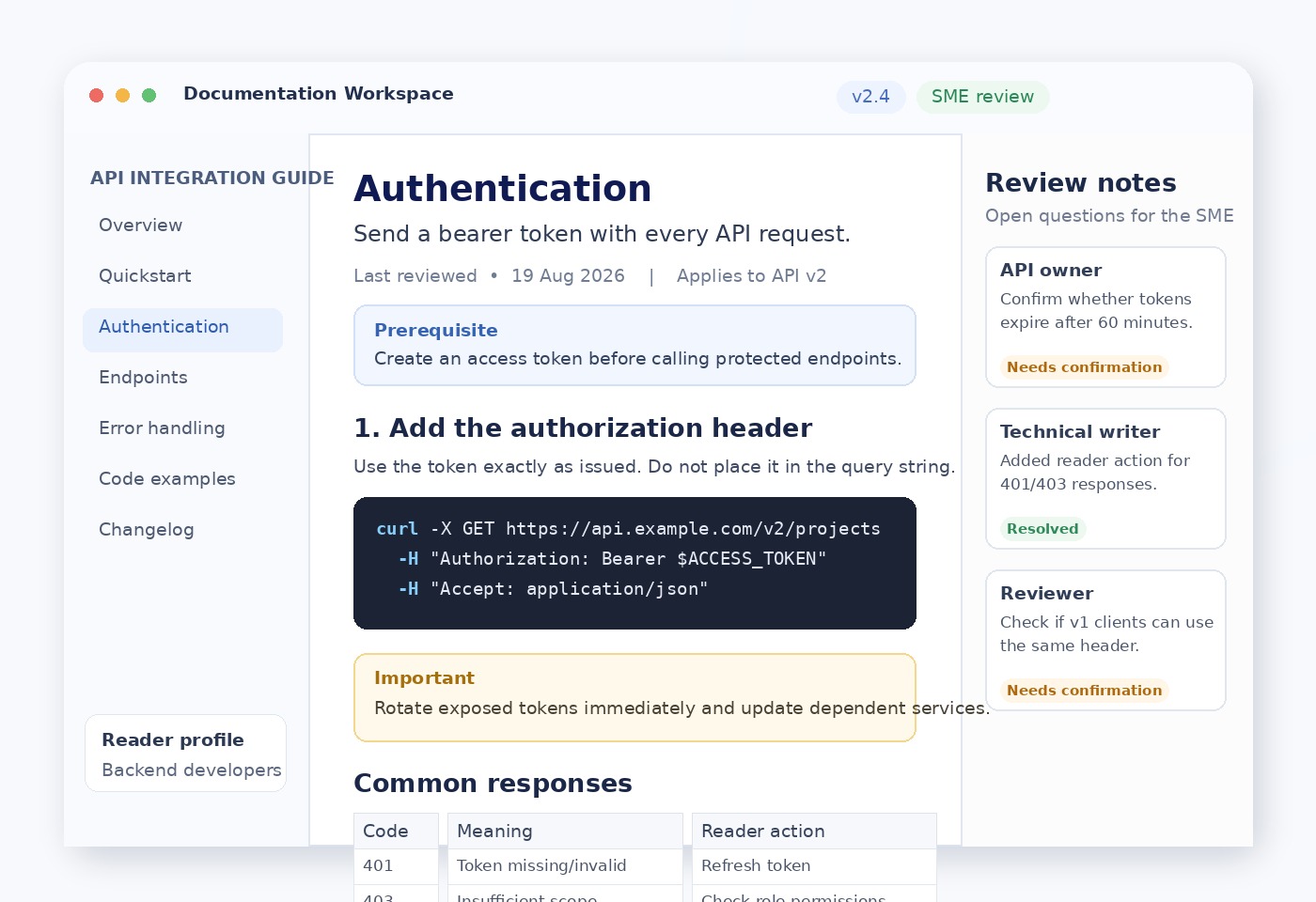
A focused writing unit works well when the source material is ready and the required output can be defined before drafting begins.
Suitable for: Best for a new guide, process, procedure, concept topic, or documentation section with accessible technical inputs.
for up to 1,500 words of technical documentation written from usable source material
Technical Documentation Writing Service starts at ₹7,500 for up to 1,500 words of technical documentation written from usable source material.
Buy Service NowComplex source discovery, interviews, code or API validation, multiple topics beyond the included volume, extensive visual work, or publishing-system implementation are quoted separately.
Technical content becomes difficult to use when the reader, task, source material, terminology, and release context are not aligned. Documentation quality depends on more than grammar.
The content is technically correct but assumes too much, explains too little, or speaks to the wrong reader role.
Requirements are split across tickets, notes, specifications, emails, code samples, screenshots, and older documents.
Feature names, labels, abbreviations, commands, and product terms change across sections and create reader uncertainty.
Steps exist, but prerequisites, expected results, warnings, decision points, or troubleshooting guidance are missing.
Product behaviour changes while examples, screenshots, labels, links, or release notes remain tied to an older version.
A documentation project can be scoped from planning through final review, with the level of writing and technical development matched to the condition of your source material.
Technical documentation writing goes beyond surface correction. The aim is to make the information understandable, actionable, structured, and reviewable without changing facts that require subject-matter confirmation.
Auth change
Need token. Put bearer token in header. Old v1 maybe same? Token timeout 60? Check with API team. 401 if wrong. 403 permissions.
If token bad then retry. Scope maybe projects:read. Update screenshot later.
Authentication change
You need a token. Put the bearer token in the header. The old v1 version maybe may use the same method. The token timeout is 60? 60 minutes.
If the token is invalid, retry. The required scope may be projects:read.
Authenticate API requests
Prerequisite: Create an access token before calling protected endpoints. Send the token in the Authorization header.
401: Token missing or invalid. 403: Token does not have sufficient permission.
Choose the depth of support based on the condition of the content. A near-final document may need language correction, while incomplete or complex technical information needs structured documentation development.
| Service Level | Proofreading | Technical Documentation Writing This Service | Documentation Strategy Support |
|---|---|---|---|
| Primary focus | Grammar, punctuation, spelling, surface consistency | Reader goals, structure, technical explanation, procedures, examples, terminology, QA | Documentation system, governance, content architecture, ownership, lifecycle planning |
| Best starting point | Content is already complete and structurally sound | Notes, specifications, existing docs, partial drafts, or material that needs a new reader-ready document | Large or fragmented documentation estates that need higher-level design and operating principles |
| Structural development | Limited | Yes — within scope | Yes — system level |
| Reader task flow | No | Developed and clarified | Standardised across content sets |
| Technical questions | Obvious inconsistencies may be flagged | Missing facts and ambiguous behaviour are identified for SME confirmation | Review responsibilities and content-governance questions are addressed |
| Rewriting depth | Light correction | Substantial rewriting or new drafting where needed | Strategic guidance plus documentation design; writing scope can be defined separately |
The exact structure depends on the document type. A typical technical document is reviewed as a sequence of reader decisions and actions rather than as isolated paragraphs.
The workflow keeps source material, writing decisions, technical questions, review comments, and final delivery connected so that uncertainty is surfaced rather than hidden.
Deliverables are confirmed for the project scope. Depending on the requested format and review process, the handoff can include the following documentation assets.
Exact deliverables depend on project scope, source material, target platform, review requirements, and agreed output format.
Quality review separates writing quality from technical certainty. Content is checked against supplied sources, and unresolved technical statements are surfaced for confirmation instead of being silently guessed.
Check claims against the specifications, notes, product information, or source material provided.
Review sequence, assumptions, prerequisites, action steps, and expected results from the reader's perspective.
Check product names, UI labels, acronyms, capitalization, command syntax, and repeated technical terms.
Review links, cross-references, headings, lists, tables, figures, notes, callouts, and formatting consistency.
Cross-check resolved comments and confirm that outstanding SME questions remain clearly visible before delivery.
The service can be adapted to different kinds of technical content. The key is to define the reader, source material, expected action, and level of technical validation required.
Technical documentation may contain unpublished product information, internal procedures, architecture details, screenshots, configuration data, or other sensitive material. Those materials should be treated as confidential service information throughout the project.
No fixed delivery time is assumed for technical documentation because effort can vary substantially by source readiness, technical depth, document length, review dependencies, and required output format.
Page or word count, number of topics, number of related documents, and the amount of restructuring or new drafting required.
Depth of product, API, engineering, operational, or process knowledge required; examples and cross-references can also affect effort.
Source-material completeness, SME availability, stakeholder review rounds, release dates, and the number of unresolved technical questions.
A project-specific delivery schedule is provided after the documentation, source material, output requirements, and review path are assessed.
The service is designed to make technical information easier to navigate, review, maintain, and act on while keeping technical decisions tied to the source material and subject-matter review.
Use a bearer token for protected API endpoints. Keep live credentials out of published examples.
Common questions about technical documentation scope, source material, SME review, accuracy, formats, turnaround, pricing, and confidentiality.
The service can be scoped for product guides, software and API documentation, standard operating procedures, implementation guides, user manuals, knowledge-base articles, technical procedures, troubleshooting content, and related documentation.
Yes. A project can begin from supplied notes, existing documentation, specifications, diagrams, tickets, product information, code examples, or other source material. Gaps and questions that need subject-matter confirmation are identified during the documentation process.
Yes. Existing content can be reviewed for structure, clarity, terminology, reader flow, procedures, examples, cross-references, links, and presentation. The exact depth is agreed during scoping.
API and software documentation can be included when sufficient source material is available. Examples, endpoints, parameters, authentication, errors, workflows, or SDK usage can be structured for the target reader, while unresolved technical behaviour is flagged for SME confirmation.
Technical claims are checked against the source material supplied for the project. Items that cannot be confirmed from those sources are flagged for subject-matter expert review rather than guessed.
Yes, when those materials are supplied as part of the project. Product terminology, capitalization, UI labels, abbreviations, headings, notes, and other presentation conventions can be aligned to the provided guidance.
Useful inputs can include specifications, existing documents, product notes, process maps, screenshots, safe code examples, diagrams, issue tickets, release notes, terminology lists, style guides, and the contact points for technical questions.
Supplied visuals, tables, and safe code examples can be incorporated, captioned, referenced, and checked for consistency with the surrounding documentation. Creation of new specialist visuals should be confirmed during scoping.
The delivery format is confirmed during scoping so it matches your publishing workflow. Tell us whether the final content is intended for an editable document, documentation platform, knowledge base, Markdown-based repository, or another destination.
Turnaround is quoted after review of documentation volume, technical complexity, source-material readiness, required formats, review dependencies, and delivery priorities. Turnaround is confirmed after scope and deadline review.
Technical Documentation Writing Service starts at ₹7,500 for up to 1,500 words of technical documentation written from usable source material. Complex source discovery, interviews, code or API validation, multiple topics beyond the included volume, extensive visual work, or publishing-system implementation are quoted separately.
Project files, instructions, contact details, and unpublished technical material are handled as confidential service information through the designated submission and delivery process. Raise any special access, NDA, retention, or handling requirements during scoping so they can be confirmed before work begins.
Share the document type, target audience, source material, approximate size, required output, and any release or review constraints. The project can then be scoped around the work the documentation actually needs.
Guide, API docs, SOP, manual, knowledge base, procedure, or other technical content.
Who will use the document and what should they be able to understand or do?
Existing docs, specs, notes, safe examples, screenshots, diagrams, or process information.
Release date, review cycle, stakeholder availability, or other scheduling requirements.
Tell us where the content will be published or maintained so the output can be scoped correctly.
Raise confidentiality, access, NDA, retention, or approval requirements before work begins.
Provide enough detail for the project to be assessed for scope, source-material readiness, technical review needs, output format, pricing, and delivery feasibility.