
Dense Information
Long, uninterrupted content makes key health messages harder to find.
Turn dense healthcare information into structured, audience-appropriate content that is easier to navigate, review, and use across patient, clinical, research, and professional communication.
Healthcare information can lose impact when important content is difficult to scan, visually inconsistent, or written for a different audience than the one using it.
Long, uninterrupted content makes key health messages harder to find.
Headings, warnings, steps, and supporting detail compete for attention.
Important instructions or escalation messages are not visually distinct.
Mixed layouts, icon styles, and spacing reduce coherence across assets.
Charts or diagrams do not explain the sequence or relationship clearly.
Stakeholders spend time commenting on structure before content can be approved.
The service can combine content structure, information design, visual communication, and production-ready layout depending on your audience and channel.
Organize complex healthcare information into a clear sequence of headings, sections, and supporting detail.
Translate processes, comparisons, pathways, data points, or educational concepts into visual explanations.
Structure patient-facing content with readable sections, visual cues, definitions, steps, and action-focused callouts.
Create professional layouts for expert audiences where denser information and precise structure are appropriate.
Design executive, research, clinical, or healthcare business content for clear on-screen and document communication.
Create reusable patterns for repeated content types so a series of healthcare assets stays visually consistent.
Plan screen-friendly healthcare content blocks for webpages, modules, campaign pages, or responsive content experiences.
Prepare content so subject-matter experts and stakeholders can review hierarchy, wording, and visual treatment efficiently.
Audience, context, and decision needs should shape the design. The same information may require a very different presentation for patients, clinicians, researchers, or internal teams.
Guides, explainers, instructions, and education assets designed for easier navigation and understanding.
Patient communication, service information, internal education, and structured clinical communication materials.
Content patterns, explainers, screen-ready information modules, and structured communication for digital experiences.
Awareness, prevention, community education, program communication, and information-rich campaign assets.
Structured professional content for medical, scientific, educational, and stakeholder communication contexts.
Research summaries, scientific explainers, teaching materials, posters, figures, and presentation-ready visual content.
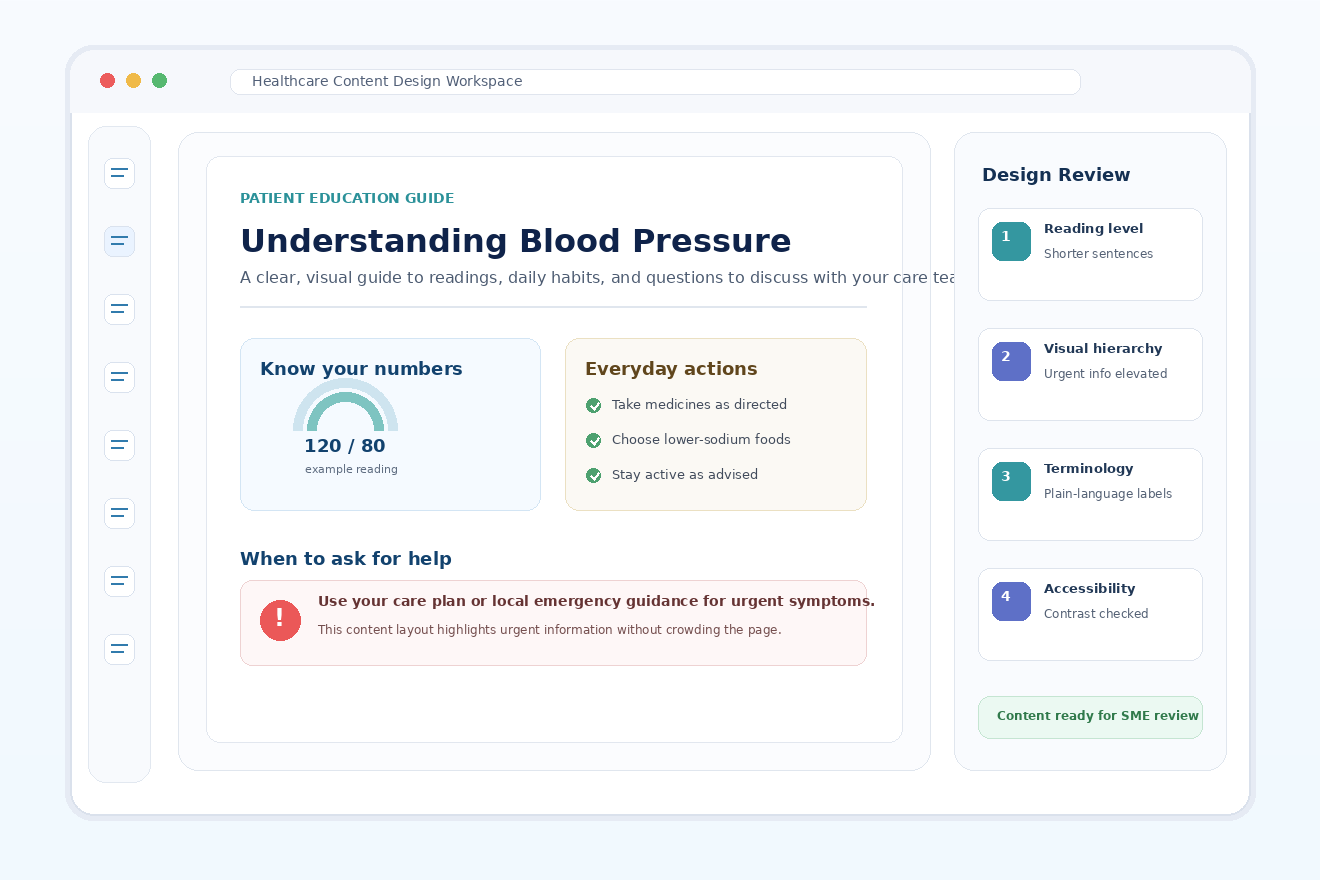
This illustrative example shows how the same underlying health information can be reorganized into shorter, scannable content without changing its core meaning.
A practical workflow keeps source information, audience needs, visual decisions, and stakeholder feedback connected from the start.
Provide content, references, brand guidance, audience details, required formats, and review needs.
Define the information order, key messages, supporting detail, warnings, actions, and visual hierarchy.
Build the layout, visual cues, charts, icons, content modules, and page or screen composition.
Collect stakeholder or subject-matter feedback and refine content structure and visual treatment.
Package the agreed formats and any supporting design notes or reusable elements included in scope.
Final deliverables should match the channel and use case. Scope can be defined for a single asset, a coordinated content set, or a reusable design system.
Primary layout prepared around the agreed content and format.
Icons, diagrams, infographic elements, or supporting graphics included in scope.
Structured content presentation for stakeholder or SME feedback.
Output variants can be defined for the intended print or digital channel.
Repeatable components or template structures for a coordinated content series.
Supporting guidance can document hierarchy, component use, or handoff decisions.
The service can be adapted to different healthcare communication contexts while keeping the visual language appropriate to the audience and source material.
Strong healthcare content design is not decoration. It helps the audience see what matters, understand the sequence, and move through complex information with less friction.
Structure and density are adjusted to the people who will actually use the content.
Visual decisions are built around the supplied content rather than generic decoration.
Key actions, definitions, data, and supporting detail are visually separated.
Components and styles can be repeated across related healthcare assets.
Stakeholder comments can focus on defined content and design decisions.
Final outputs are organized around the agreed formats and intended channels.
Questions about scope, source material, clinical review, formats, audiences, and project planning.
It turns healthcare information into clear, structured, visually usable content for defined audiences such as patients, caregivers, clinicians, health professionals, researchers, or internal healthcare teams. The work can combine content hierarchy, layout, information design, visual systems, and review-ready presentation.
The service can be scoped for patient education guides, clinical explainers, healthcare infographics, HCP materials, reports, presentations, posters, one-pagers, web content modules, campaign assets, and reusable content templates.
Yes. You can provide approved copy, references, research summaries, clinical notes, brand guidance, or other source material. The design workflow can then organize that information into a clearer content structure without changing the underlying evidence or intended meaning.
No. This is a content design service, not a medical-advice or clinical-approval service. Clinical accuracy, claims, prescribing information, and organization-specific compliance should remain subject to the appropriate qualified reviewer or approval process.
The design can focus on plain-language structure, shorter information blocks, clearer headings, visual cues, step-by-step sequencing, definitions, and emphasis of important actions. Any substantive change to clinical meaning should be reviewed by your subject-matter expert.
Yes. The content structure and visual density can be adapted for different audiences, including patient-facing materials, professional education, internal clinical communication, research communication, and healthcare business content.
Yes. Share your brand guidelines, typography, color palette, templates, logo rules, or existing examples. The service can work within an established system or help create a consistent visual pattern for a defined set of healthcare content assets.
The scope can include print-oriented layouts, screen-based assets, presentation formats, and responsive content concepts. Final file types and export requirements should be confirmed during scoping.
Share the intended audience, content objective, source material, preferred format, approximate content volume, brand guidance, required dimensions or channels, stakeholder review requirements, and any deadline you need considered.
Scope depends on the number and type of assets, source-content readiness, complexity of information, level of restructuring, visual requirements, number of review rounds, and final-format needs. These details should be reviewed before confirming the project.
The supplied service information does not define a standard turnaround for this service. Share your deadline and project details so feasibility can be assessed against the actual scope.
The workflow is designed around review checkpoints so your stakeholders can comment on content structure, hierarchy, visual treatment, and required corrections before the final delivery package is prepared.
Share the audience, source material, formats, brand guidance, review requirements, and deadline so the project can be scoped around the actual content and deliverables.
Tell us who will use the content and what they need to understand or do.
Provide approved copy, references, research, clinical notes, or existing materials.
Specify guide, infographic, presentation, report, web module, poster, campaign asset, or another format.
Share logos, colors, typography, templates, or examples that need to be followed.
Note any subject-matter, legal, medical, regulatory, or internal review process that affects the workflow.
Share the date and time zone you need considered so feasibility can be reviewed.
Provide enough context for the team to understand the content, audience, desired deliverables, and any constraints.
Share your source material, audience, and required format for a healthcare content design scope review.