
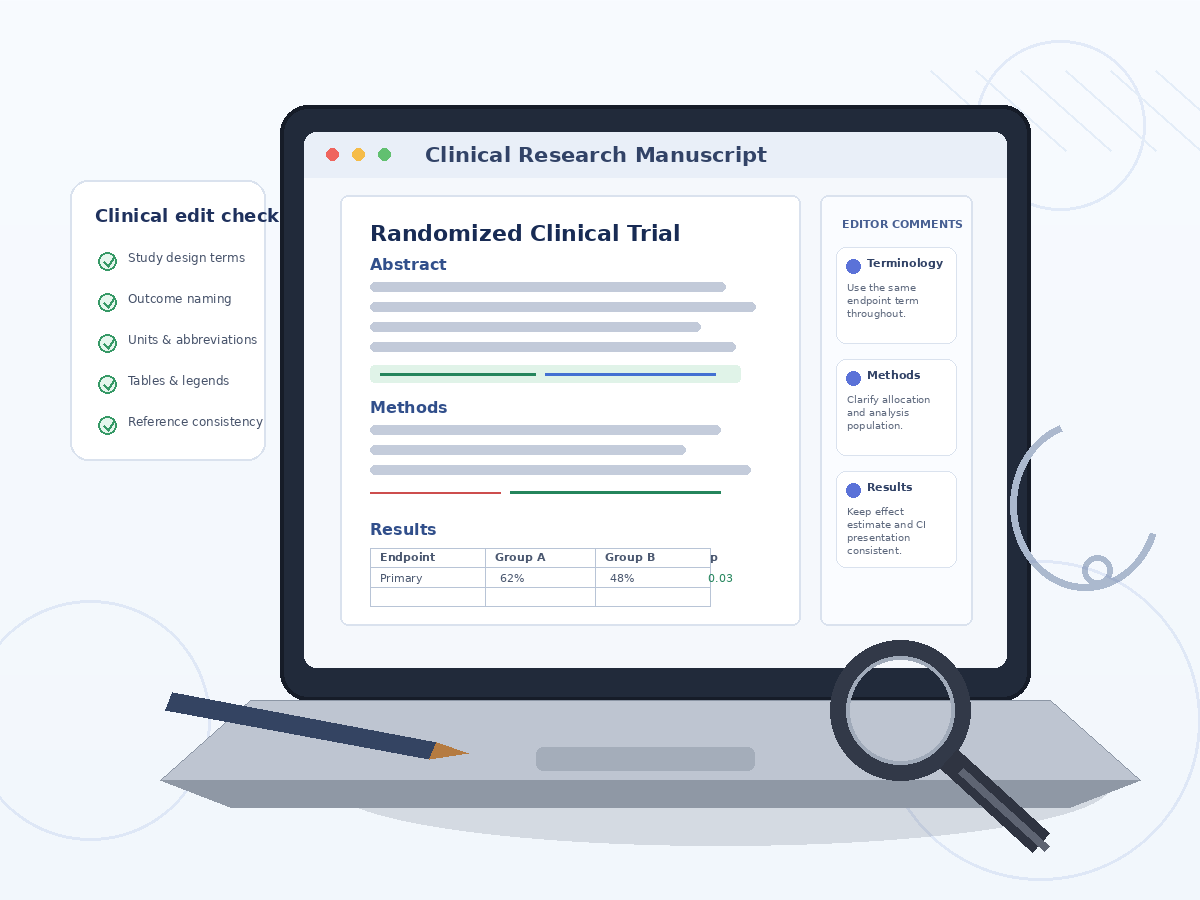
Clinical Researchers
Authors preparing trial, observational, diagnostic, therapeutic, or other clinical-study manuscripts.
Refine clinical and health-research manuscripts for clearer scientific language, consistent terminology, stronger section-to-section presentation, and an author-reviewable editing trail—without changing the underlying study data or conclusions.
Price and delivery time are confirmed after the document, required editorial depth, and deadline are reviewed.
Review every editorial revision.
Improve manuscript-wide consistency.
Flag wording that needs author input.
Apply supplied presentation instructions.
Protect unpublished research material.
Clinical manuscripts often combine dense methods, outcome definitions, intervention terminology, tables, statistical language, abbreviations, references, and journal-specific presentation requirements. Editing helps make those elements read as one coherent scientific document.
The service focuses on expression and presentation: sentence clarity, academic tone, terminology consistency, paragraph flow, section readability, captions, cross-references, and visible inconsistencies in the supplied material. It does not replace the author’s responsibility for clinical accuracy, methodology, statistics, ethics, or reporting compliance.
Whether you are preparing a clinical trial manuscript, observational study, protocol, case report, review, or health-science paper, the editing depth is confirmed from the actual document before work begins.
Use the service when the research is developed but the manuscript needs clearer scientific expression, stronger consistency, and closer editorial attention before review or submission.
Authors preparing trial, observational, diagnostic, therapeutic, or other clinical-study manuscripts.
Researchers translating study work into a clear manuscript for academic or journal readers.
Master’s and doctoral researchers working on clinical, public-health, or allied-health papers.
Collaborative authors who need terminology and presentation to remain consistent across sections.
Researchers preparing manuscripts against supplied target-journal or publisher instructions.
Authors in medicine, nursing, pharmacy, rehabilitation, epidemiology, and related fields.
Clinical research can be technically correct yet difficult to read when language, terminology, sections, and reporting elements are not presented consistently.
Long or overloaded sentences make study design, procedures, and findings harder to follow.
Outcome names, intervention labels, abbreviations, or clinical terms vary across the manuscript.
Study procedures, eligibility, allocation, measurements, or analysis descriptions read ambiguously.
Captions, labels, abbreviations, units, and text cross-references are not aligned.
Citations and reference-list presentation contain visible style or consistency problems.
The manuscript needs closer alignment with the supplied author instructions or reporting checklist.
The confirmed scope is based on the manuscript itself. These are the core editorial areas typically reviewed when relevant to the document you submit.
Refine grammar, syntax, wording, readability, scientific tone, and discipline-appropriate expression.
Check recurring clinical terms, outcome labels, intervention names, abbreviations, units, and notation for consistency.
Improve concision, clarity, internal consistency, and alignment between the abstract and main manuscript.
Clarify the language used to describe design, participants, interventions, measurements, procedures, and analysis.
Improve readability and consistency in effect descriptions, outcome statements, tables, figures, and narrative results.
Refine transitions, argument presentation, limitations language, interpretation, and conclusion wording without changing findings.
Check caption language, labels, abbreviations, units, symbols, and text cross-references for visible consistency.
Review presentation consistency and obvious citation/reference mismatches within the material supplied.
Use supplied author guidelines to review applicable headings, structure, terminology, tables, figures, and formatting.
Flag ambiguous wording, visible inconsistencies, or points that require author clarification rather than guessing.
The editorial goal is not to rewrite the science. It is to make the manuscript’s language and presentation more consistent, transparent, and reviewable.
A structured workflow keeps the editing brief, manuscript context, author priorities, and delivered revisions aligned from submission to handoff.
Share the document, journal guidance if applicable, and any reporting checklist you are using.
The document, approximate length, required editorial depth, and deadline are reviewed.
The manuscript is matched to an appropriate editorial workflow based on subject context and scope.
Language, terminology, sections, tables, legends, references, and supplied guidance are reviewed as applicable.
A final pass checks internal consistency, tracked revisions, comments, and confirmed manuscript requirements.
Receive the tracked version, clean edited copy, and included comments for author review.
The deliverables are designed to make the editorial work transparent so you can review changes before using the manuscript for your next submission step.
A Word-compatible editing trail showing the revisions made in the manuscript.
A readable version after revisions are incorporated for easier final author review.
Queries or notes where clinical wording, context, or intended meaning needs author clarification.
Review of relevant terminology, abbreviations, units, captions, tables, figures, and cross-references.
Application of supplied journal or publisher presentation instructions within the confirmed editing scope.
Clinical Research Editing Service is not an exact plan in the supplied ContentXprtz pricing catalogue, so this page does not copy a price or turnaround from another editing plan.
Suitable when the study and structure are developed but the manuscript needs clearer scientific wording and closer consistency checks.
For manuscripts that need both sentence-level refinement and closer review of terminology, section presentation, tables, legends, and journal-facing consistency.
For a developed clinical manuscript that also needs close journal-facing presentation review against supplied author instructions.
Because no exact catalogue turnaround is supplied for Clinical Research Editing Service, delivery feasibility is assessed from the document rather than borrowed from another plan.
Word count, tables, figures, references, supplementary material, and file condition affect the editing workload.
Sentence correction, terminology harmonization, section-flow review, and journal-facing checks require different levels of intervention.
Share the exact date, time, and time zone so feasibility can be assessed before a delivery commitment is confirmed.
The editing workflow is built around transparent revision, consistent scientific presentation, and an author-controlled final manuscript rather than hidden or unreviewable rewriting.
Editing decisions are made with attention to the manuscript’s clinical and health-research context.
Tracked changes make the editorial intervention visible and reviewable.
Ambiguous or meaning-sensitive passages can be flagged rather than guessed.
Supplied journal instructions can guide presentation checks within scope.
Unpublished manuscripts and related client information are treated as confidential service material.
A quality pass checks internal consistency and confirmed delivery requirements before handoff.
Clinical editing should leave a clear audit trail of what changed, why author input is needed, and what still belongs to the author’s scientific responsibility.
Requirements and supplied guidance are reviewed.
Language and presentation are refined in trackable form.
Terminology and requested elements are checked again.
Tracked and clean files are prepared for author review.
Rather than inventing named specialists or credentials on this page, the service describes the editorial roles needed for a strong clinical-research workflow.
Reviews how clinical concepts are expressed, checks terminology consistency, and refines sentences so the intended scientific meaning is easier to follow.
Uses supplied author instructions to review relevant headings, abstract presentation, tables, figure legends, citations, references, and formatting expectations.
Checks that requested editorial elements, tracked changes, comments, terminology, and manuscript presentation remain coherent before the edited files are delivered.
The service is document-led. The specific editorial approach depends on the study design, subject area, manuscript stage, and instructions you provide.
A fresh editorial pass can help surface language and consistency issues that are difficult to notice after repeatedly reading the same manuscript.
A useful clinical edit clarifies scientific expression while keeping the underlying claim and data unchanged.
Editorial issue: vague comparison language, subject–verb error, and wording that may overstate what the data can support.
Why it changed: the revision improves grammar and comparative clarity while avoiding an unsupported absolute safety or efficacy conclusion.
Answers to common questions about editing scope, clinical terminology, journal guidance, tracked changes, deliverables, and quote confirmation.
Clinical Research Editing Service is an editorial service for clinical and health-research documents. It focuses on clear scientific language, consistent clinical terminology, logical presentation, readable methods and results, and manuscript-wide presentation while preserving the author’s study, data, interpretation, and intended meaning.
The service can be used for clinical-trial manuscripts, observational studies, cohort and case-control studies, case reports, systematic reviews, meta-analyses, study protocols, public-health research, medical and allied-health papers, and related journal submissions, subject to the confirmed editing scope.
No. Editing is intended to improve expression and presentation, not to alter the underlying study data, analyses, findings, or clinical conclusions. Where wording is ambiguous or a change could affect meaning, the editor can flag the issue for author review rather than making an unsupported substantive change.
Terminology consistency can be reviewed across the manuscript, including recurring clinical terms, abbreviations, units, intervention names, outcome labels, table headings, figure legends, and related wording. The service does not replace specialist factual or statistical verification unless that work is separately confirmed.
Yes. The editing workflow can review language and presentation across the title, abstract, introduction, methods, results, discussion, conclusion, tables, figures, captions, references, and supplementary text when those items are included in the confirmed scope.
Yes, when you provide the relevant author instructions. The editor can use supplied journal or publisher guidance to review applicable presentation details such as headings, terminology, abbreviations, tables, figures, citations, references, and manuscript formatting within the agreed service scope.
If a reporting checklist or journal requirement is supplied, the editor can use it as a presentation reference and flag visible inconsistencies in the material provided. This editorial review should not be treated as a formal compliance audit, methodological review, or substitute for the author’s responsibility to satisfy the applicable reporting standard.
The ContentXprtz editing workflow uses tracked changes so revisions can be reviewed transparently, and a clean edited copy can also be supplied for easier reading after the changes are checked.
Yes. Editor comments are useful when a sentence is ambiguous, terminology needs author confirmation, a statement appears internally inconsistent, or the editor cannot safely resolve an issue without additional context.
They can be reviewed for language and internal presentation consistency when included in the manuscript. This may include labels, captions, units, symbols, abbreviations, terminology, and cross-reference wording, while preserving the underlying data.
No. Proofreading is mainly a final-stage correctness check. Clinical research editing can go further by refining sentence clarity, scientific tone, paragraph flow, terminology consistency, section presentation, tables and figure language, and editor guidance where the manuscript needs more than surface correction.
Not necessarily. Clinical Research Editing Service is a service-specific page focused on clinical and health-research documents. Scientific Editing is a separate ContentXprtz editing plan with its own supplied scope, price, and turnaround. The clinical research page does not automatically inherit that plan’s commercial terms.
No fixed price or turnaround is stated on this page because the supplied service catalogue does not contain an exact Clinical Research Editing Service plan. Share the document, approximate word count, deadline, and required editorial depth so the scope and delivery feasibility can be assessed before a quote is confirmed.
Send the document you want edited together with the target journal or publisher guidance if applicable, your deadline and time zone, approximate word count, any reporting checklist you are using, preferred language variant, and the specific issues you want the editor to prioritize.
ContentXprtz treats manuscripts, instructions, personal details, and unpublished research material as confidential service information within its designated submission and delivery process.
Share enough information to assess the manuscript’s editorial depth, journal-facing requirements, and deadline feasibility before a quote is confirmed.
The more specific your brief is, the easier it is to assess whether the manuscript needs focused language editing, deeper clinical manuscript editing, or another ContentXprtz editing service.
Clinical trial, protocol, observational study, review, case report, or another health-research document.
Include the target journal and relevant author guidance when applicable.
Share any checklist you are using so it can be referenced for visible presentation issues within scope.
Provide the exact required date and time so delivery feasibility can be reviewed.
Flag methods clarity, terminology, results wording, tables, figure legends, references, formatting, or other areas.
Complete the form below so your requirements can be reviewed before a price or delivery commitment is confirmed.
Share your manuscript type, approximate word count, journal guidance, editorial priorities, and deadline. We’ll use those details to assess the appropriate scope before confirming commercial terms.