₹20,000
for a defined standardization project
Suitable for a small set of existing quality documents that need one consistent template, naming logic, structure, terminology, and control convention.
Buy Service Now
Bring fragmented policies, procedures, SOPs, work instructions, templates, and related documents into one coherent documentation framework. We standardize structure, terminology, metadata, version conventions, formatting, and cross-document presentation while preserving the meaning and requirements you provide.
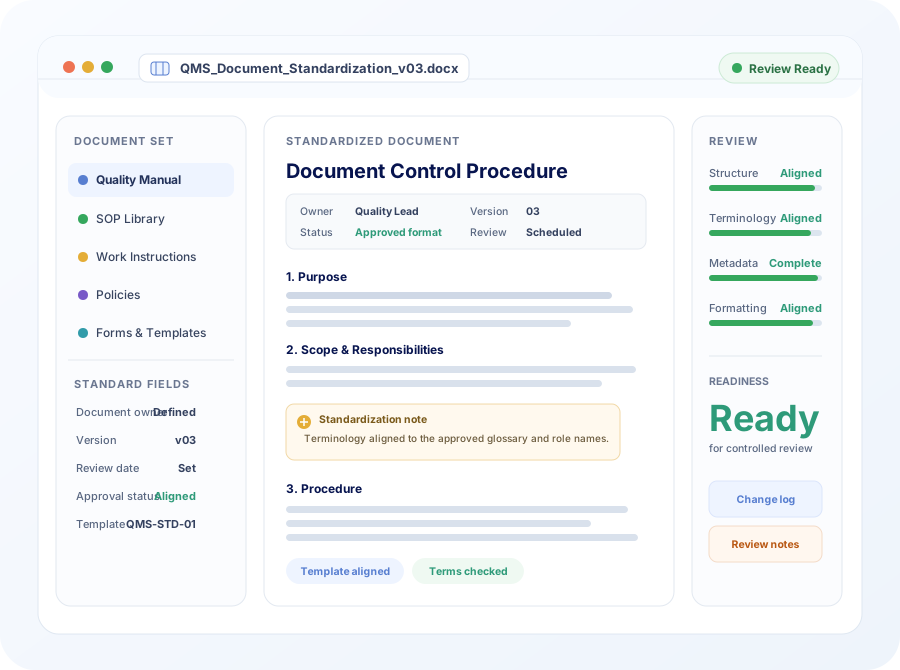
Standardization is most valuable when a document set has grown through different authors, templates, numbering conventions, and local practices. The project minimum covers a bounded library segment so the team can establish a repeatable document system before scaling it further.
Suitable for a small set of existing quality documents that need one consistent template, naming logic, structure, terminology, and control convention.
Buy Service NowDocumentation can become harder to review and reuse when structure, ownership, terminology, control fields, approvals, and formatting evolve independently across teams or document sets.
Related documents use different section order, heading depth, or information placement, making comparison and review slower.
Roles, process names, abbreviations, or key terms vary across documents even when they refer to the same concept.
Different teams may use outdated or locally modified formats without a clear common document framework.
Owner, version, effective date, review date, approval status, or classification fields may be absent or inconsistent.
Review, comment, approval, and update responsibilities are not presented consistently across the documentation set.
Tables, numbering, lists, references, spacing, labels, and visual conventions differ from one document to another.
The service can be scoped from baseline review through a reusable documentation framework, with the exact depth determined by the document set, current condition, supplied requirements, and target outputs.
This representative illustration shows the type of progression a standardization project can create: from locally inconsistent documents to an aligned, reusable document framework.
Purpose: Process steps for handling a recurring activity.
The document is mapped against the agreed structure and conventions while client-supplied meaning and requirements are retained.
Aligned structure, terminology, metadata, numbering, table treatment, and review information are presented consistently with the agreed framework.
Formatting and language editing can improve individual documents. Standardization goes further by creating consistency across the document system, including structure, terminology, control fields, templates, and cross-document conventions.
| Support Dimension | Formatting-Only Cleanup | Language Editing | Documentation Standardization |
|---|---|---|---|
| Page layout and visual consistency | ✓ | Limited | ✓ |
| Grammar and sentence-level language | × | ✓ | As scoped |
| Document architecture and section hierarchy | × | Limited | ✓ |
| Terminology and naming conventions | × | Limited | ✓ |
| Metadata, ownership, version and review fields | × | × | ✓ |
| Reusable document templates | Limited | × | ✓ |
| Cross-document harmonization | × | × | ✓ |
| Standardization issue log and review notes | × | Limited | ✓ |
| Best for | Visual cleanup | Language refinement | Consistent documentation framework |
The scope can be built around one document family or a mixed documentation set where consistent control, terminology, structure, and presentation are needed.
The workflow is designed to make scope, standards, review points, and outputs visible before final delivery. The exact sequence can be adjusted to the document set and requirements you provide.
Share the current document set, templates, reference rules, and desired outputs.
Identify document families, standardization depth, dependencies, and priority areas.
Map documents, versions, structures, and major inconsistencies across the set.
Define the agreed structure, control fields, naming, terminology, and format rules.
Apply the agreed framework across documents while preserving supplied meaning.
Check cross-document terminology, metadata, numbering, templates, and references.
Review structure, formatting, control fields, issue notes, and requested outputs.
Provide the standardized document pack and agreed supporting documentation.
A clear baseline reduces assumptions. The most useful starting point is the current document set together with any standards, templates, conventions, and approval requirements that should control the work.
A multi-stage review helps separate structural checks from terminology, control fields, cross-document consistency, presentation, and final verification.
Check section order, hierarchy, purpose, scope, responsibilities, and information placement.
Review role names, defined terms, abbreviations, labels, and recurring language across documents.
Verify headers, footers, owner fields, version fields, status, dates, and template treatment as scoped.
Compare naming, numbering, references, structure, and shared conventions across the document set.
Review tables, lists, spacing, numbering, captions, labels, and supplied reference conventions.
Confirm agreed outputs, issue resolution, document completeness, and handoff readiness.
The service is suitable where document consistency, maintainability, and controlled presentation matter across recurring business, quality, technical, or governance documentation.
No unrelated service-plan price or turnaround is applied to this service. Scheduling and pricing are confirmed after the documentation set and requested standardization depth have been reviewed.
The delivery schedule is confirmed after reviewing the document set and required outputs.
A custom quote can be prepared from the actual project scope rather than borrowing pricing from a different service family.
A representative sample helps define the standardization depth, repeated issues, template requirements, and likely cross-document dependencies before the full project is confirmed.
It is a structured review and standardization service for bringing related documents into a consistent framework for structure, terminology, templates, metadata, versioning, formatting, and review controls.
No. Proofreading focuses mainly on language errors, while formatting focuses on presentation. Documentation standardization can also address document architecture, section order, terminology, metadata, naming, version conventions, reusable templates, and consistency across a document set.
The service can be scoped around policies, procedures, SOPs, work instructions, quality manuals, templates, forms, governance documents, technical guides, training documents, and other structured business documentation.
Yes. Existing templates, branding rules, style guides, document-control requirements, terminology lists, and review conventions can be used as the baseline when they are supplied with the project.
Yes. Related documents can be reviewed together so shared structures, terminology, control fields, naming, formatting, and reference conventions can be harmonized across the set.
The standardization approach is intended to preserve the supplied meaning while improving consistency and usability. Changes requiring policy, legal, technical, regulatory, or subject-matter decisions should remain with the responsible client owner or approver.
Share the document set, current templates, style or brand guidance, terminology or naming rules, document-control requirements, applicable reference standards, desired outputs, and any known owner or approval requirements.
A delivery schedule is confirmed after the document set and scope have been reviewed. Factors can include document count, length, current condition, template complexity, terminology alignment, requested outputs, and the level of review needed.
Pricing is provided as a custom quote after scope review rather than being inferred from an unrelated service plan. The quote can reflect document volume, standardization depth, template requirements, complexity, and requested deliverables.
No independent compliance certification is implied. The documentation can be aligned to requirements, templates, or standards that you supply, but final compliance interpretation and approval remain with the responsible organization and its qualified reviewers.
Share enough information to review the document set, current inconsistencies, standards to follow, and the outputs you need. The ₹20,000 project minimum can then be confirmed or expanded according to document volume, standardization depth, and the delivery window required.
Describe the document types, approximate volume, and whether the files belong to one family or several.
Tell us whether templates, style guides, control fields, naming conventions, or brand rules already exist.
Highlight structure, terminology, metadata, versioning, formatting, cross-document consistency, or review concerns.
List the standardized documents, templates, conventions, issue notes, or handoff materials you want included.
Share your contact details and documentation requirements below so the service scope, delivery feasibility, and quote inputs can be reviewed.
Bring your document set, templates, terminology, and control requirements into a consistent framework that is easier to review, maintain, and reuse.