₹7,500
for up to 3,000 words
Best for a developed protocol, report, brochure, consent document, or related file that needs a specialist editorial pass before internal or external review.
Buy Service Now
Strengthen clinical and regulatory documents with focused editorial review of language, structure, terminology, internal consistency, cross-references, tables, captions, and presentation—while preserving the scientific and regulatory meaning supplied by your team.
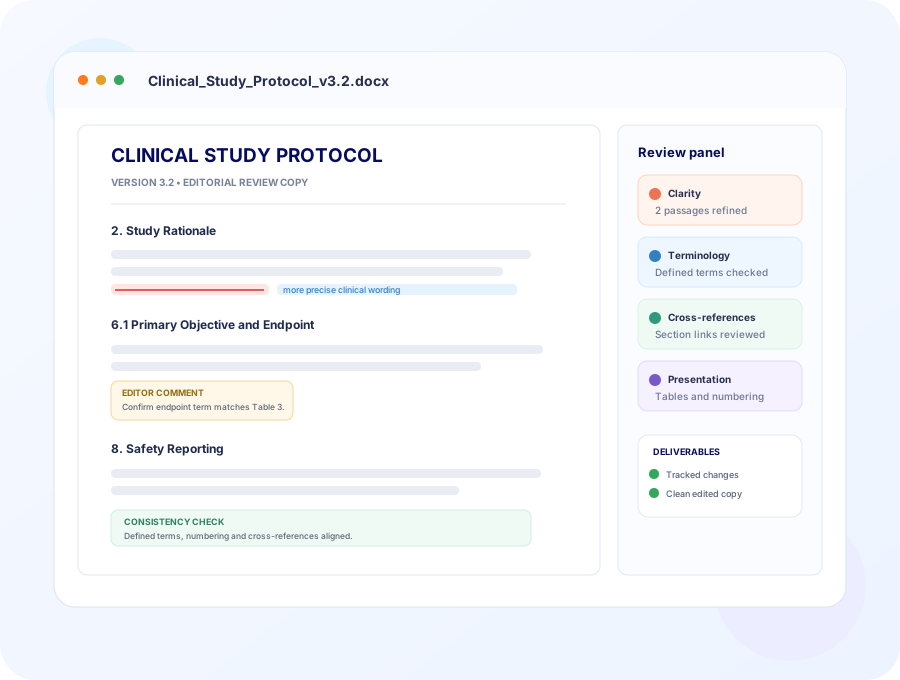
Editing centred on the file, terminology, and presentation
Unpublished material handled through controlled processes
Clarity, consistency, references, and formatting reviewed systematically
Tracked version, clean copy, and actionable editor notes where applicable
A focused clinical-regulatory edit is priced around the document’s editorial depth, not a generic manuscript package. The starting scope below is intended for an already developed document that needs controlled language, consistency, and presentation refinement.
Best for a developed protocol, report, brochure, consent document, or related file that needs a specialist editorial pass before internal or external review.
Buy Service NowEditorial issues can make complex clinical and regulatory content slower to interpret even when the underlying science is sound. We focus on the communication problems that an editor can legitimately address.
Long sentences, undefined references, or dense phrasing can obscure the intended clinical or regulatory meaning.
Defined terms, abbreviations, product names, endpoints, or role labels can drift across long documents and appendices.
Section, table, figure, appendix, and footnote references may become difficult to follow after document revisions.
Headings, subheadings, lists, and section sequencing may not communicate the intended information hierarchy clearly.
Labels, units, captions, notes, or narrative references can become inconsistent with the surrounding text.
Numbering, capitalization, punctuation, spacing, style, and document-level consistency can weaken an otherwise complete draft.
A complete editorial pass can move from document framing through final presentation. Contentxprtz clinical and regulatory document editing starts from ₹7,500 for up to 3,000 words. Final price and delivery are confirmed after the document condition, editorial depth, supporting elements, and deadline are reviewed.
Names, versions, identifiers
Scope and audience clarity
Concise high-level wording
Logical narrative flow
Clear, consistent terms
Readable technical language
Consistent editorial wording
Labels, captions, notes
Flow and data references
Clarity without reinterpretation
Internal wording consistency
Presentation consistency
Sections, tables, appendices
Headings, lists, numbering
Clean, consistent presentation
A clinical or regulatory edit should do more than correct surface grammar. It should make the intended meaning easier to follow while clearly separating editorial changes from questions that require author confirmation.
“The primary objective is to evaluate whether the investigational treatment may potentially improve the clinical outcome measures that will be assessed during the study period and this will be evaluated through the endpoint measurements described later.”
The editor improves language and consistency, then flags any point that needs scientific or regulatory confirmation rather than inventing content.
“The primary objective is to assess the effect of the investigational treatment on the prespecified clinical outcome. The primary endpoint is defined in Section 6.1 and will be evaluated at the prespecified assessment time point.”
The service is positioned as document-level editorial support. The comparison below explains the intended editorial depth without implying regulatory sign-off.
| Support dimension | Proofreading | Language Editing | Clinical & Regulatory Document Editing |
|---|---|---|---|
| Grammar, spelling, punctuation | ✓ | ✓ | ✓ |
| Sentence clarity and professional tone | Limited | ✓ | ✓ |
| Defined-term and abbreviation consistency | Limited | Selected | ✓ |
| Section-level flow and information hierarchy | × | Selected | ✓ |
| Cross-reference, numbering, table / figure consistency | Selected | Selected | ✓ |
| Review against supplied document template or style instructions | × | Selected | ✓ |
| Editor comments for author / SME clarification | × | Selected | ✓ |
| Regulatory, medical, legal, statistical or quality approval | × | × | × |
| Best for | Near-final text | Language refinement | Complete document-level editorial review |
Examples of documents that may be suitable for this service are shown below. Final suitability depends on the file, required editorial depth, source format, and any client-supplied instructions.
Objectives, design, endpoints, procedures, safety wording, tables, and appendices.
Narrative flow, results references, terminology, headings, captions, and presentation.
Section consistency, defined terms, tables, summaries, and cross-document readability.
Clearer wording, consistency, formatting, and readability without changing approved meaning.
Structure, wording, terminology, internal references, and document-level consistency.
Editorial consistency of terminology, headings, tables, references, and explanatory text.
Technical summaries, response documents, appendices, and supporting narratives.
Language, numbering, instruction clarity, formatting, and internal document consistency.
The workflow is designed to understand the document first, apply the agreed editorial depth, preserve traceability of revisions, and complete a final consistency check before delivery.
Share the document type, purpose, audience, guidelines, deadline, and key concerns.
We assess length, complexity, source format, editing depth, and supporting instructions.
The document is assigned for the agreed editorial scope and review context.
Headings, terminology, abbreviations, references, tables, and cross-links are mapped.
Language, clarity, structure, consistency, and presentation are refined section by section.
Defined terms, numbering, references, tables, captions, and repeated language are checked.
A final editorial pass checks coherence, formatting consistency, and unresolved comments.
Receive the edited file set and notes included in the agreed scope.
The more context you provide, the easier it is to distinguish editorial work from questions that require scientific, regulatory, or sponsor confirmation.
A multi-stage editorial check helps keep long clinical and regulatory documents coherent, consistent, and easy to review without crossing into unsupported scientific or regulatory decision-making.
Headings, sequence, hierarchy, and flow
Readability, concision, and sentence logic
Defined terms, abbreviations, naming consistency
Numbers, units, labels, references, capitalization
Tables, figures, captions, cross-links, style
Open comments, clean copy, editorial completeness
The service can be scoped around clinical and regulatory content across different life-science contexts, with confidentiality treated as part of the document-handling process.
For highly sensitive content, describe your requirements before transferring source documents so the appropriate handling method can be agreed.
Contentxprtz clinical and regulatory document editing starts from ₹7,500 for up to 3,000 words. Final price and delivery are confirmed after the document condition, editorial depth, supporting elements, and deadline are reviewed.
The service may be suitable for clinical study protocols, clinical study reports, investigator brochures, informed-consent materials, regulatory narratives and summaries, safety-related documents, technical support files, SOPs, and appendices. Final suitability depends on the source file and required scope.
No. The service is editorial. It can improve clarity, consistency, terminology, structure, cross-references, and presentation and can review against client-supplied requirements, but it does not replace regulatory, legal, medical, statistical, or quality review and does not certify compliance or approval.
The editing approach is designed to preserve the meaning supplied by the authoring team. When a wording change could affect interpretation, the item should be flagged for author or subject-matter confirmation rather than silently changed.
Where the source format supports it, the workflow can return a tracked-changes version together with a clean edited copy and editor comments for points that need clarification or confirmation.
Yes, these elements can be checked for editorial consistency and presentation when they are included in the agreed scope and supplied in an editable format.
Yes. Supply the relevant template, style sheet, internal convention, sponsor instruction, or authority-specific formatting guidance that should inform the editorial review.
The service can flag obvious inconsistencies or unclear references encountered during editing, but scientific fact-checking, statistical validation, and data verification are not implied by an editorial review unless separately agreed and appropriately qualified.
Defined terms, abbreviations, naming conventions, repeated clinical terms, headings, and labels can be reviewed across the document. A supplied terminology list or style sheet makes this check more precise.
Related files can be considered when cross-document consistency is part of the requested scope. Share the file set and identify which terms, sections, tables, or references must remain aligned.
A custom quote and delivery plan are confirmed after review of document length, current condition, editing depth, tables and figures, supplied guidelines, file complexity, and required deadline. Contentxprtz clinical and regulatory document editing starts from ₹7,500 for up to 3,000 words. Final price and delivery are confirmed after the document condition, editorial depth, supporting elements, and deadline are reviewed.
Share the exact deadline and time zone with the enquiry. Feasibility should be confirmed only after the document scope and current workload are reviewed; this page does not promise a specific urgent turnaround.
Provide the document type, approximate length, current format, desired deadline, editing concerns, and any relevant template, terminology list, or review instructions. If the document is highly sensitive, describe the handling requirements before transferring the file.
A concise project brief helps determine whether the need is primarily language editing, document-level clinical/regulatory editing, or a different specialist service.
Share enough detail for the service team to review scope, feasibility, and the most suitable editorial approach.