
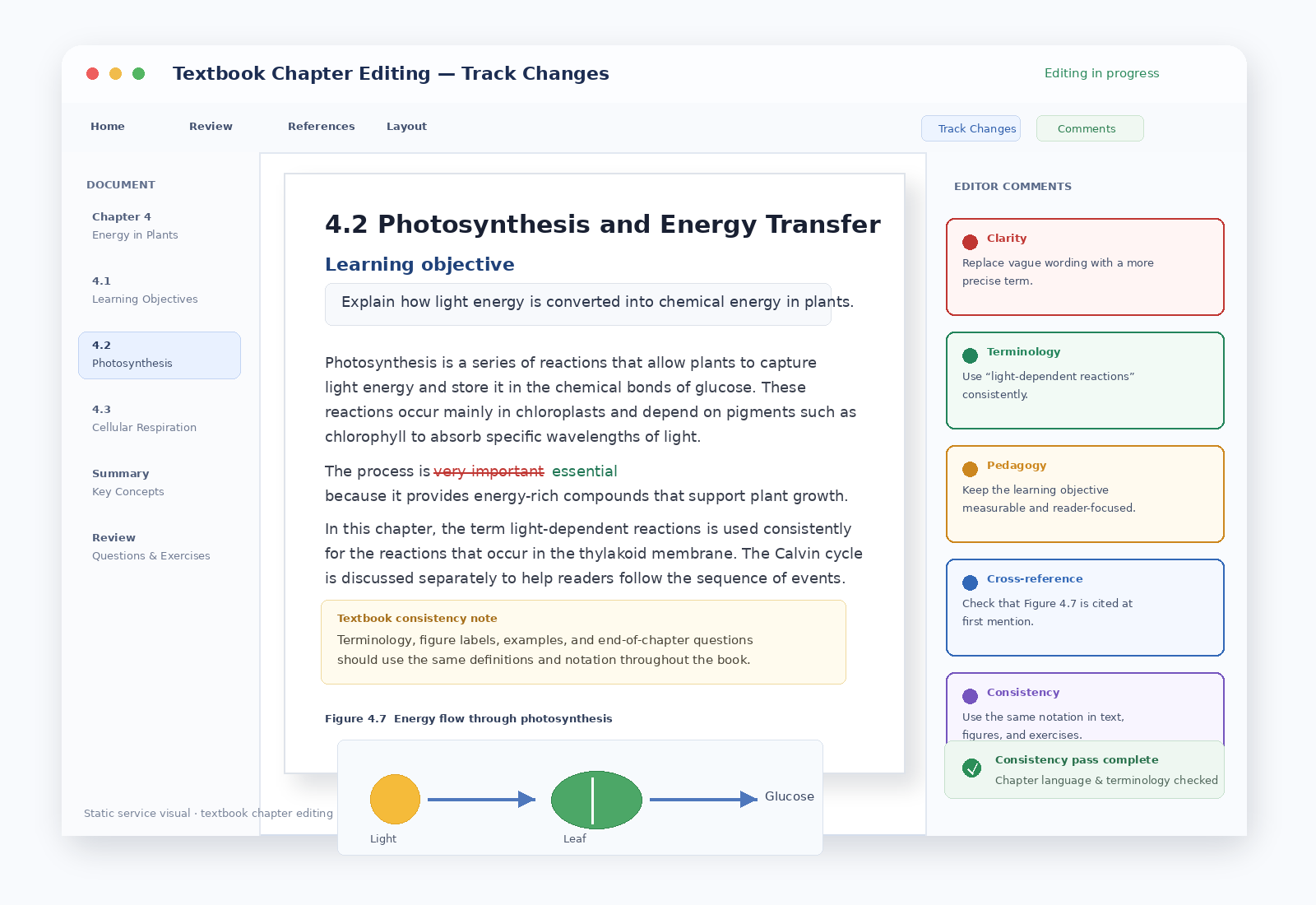
Professional editing for textbook manuscripts that need stronger language, smoother chapter flow, consistent terminology, clearer instructional wording, and publication-facing presentation—while preserving the author’s subject-matter meaning.
Textbooks must remain clear and consistent across chapters, instructional elements, examples, figures, exercises, references, and supporting material. Editing focuses attention on the places where language or presentation can interrupt reader understanding.
Dense sentences can obscure explanations and slow reader comprehension.
Surface errors reduce polish and can create unintended ambiguity.
Concept names, abbreviations, symbols, and labels need stable use across chapters.
Transitions, headings, examples, and exercises should support a logical learning sequence.
Tables, figures, citations, chapter references, and captions can contain presentation mismatches.
Supplied style guidance may require consistent headings, numbers, labels, citations, and formatting.
The exact scope is confirmed after manuscript review. Depending on the project, the edit can focus on language mechanics, readability, chapter flow, terminology, instructional presentation, references, figures, tables, and publisher-facing consistency.
A service-specific edit makes changes visible and explains why wording, terminology, pedagogy, references, or formatting may need attention.
Correct subject–verb agreement without changing the scientific meaning.
Remove vague or inflated wording and make the instructional purpose explicit.
Use one preferred term consistently across chapter text and exercises.
Check where figures, tables, and chapter references first appear.
Define abbreviations and apply the supplied style consistently.
The editorial trail lets authors review what changed, understand important queries, and work from a cleaner version after revisions are accepted.
Proofreading is a final-stage correctness check. Textbook editing can involve a deeper review of language, reader guidance, chapter flow, instructional consistency, and presentation when the manuscript needs more than surface correction.
Review can be scoped to selected components or to a complete manuscript. The elements included depend on the project brief and supporting files supplied.
Clarity, hierarchy, wording, and consistency.
Reader-focused wording and consistent presentation.
Language, readability, flow, transitions, and terminology.
Instructional clarity, labels, sequencing, and consistency.
Captions, labels, wording, and cross-references.
Presentation and consistency against supplied requirements.
Concise wording, parallel structure, and terminology alignment.
Definitions, naming, abbreviations, and cross-chapter consistency.
Preface, appendices, notes, lists, and related presentation.
Comments where meaning or instructional intent needs confirmation.
A structured workflow keeps scope, revisions, queries, consistency checks, and final files easy to follow from submission through delivery.
Share the textbook, supporting files, and project requirements.
Review length, components, complexity, deadline, and required style.
Match the project to an appropriate editorial scope.
Edit language, clarity, flow, terminology, and agreed components.
Check cross-chapter terms, labels, references, figures, and style.
Review editorial consistency and final-file presentation.
Provide visible revisions and comments for author review.
Provide a clean version alongside the editorial trail.
Files are prepared around the confirmed service scope. The core editing workflow is designed to make revisions transparent and final review easier.
Editorial quality is built through layered review rather than a single surface pass. The exact depth depends on the agreed scope, manuscript condition, and project requirements.
Editorial changes are intended to improve presentation without replacing subject-matter authorship.
Dense or awkward wording is refined where clearer language can preserve the intended meaning.
Terminology, headings, labels, abbreviations, figures, tables, and references can be checked across the project.
Relevant language and presentation requirements can be followed within the confirmed scope.
The tracked and clean copies are prepared for an efficient author review cycle.
Textbook projects can be scoped across academic, professional, and interdisciplinary subject areas. Editorial focus remains on language and presentation unless separate subject-matter services are explicitly agreed.
Encrypted transfer route for submitted files.
Files handled within the editorial workflow.
Work performed within the agreed service scope.
Final files returned through the project process.
Delivery files checked for the expected outputs.
Files retained for a limited secure period.
Non-disclosure agreement on request.
Unpublished chapters, figures, exercises, references, teaching material, and supporting files are treated as confidential project information. Request an NDA in the enquiry if your publication process requires one.
Qualitative delivery options are confirmed after manuscript review.
Custom quote based on manuscript scope—no unsupported fixed price is shown for this service.
Share your textbook, approximate word count, chapter count, target audience, publisher or institutional guidance, deadline, and the areas that need attention so a realistic scope and quote can be prepared.
Common questions about scope, deliverables, chapter-level editing, terminology, publisher guidance, references, confidentiality, pricing, and turnaround.
The exact scope is agreed after review, but textbook editing can address language, readability, chapter flow, terminology consistency, learning objectives, examples, exercises, tables, figures, captions, references, cross-references, and publisher or institutional style requirements.
Proofreading is primarily a final-stage correctness check. Textbook editing can go further by improving clarity, flow, chapter consistency, terminology, structural presentation, reader guidance, and the relationship between instructional elements.
A request can be scoped around selected chapters or a complete manuscript. Identify the chapters, approximate word count, deadline, and priority concerns so the editing depth can be assessed.
The editorial goal is to improve presentation without replacing the author’s subject expertise or intended meaning. Where a change could alter meaning, the editor can flag the point for author review rather than silently rewriting the content.
Yes. Terminology consistency can be reviewed across chapters, headings, examples, figures, tables, exercises, captions, and related instructional material when it forms part of the agreed scope.
When applicable guidelines are supplied, the editing scope can be aligned to relevant language, terminology, citation, reference, heading, table, figure, caption, and formatting requirements.
Citation and reference presentation can be checked for consistency and obvious formatting issues within the agreed scope. Source verification and factual validation remain separate from editorial presentation checks.
The editing workflow can provide a tracked-changes manuscript so revisions are visible, together with a clean edited copy for easier review, consistent with the service scope confirmed for the project.
Yes, these elements can be included when they are part of the agreed editorial scope. The review can focus on language, labels, captions, consistency, cross-references, instructional clarity, and presentation.
Turnaround depends on manuscript length, editorial depth, number of components, formatting or reference requirements, deadline, and editor capacity. The delivery schedule is confirmed after the project scope is reviewed.
Pricing is quoted after review because textbook projects can vary widely in word count, complexity, editorial depth, deadline, formatting requirements, references, figures, tables, exercises, and supporting files.
An NDA can be requested as part of the enquiry and project setup when confidentiality terms are needed for unpublished material.
Textbook-focused editing is designed around transparent revisions, consistency, confidential handling, and a practical author review cycle rather than unsupported outcome claims.
Tell us about the manuscript, target audience, approximate word count, chapter count, deadline, publisher or institutional requirements, and the areas that need editorial attention.
Share the full textbook or selected chapters and identify the parts you want reviewed.
Tell us the intended reader level, discipline, and educational context.
Include relevant house style, citation, formatting, or institutional instructions.
State the required delivery date and the chapters or components that need the most attention.
Provide enough detail for the project to be assessed for scope, complexity, deadline feasibility, and the level of editorial support required.
Let the editorial team review your manuscript for clarity, consistency, reader flow, terminology, and publication-facing presentation.