Book Chapter Editing Service for Clearer, Stronger Scholarly Writing
★★★★★4.8 rating from Researchers, Authors, Students, and Scholars
Refine an academic or scholarly book chapter for clarity, flow, consistency, and publication-ready presentation. The editing focuses on how your chapter reads and connects while preserving your argument, evidence, interpretation, and authorial meaning.
Sentence clarity, grammar, academic tone, and readability
Paragraph flow, transitions, headings, and chapter-level consistency
References, citations, tables, figures, captions, and style presentation checks
Tracked changes, clean edited file, and editor comments where clarification is needed
Confidential HandlingFiles handled as private editorial material
Chapter-Aware EditingLanguage and flow reviewed in chapter context
Clean Edited FileA polished copy for final author review
Pricing & Delivery
Book Chapter Editing Plans & Pricing
Book chapters are usually easier to scope than full books, so the plans below combine word-count boundaries with genuinely different editorial depth. Choose a language-focused edit, a fuller scholarly edit, or a deeper chapter-development pass.
Essential
Best suited for: A complete chapter needing accurate language editing without major structural intervention.
₹4,500up to 3,000 words
Scope & inclusions
Grammar, punctuation, syntax, spelling, and sentence clarity
Academic/professional tone, terminology, and abbreviation consistency
Heading, caption, citation, and reference-presentation checks within scope
Scope note: Very long chapters, highly technical notation, extensive reference repair, major restructuring, or publisher-specific production work may require a custom quote after the chapter is reviewed.
chapter word countediting depthdisciplinereferences and figuresdeadline
1
What Problems This Service Solves
Book chapter editing is for authors whose core ideas are already present but whose chapter needs clearer language, smoother progression, stronger consistency, and a more polished scholarly presentation before it is shared with an editor, publisher, or academic audience.
×
Awkward phrasing and wordiness
Long or indirect sentences can obscure otherwise strong ideas.
×
Grammar and punctuation errors
Language mechanics can distract the reader from the chapter's argument.
!
Inconsistent terminology
Key terms may shift across sections or conflict with earlier definitions.
!
Weak paragraph transitions
Ideas may be individually sound but difficult to follow as a sequence.
i
Citation and formatting inconsistencies
In-text citations, references, headings, captions, or notes may need alignment.
i
Unclear author meaning
Ambiguous claims should be queried rather than silently rewritten.
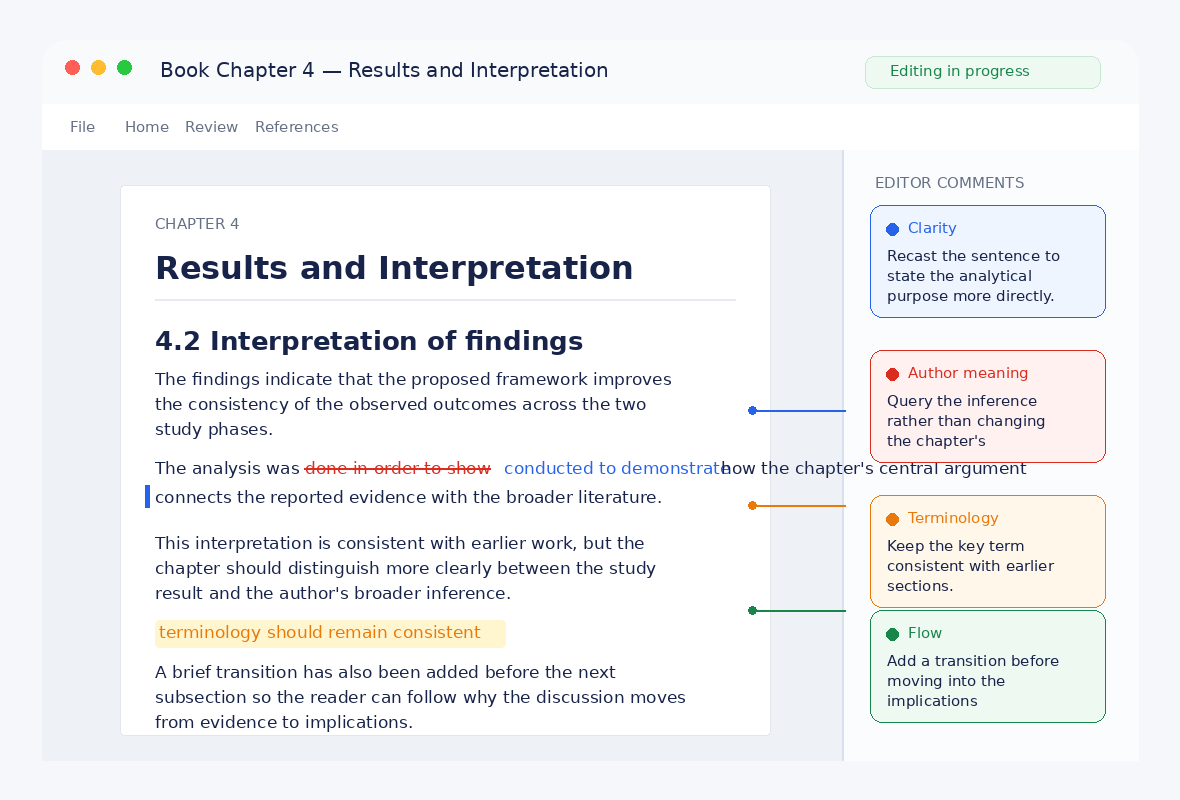
Book chapter excerpt — editing viewChapter 4 · Discussion
The purpose of this section is to make an examination ofexamine how the chapter's central framework changes the interpretation of the earlier findings.
The evidence is very strongly connected togetherclosely connected across the two cases, although the chapter must distinguish observed results from broader interpretation.
To maintain consistency, the term community-level resilience should be used throughout this section rather than alternating between three near-equivalent labels.
Editor note: The transition into the implications subsection has been strengthened, but the final interpretation remains the author's decision. Please confirm that the revised wording reflects your intended claim.
Ready to move ahead with Book Chapter Editing Service?Choose the service option that fits your current project stage and continue through secure checkout.
The review combines detailed language correction with chapter-specific editorial checks so the writing is clearer, more consistent, and easier to follow without changing the underlying research contribution.
Language Mechanics
Grammar, spelling, punctuation, syntax, typographical errors, and sentence-level correctness.
Transitions, sequencing, emphasis, and logical connections between paragraphs and subsections.
Scholarly Tone
Academic or professional phrasing, discipline-appropriate expression, and consistent authorial voice.
Terminology Consistency
Standardised terms, abbreviations, capitalization, numbers, symbols, and recurring chapter-specific labels.
References & Citations
Consistency of in-text citations, reference presentation, notes, and obvious citation-reference mismatches.
Tables, Figures & Captions
Labels, captions, cross-references, wording, terminology, and presentation consistency within the chapter.
Chapter Formatting
Headings, subheadings, lists, paragraph treatment, references, and supplied publisher-style requirements.
Author Queries
Editor comments where a claim, term, cross-reference, or intended meaning needs confirmation from the author.
Final Consistency Check
A closing review of language, chapter presentation, tracked changes, and confirmed manuscript-specific requirements.
3
Service Demonstration: Annotated Chapter Excerpt
The example below shows the depth of a chapter edit: unnecessary phrasing is tightened, terminology is standardised, unclear meaning is queried, and transitions are improved while the author's interpretation remains intact.
128
The results of this chapter demonstratesdemonstrate a consistent pattern across the three cases.
129
The analysis has the ability to showshows why the observed difference matters.
130
The community-level resilience terminology is retained to match the earlier definition.
131
A transition is inserted here to connect the evidence with the chapter's implications.
132
However, the sentence that follows makes an inference beyond the reported result and is flagged for author confirmation.
133
The discussion then returns to the evidence and prepares the reader for the concluding subsection.
134
Cross-reference wording is aligned with Section 4.3 and the corresponding table caption.
135
Reference presentation is checked for consistency with the supplied style instructions.
Move your Book Chapter Editing Service project forwardWhen the scope is clear, continue directly to the service checkout and start the next step.
A transparent editing workflow lets you compare the original wording, see the tracked editorial decisions, and review a clean version after changes have been incorporated.
Before Editing
Original Chapter Draft
The aim of this section was to look at the effect of the framework in a range of cases.
The cases was analysed and it can be seen that the framework has different results in different settings.
These findings are important due to the fact that they connect to the main argument.
The section examines the effect of the framework across several cases.
The cases were analysed, showing that the framework produces different outcomes across settings.
These findings are important because they connect directly to the chapter's main argument.
Result: clearer language · cleaner flow · consistent scholarly presentation
5
Proofreading vs. Book Chapter Editing
Choose proofreading when the chapter is already polished and needs a final error check. Choose book chapter editing when the writing also needs clearer sentences, smoother paragraph flow, stronger academic expression, and closer presentation consistency.
Aspect
Proofreading
Book Chapter Editing
Primary focus
Grammar, spelling, punctuation, typos
Clarity, language, readability, flow, tone, terminology, and presentation
Depth
Surface-level correction
Sentence-level refinement plus paragraph and section flow improvement where needed
Terminology
Checks obvious inconsistency
Reviews recurring terminology, abbreviations, capitalization, and chapter-specific usage
References
Obvious formatting inconsistencies
Citation and reference presentation consistency, with supplied style instructions considered
Tone & style
Minimal adjustments
Refines scholarly or professional tone while preserving the author's meaning
Flow
Usually not reworked
Transitions, paragraph connections, sequencing, and emphasis can be improved
Editor comments
Limited
Used where wording, meaning, cross-references, or author decisions require clarification
Best for
Near-final chapter requiring a last language check
Developed chapter that needs stronger language and editorial polish before final submission
6
Book Chapter Sections We Review
The editor reviews each part in context so the chapter reads as one coherent contribution rather than a collection of independently polished paragraphs.
Title & Headings
Clarity, hierarchy, terminology, capitalization, and consistency.
Chapter Opening
Purpose, context, reader orientation, and connection to the chapter's main argument.
Main Subsections
Paragraph flow, transitions, sequencing, scholarly tone, and internal consistency.
Analysis & Discussion
Sentence clarity, argument presentation, evidence language, and author-meaning queries.
Tables & Figures
Captions, labels, cross-references, terminology, and presentation consistency.
Citations & Notes
In-text citation, endnote or footnote, and reference presentation consistency.
Cross-References
References to other sections, tables, figures, chapters, appendices, or supporting material.
Conclusion
Clarity, synthesis, closing flow, terminology consistency, and presentation.
7
Our Editorial Workflow
The workflow begins with your chapter and requirements, confirms the appropriate editorial depth, applies the edit, checks the work, and delivers transparent files for your final author review.
01 · SUBMIT
Share Your Chapter
Provide the latest editable chapter, deadline, word count, guidelines, style information, and priority concerns.
02 · SCOPE
Review the Requirement
The chapter condition and requested checks are reviewed so the editing scope and schedule can be confirmed.
03 · EDIT
Chapter Editing
Language, clarity, flow, consistency, citations, formatting, tables, figures, and supplied requirements are addressed.
04 · QUERY
Author Queries
Comments are added where meaning, interpretation, missing context, or a manuscript-specific decision needs author input.
05 · QA
Quality Check
A final pass reviews consistency, formatting presentation, tracked changes, and confirmed chapter-specific requirements.
06 · DELIVER
Final Delivery
The tracked version, clean edited copy, and included editor comments are prepared for your final review.
8
What You Receive
The deliverables are designed to make the editorial work transparent: you can see what changed, review a clean version, and act on comments that require your judgement.
EDITED
Edited Chapter With Track Changes
A Microsoft Word-compatible edited file showing deletions, additions, replacements, and other tracked editorial revisions.
CLEAN
Clean Final Chapter
A clean edited copy with accepted language revisions for easier reading and final author review.
NOTES
Editor Comments & Queries
Comments identify wording, meaning, cross-references, or presentation points that need an author decision.
STYLE
Presentation & Style Checks
Where supplied, publisher or edited-volume guidelines are considered for relevant headings, references, tables, figures, and formatting presentation.
Have your files or project brief ready?Start the service now using the same purchase route shown in the pricing section.
The edit moves from broad chapter purpose and structure into sentence-level precision, then closes with consistency and delivery checks so the final file is coherent as well as correct.
Final ReviewTracked changes · author queries · delivery files
✓
Author intent preserved
Editorial changes improve expression without silently replacing the author's research contribution or interpretive decisions.
✓
Clarity improved
Dense, ambiguous, repetitive, or indirect wording is revised for easier scholarly reading.
✓
Reference presentation checked
Obvious consistency issues are reviewed against the chapter and any supplied style instructions.
✓
Final quality check completed
The delivery files are reviewed for consistency, tracked-change integrity, and the agreed editorial scope.
10
Disciplines We Support
Book chapters can follow very different conventions across fields. The editorial approach should therefore respect discipline-specific terminology, evidence presentation, tone, notation, and citation practices.
Life Sciences
Medicine & Health
Engineering
Computer Science
Social Sciences
Business & Economics
Humanities
Environmental Science
Multidisciplinary Work
11
Confidentiality & File Handling
Your unpublished chapter, notes, references, and supporting material are treated as confidential editorial files. Access and retention should be limited to what is needed for the confirmed service.
Secure File IntakeYour chapter enters the editorial workflow through the agreed file-transfer route.
Restricted AccessFiles are handled within the editorial process rather than shared as public material.
Editing ProcessEditorial work is performed on the chapter and supplied supporting requirements.
Confidential DeliveryEdited files and comments are returned through the agreed delivery process.
File VerificationDelivery files are checked before final handoff.
Limited RetentionFile retention is limited to the service workflow and applicable operational requirements.
Your Research Stays Yours. An NDA is available on request where needed for the engagement.
12
Turnaround Options
Turnaround is confirmed after scope and deadline review. The schedule is confirmed after reviewing chapter length, current language condition, editing depth, deadline, and any publisher or formatting requirements.
Standard
For projects where the schedule can be planned around a normal editorial workflow and confirmed chapter scope.
Priority
For authors with a nearer deadline who need the available schedule reviewed against the chapter's length and complexity.
Express
For time-sensitive requests where the shortest feasible delivery window needs to be assessed before confirmation.
Turnaround is confirmed, not assumed: send the chapter and deadline first so feasibility can be assessed without inventing a delivery time that may not fit the manuscript.
13
Why Authors Choose Book Chapter Editing
The service is designed around transparent editorial improvement: the chapter becomes clearer and more consistent, while the author can see changes and retain control over claims, interpretation, and final decisions.
Chapter-Focused Review
The edit considers how paragraphs, subsections, terminology, and transitions work together across the full chapter.
Confidential Handling
Unpublished chapter material is treated as private editorial content throughout the working process.
Revision Transparency
Tracked changes and editor comments let you understand, accept, reject, or query editorial decisions.
Publisher-Aware Presentation
Supplied author guidelines can be used for relevant chapter formatting, citation, reference, table, figure, and style checks.
14
Book Chapter Editing Service FAQs
Answers to common questions about editing depth, suitable chapter types, tracked changes, author meaning, citations, tables, publisher guidelines, pricing, turnaround, files, and confidentiality.
What is a Book Chapter Editing Service?+
Book chapter editing improves the language, readability, flow, consistency, and presentation of an academic or scholarly chapter while preserving the author's intended meaning and contribution.
What kinds of book chapters can be edited?+
The service can be used for chapters prepared for edited volumes, scholarly books, academic collections, research-based books, and other chapter-based academic or professional publications.
How is book chapter editing different from proofreading?+
Proofreading focuses on final-stage errors such as grammar, spelling, punctuation, and typos. Book chapter editing can also refine sentence clarity, paragraph flow, transitions, academic tone, terminology, and presentation.
Will the editor change my argument or interpretation?+
The editing is intended to improve expression and presentation rather than replace your argument. Where meaning is unclear, an editor comment can flag the point for your review instead of guessing.
Do you use tracked changes?+
Yes. The service scope shown on this page includes an edited file with tracked changes so you can review revisions, together with a clean edited copy.
Can citations and references be checked?+
The service can check citation and reference presentation for consistency and obvious mismatches, and can review supplied publisher or style requirements when they are provided.
Can tables, figures, and captions be reviewed?+
Yes. The editorial review can check language, labels, captions, cross-references, terminology, and formatting consistency for tables and figures within the chapter.
Can you follow a publisher or edited-volume style guide?+
Yes. When author guidelines, house style, or chapter instructions are supplied, the editor can use them to guide relevant formatting and presentation checks.
Is there a fixed price for book chapter editing?+
Book Chapter Editing starts from ₹4,500 for up to 3,000 words. Professional and Advanced plans cover longer chapters and deeper editorial work; unusually long or technically complex chapters are quoted separately.
How long does book chapter editing take?+
A fixed turnaround is not stated on this page. The schedule is confirmed after the chapter length, editorial depth, deadline, and supporting requirements are reviewed.
What should I send with my chapter?+
Send the latest editable chapter, approximate word count, deadline and time zone, publisher or editor guidelines if available, citation or formatting style, and any priority concerns.
How are files handled?+
The service page describes confidential file handling, restricted access during the editing process, confidential delivery, file verification, limited retention, and NDA availability on request.
Ready for the next milestone?Buy the service now and continue with the confirmed project workflow.