Tracked Changes
Review visible proofreading corrections

Give a near-final scholarly book manuscript a careful final-stage language and presentation check. We focus on grammar, spelling, punctuation, typographical accuracy, terminology, headings, captions, references, and document-wide consistency without turning proofreading into substantive rewriting.
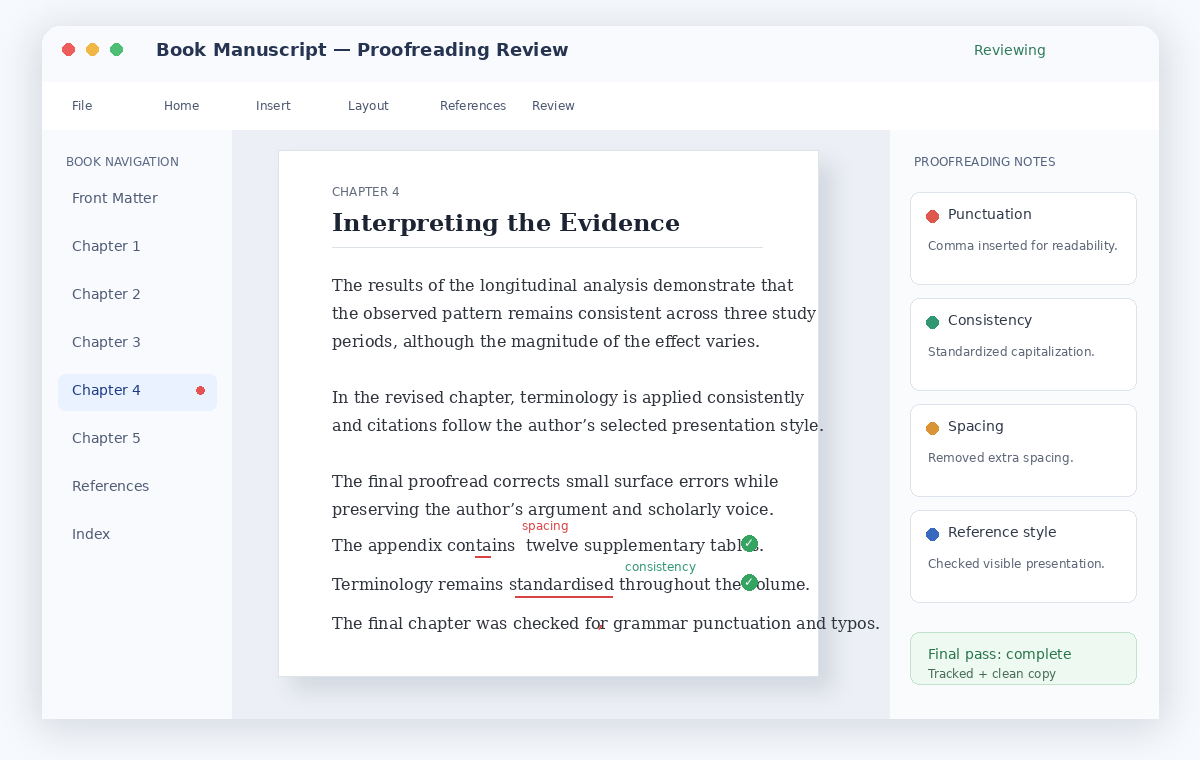
Review visible proofreading corrections
Unpublished book files handled privately
Check recurring terms and presentation
Presentation checks within agreed scope
A clear copy for final author review
These proofreading plans are for near-final scholarly text that is already structurally complete. Select by manuscript volume and the amount of book-level consistency checking required; longer books can be quoted in blocks or as one complete project.
Best suited for: A short chapter, preface, introduction, or sample section ready for final language polish.
Scope & inclusions
Best suited for: A standard academic-book chapter or multi-section extract needing stronger document-wide consistency.
Scope & inclusions
Best suited for: A larger scholarly section with front/back matter, references, figures, or more demanding consistency checks.
Scope & inclusions
Academic books are long, repeated-use documents. Small language and consistency issues can accumulate across chapters even after major editing is complete.
The aim of this chapter is to investigate on investigate the relationship between institutional change and scholarly communication.
The findings are discussed across three historical periods, however, the terminology is standardised throughout the chapter.
Several table captions and cross-references were also checked to ensure that labels, capitalization, and numbering remain consistent.
The review follows the manuscript as a connected book, not just a collection of isolated pages.
The example below shows the light-touch depth expected from proofreading: small corrections, not substantive rewriting.
Tracked changes make each correction reviewable, while the clean copy provides a straightforward final reading version.
Proofreading is best when the manuscript structure and argument are already settled. Use a deeper editing service when substantial rewriting or reorganisation is still needed.
| Aspect | Academic Book Proofreading | Deeper Editing |
|---|---|---|
| Primary focus | Grammar, spelling, punctuation, typos, final consistency | Clarity, flow, structure, academic expression, organisation |
| Sentence intervention | Light corrections where needed for correctness and clear reading | May involve stronger sentence restructuring and rewriting |
| Paragraph / chapter structure | Not the main purpose | May be reviewed and improved |
| References / captions / headings | Visible consistency and presentation checks within agreed scope | Can include broader presentation and editorial review depending on service |
| Best stage | Near-final manuscript before final handoff or submission | Earlier, while substantial revision is still appropriate |
Scope can be tailored to the files you provide and the elements that need final consistency.
Final language correctness and recurring terminology across the core manuscript.
Preface, acknowledgements, appendices, glossaries, notes, and other supplied sections.
Visible caption language, labels, callouts, numbering, and presentation consistency.
Presentation consistency checks using the supplied style or publisher requirements when available.
A staged workflow keeps the review focused on final-stage correctness while protecting the author’s intended meaning.
Share the manuscript, approximate word count, deadline, and publisher or style instructions.
Confirm which files, sections, references, captions, and presentation checks are included.
Correct language mechanics and visible consistency issues with trackable changes.
Recheck recurring terminology, headings, captions, and document-level consistency.
Receive tracked and clean proofread versions for final author review.
Deliverables remain focused on transparent proofreading and a usable final reading copy.
Quality control narrows from broad language mechanics to final manuscript-wide consistency before delivery.
The proofreading approach can be applied to scholarly books across disciplines when the manuscript is ready for a final language and consistency pass.
Unpublished book manuscripts, author details, and supporting files should be handled through the designated submission and delivery process.
Proofreading corrects presentation; it does not transfer ownership of your unpublished research, argument, data, or authorial decisions.
Academic Book Proofreading Service is not an exact plan in the supplied proofreading catalogue, so this page does not attach a fixed turnaround time to the service.
Share the approximate total word count and whether the book will be supplied as one file or multiple chapter files.
Identify whether references, captions, tables, figures, notes, front matter, back matter, or house-style checks are included.
Provide the required date and time zone so delivery feasibility can be assessed against the actual manuscript scope.
A book-length final pass needs both local accuracy and consistency across the whole manuscript.
Focused final-stage language and typographical review.
Recurring terms, headings, and presentation choices are checked together.
Tracked revisions help authors see what changed.
Proofreading does not replace your argument or scholarly voice.
A clean proofread version supports the final author review stage.
Answers to practical questions about scope, manuscript readiness, tracked changes, references, publisher style, pricing, and delivery planning.
Academic book proofreading is a final-stage review of a developed scholarly book manuscript. It focuses on grammar, spelling, punctuation, typographical accuracy, and consistent presentation without turning the service into substantive rewriting or developmental editing.
Proofreading is most useful when the manuscript structure is settled and major author or editor revisions are complete. That allows the final pass to concentrate on surface correctness and consistency across the book.
No. This is a final-stage correction service. If chapters still need significant rewriting, paragraph reorganisation, argument development, or structural changes, a deeper editing service is more appropriate.
The service workflow can provide a tracked-changes version so you can review corrections, together with a clean proofread copy for final reading.
References and citations can be checked for visible presentation and consistency within the confirmed scope. This is not a claim of source verification or fact checking; authors remain responsible for source accuracy and completeness.
Yes, when they are included in the agreed scope. The review can cover caption language, visible labels, numbering, callouts, and consistency with the surrounding manuscript.
Yes, when you provide the relevant publisher, university, series, or house-style instructions. Applicable presentation and consistency checks can then use those supplied requirements.
Yes, chapter files can be reviewed as part of a single book project when the scope is clearly defined. Sharing the complete file set helps with document-wide terminology and presentation consistency.
Provide the book files, approximate word count, deadline and time zone, required reference or style system, publisher or series instructions, and any priority concerns such as terminology, captions, notes, or cross-references.
Academic Book Proofreading starts at ₹5,000 for up to 3,000 words, with larger 6,000-word and 12,000-word proofreading plans available. Full-book pricing is confirmed from the complete word count and presentation complexity.
Turnaround is confirmed after scope and deadline review. Send the manuscript length, scope, deadline, and time zone so a realistic delivery schedule can be assessed for the book project.
If the manuscript still needs substantial changes to sentence construction, paragraph flow, chapter organisation, argument progression, or content development, ask for an editing assessment instead of forcing those needs into a proofreading scope.
Share your manuscript details and let us assess the proofreading scope, book length, publisher requirements, and deadline.
Tell us about your book manuscript, approximate word count, scope, deadline, publisher or house-style requirements, and the elements that need final checking.
State the book type, approximate total word count, and whether files are combined or chapter-based.
Describe references, captions, tables, notes, publisher guidance, or house-style requirements.
Provide the required delivery date and time zone so feasibility can be assessed.
Highlight recurring terminology, chapter consistency, spelling variant, captions, references, or other final-stage concerns.
Share enough detail for the proofreading scope, pricing, and delivery schedule to be assessed against your actual book manuscript.