Final Manuscript File
The latest editable Word file, including title page, abstract, main text, acknowledgements, declarations, and references where applicable.

Your analysis is complete, the manuscript is assembled, and submission is close. Journal-Ready Proofreading gives the full paper one coordinated final pass across language, headings, captions, callouts, references, numbering, and presentation so the document reads consistently from abstract to reference list.
A single submission-stage plan for complete journal manuscripts that need a detailed final pass across language, presentation, captions, references, and journal-facing consistency before the author uploads the paper.
Detailed final proofreading for a complete manuscript that is structurally finished and approaching journal submission.
Everything included in Standard Proofreading, plus the following journal-focused checks:
This is proofreading, not substantive rewriting or developmental editing. If major restructuring, argument revision, or extensive rewriting is needed, we will identify that before starting.
The final pass is most accurate when we receive the same material you intend to submit. A complete package lets the proofreader check the manuscript in context rather than treating the body text as an isolated document.
Use your latest author-approved manuscript and include any journal instructions that affect spelling, headings, captions, references, abbreviations, or presentation.
The latest editable Word file, including title page, abstract, main text, acknowledgements, declarations, and references where applicable.
Journal name, author instructions, spelling convention, and any template or formatting notes you want used as the presentation reference.
Provide embedded or separate figures/tables when caption wording, numbering, labels, and in-text callouts need to be checked together.
Share the journal's citation/reference style or a sample reference when consistency is important and instructions are not explicit.
Give the exact date and time zone so the 4-business-day schedule is assessed against your real upload deadline.
Flag terminology that must remain unchanged, discipline-specific capitalization, preferred spellings, or sections that received late revisions.
Journal-ready proofreading follows the manuscript from front matter to references so inconsistencies that appear only across sections are easier to catch before submission.
A journal manuscript is a connected submission package. We compare recurring terms, labels, numbering, abbreviations, spelling choices, and presentation conventions across the full document.
Names, affiliations, headings, declarations, and recurring presentation conventions.
Grammar, spelling, punctuation, terminology, abbreviations, and alignment with manuscript usage.
Language accuracy, sentence-level clarity, formal academic tone, consistency, and obvious usage issues.
Hierarchy, capitalization, numbering patterns, section labels, and document-wide consistency.
Caption language, labels, numbering, in-text references, and consistent presentation terminology.
Presentation and formatting consistency, punctuation patterns, capitalization, and obvious mismatches.
Repeated forms checked for consistent spacing, capitalization, definition, and use.
A final visual pass for obvious residue such as duplicated spaces, inconsistent headings, or tracked-edit artifacts.
Share your document type, word count, deadline, academic level, and any formatting or style requirements. We’ll confirm whether final-stage proofreading is the right fit for your paper.
A paper can be grammatically strong and still look unfinished at submission because small inconsistencies accumulate across revisions, co-author edits, tables, captions, references, and last-minute changes.
Late edits often leave duplicated words, mixed spellings, inconsistent abbreviations, stale cross-references, or headings that no longer match the final structure.
Captions, labels, numbering, and in-text callouts are reviewed together so the reader is not sent to the wrong figure or table.
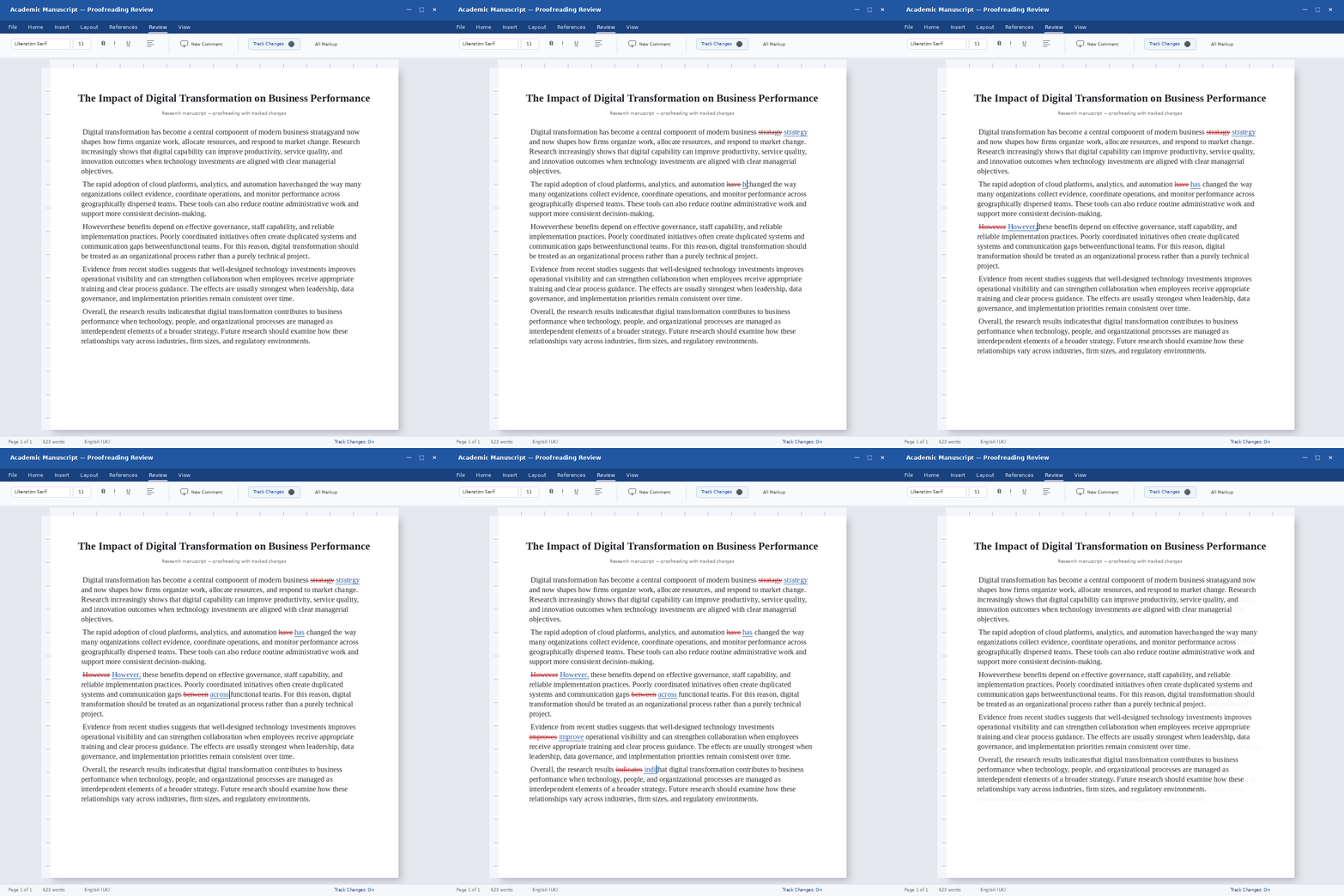
The handoff includes a tracked version for transparency and a clean version that has been checked for obvious presentation residue before delivery.
The workflow is designed for authors who have finished substantive revisions and need a controlled final language-and-consistency pass before submission.
Send the final editable draft plus journal instructions and supporting files.
Language corrections are made while terminology, headings, labels, callouts, and repeated conventions are compared across the paper.
Where instructions are supplied, spelling and presentation conventions are aligned to the requested journal style.
You receive tracked and clean files after a last check for obvious presentation residue.
The delivery is designed to let you review exactly what changed, then move efficiently to the version you intend to submit.
All proofreading corrections remain visible for author review and co-author discussion.
A version with accepted corrections presented cleanly for your final content check.
Comments are used when a point cannot be corrected safely without author clarification.
The clean file is checked once more for obvious spacing, heading, numbering, and track-change residue.
Journal-ready proofreading uses more than a single read-through. The manuscript is checked in layers so local language corrections and document-wide consistency are both reviewed.
Grammar, spelling, punctuation, usage, typographical errors, and light sentence-level clarity.
Terminology, abbreviations, capitalization, symbols, units, headings, numbering, and repeated formatting patterns.
Abstract, body text, figures, tables, captions, labels, callouts, citations, and references are reviewed together.
The final clean file is scanned for obvious formatting residue before delivery to the author.
Proofreading works best when the paper is already well written and structurally complete. Share your document details and we can confirm whether a final language check matches what you need.
These services can be requested separately when the journal requires work beyond the Journal-Ready Proofreading scope.
Layout, headings, tables, references, and file presentation can be formatted to journal instructions when a separate formatting service is required.
Language and presentation review for an author-prepared cover letter submitted with the manuscript.
Final language check for an author-prepared response to reviewers after revisions are complete.
For deadlines shorter than four business days, availability and scope must be reviewed before confirmation.
When references require conversion rather than consistency checking, a separate formatting task can be quoted.
Formatting or redesign of visual elements can be handled separately when the need goes beyond proofreading captions and callouts.
The language pass corrects clear errors while keeping your scientific or scholarly meaning intact. The goal is a polished final manuscript, not a rewritten one.
Agreement, tense, articles, prepositions, sentence construction, and other clear grammatical issues.
Typos, misspellings, variant spelling consistency, compounds, and obvious incorrect word forms.
Commas, periods, colons, semicolons, parentheses, quotation marks, hyphens, and related conventions.
Light corrections where wording is clearly awkward or ambiguous without changing the author's argument.
Repeated capitalization conventions, extra spaces, inconsistent spacing around symbols, and similar presentation issues.
Recurring technical terms, hyphenation, abbreviations, acronyms, symbols, and units checked for consistency.
Hierarchy, numbering sequence, label wording, and repeated heading presentation patterns.
Formatting consistency and obvious presentation mismatches; source verification is outside standard proofreading scope.
This additional cross-document review focuses on the details that often become inconsistent after multiple rounds of revision and co-author input.
Scope note: The matrix is a consistency review, not a technical validation of study data, reference accuracy, statistical results, or journal compliance beyond the materials supplied.
Corrections remain targeted. The proofreader improves language and consistency while preserving the author's scientific meaning, data, interpretation, and disciplinary terminology.
The intervention group showshowed a significant improvement at 12 weeks, whereas the control group have not demonstrateddid not demonstrate a comparable change.
As shown in Fig 2Figure 2, the response remained stable during follow-up. The same presentation form is then checked against the caption and other figure callouts.
The final pass also compares repeated abbreviations and terminology across the abstract, results, tables, and captions so the manuscript does not alternate between competing forms.
The intervention group showed a significant improvement at 12 weeks, whereas the control group did not demonstrate a comparable change.
As shown in Figure 2, the response remained stable during follow-up.
The same final-pass principles apply across disciplines, while terminology and conventions vary by subject. Explore relevant proofreading examples by broad research area.
Manuscripts, case reports, clinical studies, health sciences, and allied medical disciplines.
View medical proofreading samples →Biology, biotechnology, microbiology, genetics, ecology, biomedical and laboratory research.
View life-science samples →Engineering, computer science, materials, electronics, applied sciences, and technical research.
View engineering samples →Education, psychology, sociology, communication, history, language, and interdisciplinary research.
View social-science samples →Management, finance, marketing, economics, organizational studies, and policy-related research.
View business samples →Legal research, public policy, governance, regulation, and related interdisciplinary manuscripts.
View law samples →Climate, environmental science, sustainability, conservation, energy, and resource management.
View environment samples →Manuscripts that combine methods, terminology, or conventions across two or more academic fields.
Ask about your subject area →If your paper is already well written and complete, send the latest version with your deadline and style requirements. We’ll review the scope for the 2-day proofreading service.
Submission-stage proofreading is most useful when the manuscript is already complete and the author wants a careful, transparent final check rather than broad rewriting.
“The most useful part was the consistency check between the text and figure captions. Several small differences had survived our co-author revisions, and the tracked file made them easy to review.”
“I needed a final language pass without changing the technical meaning. The edits were restrained, the comments were clear, and the clean copy was much easier to prepare for journal upload.”
“The paper had been revised by multiple co-authors, so abbreviations and spellings were inconsistent. The final review helped make the manuscript feel like one document again.”
Answers to common questions about scope, journal guidelines, references, figures, tracked changes, and the 4-business-day plan.
It is a final-stage proofreading service for complete journal manuscripts approaching submission. The review covers language accuracy plus document-wide consistency across headings, captions, labels, numbering, citations, references, abbreviations, symbols, and presentation conventions.
Journal-Ready includes the core language and consistency checks of Standard Proofreading, then adds submission-focused checks across figure/table captions, callouts, numbering, citation/reference presentation, abstract-to-main-text consistency, and journal-facing conventions when instructions are supplied.
The suggested price covers a manuscript up to 10,000 words with a standard turnaround of 4 business days and the Journal-Ready scope described on this page. Complex formatting, urgent work, extensive supplementary material, or tasks outside proofreading may need a separate quote.
No. This plan is intended for a manuscript whose structure and argument are already complete. We make clear proofreading-level corrections and light sentence-level clarity fixes without substantive rewriting, developmental editing, or changing the author's claims.
Yes, for proofreading-level conventions when you provide the instructions. Examples include requested English spelling, caption presentation, heading conventions, and similar style details. Full reformatting or template conversion can be quoted separately.
Yes. Caption language, numbering, labels, and in-text callouts are checked for consistency when the figures and tables are available with the manuscript or supplied separately.
No. Standard Journal-Ready Proofreading checks citation and reference-format consistency and may flag obvious mismatches, but it does not independently verify the accuracy of each source, DOI, page number, quotation, or bibliographic record.
You receive a tracked-changes version so you can review corrections and a clean proofread copy. Comments are added where author clarification is needed or where an issue should not be changed without your decision.
Yes, but the ₹15,000 suggested price and 4-business-day turnaround are based on manuscripts up to 10,000 words. Longer documents are assessed separately based on length, complexity, and deadline.
Urgent scheduling may be possible depending on manuscript length and editor availability, but it must be confirmed before work begins. Send the exact submission deadline and time zone with your enquiry.
For the best final-pass value, send the version closest to submission after substantive co-author revisions are complete. Proofreading an earlier draft can lead to duplicated work if major text changes are made later.
The authors remain responsible for scientific and scholarly accuracy, data, interpretations, references, ethics, authorship, journal requirements, and final approval of all proofreading corrections before submission.
Share your manuscript length, target journal, deadline, and any journal instructions. We will confirm whether the document fits the Journal-Ready Proofreading scope and standard 4-business-day schedule.
Share the document type, approximate word count, exact deadline, and time zone.
Confirm that the manuscript is substantively complete and needs a final proofreading and consistency pass rather than rewriting.
Share the journal name and any supplied author instructions that affect spelling, captions, headings, references, or presentation.
Share the journal citation/reference convention or a sample reference so presentation consistency can be assessed.
Provide university, journal, supervisor, or submission instructions that should guide the final consistency check.
Flag late revisions, recurring terminology, figure/table callouts, abbreviations, reference presentation, or other areas needing extra attention.
Share your manuscript details below so our team can assess the Journal-Ready scope, 10,000-word plan limit, and 4-business-day turnaround.
Operational controls supporting document security, quality management, and professional language-service workflows for academic manuscripts.
Information Security
Management System
Quality Management
System
Translation service
requirements
256-bit SSL Encryption
We prioritize data confidentiality with robust policies, procedures, and infrastructure to secure your valuable information.
Always at Your Service
We offer 24-hour email support to provide you with accurate information and to swiftly address & resolve all your queries.
Flexible Payment Options
We accept payments via Paypal and all major debit/credit cards & bank transfers. Use our flexible Pay now or Pay later options.
Verb tense was aligned with the completed study result.
Figure presentation was made consistent with the supplied journal convention.
No result, interpretation, or claim was added or changed.